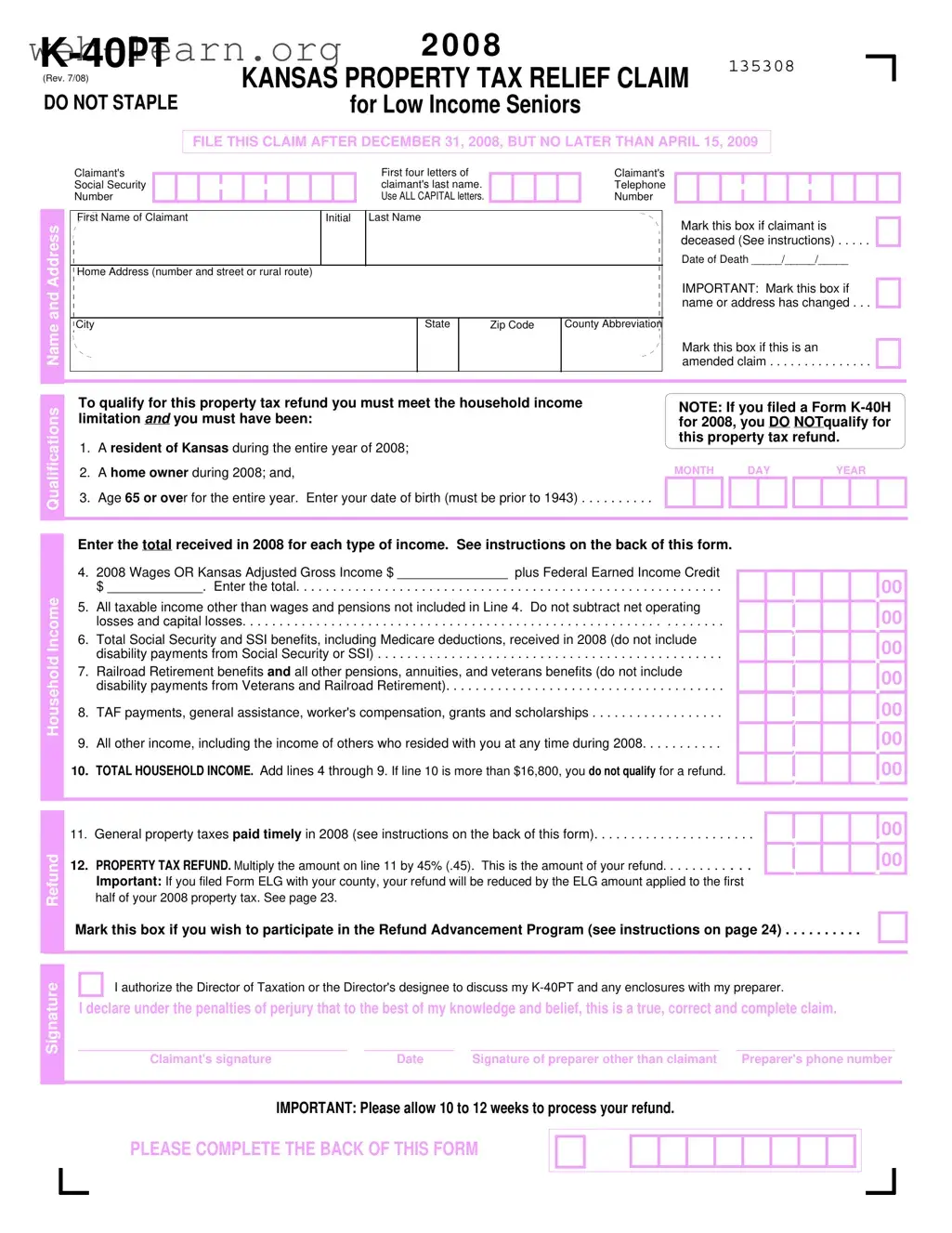
The Kansas K-40PT form serves as a crucial tool for low-income seniors seeking property tax relief in the state. Designed specifically for residents aged 65 and older, this form allows eligible homeowners to claim a refund on their property taxes, provided they meet certain income limitations. To qualify, individuals must have lived in Kansas throughout the entire year of 2008 and must have owned their home during that time. The form requires detailed information about household income, including wages, Social Security benefits, and other sources of income, ensuring that only those who truly need assistance can benefit. It is essential to file the claim after December 31, 2008, but no later than April 15, 2009. The process includes calculating total household income and determining the refund amount based on property taxes paid. Additionally, the K-40PT form allows seniors to indicate if they wish to participate in the Refund Advancement Program, which can expedite the refund process. Proper completion of the form, including all required signatures and documentation, is vital for a successful claim. Understanding these key aspects can help seniors navigate the application process more effectively.

2 0 0 8 |
135308 |
|
(Rev. 7/08) |
KANSAS PROPERTY TAX RELIEF CLAIM |
|
DO NOT STAPLE |
for Low Income Seniors |
|
|
|
|
FILE THIS CLAIM AFTER DECEMBER 31, 2008, BUT NO LATER THAN APRIL 15, 2009 |
|
|
|
|
|
|
||||||||||||||||||
|
|
|
|
|
|
|
|
|
|
|
|
|
|
|
|
|
|
|
|
|
|
- |
|
|
|
||
Claimant's |
|
|
- - |
|
|
|
First four letters of |
|
|
|
|
Claimant's |
- |
|
|||||||||||||
Social Security |
|
|
|
|
|
|
|
|
|
|
claimant's last name. |
|
|
|
|
Telephone |
|
|
|
|
|
|
|
|
|
|
|
Number |
|
|
|
|
|
|
|
|
|
|
USE ALL CAPITAL LETTERS. |
|
|
|
|
Number |
|
|
|
|
|
|
|
|
|
|
|
Name and Address
First Name of Claimant |
Initial |
Last Name |
|
|
|
Home Address (number and street or rural route)
City |
State |
Zip Code |
County Abbreviation |
|
|
|
|
Mark this box if claimant is deceased (See instructions) . . . . .
Date of Death _____/_____/_____
IMPORTANT: Mark this box if name or address has changed . . .
Mark this box if this is an amended claim . . . . . . . . . . . . . . .
Qualifications |
To qualify for this property tax refund you must meet the household income |
NOTE: If you filed a Form |
|||||||||||||
limitation AND you must have been: |
|
||||||||||||||
|
for 2008, you DO NOTqualify for |
||||||||||||||
|
|
||||||||||||||
|
|
|
|
||||||||||||
|
1. A resident of Kansas during the entire year of 2008; |
|
this property tax refund. |
||||||||||||
|
|
|
|
|
|
|
|
|
|
|
|
|
|
||
|
2. |
A home owner during 2008; and, |
|
MONTH |
|
|
DAY |
|
|
YEAR |
|||||
|
. . . . . . . . . .3. Age 65 or over for the entire year. Enter your date of birth (must be prior to 1943) |
|
|
|
|
|
|
|
|
|
|
|
|
||
|
|
|
|
|
|
|
|
|
|
|
|
|
|
|
|
|
Enter the total received in 2008 for each type of income. See instructions on the back of this form. |
|
|
|
|
|
|
|
|
||||||
|
|
|
|
|
|
|
|
|
|||||||
|
4. |
2008 Wages OR Kansas Adjusted Gross Income $ _______________ plus Federal Earned Income Credit |
|
|
|
|
|
|
|
|
|||||
|
|
|
, |
|
.00 |
||||||||||
|
|
.$ _____________. Enter the total |
. . . . . . . . . . . . . . . . . . |
. . . . |
. . . . |
|
|
|
|
|
|
|
|
|
|
Income |
5. |
All taxable income other than wages and pensions not included in Line 4. |
Do not subtract net operating |
|
|
|
|
|
|
|
|
||||
|
|
|
, |
|
.00 |
||||||||||
|
|
losses and capital losses |
. . . . . . . . . . . . . . . . . . |
. . . . |
. . . . |
|
|
|
|
|
|||||
|
6. |
Total Social Security and SSI benefits, including Medicare deductions, received in 2008 (do not include |
|
|
, |
|
. |
||||||||
Household |
|
disability payments from Social Security or SSI) |
. . . . . . . . . . . . . . . . . . |
. . . . |
. . . . |
|
|
|
|
|
|
|
|
00 |
|
|
7. |
Railroad Retirement benefits and all other pensions, annuities, and veterans benefits (do not include |
|
|
, |
|
. |
||||||||
|
|
disability payments from Veterans and Railroad Retirement) |
|
|
|
|
|
|
|
|
|
|
|
00 |
|
|
|
. . . . |
. . . . |
|
|
|
|
|
|
|
|
|
|
||
|
8. |
TAF payments, general assistance, worker's compensation, grants and scholarships |
. . . . |
. . . . |
|
|
|
|
, |
|
.00 |
||||
|
9. |
All other income, including the income of others who resided with you at any time during 2008. . . |
. . . . |
. . . . |
|
|
|
|
, |
|
.00 |
||||
|
10. |
TOTAL HOUSEHOLD INCOME. Add lines 4 through 9. If line 10 is more than $16,800, you do not qualify for a refund. |
|
|
, |
|
.00 |
||||||||
|
|
|
|
|
|
|
|
|
|
|
|
|
|
|
|
Refund
|
General property taxes paid timely in 2008 (see instructions on the back of this form) |
, |
|
. |
11. |
|
|
00 |
|
12. |
PROPERTY TAX REFUND. Multiply the amount on line 11 by 45% (.45). This is the amount of your refund |
, |
|
. |
|
|
00 |
Important: If you filed Form ELG with your county, your refund will be reduced by the ELG amount applied to the first half of your 2008 property tax. See page 23.
Mark this box if you wish to participate in the Refund Advancement Program (see instructions on page 24) . . . . . . . . . .
Signature
I authorize the Director of Taxation or the Director's designee to discuss my
I declare under the penalties of perjury that to the best of my knowledge and belief, this is a true, correct and complete claim.
_______________________________________ |
_____________ |
____________________________________ |
_______________________ |
Claimant's signature |
Date |
Signature of preparer other than claimant |
Preparer's phone number |
IMPORTANT: Please allow 10 to 12 weeks to process your refund.
PLEASE COMPLETE THE BACK OF THIS FORM

135408
Providing this information should speed the processing of your claim. Income reported here should not be included on line 8 of this form.
13. Enter in the spaces provided the annual amount of all other income not included as household income on line 8:
Excluded Income
(a) |
Food Stamps . . . . . . . . . . . . . . $ |
|
, |
|
.00 |
|
|
|
|
||
|
|
|
|
|
|
(c) |
Child Support . . . . . . . . . . . . . . $ |
|
, |
|
.00 |
|
|
|
, |
|
. |
(e) |
Personal and Student Loans . . $ |
|
|
|
00 |
(g) |
Other (See instructions on page 17): |
Source |
|
|
|
(b) Nongovernmental Gifts. . . . . . . . $
(d) Settlements (lump sum) . . . . . . . $
( f) SSI, Social Security, Veterans
or Railroad Disability . . . . . . . . . $ (enclose documentation)
Amount $
,
,
,
,
.00
.00
.00
.00
|
14. List the names of ALL persons who resided in your household at any time during 2008. Specify the number of months they lived with |
|
|||||||||||||||||
|
|
you and report their portion of income that is included in total household income on line 10 of this form. |
|
|
|
|
|
|
|||||||||||
ofHousehold |
|
|
|
Number of |
|
|
|
|
|
|
|
|
|
|
|
|
|
||
|
Name |
months resided |
Their portion of income that |
Social Security Number |
|
||||||||||||||
|
in household |
|
is included on line 10 |
|
|||||||||||||||
|
|
|
|
|
|
|
|
|
|
|
|
|
|
|
|
|
|
|
|
|
|
|
|
|
$ |
|
, |
|
.00 |
|
|
|
- |
- |
|
|
|
|
|
|
|
|
|
|
|
|
|
|
|
|
|
|
|
|
|||||
|
|
|
|
|
$ |
|
, |
|
.00 |
|
|
|
- |
- |
|
|
|
|
|
|
|
|
|
|
$ |
|
|
|
|
|
|
|
|
|
|||||
|
|
|
|
|
|
$ |
|
, |
|
.00 |
|
|
|
- |
- |
|
|
|
|
Members |
|
|
|
|
|
|
, |
|
.00 |
|
|
|
- |
- |
|
|
|
|
|
|
|
|
|
|
$ |
|
|
|
|
|
|
|
|
|
|||||
|
|
|
|
|
|
, |
|
.00 |
|
|
|
- |
- |
|
|
|
|
||
|
|
|
|
|
|
|
|
|
|
|
|
|
|
|
|||||
|
|
|
|
|
|
$ |
|
|
|
|
|
|
|
|
|
||||
|
|
|
|
|
|
|
|
|
00 |
|
|
|
- |
- |
|
|
|
|
|
|
|
|
|
|
|
$ |
|
|
|
|
|
|
|
|
|
|
|||
|
|
|
|
|
|
|
, |
|
. |
|
|
|
|
|
|
|
|||
|
|
|
|
|
|
|
|
|
|
|
|
|
|
|
|
|
|
|
|
INSTRUCTIONS-
- -
MAIL TO: Homestead Claim, Kansas Department of Revenue, 915 SW Harrison Street, Topeka KS
| Fact Name | Details |
|---|---|
| Form Purpose | The K-40PT form is used to claim property tax relief for low-income seniors in Kansas. |
| Eligibility Age | Claimants must be 65 years or older for the entire year of 2008 to qualify. |
| Income Limit | The total household income must not exceed $16,800 to be eligible for a refund. |
| Filing Deadline | Claims must be filed between December 31, 2008, and April 15, 2009. |
| Residency Requirement | Claimants must have been residents of Kansas throughout the entire year of 2008. |
| Governing Law | The K-40PT form is governed by Kansas Statutes Annotated (K.S.A.) 79-4501 et seq. |
| Refund Calculation | The refund is calculated as 45% of the general property taxes paid timely in 2008. |
Completing the Kansas K 40Pt form requires careful attention to detail. Follow these steps to ensure that your claim is filled out correctly and submitted on time.
What is the Kansas K-40PT form?
The Kansas K-40PT form is a property tax relief claim specifically designed for low-income seniors. This form allows eligible residents of Kansas to apply for a refund on property taxes paid in the previous year. To qualify, applicants must meet certain criteria regarding age, residency, and income.
Who is eligible to file the K-40PT form?
To be eligible for this property tax refund, you must meet the following requirements:
If you filed a Form K-40H for 2008, you do not qualify for this property tax refund.
When should I file the K-40PT form?
You should file the K-40PT form after December 31, 2008, but no later than April 15, 2009. It is important to adhere to this timeline to ensure that your claim is processed in a timely manner.
What information do I need to provide on the form?
When completing the K-40PT form, you will need to provide:
How is the refund amount calculated?
The refund amount is calculated based on the total property taxes you paid in 2008. This amount is then multiplied by 45% to determine your refund. If your total household income exceeds $16,800, you will not qualify for a refund.
What if my name or address has changed?
If your name or address has changed since the last time you filed, you should mark the appropriate box on the form. This ensures that the Kansas Department of Revenue has your current information on file, which is crucial for processing your claim correctly.
How long will it take to process my refund?
After submitting your K-40PT form, you should allow approximately 10 to 12 weeks for the processing of your refund. This timeframe can vary based on the volume of claims being processed.
What should I do if I need assistance with the form?
If you require assistance while completing the K-40PT form, you may seek help from a tax preparer or contact the Kansas Department of Revenue directly. They can provide guidance and answer any specific questions you may have about your claim.
Where do I send my completed K-40PT form?
Your completed K-40PT form should be mailed to the following address:
Homestead Claim
Kansas Department of Revenue
915 SW Harrison Street
Topeka, KS 66699-2000
Filling out the Kansas K-40PT form can be a straightforward process, but many people make common mistakes that can delay their property tax relief claims. One frequent error is not using all capital letters when entering personal information. This requirement is clearly stated on the form, yet many claimants overlook it, leading to potential processing issues.
Another mistake involves incorrect or incomplete social security numbers. Claimants must ensure that they provide the first four letters of their last name along with the full social security number. Omitting or misplacing digits can result in significant delays or even rejection of the claim.
Many individuals also fail to check the appropriate boxes regarding changes in name or address. Not marking these boxes can lead to confusion during processing, especially if the information on the form does not match other records.
Claimants often miscalculate their total household income, which is critical for determining eligibility. It’s essential to include all sources of income accurately, including wages, pensions, and any other relevant earnings. Missing even a small amount can disqualify someone from receiving a refund.
Some people neglect to include their date of birth, which is a requirement for confirming eligibility. The form specifically asks for this information to verify that the claimant is 65 or older, and failing to provide it can lead to unnecessary complications.
Another common oversight is not signing the form. A signature is required to validate the claim, and without it, the submission may be considered incomplete. This simple step is often forgotten in the rush to submit the form before the deadline.
Additionally, individuals sometimes fail to report all household members and their respective incomes. The form requires a comprehensive list of all persons residing in the household, along with their income contributions. Missing this information can lead to inaccurate calculations of total household income.
Some claimants do not read the instructions carefully, especially regarding exclusions from household income. Certain types of income, like food stamps or child support, should not be included, but many people mistakenly add these figures, skewing their total income calculations.
Lastly, not allowing sufficient time for processing can lead to frustration. Claimants should remember that it can take 10 to 12 weeks for refunds to be processed. Being aware of this timeline helps manage expectations and reduces anxiety about the status of the claim.
The Kansas K-40Pt form is essential for low-income seniors seeking property tax relief. To ensure a smooth filing process, several other documents may be required or beneficial when submitting this claim. Below is a list of commonly used forms and documents that complement the K-40Pt form.
Gathering these documents ahead of time can streamline the filing process and help ensure that you receive any benefits you may be entitled to. Always check for the most current forms and requirements to avoid any delays in processing your claim.
The Kansas K-40PT form is a property tax relief claim specifically designed for low-income seniors. It shares similarities with several other tax-related documents. Here are four documents that are comparable to the K-40PT form:
When filling out the Kansas K-40Pt form, it is important to follow certain guidelines to ensure your application is processed smoothly. Below are some key dos and don’ts to keep in mind.
By following these guidelines, you can help ensure that your Kansas K-40Pt form is completed correctly and submitted on time. Take your time, review the instructions, and reach out for assistance if needed. Your diligence will pay off in the end.
The Kansas K 40Pt form, officially known as the Kansas Property Tax Relief Claim for Low Income Seniors, is an essential document for eligible residents seeking tax relief. However, several misconceptions surround its use and requirements. Below are five common misunderstandings:
Understanding these misconceptions can help eligible seniors navigate the application process more effectively and ensure they receive the tax relief they deserve.
When filling out the Kansas K-40PT form for property tax relief, there are several important points to keep in mind. This form is specifically designed for low-income seniors, and understanding its requirements can help ensure a smooth application process.
By following these key takeaways, applicants can navigate the K-40PT form with greater confidence and clarity. Proper attention to detail will aid in the timely processing of claims and ensure eligibility for the property tax refund.