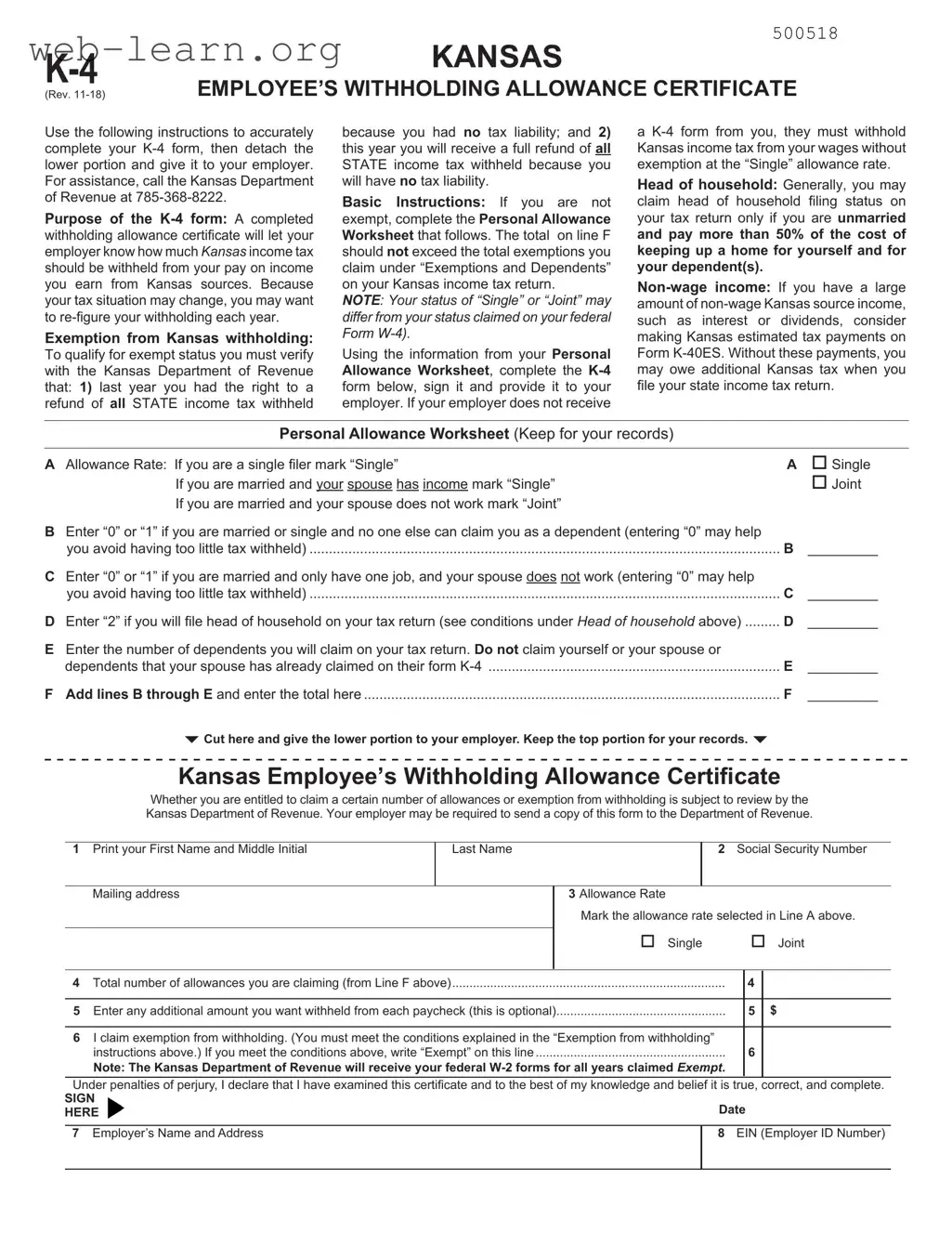
The Kansas K-4 form, officially known as the Employee’s Withholding Allowance Certificate, plays a crucial role in determining how much state income tax is withheld from your paycheck. When completed accurately, this form informs your employer of your withholding allowances, which directly influences your take-home pay. It is essential to provide this form to your employer to avoid default withholding at the “Single” allowance rate, which could lead to higher tax deductions than necessary. The form also includes a Personal Allowance Worksheet, designed to help you calculate the number of allowances you are entitled to claim based on your filing status and dependents. Additionally, if you qualify for exemption from Kansas withholding, specific criteria must be met, including having no tax liability in the previous year and the current year. It is advisable to review your withholding status annually, especially if your financial situation changes. For those with significant non-wage income, such as interest or dividends, making estimated tax payments may be necessary to prevent owing additional taxes at the end of the year. Overall, understanding the Kansas K-4 form and its implications can help ensure that you manage your tax obligations effectively.
KANSAS |
500518 |
|
|
||
(Rev. |
EMPLOYEE’S WITHHOLDING ALLOWANCE CERTIFICATE |
|
Use the following instructions to accurately complete your
Purpose of the
Exemption from Kansas withholding:
To qualify for exempt status you must verify with the Kansas Department of Revenue that: 1) last year you had the right to a refund of all STATE income tax withheld
because you had no tax liability; and 2) this year you will receive a full refund of all STATE income tax withheld because you will have no tax liability.
Basic Instructions: If you are not exempt, complete the Personal Allowance Worksheet that follows. The total on line F should not exceed the total exemptions you claim under “Exemptions and Dependents” on your Kansas income tax return.
NOTE: Your status of “Single” or “Joint” may differ from your status claimed on your federal Form
Using the information from your Personal Allowance Worksheet, complete the
a
Head of household: Generally, you may claim head of household filing status on your tax return only if you are unmarried and pay more than 50% of the cost of keeping up a home for yourself and for your dependent(s).
Personal Allowance Worksheet (Keep for your records)
A Allowance Rate: If you are a single filer mark “Single” |
A o Single |
If you are married and your spouse has income mark “Single” |
o Joint |
If you are married and your spouse does not work mark “Joint” |
|
BEnter “0” or “1” if you are married or single and no one else can claim you as a dependent (entering “0” may help
you avoid having too little tax withheld) |
B _________ |
CEnter “0” or “1” if you are married and only have one job, and your spouse does not work (entering “0” may help
you avoid having too little tax withheld) |
C |
_________ |
D Enter “2” if you will file head of household on your tax return (see conditions under Head of household above) |
D |
_________ |
EEnter the number of dependents you will claim on your tax return. Do not claim yourself or your spouse or
dependents that your spouse has already claimed on their form |
E |
_________ |
F Add lines B through E and enter the total here |
F |
_________ |
Cut here and give the lower portion to your employer. Keep the top portion for your records.
Kansas Employee’s Withholding Allowance Certificate
Whether you are entitled to claim a certain number of allowances or exemption from withholding is subject to review by the Kansas Department of Revenue. Your employer may be required to send a copy of this form to the Department of Revenue.
1 |
Print your First Name and Middle Initial |
|
Last Name |
|
2 |
Social Security Number |
||
|
|
|
|
|
|
|
|
|
|
Mailing address |
|
|
3 Allowance Rate |
|
|
||
|
|
|
|
|
Mark the allowance rate selected in Line A above. |
|||
|
|
|
|
|
o Single |
o Joint |
||
|
|
|
|
|
||||
|
|
|
|
|
|
|
|
|
4 |
Total number of allowances you are claiming (from Line F above) |
............................................................................... |
|
|
|
4 |
|
|
|
|
|
|
|
|
|
||
5 Enter any additional amount you want withheld from each paycheck (this is optional) |
................................................. |
|
5 |
$ |
||||
6I claim exemption from withholding. (You must meet the conditions explained in the “Exemption from withholding”
instructions above.) If you meet the conditions above, write “Exempt” on this line |
6 |
Note: The Kansas Department of Revenue will receive your federal |
|
Under penalties of perjury, I declare that I have examined this certificate and to the best of my knowledge and belief it is true, correct, and complete.
SIGN |
Date |
HERE |
7Employer’s Name and Address
8EIN (Employer ID Number)
| Fact Name | Fact Description |
|---|---|
| Purpose | The K-4 form allows employees to inform their employers how much Kansas income tax to withhold from their paychecks. |
| Exemption Criteria | To qualify for exemption from withholding, an employee must have had no tax liability in the previous year and expect the same for the current year. |
| Filing Status | Employees can select "Single" or "Joint" filing status, which may differ from their federal Form W-4 status. |
| Dependents | When completing the form, employees should not claim themselves or their spouse as dependents. |
| Non-Wage Income | If employees have significant non-wage income, such as interest or dividends, they should consider making estimated tax payments using Form K-40ES. |
| Submission | Employees must provide the completed K-4 form to their employer. Without it, employers will withhold tax at the “Single” allowance rate. |
| Record Keeping | Employees should keep the top portion of the K-4 form for their records after submitting the lower portion to their employer. |
| Governing Law | The K-4 form is governed by Kansas state tax laws, specifically those related to income tax withholding. |
After completing the Kansas K-4 form, detach the lower portion and provide it to your employer. This form helps determine the amount of Kansas income tax to withhold from your pay. It is important to keep a copy for your records. If you have questions, contact the Kansas Department of Revenue.
What is the purpose of the Kansas K-4 form?
The Kansas K-4 form is an Employee’s Withholding Allowance Certificate. It informs your employer how much Kansas income tax to withhold from your pay. Completing this form accurately is essential to ensure the correct amount is deducted based on your tax situation.
How do I complete the K-4 form?
To complete the K-4 form, follow these steps:
If you do not submit the K-4 form, your employer will withhold taxes at the highest rate.
Who qualifies for exemption from Kansas withholding?
To qualify for exempt status, you must meet two criteria:
Verification with the Kansas Department of Revenue is necessary to confirm your exempt status.
What if my tax situation changes?
It is advisable to re-evaluate your withholding each year or whenever your financial situation changes. Changes in income, marital status, or dependents can all impact your tax liability and withholding allowances.
What should I do if I have non-wage income?
If you earn significant non-wage income from Kansas sources, such as interest or dividends, consider making estimated tax payments using Form K-40ES. This will help you avoid owing additional taxes when filing your state income tax return.
What happens if I do not submit the K-4 form?
If you do not provide a completed K-4 form to your employer, they are required to withhold Kansas income tax at the “Single” allowance rate. This may lead to higher tax withholding than necessary.
How can I contact the Kansas Department of Revenue for assistance?
If you need help with the K-4 form or have questions about your withholding, you can contact the Kansas Department of Revenue at 785-368-8222. They can provide guidance and support regarding your tax situation.
Filling out the Kansas K-4 form can seem straightforward, but many people make common mistakes that can lead to incorrect tax withholding. One frequent error is failing to accurately assess personal allowances. Individuals often overlook the instructions for the Personal Allowance Worksheet, which can lead to claiming too many or too few allowances. This miscalculation directly affects the amount of tax withheld from paychecks, potentially resulting in owing money at tax time or receiving a smaller refund than expected.
Another common mistake involves misunderstanding the filing status. Some filers do not realize that their status on the K-4 form may differ from their federal Form W-4. For instance, a person may be married but incorrectly mark their status as “Single.” This confusion can lead to higher withholding rates, which is especially problematic for those who prefer to receive more take-home pay throughout the year.
People often forget to include all dependents when completing the form. When entering the number of dependents on Line E, individuals sometimes neglect to account for dependents that their spouse has already claimed. This oversight can result in a higher tax liability, as it can lead to under-withholding of taxes throughout the year.
Additionally, some individuals incorrectly assume they qualify for exempt status without verifying their eligibility. To claim exemption from withholding, one must meet specific criteria outlined by the Kansas Department of Revenue. Failing to confirm eligibility can lead to unexpected tax bills, as employers will withhold taxes at the higher “Single” allowance rate if no K-4 form is provided.
Finally, many people overlook the option to have additional amounts withheld from their paychecks. On Line 5, individuals can specify an extra amount to be withheld, which can be beneficial for those who anticipate owing taxes. Ignoring this option can lead to a tax bill at the end of the year, which could have been avoided with a little foresight.
The Kansas K-4 form is essential for employees in Kansas to communicate their withholding allowances to their employers. However, it is often accompanied by other important documents that help ensure accurate tax withholding and reporting. Below is a list of these related forms and documents.
Understanding these documents can simplify the tax withholding process for employees in Kansas. Properly completing and submitting the K-4 form along with these related documents ensures compliance with state tax regulations and helps manage tax liabilities effectively.
The Kansas K-4 form is similar to several other documents that serve the purpose of determining tax withholding and allowances. Here’s a list of nine documents that share similarities with the K-4 form:
Each of these forms serves to communicate an employee's tax situation to their employer, ensuring that the correct amount of tax is withheld from their earnings.
When filling out the Kansas K-4 form, there are some important dos and don'ts to keep in mind. Here’s a helpful list to guide you:
By following these guidelines, you can help ensure that your K-4 form is completed correctly and efficiently.
Understanding the Kansas K-4 form can be challenging, and there are several misconceptions that can lead to confusion. Here are eight common misconceptions, along with clarifications to help you navigate this important document.
This is not true. While new employees do need to complete the K-4 form, existing employees should also review and update their form annually or whenever their tax situation changes.
The total number of allowances you claim cannot exceed the exemptions you report on your Kansas income tax return. Claiming too many allowances may lead to under-withholding and unexpected tax bills.
In reality, if your employer does not receive a K-4 form from you, they are required to withhold taxes at the “Single” allowance rate, which may be higher than your actual tax liability.
This is incorrect. Any individual earning income from Kansas sources, regardless of their employment status, should complete the K-4 form to ensure proper tax withholding.
While both forms serve similar purposes, they are different. The K-4 form is specific to Kansas state tax withholding, while the W-4 is for federal income tax withholding. Your filing status may differ between the two.
To qualify for exemption, you must meet specific criteria outlined by the Kansas Department of Revenue, including having had no tax liability in the previous year and expecting none in the current year.
This is false. You can update your K-4 form whenever your financial situation changes. It’s advisable to review your allowances annually or when significant life changes occur.
Submitting the K-4 form is not optional if you want to claim allowances or exemptions. It is crucial for ensuring that the correct amount of state tax is withheld from your paychecks.
Here are some key takeaways for filling out and using the Kansas K-4 form: