In Kansas, families who choose to homeschool their children must submit a Homeschool Letter of Intent to the appropriate school district. This form serves as a formal notification of a family's decision to educate their children at home, and it must be filed annually. Key details required on the form include the names and ages of the children being homeschooled, as well as the address of the residence where the homeschooling will take place. Parents are not required to provide specific curriculum information or educational philosophy, but they must affirm their commitment to providing an educational experience that meets their children's needs. The submission of this letter is a vital step in ensuring compliance with state regulations while also allowing families the freedom to tailor their children's education. Understanding the importance of this document and the process surrounding it can empower families to navigate their homeschooling journey with confidence.
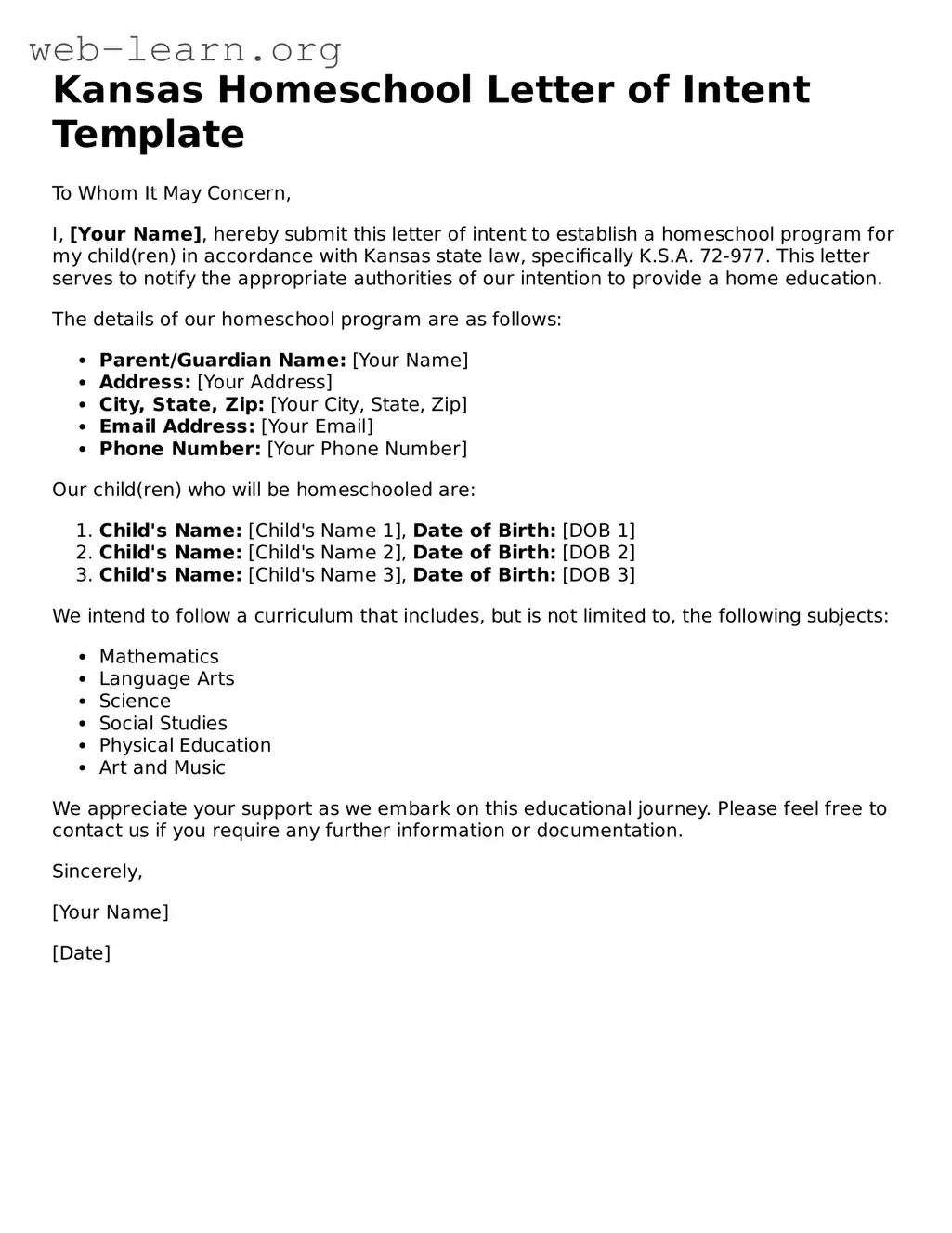
Kansas Homeschool Letter of Intent Template
To Whom It May Concern,
I, [Your Name], hereby submit this letter of intent to establish a homeschool program for my child(ren) in accordance with Kansas state law, specifically K.S.A. 72-977. This letter serves to notify the appropriate authorities of our intention to provide a home education.
The details of our homeschool program are as follows:
Our child(ren) who will be homeschooled are:
We intend to follow a curriculum that includes, but is not limited to, the following subjects:
We appreciate your support as we embark on this educational journey. Please feel free to contact us if you require any further information or documentation.
Sincerely,
[Your Name]
[Date]
| Fact Name | Description |
|---|---|
| Purpose | The Kansas Homeschool Letter of Intent form notifies the state of your intention to homeschool your child. |
| Governing Law | The form is governed by Kansas Statutes Annotated (K.S.A.) 72-977. |
| Submission Deadline | Parents must submit the form within 14 days of starting homeschooling. |
| Information Required | The form requires basic information, including the child's name, age, and the address of the homeschool. |
| Record Keeping | While the form is not submitted annually, parents must keep a copy for their records. |
After you complete the Kansas Homeschool Letter of Intent form, you will need to submit it to your local school district. This step is essential to ensure that you are officially recognized as a homeschooling family in Kansas. Below are the steps to guide you through filling out the form accurately.
The Kansas Homeschool Letter of Intent is a formal document that parents or guardians must submit to inform the local school district of their intention to homeschool their children. This letter serves as a notification that the child will not be attending public school and will be receiving education at home instead.
Any parent or guardian who decides to homeschool their child in Kansas must file this letter. This requirement applies to children who are between the ages of 7 and 18. If your child is younger than 7, you are not required to submit the letter, but you may choose to do so if you wish.
You should submit the Letter of Intent at the beginning of your homeschooling journey. Ideally, it should be filed before the start of the school year or as soon as you decide to homeschool. This ensures that the local school district is aware of your educational plans.
The Letter of Intent typically includes:
While the exact format may vary, including this information will help ensure your letter is complete.
There is no mandated format for the Letter of Intent in Kansas. However, it is recommended to keep the letter clear and concise. Including all required information will help facilitate the process. Some families may find it helpful to use a template to ensure they include everything necessary.
Once you submit the Letter of Intent, the local school district will acknowledge your notification. They may not require further action from you, but it’s a good idea to keep a copy of the letter for your records. Additionally, you may be contacted for any follow-up questions or information.
If you decide to stop homeschooling and enroll your child in public school, you should notify the school district. While you are not required to submit another Letter of Intent in this case, informing them of the change is a courteous and responsible step.
Filling out the Kansas Homeschool Letter of Intent form can be a straightforward process, but many families encounter common pitfalls that can delay their homeschooling journey. Understanding these mistakes can help ensure a smoother experience. Here are seven frequent errors to avoid.
One of the most common mistakes is failing to include all required information. The form asks for specific details such as the names and ages of the children being homeschooled. Omitting even one child's information can lead to complications. Always double-check to ensure that every necessary field is filled out completely.
Another mistake involves incorrect dates. Families often miscalculate the start date of their homeschooling year. It’s crucial to accurately reflect the intended start date, as this can affect compliance with state regulations. Take a moment to confirm the date before submitting the form.
Some individuals overlook the importance of signing the form. A signature is not just a formality; it signifies that the information provided is accurate and that the family intends to homeschool. Without a signature, the form may be considered incomplete, leading to potential issues down the line.
Additionally, many forget to submit the form within the designated timeframe. Kansas law requires that the Letter of Intent be submitted within a specific period before the start of the school year. Missing this deadline can result in a loss of eligibility to homeschool for that year.
Another frequent error is not keeping a copy of the submitted form. It’s essential to maintain a record of the Letter of Intent for personal files. This documentation can be helpful for future reference or if questions arise regarding the homeschooling status.
Many families also make the mistake of not reviewing the local school district's requirements. Each district may have specific guidelines or additional forms to fill out. Familiarizing oneself with these requirements can prevent unnecessary confusion and ensure compliance with local regulations.
Finally, some individuals may rush through the form without reading the instructions thoroughly. Each section of the form is designed to gather specific information. Taking the time to read and understand these instructions can help avoid errors and ensure that the form is filled out correctly.
By being aware of these common mistakes, families can navigate the Kansas Homeschool Letter of Intent form with greater confidence. A careful approach can pave the way for a successful homeschooling experience.
When families decide to homeschool in Kansas, they often need to submit various forms and documents alongside the Kansas Homeschool Letter of Intent. These documents help ensure compliance with state regulations and provide necessary information about the homeschooling plan. Below is a list of commonly used forms and documents.
Submitting these documents along with the Kansas Homeschool Letter of Intent can streamline the homeschooling process and provide clarity for both families and state authorities. Ensuring that all necessary paperwork is in order supports a successful homeschooling experience.
When filling out the Kansas Homeschool Letter of Intent form, it’s important to approach the process with care. Here are five things you should and shouldn’t do:
By following these guidelines, you can ensure a smoother process as you begin your homeschooling journey in Kansas.
Many people have misconceptions about the Kansas Homeschool Letter of Intent form. Understanding these can help clarify the process for families considering homeschooling. Here are ten common misconceptions:
By addressing these misconceptions, families can feel more confident in their decision to homeschool and navigate the process more easily.
When filling out and using the Kansas Homeschool Letter of Intent form, there are several important points to keep in mind. These takeaways can help ensure a smooth process for families choosing to homeschool their children.
By following these key takeaways, families can navigate the process of homeschooling in Kansas more effectively and with greater confidence.
Colorado Homeschool Testing Requirements - Submitting the letter is often the first step in establishing a homeschooling program for your child.
Best Homeschool Programs in Alabama - Documents the educational journey of the child from the start.
Unschooling in Ct - The letter typically includes the child's name, age, and the educational plan for the year.
Do Homeschool Parents Get Paid - Communication to ensure compliance with state homeschooling laws.