Homepage Attorney-Approved Hold Harmless Agreement Template Attorney-Approved Hold Harmless Agreement Document for the State of Kansas
Outline

The Kansas Hold Harmless Agreement form serves an important purpose in various legal and business contexts. This document is designed to protect one party from liability for certain actions or events that may occur during a specified activity or agreement. Typically, it outlines the responsibilities of the parties involved and clarifies that one party will not hold the other responsible for any injuries, damages, or losses that may arise. This form is commonly used in situations such as rental agreements, event planning, and contractor agreements, where risk is inherent. By signing this document, individuals or organizations acknowledge the risks involved and agree to indemnify the other party. It is essential for all parties to understand the implications of this agreement, as it can significantly affect liability and legal recourse in the event of an incident. Properly executed, the Kansas Hold Harmless Agreement helps foster trust and clarity between parties, allowing them to engage in activities with a mutual understanding of their rights and responsibilities.

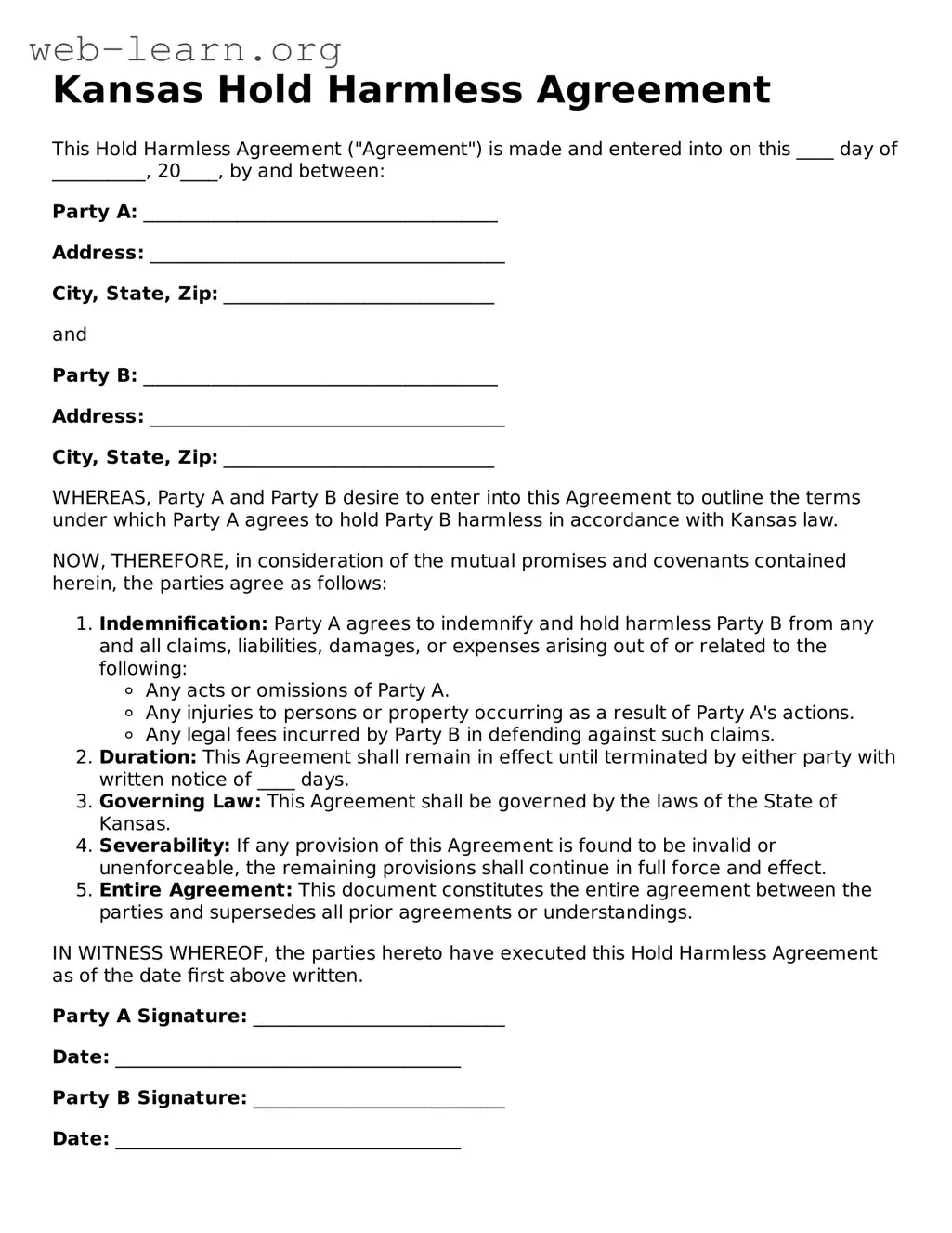
Sample - Kansas Hold Harmless Agreement Form

Kansas Hold Harmless Agreement

This Hold Harmless Agreement ("Agreement") is made and entered into on this ____ day of __________, 20____, by and between:

Party A: ______________________________________

Address: ______________________________________

City, State, Zip: _____________________________

and

Party B: ______________________________________

Address: ______________________________________

City, State, Zip: _____________________________

WHEREAS, Party A and Party B desire to enter into this Agreement to outline the terms under which Party A agrees to hold Party B harmless in accordance with Kansas law.

NOW, THEREFORE, in consideration of the mutual promises and covenants contained herein, the parties agree as follows:

  1. Indemnification: Party A agrees to indemnify and hold harmless Party B from any and all claims, liabilities, damages, or expenses arising out of or related to the following:
    • Any acts or omissions of Party A.
    • Any injuries to persons or property occurring as a result of Party A's actions.
    • Any legal fees incurred by Party B in defending against such claims.
  2. Duration: This Agreement shall remain in effect until terminated by either party with written notice of ____ days.
  3. Governing Law: This Agreement shall be governed by the laws of the State of Kansas.
  4. Severability: If any provision of this Agreement is found to be invalid or unenforceable, the remaining provisions shall continue in full force and effect.
  5. Entire Agreement: This document constitutes the entire agreement between the parties and supersedes all prior agreements or understandings.

IN WITNESS WHEREOF, the parties hereto have executed this Hold Harmless Agreement as of the date first above written.

Party A Signature: ___________________________

Date: _____________________________________

Party B Signature: ___________________________

Date: _____________________________________

File Characteristics

Fact Name Description
Purpose The Kansas Hold Harmless Agreement is designed to protect one party from legal liability for any injuries or damages that may occur during an event or activity.
Parties Involved The agreement typically involves two parties: the indemnitor (the party being held harmless) and the indemnitee (the party seeking protection).
Governing Law This agreement is governed by the laws of the State of Kansas, specifically under Kansas Statutes.
Scope of Agreement The agreement can cover various activities, including recreational events, facility use, and other organized activities.
Legal Enforceability For the agreement to be enforceable, it must be clear, specific, and voluntarily signed by both parties.
Consideration There must be consideration, or something of value exchanged, for the agreement to be legally binding.
Duration The duration of the hold harmless provision can vary; it may be limited to a specific event or extend over a longer period.
Limitations Some limitations may apply, such as not covering gross negligence or willful misconduct.
Signature Requirement Both parties must sign the agreement for it to take effect, indicating their consent to the terms outlined.
Common Uses This form is commonly used in contexts such as sports events, community gatherings, and facility rentals.

Detailed Guide for Filling Out Kansas Hold Harmless Agreement

Completing the Kansas Hold Harmless Agreement form is a straightforward process that requires careful attention to detail. Once filled out, the form will need to be submitted as part of your legal documentation. Follow these steps to ensure you complete the form accurately.

  1. Begin by downloading the Kansas Hold Harmless Agreement form from the appropriate source.
  2. Read through the entire form to familiarize yourself with its sections and requirements.
  3. In the first section, fill in your full name and contact information. This typically includes your address, phone number, and email.
  4. Next, identify the party or parties that you are holding harmless. This may include individuals, organizations, or businesses.
  5. Clearly state the specific activity or event that the agreement pertains to. Be as detailed as possible to avoid ambiguity.
  6. In the designated area, include any relevant dates associated with the activity or event.
  7. Review the terms of the agreement carefully. Make sure you understand what you are agreeing to and that it aligns with your intentions.
  8. Sign and date the form in the appropriate sections. If required, have a witness or notary public sign as well.
  9. Make a copy of the completed form for your records before submitting it to the relevant party.

After completing these steps, ensure that you submit the form to the designated recipient promptly. This will help facilitate any necessary processes related to the agreement.

Obtain Answers on Kansas Hold Harmless Agreement

  1. What is a Kansas Hold Harmless Agreement?

    A Kansas Hold Harmless Agreement is a legal document designed to protect one party from liability for any damages or injuries that may occur during a specific activity or event. This agreement is often used in situations where one party is assuming responsibility for risks associated with an activity, thereby relieving the other party of potential legal claims.

  2. Who typically uses this agreement?

    Various individuals and organizations use the Hold Harmless Agreement in Kansas. Common users include:

    • Event organizers who need to protect themselves from liability during public events.
    • Property owners allowing others to use their property for activities.
    • Contractors and service providers who want to limit their liability in client agreements.
  3. What should be included in the agreement?

    When drafting a Hold Harmless Agreement, it is important to include several key components:

    • The names of the parties involved.
    • A clear description of the activity or event.
    • A statement of liability, specifying what risks are being assumed.
    • Signatures of all parties, indicating their agreement to the terms.
  4. Is a Hold Harmless Agreement enforceable in Kansas?

    Yes, a Hold Harmless Agreement can be enforceable in Kansas, provided it is drafted correctly. The agreement must be clear and specific about the terms and conditions. It is advisable to consult with a legal professional to ensure that the agreement complies with state laws and adequately protects the interests of all parties involved.

Common mistakes

When completing the Kansas Hold Harmless Agreement form, individuals often overlook critical details that can lead to complications. One common mistake is failing to provide accurate personal information. This includes names, addresses, and contact numbers. Inaccuracies can result in delays or even the rejection of the agreement.

Another frequent error involves not clearly identifying the parties involved. The agreement must specify who is being held harmless and who is providing the hold harmless protection. Ambiguities in this section can create confusion and weaken the legal standing of the document.

Many individuals neglect to read the entire agreement before signing. Skimming through the document can lead to misunderstandings regarding the terms and conditions. It is essential to understand what rights are being waived and the implications of the agreement.

Additionally, some people forget to include the date of signing. Without a date, the agreement may lack validity or be difficult to enforce. This simple oversight can render the document ineffective when it is needed most.

Another mistake is not obtaining the necessary signatures. The agreement typically requires signatures from all parties involved. Failing to secure these signatures can invalidate the agreement and defeat its purpose.

People also often misinterpret the scope of the agreement. The language used can be complex, leading to assumptions about what is covered. It is crucial to clarify the extent of the hold harmless clause to ensure all parties are on the same page.

In some cases, individuals do not seek legal advice before completing the form. While it may seem straightforward, consulting with a legal professional can provide clarity and help avoid pitfalls that could arise from misinterpretation.

Another common oversight is neglecting to keep a copy of the signed agreement. Once the document is completed, it is vital to retain a copy for personal records. Without it, individuals may find themselves in difficult situations without proof of the agreement.

Lastly, people may underestimate the importance of the agreement. Some view it as a mere formality, failing to grasp its potential impact on liability and legal rights. Recognizing the significance of the Hold Harmless Agreement can lead to more careful completion and a better understanding of its implications.

Documents used along the form

A Kansas Hold Harmless Agreement is often used in various situations to allocate risk and protect parties from liability. Several other forms and documents may accompany this agreement to ensure comprehensive legal coverage. Below is a list of related documents commonly utilized in conjunction with the Hold Harmless Agreement.

  • Indemnity Agreement: This document outlines the responsibilities of one party to compensate another for certain damages or losses. It is often used in conjunction with a Hold Harmless Agreement to provide additional protection.
  • Liability Waiver: A liability waiver releases one party from liability for injuries or damages that may occur during a specific event or activity. This document complements the Hold Harmless Agreement by further limiting liability.
  • Insurance Certificate: An insurance certificate provides proof of insurance coverage. It is important to include this document to verify that adequate coverage exists in case of claims.
  • Service Agreement: A service agreement outlines the terms and conditions between parties regarding services provided. This document can specify the roles and responsibilities that the Hold Harmless Agreement may not cover.
  • Contract for Services: Similar to a service agreement, this contract details the scope of work and obligations between the parties. It can include indemnification clauses that align with the Hold Harmless Agreement.
  • Release of Liability Form: This form is signed by participants to acknowledge the risks involved in an activity and release the organizer from liability. It works alongside the Hold Harmless Agreement to ensure participants understand the risks.
  • Property Use Agreement: This agreement governs the use of property by one party and typically includes terms regarding liability and indemnification. It is relevant when property is involved in the activities covered by the Hold Harmless Agreement.
  • Event Planning Agreement: This document outlines the responsibilities and expectations of parties involved in planning an event. It may include provisions related to liability and risk management, complementing the Hold Harmless Agreement.

Utilizing these documents alongside the Kansas Hold Harmless Agreement can help clarify responsibilities and protect parties from potential legal issues. Each document serves a specific purpose and contributes to a comprehensive risk management strategy.

Similar forms

The Hold Harmless Agreement is a useful document in various contexts, providing protection against liability. Below are eight documents that share similarities with the Hold Harmless Agreement, along with explanations of how they are alike:

  • Indemnity Agreement: This document obligates one party to compensate another for certain damages or losses. Like the Hold Harmless Agreement, it aims to protect against financial liability arising from specific actions or events.
  • Liability Waiver: Often used in recreational activities, this document releases a party from liability for injuries or damages. Similar to the Hold Harmless Agreement, it requires participants to acknowledge risks and agree not to hold the provider responsible.
  • Release of Liability: This form allows individuals to relinquish their right to sue for negligence. It parallels the Hold Harmless Agreement by focusing on preventing legal claims related to specified activities or situations.
  • Non-Disclosure Agreement (NDA): While primarily used to protect confidential information, NDAs can include clauses that limit liability for the misuse of shared information. Both documents emphasize risk management and protection of interests.
  • Service Agreement: This contract outlines the terms of service between parties, often including liability clauses. Like the Hold Harmless Agreement, it defines responsibilities and protections related to the service provided.
  • Contractor Agreement: This document establishes the terms between a contractor and a client, often incorporating indemnity clauses. It shares similarities with the Hold Harmless Agreement in managing risk and liability for work performed.
  • Event Agreement: Used for organizing events, this document often includes provisions to protect organizers from liability. Similar to the Hold Harmless Agreement, it addresses risks associated with hosting events.
  • Insurance Policy: Although not a contract between two parties, insurance policies provide coverage against specific risks. Both documents serve the purpose of mitigating financial loss due to unforeseen events or actions.

Dos and Don'ts

When filling out the Kansas Hold Harmless Agreement form, it's important to follow certain guidelines to ensure accuracy and compliance. Below is a list of ten things you should and shouldn't do:

  • Do read the entire form carefully before starting.
  • Do provide accurate information about all parties involved.
  • Do sign and date the form where indicated.
  • Do keep a copy of the completed form for your records.
  • Do consult with a legal professional if you have questions.
  • Don't leave any required fields blank.
  • Don't use unclear or ambiguous language.
  • Don't sign the form without fully understanding its implications.
  • Don't provide false information, as it can lead to legal issues.
  • Don't rush through the process; take your time to ensure accuracy.

Misconceptions

The Kansas Hold Harmless Agreement form is often misunderstood. Below are some common misconceptions that can lead to confusion regarding its purpose and implications.

  1. It absolves all liability. Many believe that signing a Hold Harmless Agreement completely frees one party from all forms of liability. In reality, it typically limits liability but does not eliminate it entirely, especially in cases of gross negligence or willful misconduct.
  2. It is only necessary for businesses. While businesses often utilize these agreements, individuals engaging in personal activities that involve risk should also consider them. For example, homeowners hosting events may want to protect themselves from potential claims.
  3. It is a one-size-fits-all document. Some think that any Hold Harmless Agreement will suffice for any situation. Each agreement should be tailored to the specific circumstances and risks involved to ensure it is effective.
  4. Signing it means you cannot sue. A common belief is that signing this agreement prevents any legal action. However, while it may limit the ability to sue for certain issues, it does not completely remove the right to seek legal recourse in all situations.
  5. It is only valid if notarized. Some individuals assume that a Hold Harmless Agreement must be notarized to be enforceable. While notarization can add a layer of authenticity, many agreements are valid without it, provided they are signed by both parties.
  6. It protects only one party. There is a misconception that these agreements only protect the party requiring the hold harmless clause. In fact, they can be mutually beneficial, providing protection for both parties involved.
  7. It is not legally binding. Many people think that Hold Harmless Agreements lack legal standing. When properly drafted and executed, these agreements are generally enforceable in a court of law.
  8. It is only for high-risk activities. While often associated with high-risk activities, Hold Harmless Agreements can be useful in a variety of contexts, including low-risk situations where there is still a potential for disputes.
  9. Once signed, it cannot be modified. Some believe that a Hold Harmless Agreement is set in stone once signed. In fact, parties can negotiate and modify the terms of the agreement, provided both sides agree to the changes.

Understanding these misconceptions can help individuals and businesses navigate the complexities of Hold Harmless Agreements more effectively. It is always advisable to consult with a legal professional when drafting or signing such documents to ensure clarity and protection.

Key takeaways

Filling out and using the Kansas Hold Harmless Agreement form is essential for protecting parties involved in various activities. Here are some key takeaways to keep in mind:

  • The agreement is designed to protect one party from liability for injuries or damages that may occur during an activity.
  • Ensure that all parties involved clearly understand the terms of the agreement before signing.
  • Complete all required sections of the form, including names, dates, and specific activities covered.
  • Consider having the agreement reviewed by a legal professional to ensure it meets all legal requirements.
  • Keep a signed copy of the agreement for your records and provide copies to all parties involved.
  • Be aware that the enforceability of the agreement may vary based on specific circumstances and local laws.