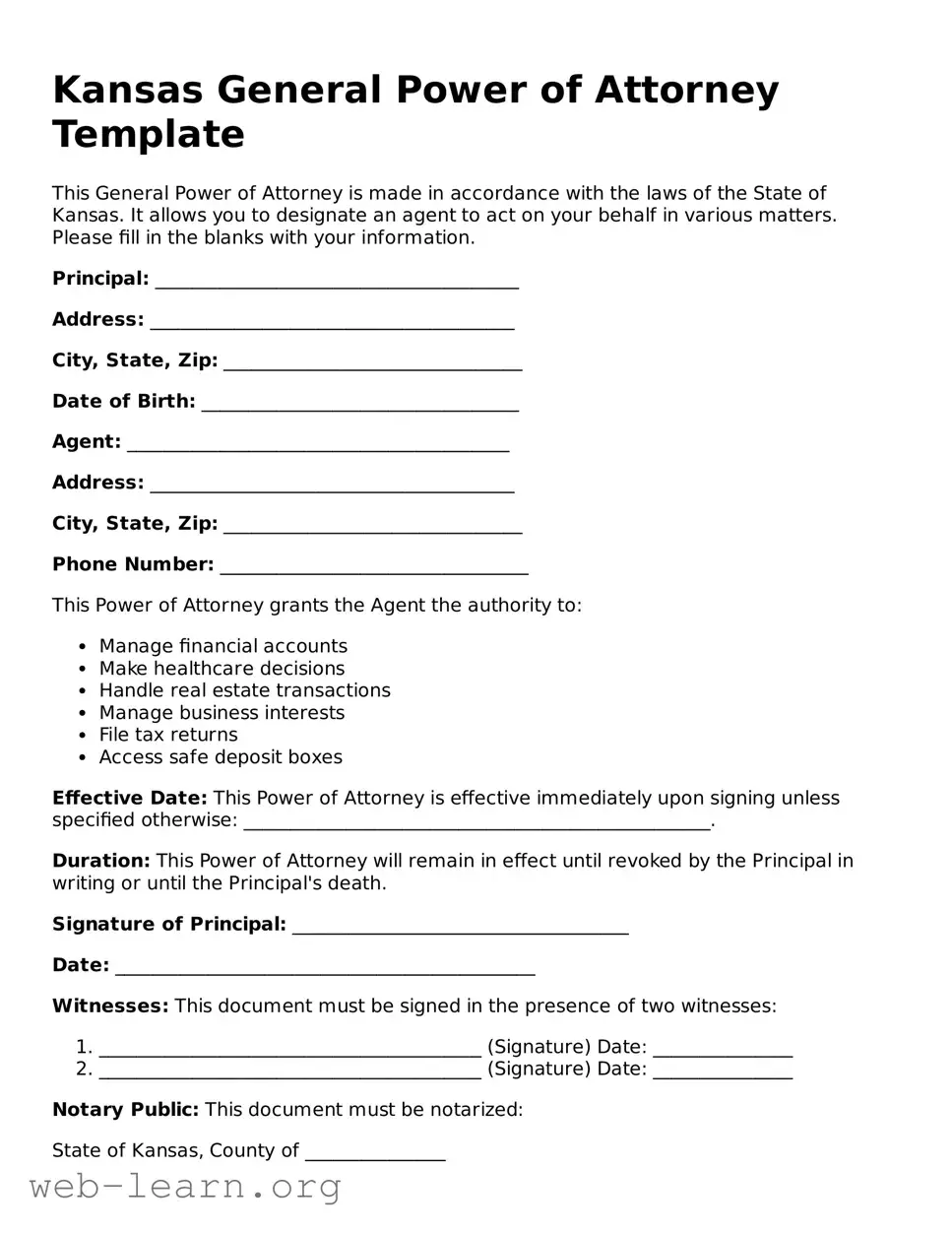
The Kansas General Power of Attorney form is a crucial legal document that grants an individual, known as the agent or attorney-in-fact, the authority to act on behalf of another person, referred to as the principal. This form is particularly useful in situations where the principal is unable to manage their affairs due to health issues, absence, or other circumstances. The powers bestowed upon the agent can encompass a wide range of financial and legal decisions, including handling bank transactions, managing real estate, and making healthcare decisions. Importantly, the principal retains the right to specify which powers are granted, allowing for tailored authority based on individual needs. The form also includes provisions for revocation, ensuring that the principal can terminate the agent's authority at any time, provided they are of sound mind. By understanding the key elements of the Kansas General Power of Attorney form, individuals can better prepare for unforeseen circumstances and ensure their interests are protected.
Kansas General Power of Attorney Template
This General Power of Attorney is made in accordance with the laws of the State of Kansas. It allows you to designate an agent to act on your behalf in various matters. Please fill in the blanks with your information.
Principal: _______________________________________
Address: _______________________________________
City, State, Zip: ________________________________
Date of Birth: __________________________________
Agent: _________________________________________
Address: _______________________________________
City, State, Zip: ________________________________
Phone Number: _________________________________
This Power of Attorney grants the Agent the authority to:
Effective Date: This Power of Attorney is effective immediately upon signing unless specified otherwise: __________________________________________________.
Duration: This Power of Attorney will remain in effect until revoked by the Principal in writing or until the Principal's death.
Signature of Principal: ____________________________________
Date: _____________________________________________
Witnesses: This document must be signed in the presence of two witnesses:
Notary Public: This document must be notarized:
State of Kansas, County of _______________
Subscribed and sworn to before me this ______ day of ______________, 20__.
_________________________________________
Notary Public Signature
My commission expires: _______________
| Fact Name | Description |
|---|---|
| Definition | A Kansas General Power of Attorney allows one person to grant another the authority to act on their behalf in legal and financial matters. |
| Governing Law | This form is governed by the Kansas Statutes Annotated, specifically K.S.A. 58-6501 et seq. |
| Durability | The General Power of Attorney can be made durable, meaning it remains effective even if the principal becomes incapacitated. |
| Agent's Authority | The agent can manage financial accounts, sign documents, and make decisions regarding property, among other responsibilities. |
| Revocation | The principal can revoke the General Power of Attorney at any time, as long as they are mentally competent. |
| Execution Requirements | The form must be signed by the principal and notarized to be legally valid in Kansas. |
| Limitations | There are certain limitations, such as the agent cannot make healthcare decisions unless specifically granted that power. |
| Use Cases | This form is commonly used for managing finances, real estate transactions, and handling business affairs when the principal is unavailable. |
After obtaining the Kansas General Power of Attorney form, you will need to complete it with accurate information. This form allows you to designate someone to manage your financial and legal affairs on your behalf. Follow these steps to fill it out correctly.
Once you have filled out and notarized the form, it is ready to be used. Ensure that your agent understands their responsibilities and the extent of their authority.
What is a General Power of Attorney in Kansas?
A General Power of Attorney (GPOA) in Kansas is a legal document that allows one person, known as the principal, to grant another person, known as the agent or attorney-in-fact, the authority to make decisions on their behalf. This can include managing financial matters, handling real estate transactions, and making legal decisions.
Who can be an agent under a General Power of Attorney?
In Kansas, the agent can be any competent adult, which means they must be at least 18 years old and mentally capable of making decisions. It is advisable to choose someone trustworthy, as the agent will have significant control over the principal's affairs.
What powers can be granted to the agent?
The powers granted can vary based on the principal's needs. Common powers include:
It is important to specify which powers are granted in the document to avoid confusion later.
Does a General Power of Attorney need to be notarized?
Yes, in Kansas, a General Power of Attorney must be signed by the principal and notarized to be legally valid. This ensures that the document is authentic and that the principal understands the powers they are granting.
Can a General Power of Attorney be revoked?
Yes, the principal can revoke a General Power of Attorney at any time, as long as they are mentally competent. To revoke the document, the principal must provide written notice to the agent and any relevant third parties. It is advisable to create a formal revocation document for clarity.
What happens if the principal becomes incapacitated?
If the principal becomes incapacitated, the General Power of Attorney remains in effect unless it specifically states that it is only valid while the principal is competent. If the principal wants the power to continue during incapacitation, they should consider creating a Durable Power of Attorney instead.
Is a General Power of Attorney effective immediately?
A General Power of Attorney can be effective immediately upon signing, unless the principal specifies a different start date. If the principal prefers the powers to activate only upon incapacitation, they should opt for a Durable Power of Attorney with a springing clause.
Where can I obtain a General Power of Attorney form in Kansas?
General Power of Attorney forms can be obtained from various sources, including legal stationery stores, online legal services, or through an attorney. It is important to ensure that the form complies with Kansas state laws.
Filling out the Kansas General Power of Attorney form requires careful attention to detail. One common mistake individuals make is not clearly identifying the agent. The agent is the person authorized to act on behalf of the principal. If the agent's name is not written clearly or is incomplete, it can lead to confusion and potential disputes later on.
Another frequent error involves failing to specify the powers granted. The form allows for a range of powers, from managing financial matters to making healthcare decisions. If the powers are not explicitly stated, the agent may not have the authority to act in certain situations, which can hinder their ability to assist the principal effectively.
People often overlook the importance of signing and dating the document correctly. The principal must sign the form in the presence of a notary public. If the signature is missing or the date is incorrect, the document may be considered invalid. This oversight can render the entire power of attorney ineffective.
In addition, individuals sometimes neglect to discuss their decisions with the agent beforehand. It is crucial for the principal to communicate their wishes and expectations clearly. If the agent is unaware of the principal's intentions, they may make decisions that do not align with the principal's preferences.
Lastly, failing to keep the document updated is a common mistake. Life circumstances change, and so do relationships. If the principal's situation evolves, such as a change in health or a shift in personal relationships, it is essential to revise the power of attorney accordingly. An outdated document can lead to complications and may not reflect the principal's current wishes.
When creating a Kansas General Power of Attorney, there are several other forms and documents that may be useful to consider. Each of these documents serves a specific purpose and can help ensure that your wishes are clearly communicated and legally recognized.
Considering these documents alongside the Kansas General Power of Attorney can help create a comprehensive plan for managing both financial and health care decisions. Each form plays a vital role in ensuring that your wishes are respected and that your loved ones are supported during difficult times.
When filling out the Kansas General Power of Attorney form, it is important to approach the process with care. Here are some essential do's and don'ts to keep in mind:
Taking these steps seriously can help ensure that your General Power of Attorney form is completed correctly and serves your intentions effectively.
The Kansas General Power of Attorney form is often misunderstood. Here are five common misconceptions about this legal document:
Understanding these misconceptions can help individuals make informed decisions regarding their legal rights and responsibilities.
When filling out and using the Kansas General Power of Attorney form, it is essential to understand its implications and requirements. Here are some key takeaways to consider:
By understanding these key points, you can confidently fill out and utilize the Kansas General Power of Attorney form to protect your interests and ensure your wishes are honored.