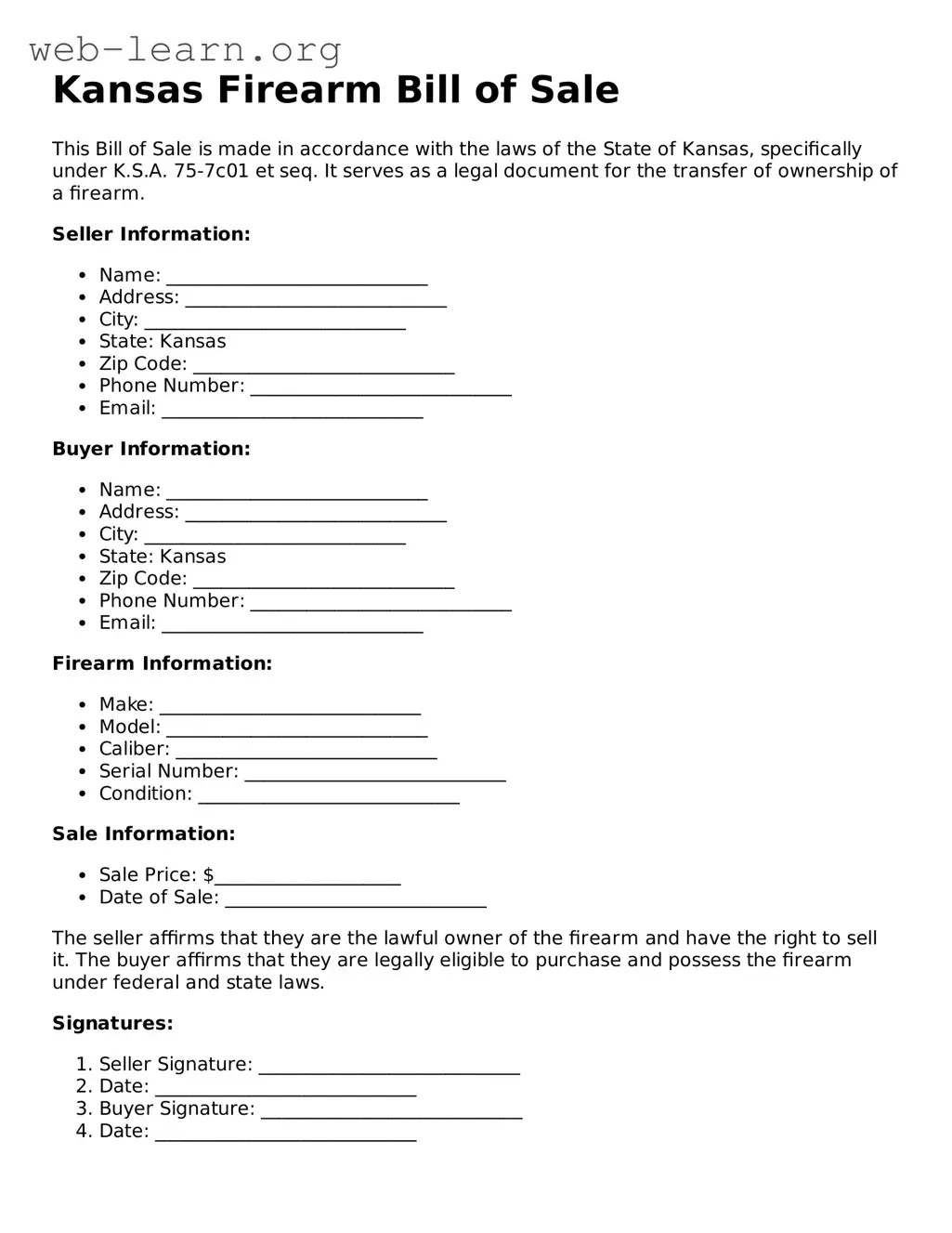
When engaging in the buying or selling of firearms in Kansas, it is crucial to understand the importance of a Firearm Bill of Sale form. This document serves as a legal record of the transaction between the seller and the buyer, ensuring that both parties are protected and that the transfer of ownership is clearly documented. The form typically includes essential details such as the names and addresses of both the buyer and seller, a description of the firearm being sold—including its make, model, and serial number—and the date of the transaction. Additionally, the Firearm Bill of Sale may require signatures from both parties, affirming that the sale is legitimate and that the firearm is being transferred in accordance with state laws. By utilizing this form, individuals can help prevent potential legal issues in the future, as it provides proof of ownership and outlines the terms of the sale. Understanding how to properly complete and maintain this document is vital for anyone involved in the firearms market in Kansas.
Kansas Firearm Bill of Sale
This Bill of Sale is made in accordance with the laws of the State of Kansas, specifically under K.S.A. 75-7c01 et seq. It serves as a legal document for the transfer of ownership of a firearm.
Seller Information:
Buyer Information:
Firearm Information:
Sale Information:
The seller affirms that they are the lawful owner of the firearm and have the right to sell it. The buyer affirms that they are legally eligible to purchase and possess the firearm under federal and state laws.
Signatures:
This document should be retained by both parties for their records. It is recommended to keep a copy for future reference.
| Fact Name | Description |
|---|---|
| Purpose | The Kansas Firearm Bill of Sale form is used to document the sale or transfer of a firearm between individuals. |
| Legal Requirement | While Kansas does not require a bill of sale for private firearm sales, it is recommended for record-keeping purposes. |
| Governing Laws | The form is governed by Kansas Statutes Annotated (K.S.A.) 75-7c01 et seq., which outlines firearm regulations in the state. |
| Information Included | The form typically includes details about the buyer, seller, firearm description, and signatures of both parties. |
Filling out the Kansas Firearm Bill of Sale form is an important step in the process of transferring ownership of a firearm. Once you have completed the form, ensure that both parties retain a copy for their records. This documentation helps to establish a clear record of the transaction.
A Kansas Firearm Bill of Sale is a legal document that serves as proof of the transfer of ownership of a firearm between two parties. This form outlines essential details about the firearm, such as its make, model, and serial number, as well as the names and addresses of both the seller and the buyer. Having a Bill of Sale is crucial for ensuring that the transaction is documented and can help prevent legal issues in the future.
While Kansas does not legally require a Bill of Sale for private firearm transactions, it is highly recommended. This document provides both parties with a record of the sale, which can be beneficial in case of disputes or questions about ownership down the line. Additionally, having a Bill of Sale can help demonstrate compliance with state laws regarding firearm sales.
A comprehensive Kansas Firearm Bill of Sale should include the following information:
Including all these details helps ensure clarity and protects both parties involved in the transaction.
Yes, you can create your own Bill of Sale for a firearm in Kansas. There are many templates available online that you can customize to fit your needs. However, it is essential to ensure that the document includes all necessary information and complies with state laws. If you are unsure about the process, consulting with a legal professional may provide additional peace of mind.
Filling out the Kansas Firearm Bill of Sale form can be straightforward, but there are several common mistakes that individuals often make. One frequent error is failing to provide complete information. Both the buyer and seller must fill out their names, addresses, and contact information accurately. Incomplete details can lead to confusion or disputes later on.
Another mistake is neglecting to include the firearm's serial number. This number is crucial for identification and tracking purposes. Without it, the bill of sale may not serve its intended purpose, which is to document the transfer of ownership legally.
People sometimes forget to sign the document. A signature is essential as it indicates agreement to the terms of the sale. Without signatures from both parties, the bill of sale lacks legal validity and may not be enforceable in a dispute.
Additionally, individuals may overlook the date of the transaction. Including the date is important for establishing when the transfer occurred. This information can be vital for record-keeping and legal purposes, especially if questions arise about the firearm's ownership history.
Another common issue is not providing a clear description of the firearm. The form should include details such as the make, model, and caliber. A vague description can lead to misunderstandings about what was sold, potentially resulting in disputes between the buyer and seller.
Sometimes, people mistakenly assume that a bill of sale is only necessary for high-value firearms. However, regardless of the firearm's value, having a bill of sale is a good practice. It protects both parties and provides a record of the transaction.
Finally, individuals may fail to keep a copy of the completed bill of sale. After filling out the form, both parties should retain a copy for their records. This documentation can serve as proof of the sale and help resolve any future issues regarding ownership or legality.
The Kansas Firearm Bill of Sale form is a crucial document for anyone involved in the sale or transfer of firearms in Kansas. However, it is often accompanied by several other forms and documents that help ensure the transaction is legal and properly documented. Below is a list of additional forms that may be used alongside the Firearm Bill of Sale.
Using these documents together with the Kansas Firearm Bill of Sale helps to create a comprehensive record of the transaction. This can protect both the buyer and seller by ensuring compliance with state and federal laws, thus promoting responsible firearm ownership and transfer.
When filling out the Kansas Firearm Bill of Sale form, it's important to follow certain guidelines to ensure a smooth process. Here are nine things to keep in mind:
Understanding the Kansas Firearm Bill of Sale form can be challenging, and several misconceptions often arise. Here are seven common misunderstandings about this form:
The Bill of Sale is a legal requirement for all firearm transactions in Kansas. This is not true. While it is a good practice to document the sale, Kansas law does not require a Bill of Sale for private firearm transactions between individuals.
A Bill of Sale serves as a registration of the firearm. This misconception is misleading. A Bill of Sale does not register the firearm with the state. Instead, it simply serves as a receipt that records the transaction between the buyer and the seller.
You must use a specific form for the Bill of Sale. There is no mandated format for the Bill of Sale in Kansas. While using a standard form can help ensure that all necessary information is included, individuals can create their own document as long as it captures the essential details of the transaction.
The Bill of Sale must be notarized. Notarization is not a requirement for the Bill of Sale in Kansas. However, having it notarized can add an extra layer of authenticity and may be beneficial in certain situations.
Both parties must be residents of Kansas to complete a Bill of Sale. This is incorrect. While it is advisable for both parties to be Kansas residents, individuals from other states can also engage in firearm transactions, provided they comply with federal laws and the laws of their respective states.
The Bill of Sale protects the seller from liability. While a Bill of Sale can provide some documentation of the transaction, it does not completely absolve the seller from liability if the firearm is used in a crime or causes harm after the sale.
You cannot sell a firearm without a Bill of Sale. This is a common misconception. In Kansas, private sales do not require a Bill of Sale, although it is highly recommended to have one for record-keeping purposes.
By clarifying these misconceptions, individuals can better navigate the process of buying and selling firearms in Kansas while ensuring compliance with the law.
When filling out and using the Kansas Firearm Bill of Sale form, keep these key takeaways in mind:
By following these guidelines, you can ensure a smooth and legally compliant transaction.
Oregon Gun Transfer Form - A Firearm Bill of Sale can help protect against future liability.
Alabama Firearm Transfer Laws - Both parties should carefully review the information on the Bill of Sale before signing.
Kentucky Firearm Bill of Sale - Helps to maintain transparency in private firearm sales.
Hawaii Bill of Sale for a Gun - The Firearm Bill of Sale can be created digitally or in paper format, depending on preference.