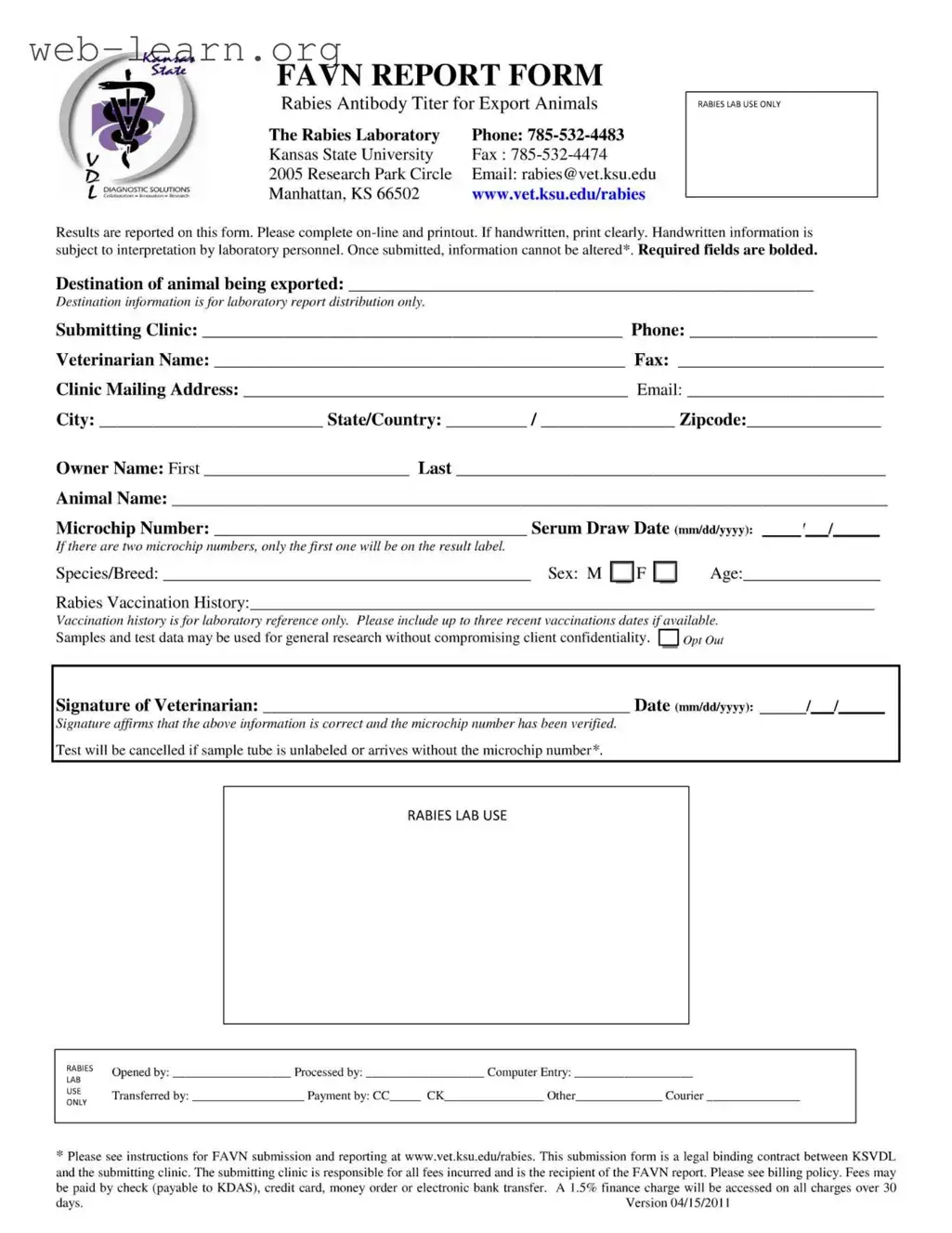
Homepage Blank Kansas Favn Report Form
Outline

The Kansas FAVN Report Form is an essential document for pet owners and veterinarians involved in the export of animals, particularly in relation to rabies vaccination requirements. This form is utilized to report the rabies antibody titer for animals destined for international travel. It is crucial that the form is completed accurately, either online or by hand, with clear information to avoid any misinterpretation by laboratory personnel. Required fields, such as the submitting clinic's details, the owner's name, and the animal's microchip number, are highlighted to ensure compliance. Additionally, the form includes sections for the animal's vaccination history and specific details about the destination of the animal, which are vital for laboratory report distribution. The FAVN Report Form also serves as a binding contract between the submitting clinic and the Kansas State Veterinary Diagnostic Laboratory (KSVDL), outlining the responsibilities regarding fees and the integrity of the information provided. Proper handling of the specimen is emphasized, including labeling and shipping instructions, to ensure that the sample arrives safely and meets all requirements for testing. Understanding the nuances of this form is critical for a smooth export process, as any errors or omissions could lead to delays or complications in the animal's travel plans.
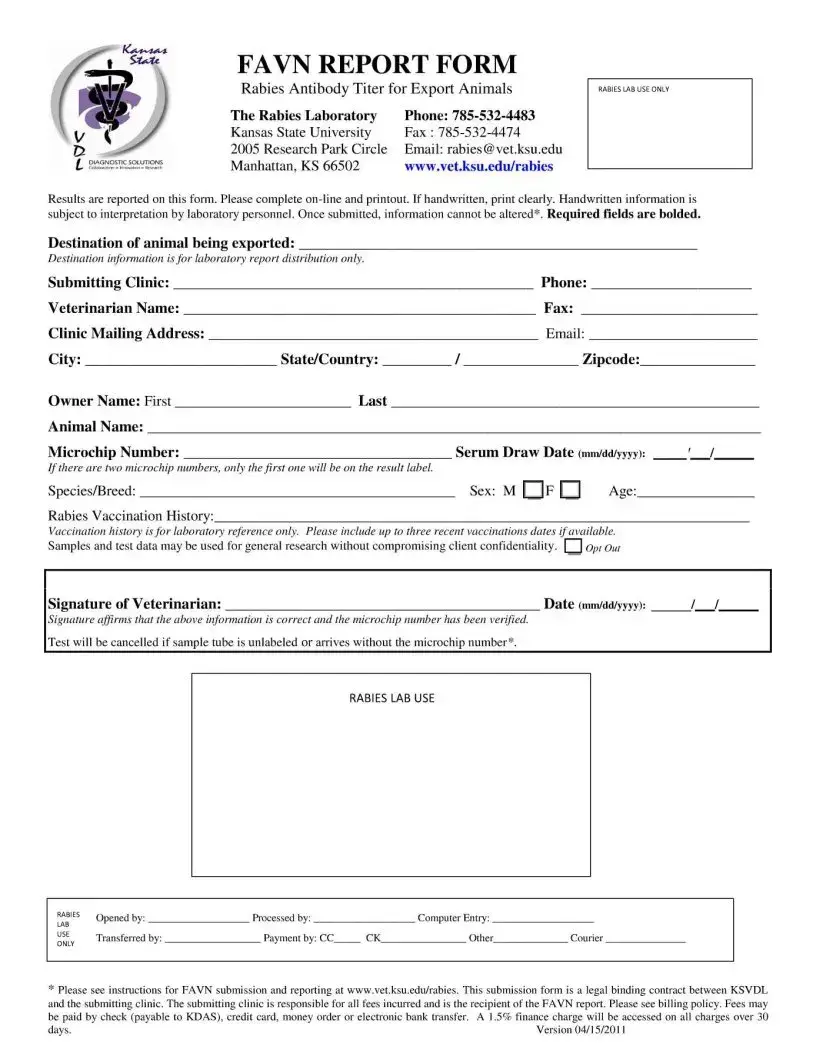
Sample - Kansas Favn Report Form

Form Information

Fact Name Description
Form Purpose The FAVN Report Form is used to document rabies antibody titers for animals being exported.
Governing Law This form operates under the regulations of the Kansas State Veterinary Diagnostic Laboratory (KSVDL).
Submission Requirements Information must be completed online or printed clearly if handwritten, as legibility is crucial for laboratory processing.
Microchip Verification The microchip number must be verified and accurately recorded on the form to ensure proper identification of the animal.
Payment Responsibility The submitting clinic is financially responsible for all fees associated with the FAVN report and testing.
Sample Handling Samples must be properly labeled and packaged to prevent leakage and breakage during shipping.
Processing Time The processing time for FAVN tests may vary, and clients should consult the laboratory for specific timelines.
Legal Binding Contract Submitting the form constitutes a legal agreement between the submitting clinic and KSVDL, affirming the accuracy of the provided information.

Detailed Guide for Filling Out Kansas Favn Report

Filling out the Kansas FAVN Report form is essential for ensuring accurate reporting of rabies antibody titer for exported animals. After completing the form, it must be submitted along with the appropriate samples and payment. Ensure that all information is clear and accurate to avoid any issues during processing.

  1. Visit the Kansas State University Rabies Laboratory website to access the FAVN Report form.
  2. Complete the required fields, ensuring that all bolded sections are filled out.
  3. Provide the destination of the animal being exported. This is for laboratory report distribution only.
  4. Enter the submitting clinic's details, including the veterinarian's name, phone number, fax number, mailing address, email, city, state/country, and zip code.
  5. Fill in the owner's name, including first and last name.
  6. Input the animal's name and microchip number. If there are two microchip numbers, only include the first one.
  7. Record the serum draw date in the format mm/dd/yyyy.
  8. Specify the species/breed and sex of the animal. Indicate if the animal is male or female.
  9. Document the rabies vaccination history, including up to three recent vaccination dates if available.
  10. Have the veterinarian sign the form, affirming that all information is correct and that the microchip number has been verified.
  11. Enter the date of signature in the format mm/dd/yyyy.
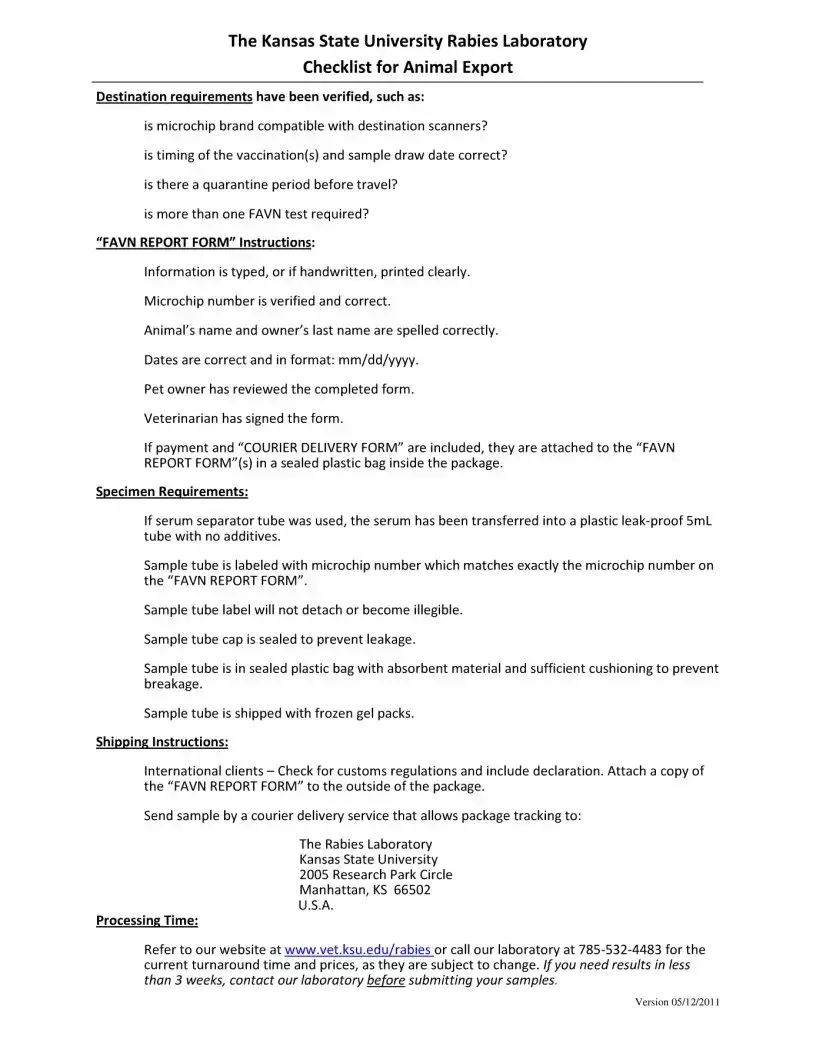
  12. Ensure the sample tube is labeled correctly with the microchip number that matches the one on the form.
  13. Prepare the sample tube according to the specimen requirements, ensuring it is leak-proof and sealed properly.
  14. Package the form, payment, and sample securely, placing them in a sealed plastic bag.
  15. Ship the package using a courier service that allows for package tracking, including a copy of the FAVN Report form on the outside.

Obtain Answers on Kansas Favn Report

  1. What is the purpose of the Kansas FAVN Report Form?

    The Kansas FAVN Report Form is used to report rabies antibody titers for animals being exported. This form collects essential information about the animal, its vaccination history, and the submitting veterinarian. Accurate completion of the form is crucial, as it serves as a legal binding contract between the submitting clinic and the Kansas State University Rabies Laboratory.

  2. How should I complete the form?

    To complete the form, you can fill it out online and print it, or you may write it by hand. If you choose to handwrite, please ensure that all information is printed clearly. Required fields are bolded for your convenience. It's important to verify the microchip number and ensure that all details, including dates, are accurate and formatted as mm/dd/yyyy.

  3. What happens if the form is not filled out correctly?

    If the form contains errors, such as an unlabeled sample tube or an incorrect microchip number, the test will be canceled. Therefore, double-check all entries before submission. The laboratory personnel may interpret handwritten information differently, which can lead to further complications.

  4. What are the payment options for the FAVN testing?

    Payment for the FAVN testing can be made through several methods. You may use a check payable to KDAS, a credit card, a money order, or an electronic bank transfer. Be aware that a 1.5% finance charge will be applied to all charges that remain unpaid for over 30 days.

  5. What shipping instructions should I follow?

    When shipping samples, ensure compliance with customs regulations for international clients. Include a copy of the FAVN Report Form on the outside of the package. Use a courier service that allows package tracking. Send the sample to the following address:

    The Rabies Laboratory
    Kansas State University
    2005 Research Park Circle
    Manhattan, KS 66502 U.S.A.

    Make sure the sample is securely packaged with appropriate cushioning and frozen gel packs to prevent breakage during transit.

Common mistakes

Filling out the Kansas FAVN Report form is a crucial step in ensuring the safe export of animals, particularly in regard to rabies testing. However, many people make common mistakes that can delay the process or even result in the rejection of the submission. One frequent error is failing to provide complete and accurate information in the required fields. Each field marked in bold is essential, and omitting even one piece of information can lead to complications. For instance, if the veterinarian’s name or contact details are incorrect, it may hinder communication regarding the test results.

Another mistake often made is not verifying the microchip number. The microchip number on the sample tube must match exactly with the number provided on the FAVN Report form. If there is a discrepancy, the test will be canceled. This highlights the importance of double-checking all details before submission. Additionally, individuals sometimes overlook the need for proper formatting of dates. The form requires dates to be in the format mm/dd/yyyy. A simple error in this format can lead to misunderstandings or delays in processing.

Many submitters also neglect to ensure that the animal's name and the owner's last name are spelled correctly. Errors in names can create confusion and complicate the identification of the animal and its owner. Furthermore, it’s crucial that the pet owner reviews the completed form before it is submitted. This step can catch errors that the submitting clinic might have missed, ensuring that all information is accurate and complete.

Lastly, some people fail to follow the shipping instructions carefully. It’s essential to use a courier service that allows for package tracking and to include a copy of the FAVN Report form on the outside of the package. Inadequate packaging can also lead to issues; the sample tube must be labeled correctly and sealed properly to prevent leakage. Following these guidelines can significantly reduce the risk of delays or complications in the export process.

Documents used along the form

The Kansas FAVN Report form is a critical document for exporting animals, particularly in relation to rabies vaccination compliance. Along with this form, there are several other documents and forms that are often required to ensure a smooth export process. Below is a list of these documents, each briefly described for clarity.

  • COURIER DELIVERY FORM: This form is used to provide details about the shipping method and service chosen for transporting the animal's sample to the laboratory. It ensures that the package is handled correctly and can be tracked during transit.
  • Health Certificate: Issued by a licensed veterinarian, this certificate confirms that the animal is healthy and free from contagious diseases. It is often required by destination countries to ensure animal welfare during transport.
  • Import Permit: Some countries require an import permit for animals entering their borders. This document outlines the specific conditions under which the animal may be imported, including health requirements and quarantine measures.
  • Vaccination Records: Detailed records of the animal’s vaccinations, particularly against rabies, are essential. These records help verify that the animal has received the necessary vaccinations within the required timeframe.
  • Microchip Registration Document: This document provides proof of the animal’s microchip registration, confirming the identification details associated with the microchip number listed on the FAVN Report form.
  • Quarantine Agreement: In some cases, a quarantine agreement may be necessary, outlining the conditions under which the animal will be quarantined upon arrival at the destination. This ensures compliance with local regulations.
  • Owner's Declaration: This declaration is often required by destination authorities, confirming that the owner understands and agrees to the terms of the animal's export and any associated regulations.
  • Shipping Instructions: Detailed instructions for how the animal should be handled during shipping, including temperature controls and care instructions, may be necessary to ensure the animal's well-being.
  • Payment Receipt: A receipt for any fees paid, including those for testing and shipping, may be required to confirm that all financial obligations have been met before the animal is exported.

Each of these documents plays an important role in the export process, ensuring compliance with legal requirements and promoting the safety and well-being of the animal. It is essential to prepare and submit all necessary paperwork accurately and promptly to avoid delays or complications during export.

Similar forms

  • Health Certificate: Similar to the Kansas FAVN Report, a health certificate is required for the export of animals. It verifies that the animal is healthy and free from diseases, ensuring compliance with the destination country’s regulations.
  • Import Permit: This document is often required by the destination country to allow the entry of an animal. It ensures that the necessary health and vaccination standards are met, much like the FAVN Report does for rabies.
  • Vaccination Record: This document outlines the vaccination history of the animal, including rabies vaccinations. It serves as a reference for health officials, similar to the vaccination history section in the FAVN Report.
  • Microchip Registration: Just as the FAVN Report requires a microchip number for identification, microchip registration documents confirm that the animal has been microchipped and provide ownership details.
  • Export Declaration: This form is used to declare the export of animals and ensures that all legal and health requirements are met, paralleling the legal binding nature of the FAVN Report.
  • Quarantine Certificate: Some countries require a quarantine certificate to confirm that an animal has been held in quarantine for the necessary period. This is similar to the FAVN Report’s emphasis on verifying quarantine periods before travel.
  • Shipping Manifest: This document details the contents of a shipment, including the animal being exported. It ensures that all items are accounted for, much like the detailed information required on the FAVN Report.
  • Laboratory Test Results: Similar to the FAVN Report, laboratory test results provide verification of an animal's health status. These results are crucial for compliance with export regulations.

Dos and Don'ts

When filling out the Kansas FAVN Report form, it’s essential to follow certain guidelines to ensure a smooth process. Here’s a list of things to do and avoid:

  • Do complete the form online and print it out for submission.
  • Do print clearly if you choose to handwrite the information.
  • Do verify the microchip number and ensure it matches the information on the form.
  • Do check that all required fields are filled out accurately.
  • Do include up to three recent vaccination dates for reference.
  • Do ensure the animal's name and owner's last name are spelled correctly.
  • Do attach the completed form securely to the sample package.
  • Do review the form with the pet owner before submission.
  • Do keep a copy of the form for your records.
  • Do use a courier service that allows for package tracking when sending the sample.
  • Don't submit the form without verifying all information is correct.
  • Don't forget to label the sample tube with the matching microchip number.
  • Don't leave any required fields blank, as this may delay processing.
  • Don't use a sample tube that is unlabeled or has a detached label.
  • Don't send the sample without proper cushioning to prevent breakage.
  • Don't ignore customs regulations if shipping internationally.
  • Don't forget to include the payment and "Courier Delivery Form" if required.
  • Don't submit the form after the sample has been drawn without ensuring all details are correct.
  • Don't assume that handwritten information will be interpreted correctly by laboratory personnel.
  • Don't delay payment, as a finance charge will apply to overdue fees.

By following these guidelines, you can help ensure that the FAVN Report form is filled out correctly and efficiently. This will facilitate a smoother process for the animal's export.

Misconceptions

Understanding the Kansas FAVN Report form is crucial for anyone involved in exporting animals. However, several misconceptions persist about this important document. Here are eight common misunderstandings:

  • All fields are optional. Many people believe that all fields on the form are optional. In reality, certain fields are mandatory. Missing required information can lead to delays or rejection of the submission.
  • Handwritten forms are always acceptable. While handwritten forms are allowed, they must be clear. Poor handwriting can lead to misinterpretation by laboratory personnel, potentially causing issues with the report.
  • Submitting the form guarantees a successful test. Some assume that simply submitting the form will ensure a successful rabies titer test. However, the quality of the sample and adherence to submission guidelines are critical factors that determine the outcome.
  • Microchip numbers do not need to be verified. A common misconception is that microchip verification is unnecessary. In fact, the microchip number must match precisely on both the sample tube and the FAVN Report form to avoid test cancellation.
  • Vaccination history is irrelevant. Many believe that the vaccination history provided is not significant. However, this information is crucial for laboratory reference and can impact the test results.
  • Payment options are limited. Some individuals think that there are few ways to pay for the service. In reality, payments can be made through various methods, including credit card, check, and electronic bank transfer.
  • Shipping instructions are optional. A misconception exists that following the shipping instructions is not essential. However, adhering to these guidelines is vital to ensure the sample arrives safely and is processed correctly.
  • Once submitted, the form can be altered. Many people mistakenly believe they can change information after submission. Once the form is submitted, alterations are not permitted, making accuracy at the outset crucial.

By clarifying these misconceptions, individuals can better navigate the requirements of the Kansas FAVN Report form and ensure a smoother process for exporting animals.

Key takeaways

When filling out and using the Kansas FAVN Report form, it is essential to follow specific guidelines to ensure accuracy and compliance. Here are key takeaways to consider:

  • Complete the form online or print clearly: Handwritten entries must be legible. Poor handwriting can lead to misinterpretation by laboratory personnel.
  • Verify microchip information: Ensure that the microchip number is correct and matches the animal. This is crucial for accurate reporting.
  • Provide complete vaccination history: Include up to three recent vaccination dates. This information is for laboratory reference and may be used for research purposes.
  • Signatures are mandatory: The veterinarian must sign the form, affirming that all provided information is accurate and verified.
  • Check shipping requirements: Ensure compliance with destination regulations, including microchip compatibility and quarantine periods.
  • Prepare the sample correctly: Use a labeled, leak-proof tube for serum samples. The label must match the microchip number on the form.
  • Follow payment and shipping instructions: Include payment with the submission and use a courier service that provides tracking. Attach a copy of the form to the package.

By adhering to these guidelines, you can facilitate a smoother process for exporting animals while ensuring compliance with necessary regulations.