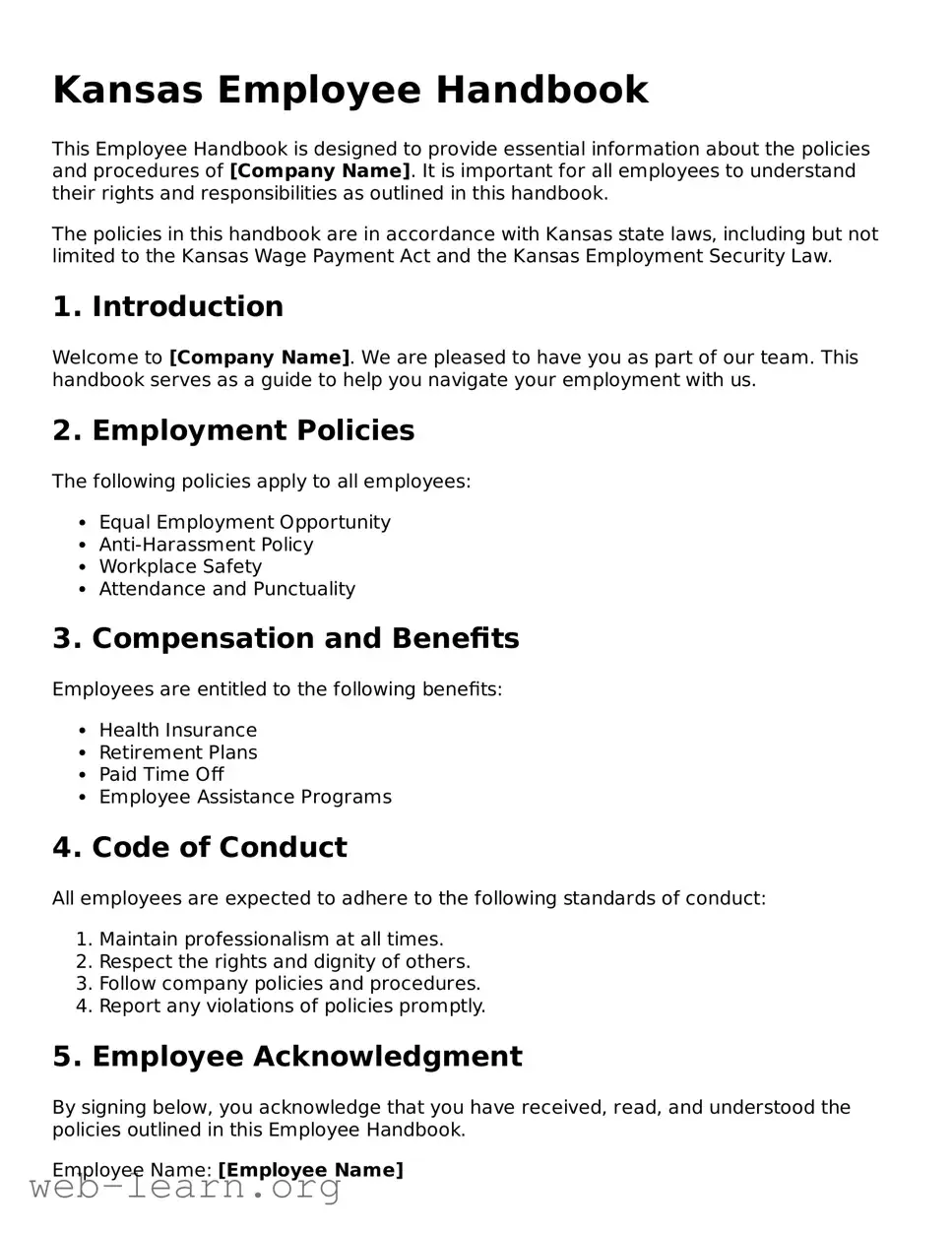
In the state of Kansas, an Employee Handbook serves as a crucial document for both employers and employees, outlining essential policies and procedures that govern workplace behavior and expectations. This handbook not only communicates the rights and responsibilities of employees but also provides guidance on various aspects such as workplace conduct, attendance policies, and benefits information. Employers can use this document to establish a clear understanding of company culture and operational standards. Additionally, the handbook can address critical topics like anti-discrimination policies, harassment prevention, and conflict resolution procedures. By presenting this information in a structured format, the Employee Handbook helps foster a transparent work environment, ensuring that all employees are aware of the rules that guide their employment. Ultimately, a well-crafted handbook is not merely a formality; it is a vital tool for promoting compliance, enhancing communication, and protecting both the organization and its workforce.
Kansas Employee Handbook
This Employee Handbook is designed to provide essential information about the policies and procedures of [Company Name]. It is important for all employees to understand their rights and responsibilities as outlined in this handbook.
The policies in this handbook are in accordance with Kansas state laws, including but not limited to the Kansas Wage Payment Act and the Kansas Employment Security Law.
1. Introduction
Welcome to [Company Name]. We are pleased to have you as part of our team. This handbook serves as a guide to help you navigate your employment with us.
2. Employment Policies
The following policies apply to all employees:
3. Compensation and Benefits
Employees are entitled to the following benefits:
4. Code of Conduct
All employees are expected to adhere to the following standards of conduct:
5. Employee Acknowledgment
By signing below, you acknowledge that you have received, read, and understood the policies outlined in this Employee Handbook.
Employee Name: [Employee Name]
Employee Signature: ______________________
Date: [Date]
| Fact Name | Description |
|---|---|
| Purpose | The Kansas Employee Handbook serves as a guide for employees, outlining company policies, procedures, and expectations. |
| Governing Law | This handbook is governed by the Kansas Statutes Annotated (K.S.A.) Chapter 44, which covers employment laws in the state. |
| Mandatory Policies | Employers are encouraged to include mandatory policies such as anti-discrimination and harassment guidelines. |
| At-Will Employment | The handbook should clarify that employment is at-will, meaning either party can terminate the employment relationship at any time. |
| Employee Rights | It should inform employees about their rights, including wage laws and workplace safety regulations. |
| Updates and Revisions | Employers must regularly update the handbook to reflect changes in laws or company policies. |
| Distribution | The handbook should be distributed to all employees, and a signed acknowledgment of receipt is recommended. |
| Confidentiality Clause | Including a confidentiality clause can help protect sensitive company information from being disclosed. |
| Legal Compliance | Employers should ensure that the handbook complies with both federal and state employment laws to avoid legal issues. |
Completing the Kansas Employee Handbook form is a straightforward process that ensures you provide all necessary information clearly and accurately. Following these steps will help you navigate through the form efficiently.
What is the Kansas Employee Handbook form?
The Kansas Employee Handbook form is a document designed to provide employees with essential information about their rights, responsibilities, and the policies of their workplace. It serves as a guide for both employers and employees, ensuring that everyone is on the same page regarding workplace expectations and procedures.
Who should receive a copy of the Employee Handbook?
All employees should receive a copy of the Employee Handbook. This includes full-time, part-time, and temporary staff. Providing a handbook to every employee helps ensure that everyone understands the company’s policies and procedures, promoting a harmonious work environment.
What key topics are typically included in the Employee Handbook?
Employee Handbooks generally cover a variety of important topics, such as:
These topics help create a clear understanding of the work environment and what is expected from employees.
How often should the Employee Handbook be updated?
It’s important to review and update the Employee Handbook regularly. Changes in laws, company policies, or workplace culture may necessitate updates. Ideally, the handbook should be reviewed at least once a year to ensure it remains current and relevant. When updates occur, employees should be notified promptly and provided with the revised handbook.
What should an employee do if they have questions about the handbook?
If an employee has questions or needs clarification about any section of the Employee Handbook, they should feel encouraged to reach out to their supervisor or the Human Resources department. Open communication is vital, and addressing concerns helps maintain a positive workplace culture.
Filling out the Kansas Employee Handbook form is a crucial step for new employees. However, many individuals make common mistakes that can lead to confusion or issues later on. Understanding these mistakes can help ensure that the form is completed accurately.
One frequent error is failing to read the instructions thoroughly. Employees often rush through the process, skipping important details. This oversight can result in incomplete or incorrect information, which may delay the onboarding process.
Another mistake is not providing accurate personal information. Some individuals may overlook the need to double-check their name, address, or contact details. Inaccurate information can lead to problems with payroll, benefits, and communication.
Many employees neglect to sign and date the form. A signature is often required to validate the information provided. Without it, the form may be considered incomplete, leading to potential complications.
Additionally, people sometimes fail to ask questions when they are unsure about specific sections. Ignoring this opportunity can result in misunderstandings or misinterpretations of the policies outlined in the handbook.
Another common mistake is overlooking the acknowledgment section. Employees may not realize that acknowledging receipt of the handbook signifies their understanding of the policies. Failing to do so can lead to disputes over policy knowledge in the future.
Lastly, some individuals forget to keep a copy of the completed form for their records. Retaining a copy is essential for reference and can help clarify any future questions about policies or procedures.
When creating an employee handbook in Kansas, several other documents can complement it. These forms help clarify policies, ensure compliance, and enhance communication between employers and employees. Below are five important documents that are often used alongside the Kansas Employee Handbook.
Incorporating these documents alongside the Kansas Employee Handbook can help create a clear framework for workplace policies and procedures. This approach fosters a better understanding of expectations and promotes a positive work culture.
The Employee Handbook serves as a crucial resource for employees, outlining company policies and expectations. Several other documents share similarities with the Employee Handbook in terms of purpose and content. Here are eight such documents:
When filling out the Kansas Employee Handbook form, it's important to approach the task with care. Here are six things to keep in mind:
Understanding the Kansas Employee Handbook form can be challenging, and several misconceptions may lead to confusion. Here are some common misunderstandings clarified:
This is not entirely true. While not every business is legally required to have an employee handbook, having one is highly recommended. It helps establish clear policies and expectations, which can protect both the employer and employees.
Each business is unique, and so should its handbook be. The content should reflect the specific culture, values, and policies of the organization, tailored to its particular needs.
Policies and laws change frequently. Regularly reviewing and updating the handbook is essential to ensure compliance and relevance to current practices.
Small businesses can benefit significantly from having an employee handbook. It provides clarity and consistency in managing employees, which is crucial for any size of organization.
While handbooks aim to address many scenarios, they cannot predict every situation that may arise. They serve as a guide, but flexibility and communication are also important.
While it is good practice to have employees acknowledge receipt of the handbook, a signature is not legally required. What matters is that employees have access to it and understand its contents.
In fact, a well-crafted employee handbook can serve as an important document in legal matters. It can help demonstrate that the employer has established clear policies and expectations.
By addressing these misconceptions, employers can better understand the importance of the Kansas Employee Handbook form and its role in fostering a positive workplace environment.
When filling out and using the Kansas Employee Handbook form, keep the following key takeaways in mind:
Following these guidelines will help create a comprehensive and effective employee handbook.