When it comes to transferring property ownership in Kansas, the Kansas Deed form plays a crucial role in ensuring that the process is both legal and efficient. This document serves as the official record of the transaction, detailing essential information such as the names of the buyer and seller, the legal description of the property, and the terms of the transfer. It is vital for the deed to be accurately filled out and signed to avoid any future disputes regarding ownership. Additionally, understanding the different types of deeds available—such as warranty deeds and quitclaim deeds—can help parties choose the most appropriate option for their specific situation. Furthermore, the Kansas Deed form must be properly executed and recorded with the county clerk to provide public notice of the change in ownership. This ensures transparency and protects the rights of all parties involved. By familiarizing oneself with the key elements and requirements of the Kansas Deed form, individuals can navigate the property transfer process with confidence and clarity.
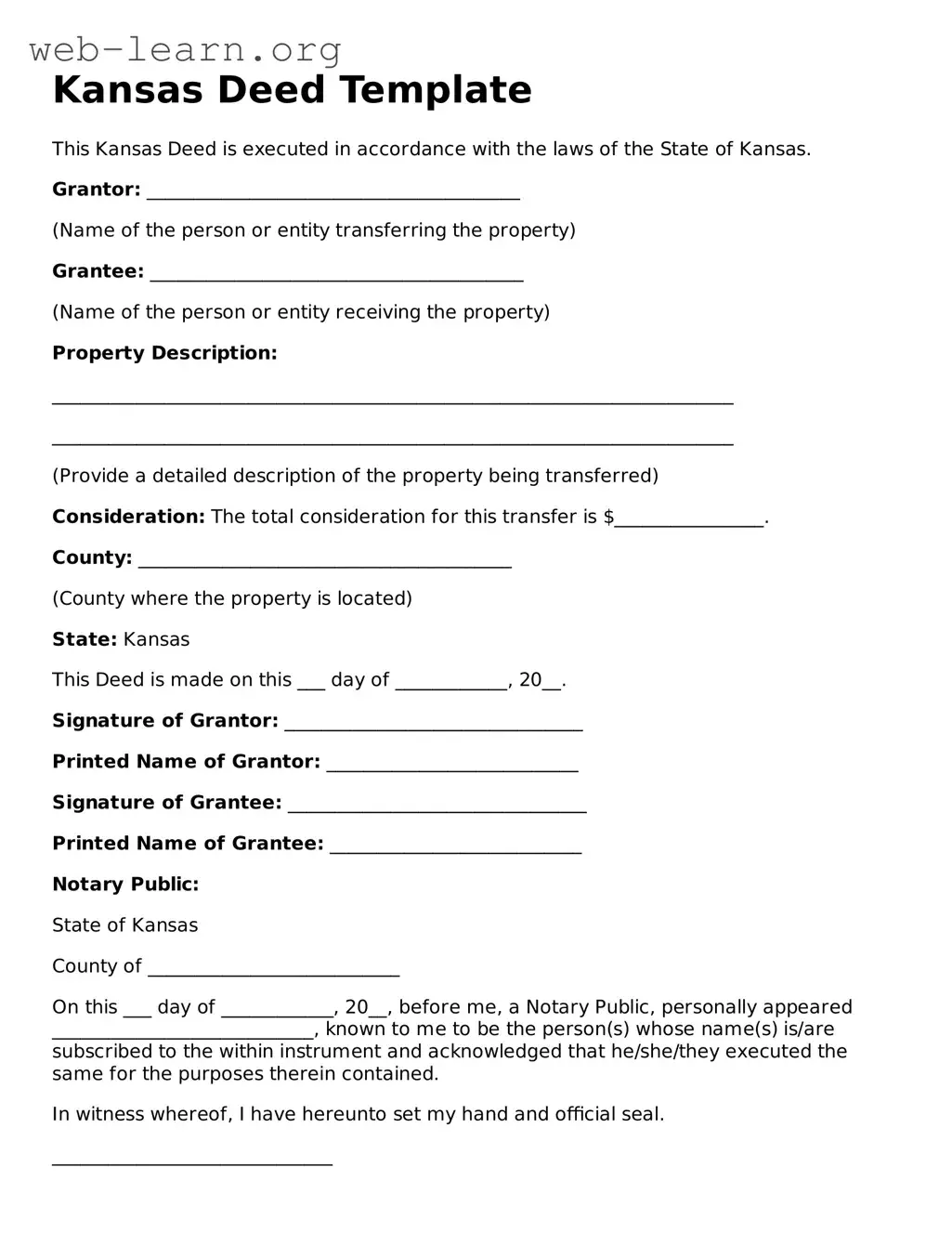
Kansas Deed Template
This Kansas Deed is executed in accordance with the laws of the State of Kansas.
Grantor: ________________________________________
(Name of the person or entity transferring the property)
Grantee: ________________________________________
(Name of the person or entity receiving the property)
Property Description:
_________________________________________________________________________
_________________________________________________________________________
(Provide a detailed description of the property being transferred)
Consideration: The total consideration for this transfer is $________________.
County: ________________________________________
(County where the property is located)
State: Kansas
This Deed is made on this ___ day of ____________, 20__.
Signature of Grantor: ________________________________
Printed Name of Grantor: ___________________________
Signature of Grantee: ________________________________
Printed Name of Grantee: ___________________________
Notary Public:
State of Kansas
County of ___________________________
On this ___ day of ____________, 20__, before me, a Notary Public, personally appeared ____________________________, known to me to be the person(s) whose name(s) is/are subscribed to the within instrument and acknowledged that he/she/they executed the same for the purposes therein contained.
In witness whereof, I have hereunto set my hand and official seal.
______________________________
Notary Public
My Commission Expires: ________________
| Fact Name | Details |
|---|---|
| Governing Law | The Kansas Deed form is governed by the Kansas Statutes Annotated, specifically K.S.A. 58-2201 et seq. |
| Types of Deeds | Kansas recognizes several types of deeds, including warranty deeds, quitclaim deeds, and special warranty deeds. |
| Execution Requirements | The deed must be signed by the grantor and acknowledged before a notary public to be valid. |
| Recording | To protect the interests of the parties, the deed should be recorded with the county register of deeds. |
| Consideration | The deed must state the consideration (value) exchanged for the property, though it can be nominal. |
After completing the Kansas Deed form, it is important to ensure that all information is accurate and that the document is signed appropriately. The next step involves submitting the deed for recording with the local county clerk’s office. This process may require a small fee and is essential for the deed to be legally recognized.
What is a Kansas Deed form?
A Kansas Deed form is a legal document used to transfer ownership of real property from one person or entity to another. It outlines the details of the transaction, including the names of the parties involved, a description of the property, and the terms of the transfer.
What types of Deeds are available in Kansas?
In Kansas, there are several types of Deeds, including:
How do I complete a Kansas Deed form?
To complete a Kansas Deed form, follow these steps:
Do I need to have the Deed notarized?
Yes, a Kansas Deed must be notarized to be valid. The notary public verifies the identity of the signers and witnesses the signing of the document. This step is essential for the deed to be recorded in the county where the property is located.
Where do I file the Kansas Deed?
The completed and notarized Kansas Deed should be filed with the Register of Deeds in the county where the property is located. Filing the deed officially records the transfer of ownership and protects the new owner's rights to the property.
Are there any fees associated with filing a Kansas Deed?
Yes, there are typically fees for filing a Kansas Deed. The amount varies by county. It’s advisable to check with the local Register of Deeds office for the exact fee schedule.
What happens if I do not file the Deed?
If you do not file the Kansas Deed, the transfer of ownership may not be recognized by the state. This can lead to complications, especially if there are disputes over property rights in the future. Filing the deed is crucial for establishing legal ownership.
Filling out a Kansas Deed form can seem straightforward, but many people make common mistakes that can lead to complications down the line. One significant error is failing to include the correct legal description of the property. Instead of using a simple address, the deed requires a detailed description that outlines the boundaries and specific location of the property. Omitting this information can create confusion and disputes over property lines.
Another frequent mistake is not properly identifying the grantor and grantee. The grantor is the person transferring the property, while the grantee is the one receiving it. If the names are misspelled or if the wrong individuals are listed, it can invalidate the deed. It's crucial to double-check that all names are accurate and match official identification documents.
People also often overlook the importance of signatures. Both the grantor and any witnesses must sign the deed for it to be legally binding. If a signature is missing or if the deed is not notarized, it may not hold up in court. Taking the time to ensure that all necessary signatures are in place can save a lot of trouble later.
Lastly, many individuals forget to file the deed with the appropriate county office after completing it. Even if the deed is filled out correctly, it must be officially recorded to provide public notice of the property transfer. Failing to file the deed can lead to issues with ownership and rights in the future. Always remember to submit the completed deed to the relevant authority to ensure everything is in order.
The Kansas Deed form is an essential document for transferring property ownership. Several other forms and documents often accompany it to ensure a smooth transaction. Below is a list of these commonly used documents.
These documents work together with the Kansas Deed form to facilitate a clear and legally binding property transfer. Ensure all necessary paperwork is completed accurately to avoid any issues during the process.
When filling out the Kansas Deed form, it is essential to follow specific guidelines to ensure accuracy and compliance. Here are some important dos and don'ts to consider:
By adhering to these guidelines, individuals can help facilitate a smoother process when completing the Kansas Deed form.
When dealing with the Kansas Deed form, several misconceptions can arise. Understanding these can help ensure a smoother process when transferring property. Here are eight common misconceptions:
Different types of deeds serve various purposes. For example, a warranty deed offers more protection to the buyer compared to a quitclaim deed.
While notarization is often required, some deeds may be valid without it, depending on the specific circumstances and local laws.
Using a generic form may not meet the legal requirements for your specific situation. It’s essential to use the correct form for your needs.
While a recorded deed is a public document, it can be amended or corrected through a new deed if necessary.
Though having legal assistance can be beneficial, not all property transfers require a lawyer. Many individuals handle simple transactions on their own.
Deeds are also necessary for gifts, inheritance, and other types of property transfers, not just sales.
While a signed deed is generally binding, there are circumstances under which it can be contested, such as fraud or lack of capacity.
While recording a deed is not always legally required, it is highly recommended. Recording protects your ownership rights and provides public notice of the transfer.
Understanding these misconceptions can help in making informed decisions regarding property transactions in Kansas.
When filling out and using the Kansas Deed form, consider the following key takeaways:
Indiana Quit Claim Deed Form - They can help clarify the terms of property use and ownership.
Quitclaim Deed Georgia - Some deeds are created for the purpose of gifting property to others.
Quit Claim Deed Broward County - Can be used for residential, commercial, or industrial properties.