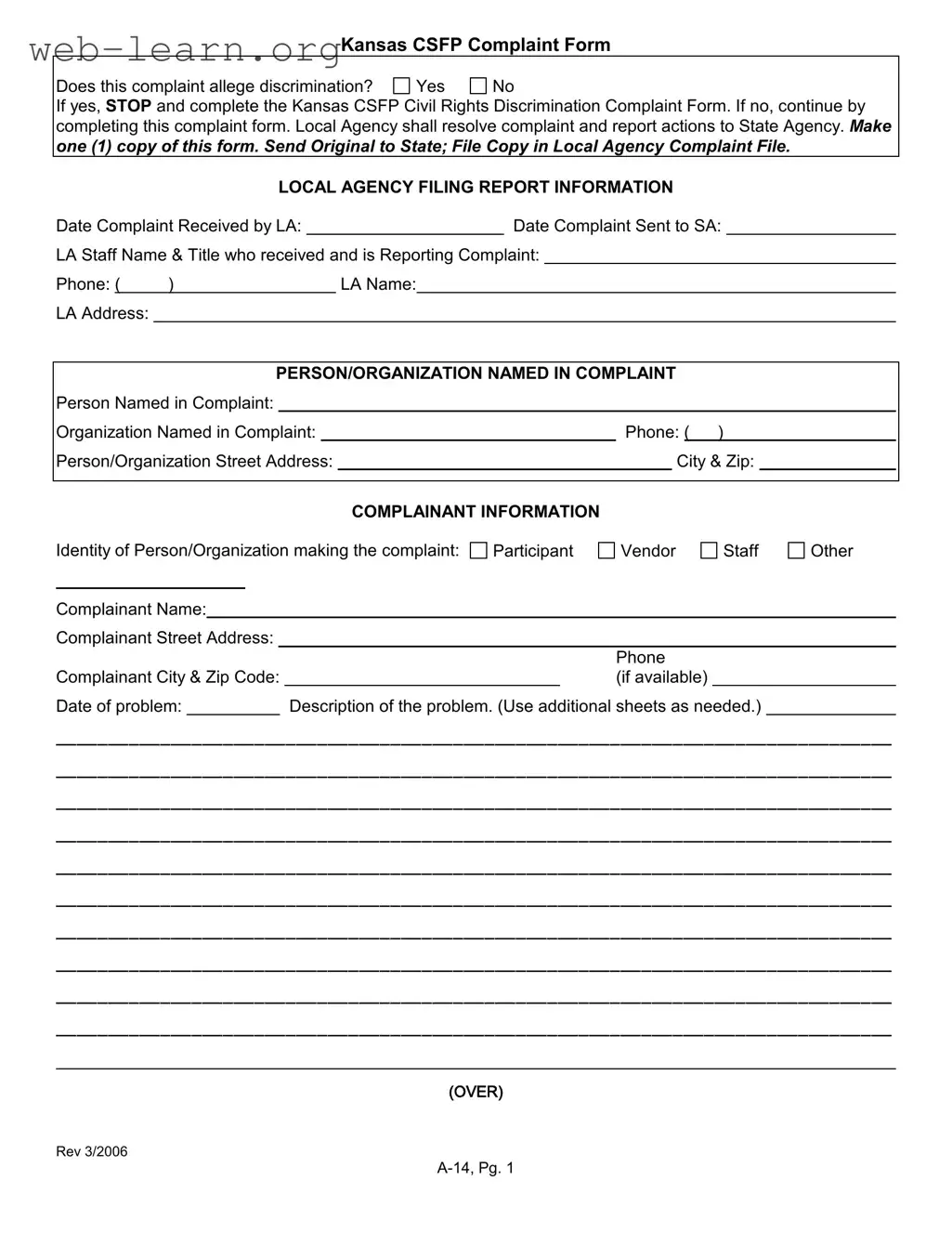
The Kansas CSFP Complaint Form serves as a crucial tool for individuals seeking to address grievances related to the Commodity Supplemental Food Program. This form guides users through a structured process to report complaints, ensuring that their concerns are documented and addressed appropriately. Initially, the form prompts users to determine whether their complaint involves discrimination; if so, they are instructed to complete a different form specifically for civil rights complaints. For complaints that do not allege discrimination, the user continues with the standard complaint form. Essential information is required, including details about the local agency handling the complaint, the person or organization named in the complaint, and the complainant's information. A description of the problem is necessary, allowing individuals to articulate their concerns clearly. The local agency is responsible for resolving the complaint and reporting actions taken to the state agency, ensuring accountability and transparency. Proper record-keeping is emphasized, as complainants must retain a copy of their submission while the original is sent to the state agency for further action.

Kansas CSFP Complaint Form
Does this complaint allege discrimination? |
Yes |
No |
If yes, STOP and complete the Kansas CSFP Civil Rights Discrimination Complaint Form. If no, continue by completing this complaint form. Local Agency shall resolve complaint and report actions to State Agency. Make one (1) copy of this form. Send Original to State; File Copy in Local Agency Complaint File.
|
|
LOCAL AGENCY FILING REPORT INFORMATION |
||||||
Date Complaint Received by LA: |
|
|
|
Date Complaint Sent to SA: |
|
|||
LA Staff Name & Title who received and is Reporting Complaint: |
|
|||||||
Phone: ( |
) |
|
LA Name: |
|||||
|
|
|
|
|
|
|
|
|
LA Address: |
|
|
|
|
|
|
|
|
PERSON/ORGANIZATION NAMED IN COMPLAINT |
|
|||||||
Person Named in Complaint: |
|
|
|
|
|
|
||
Organization Named in Complaint: |
|
Phone: ( ) |
|
|||||
|
|
|
|
|
|
|
|
|
Person/Organization Street Address: |
|
City & Zip: |
|
|||||
|
|
|
|
|
|
|
|
|
|
|
|
|
|
|
COMPLAINANT INFORMATION |
|
|
|
||
Identity of Person/Organization making the complaint: |
Participant |
Vendor |
Staff |
Other |
|||||||
______________ |
|
|
|
|
|
|
|
|
|
||
Complainant Name: |
|
|
|
|
|
|
|
||||
Complainant Street Address: |
|
|
|
|
|
|
|||||
|
|
|
|
|
|
|
|
|
Phone |
|
|
Complainant City & Zip Code: |
|
|
|
(if available) |
|
|
|||||
Date of problem: |
|
|
Description of the problem. (Use additional sheets as needed.) |
|
|||||||
________________________________________________________________________________
________________________________________________________________________________
________________________________________________________________________________
________________________________________________________________________________
________________________________________________________________________________
________________________________________________________________________________
________________________________________________________________________________
________________________________________________________________________________
________________________________________________________________________________
________________________________________________________________________________
(OVER)
Rev 3/2006

LA Action Taken. (Use additional sheets as needed.)
Signature/Title/Date:
|
|
FOR STATE AGENCY USE ONLY. |
|
|
|
|
|
|
|
|
|
|
|
|
Staff Agency Staff Assigned: |
|
Date: |
|
|
|
|
|
|
|
|
|
|
|
|
|
|
|||
|
|
|
|
|
|
|
|
|
|
|
|
|
|
|
|
|
|
|
|
|
|
|
|
|
|
|
|
|
|
|
|
|
|
|
|
|
|
|
|
|
|
|
|
|
|
|
|
|
|
|
|
|
|
|
|
|
|
|
|
|
|
|
|
|
|
|
|
|
|
|
|
|
|
|
|
|
|
|
|
|
|
|
|
|
|
|
|
|
|
|
|
|
|
|
|
|
|
|
|
|
|
|
|
|
Submit original complaint form to State Agency.
Retain a copy of the complaint in agency Complaint File.
Rev 3/2006
| Fact Name | Details |
|---|---|
| Discrimination Allegation | The Kansas CSFP Complaint Form includes a section to determine if the complaint alleges discrimination. If it does, the complainant must complete a different form specifically for civil rights discrimination. |
| Complaint Resolution Process | Local agencies are responsible for resolving complaints and must report their actions to the State Agency. This ensures that all complaints are handled appropriately and tracked for accountability. |
| Filing Requirements | Complainants must make one copy of the completed form. The original should be sent to the State Agency, while a copy is retained in the Local Agency's complaint file for record-keeping. |
| Governing Law | The Kansas CSFP Complaint Form is governed by state laws related to civil rights and program compliance, ensuring that all complaints are addressed in accordance with Kansas regulations. |
Completing the Kansas CSFP Complaint Form is an important step in addressing any concerns you may have. After filling out the form, it will be submitted to the appropriate state agency for review. The local agency will then take action based on the complaint and report back to the state agency. Here’s how to fill out the form step by step.
What is the Kansas CSFP Complaint Form used for?
The Kansas CSFP Complaint Form is designed for individuals or organizations to report issues related to the Commodity Supplemental Food Program (CSFP). This form is specifically for complaints that do not involve discrimination. If a complaint alleges discrimination, a different form, the Kansas CSFP Civil Rights Discrimination Complaint Form, must be completed.
How do I file a complaint using the Kansas CSFP Complaint Form?
To file a complaint, complete the Kansas CSFP Complaint Form by providing detailed information about the issue. Include your name, contact information, and a description of the problem. Once completed, send the original form to the State Agency and keep a copy for your records. The local agency will then investigate and report their actions back to the State Agency.
What information do I need to provide on the form?
You will need to provide several key pieces of information:
What happens after I submit my complaint?
After submission, the local agency is responsible for resolving the complaint. They will investigate the issue and report their findings and actions taken to the State Agency. You will not receive direct updates unless you inquire about the status of your complaint.
Is there a deadline for filing a complaint?
While the form does not specify a strict deadline, it is advisable to file your complaint as soon as possible after the issue arises. Timely reporting helps ensure that the situation can be addressed effectively and may improve the chances of a satisfactory resolution.
Filing a complaint using the Kansas CSFP Complaint Form can be a straightforward process, but many individuals make common mistakes that can hinder their efforts. Understanding these pitfalls is essential for ensuring that the complaint is processed efficiently.
One frequent error is failing to determine if the complaint alleges discrimination. If the answer is "yes," the individual should immediately stop and complete the Kansas CSFP Civil Rights Discrimination Complaint Form. Neglecting this step can lead to delays or the rejection of the complaint.
Another mistake involves not providing complete contact information. It is crucial to include the full name, address, and phone number of both the complainant and the person or organization named in the complaint. Incomplete information can result in difficulties during follow-up communications.
Many people also overlook the importance of clearly describing the problem. The form allows for additional sheets to be attached, yet some individuals provide vague or insufficient details. A well-articulated description is vital for the local agency to understand the issue at hand.
Additionally, failing to specify the date of the problem can weaken a complaint. Accurate dates help establish a timeline and context for the issue being reported. Without this information, the agency may struggle to investigate effectively.
Some individuals forget to sign and date the form. This step is essential as it validates the complaint and confirms the complainant's intention to proceed. Submitting an unsigned form may lead to unnecessary complications.
Another common oversight is not making a copy of the completed form. Keeping a copy for personal records is advisable, as it provides a reference for future communications and follow-ups regarding the complaint.
Individuals often neglect to specify their relationship to the complaint, such as whether they are a participant, vendor, or staff member. This information can provide context for the agency and help them address the complaint more effectively.
Moreover, some people do not follow the instructions for submitting the form. It is essential to send the original to the state agency and retain a copy for the local agency's complaint file. Ignoring these instructions can lead to confusion and delays in processing.
Lastly, failing to keep track of the dates related to the complaint, such as when it was received by the local agency and when it was sent to the state agency, can create challenges in monitoring the complaint's progress. Accurate record-keeping is crucial for accountability and follow-up.
The Kansas CSFP Complaint Form is an essential document for individuals wishing to report grievances related to the Commodity Supplemental Food Program. Along with this form, several other documents may be relevant in the complaint process. Below is a list of these forms, each serving a specific purpose in addressing complaints or providing necessary information.
Each of these documents plays a critical role in the complaint process, ensuring that concerns are addressed thoroughly and appropriately. Understanding these forms can help individuals navigate the complaint process more effectively.
The Kansas CSFP Complaint Form is designed to facilitate the reporting of complaints related to the Commodity Supplemental Food Program. It shares similarities with several other complaint forms used in various contexts. Below is a list of documents that are comparable to the Kansas CSFP Complaint Form, along with explanations of their similarities.
When filling out the Kansas CSFP Complaint Form, it’s important to follow certain guidelines to ensure your complaint is processed smoothly. Here’s a helpful list of things you should and shouldn’t do:
By following these guidelines, you can help ensure that your complaint is addressed in a timely manner. Remember, clear communication is key!
Understanding the Kansas CSFP Complaint Form can be challenging, especially with the various misconceptions surrounding it. Here are five common misunderstandings that may lead to confusion:
This is not true. While there is a specific section for discrimination complaints, the Kansas CSFP Complaint Form can be used for a variety of issues. If the complaint does not involve discrimination, you can still proceed with this form.
Many believe that complaints need to be filed on the same day the issue occurs. However, you have a reasonable timeframe to gather your thoughts and evidence before submitting the complaint.
In reality, the Local Agency is required to report their actions to the State Agency. This ensures that there is a level of accountability and oversight in how complaints are handled.
While it's important to describe the issue, you can use additional sheets if necessary. The form is designed to accommodate your needs, so don’t feel pressured to fit everything into a small space.
This is incorrect. If you realize that you need to amend your complaint after submission, you can typically do so by contacting the Local Agency and providing the updated information.
By clarifying these misconceptions, individuals can navigate the Kansas CSFP Complaint Form with greater confidence and accuracy.
When filling out and using the Kansas CSFP Complaint Form, keep these key takeaways in mind: