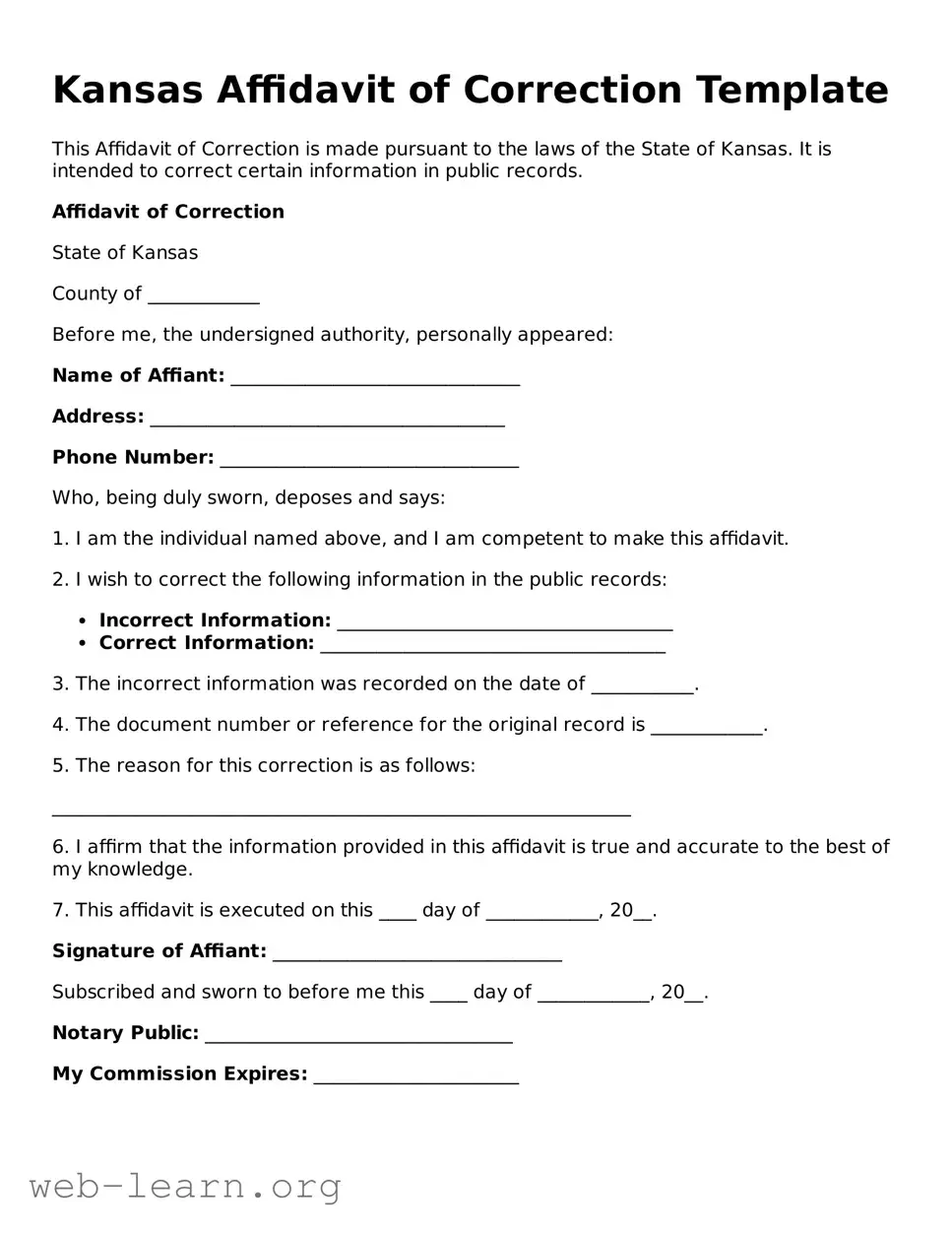
The Kansas Affidavit of Correction form serves as a vital tool for individuals seeking to amend errors in public records. This form is typically used when there are mistakes in documents such as property deeds, marriage certificates, or other official filings. By submitting this affidavit, individuals can clarify inaccuracies that may lead to confusion or legal complications in the future. The process of completing the form requires specific details about the original document, including the nature of the error and the correct information that should replace it. Additionally, the affidavit must be signed and notarized, ensuring its authenticity and legal standing. Understanding how to properly fill out and file this form can help streamline the correction process, making it easier for individuals to maintain accurate records in Kansas.
Kansas Affidavit of Correction Template
This Affidavit of Correction is made pursuant to the laws of the State of Kansas. It is intended to correct certain information in public records.
Affidavit of Correction
State of Kansas
County of ____________
Before me, the undersigned authority, personally appeared:
Name of Affiant: _______________________________
Address: ______________________________________
Phone Number: ________________________________
Who, being duly sworn, deposes and says:
1. I am the individual named above, and I am competent to make this affidavit.
2. I wish to correct the following information in the public records:
3. The incorrect information was recorded on the date of ___________.
4. The document number or reference for the original record is ____________.
5. The reason for this correction is as follows:
______________________________________________________________
6. I affirm that the information provided in this affidavit is true and accurate to the best of my knowledge.
7. This affidavit is executed on this ____ day of ____________, 20__.
Signature of Affiant: _______________________________
Subscribed and sworn to before me this ____ day of ____________, 20__.
Notary Public: _________________________________
My Commission Expires: ______________________
| Fact Name | Description |
|---|---|
| Purpose | The Kansas Affidavit of Correction is used to correct clerical errors in public records. |
| Governing Law | This form is governed by Kansas Statutes Annotated (K.S.A.) 58-2220. |
| Who Can File | Any individual or entity that is a party to the document may file this affidavit. |
| Common Errors | Common errors corrected include misspellings, incorrect dates, or wrong legal descriptions. |
| Filing Location | The affidavit must be filed with the appropriate county register of deeds. |
| Signature Requirement | The affidavit must be signed by the individual correcting the error, or their authorized representative. |
| Notarization | Notarization is required for the affidavit to be considered valid. |
| Effect of Filing | Filing the affidavit serves to officially correct the public record. |
| Fee | A filing fee may be required, which varies by county. |
Filling out the Kansas Affidavit of Correction form is a straightforward process. Once completed, the form needs to be submitted to the appropriate authority for processing. This ensures that the necessary corrections are officially recognized.
What is the Kansas Affidavit of Correction?
The Kansas Affidavit of Correction is a legal document used to correct errors or inaccuracies in public records. This form is typically utilized when there are mistakes in documents such as deeds, mortgages, or other filings that have been recorded with the county clerk or register of deeds.
Who can file an Affidavit of Correction?
Any individual or entity that has a vested interest in the document can file an Affidavit of Correction. This includes property owners, lienholders, or anyone who has a legal interest in the record that contains the error.
What types of errors can be corrected using this form?
The Affidavit of Correction can be used to correct various types of errors, including:
How do I complete the Affidavit of Correction?
To complete the Affidavit of Correction, you will need to provide specific information about the original document, including:
It is important to sign the affidavit in the presence of a notary public to ensure its validity.
Where do I file the Affidavit of Correction?
The completed Affidavit of Correction should be filed with the same office where the original document was recorded. This is usually the county clerk or the register of deeds in the county where the property is located.
Is there a fee associated with filing the Affidavit of Correction?
Yes, there may be a fee for filing the Affidavit of Correction. The fee varies by county, so it is advisable to check with the local office for the exact amount. Payment methods may also differ, so confirm the accepted forms of payment before filing.
Filling out the Kansas Affidavit of Correction form can be a straightforward process, but many individuals encounter common pitfalls that can lead to delays or complications. One significant mistake is failing to provide accurate information. It is essential to double-check all details, including names, dates, and other identifying information. Even a small typo can result in the form being rejected or the correction not being processed.
Another frequent error is neglecting to sign the form. The Affidavit of Correction must be signed by the person making the correction or their authorized representative. Without a signature, the document is incomplete and cannot be accepted. Always ensure that the appropriate person has signed the form before submission.
Many people also overlook the requirement for notarization. In Kansas, the Affidavit of Correction must be notarized to validate the signatures. Failing to have the document notarized can lead to further complications. It is advisable to take the form to a notary public before submitting it to ensure that all legal requirements are met.
Additionally, some individuals may forget to include supporting documentation. The Affidavit of Correction should be accompanied by any necessary evidence that supports the requested correction. This could include copies of original documents or other relevant information. Omitting this documentation can hinder the processing of the correction.
Another common mistake involves not following the specific instructions provided on the form. Each section of the Affidavit of Correction has guidelines that must be adhered to. Ignoring these instructions can lead to incomplete submissions or errors in the information provided.
People may also underestimate the importance of timely submission. There are deadlines associated with filing corrections, and failing to submit the form within the required timeframe can result in the inability to make the correction. It is crucial to be aware of these deadlines and plan accordingly.
Lastly, some individuals may not keep a copy of the submitted form. Retaining a copy of the Affidavit of Correction is vital for personal records and can be useful if any issues arise during processing. This simple step can provide peace of mind and ensure that you have a reference point in case further action is needed.
When filing an Affidavit of Correction in Kansas, several other forms and documents may be necessary to ensure the process is complete and legally sound. Each of these documents serves a specific purpose in the correction process, facilitating clarity and compliance with state regulations.
Each of these documents plays a crucial role in the correction process. Ensuring all necessary forms are accurately completed and submitted can help prevent future disputes and maintain clear records.
The Affidavit of Correction form serves a specific purpose in legal matters, particularly for correcting errors in official documents. It is similar to several other documents that also address corrections, affirmations, or declarations. Here’s a look at nine documents that share similarities with the Affidavit of Correction:
Each of these documents serves a unique function, yet they all share the common goal of clarifying or correcting information in legal contexts. Understanding their purposes can aid in navigating legal processes more effectively.
When filling out the Kansas Affidavit of Correction form, it’s essential to follow specific guidelines to ensure accuracy and compliance. Here are five things to do and five things to avoid:
The Kansas Affidavit of Correction form is often misunderstood. Here are six common misconceptions:
Understanding these misconceptions can help ensure the correct use of the Kansas Affidavit of Correction form.
When filling out and using the Kansas Affidavit of Correction form, keep these key takeaways in mind: