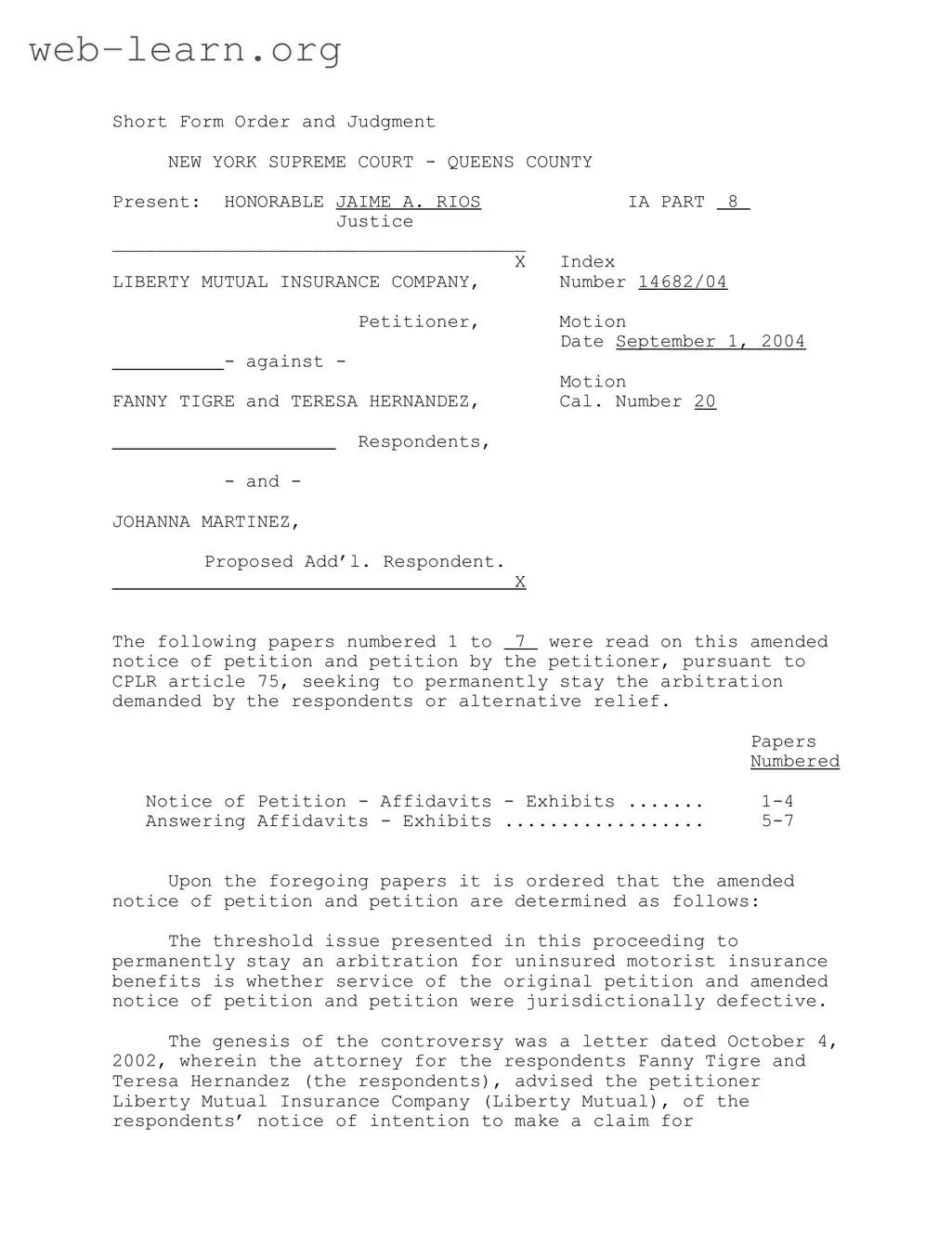
The Judgment New York Supreme Court form, particularly as it pertains to the case involving Liberty Mutual Insurance Company, Fanny Tigre, and Teresa Hernandez, serves as a critical document in the legal process concerning arbitration disputes. This form outlines the procedural steps taken by Liberty Mutual in its attempt to permanently stay the arbitration sought by the respondents for uninsured motorist insurance benefits. The form includes essential details such as the index number, the parties involved, and the motion date, all of which help to establish the context of the case. It also highlights the key issues surrounding the jurisdictional validity of the service of the original and amended petitions, which are central to the court's decision. The court's findings emphasize the importance of adhering to specific service requirements under the CPLR, illustrating that any deviation can render a petition defective. Furthermore, the form encapsulates the arguments presented by both parties, shedding light on the complexities of the case, including the necessity of proper notice and the implications of service methods. Ultimately, this Judgment form not only documents the court's ruling but also serves as a reminder of the procedural rigor required in legal proceedings.
Short Form Order and Judgment
NEW YORK SUPREME COURT - QUEENS COUNTY
Present: HONORABLE JAIME A. RIOS |
IA PART 8 |
||
|
|
Justice |
|
_____________________________________ |
|
||
|
|
X |
Index |
LIBERTY MUTUAL INSURANCE COMPANY, |
Number 14682/04 |
||
|
|
Petitioner, |
Motion |
|
|
|
Date September 1, 2004 |
|
- against - |
|
|
|
|
|
Motion |
FANNY TIGRE and TERESA HERNANDEZ, |
Cal. Number 20 |
||
|
|
Respondents, |
|
|
- and - |
|
|
JOHANNA MARTINEZ, |
|
||
Proposed Add’l. Respondent. |
|
||
|
|
X |
|
The following papers numbered 1 to 7 were read on this amended notice of petition and petition by the petitioner, pursuant to CPLR article 75, seeking to permanently stay the arbitration demanded by the respondents or alternative relief.
|
|
|
Papers |
|
|
|
Numbered |
Notice of |
Petition - Affidavits |
- Exhibits |
|
Answering |
Affidavits - Exhibits |
.................. |
Upon the foregoing papers it is ordered that the amended notice of petition and petition are determined as follows:
The threshold issue presented in this proceeding to permanently stay an arbitration for uninsured motorist insurance benefits is whether service of the original petition and amended notice of petition and petition were jurisdictionally defective.
The genesis of the controversy was a letter dated October 4, 2002, wherein the attorney for the respondents Fanny Tigre and Teresa Hernandez (the respondents), advised the petitioner Liberty Mutual Insurance Company (Liberty Mutual), of the respondents’ notice of intention to make a claim for
uninsured/underinsured benefits based upon an accident that occurred on September 4, 2002.
By demand dated June 1, 2004 and received by Liberty Mutual on June 7, 2004, the respondents, through their attorney, sought arbitration of their claim for such benefits.
Court records disclose that Liberty Mutual filed a notice of petition and petition to permanently stay the arbitration on June 25, 2004; however, the notice of petition bore a return date of June 27, 2004, a period of two days, and there is no affidavit of service in the record. In any event, on June 30, 2004, Liberty Mutual served an amended notice of petition bearing a return date of July 27, 2004.
Annexed to the amended notice of petition is an affidavit of service which initially states that service was made by certified mail, return receipt requested; however, Liberty Mutual has not produced the return receipt or other evidence of such mailing. Moreover, the affidavit of service also states that service was accomplished by regular mail, and the respondents’ attorney has produced an envelope demonstrating that the amended notice was served on him by regular mail.
In its petition Liberty Mutual seeks, inter alia, a permanent stay on the ground that the adverse vehicle had insurance coverage. In the alternative, it seeks leave to join the driver of the offending vehicle, and a temporary stay pending a hearing on the issue of coverage. In addition, Liberty Mutual seeks an order directing the respondents’ compliancy with the insurance policy provisions mandating discovery.
The respondents oppose the petition contending, inter alia, that: (1) the original notice of petition was a nullity as it bore an incorrect return date; (2) the amended notice of petition was a nullity as it was served by regular mail rather than in a manner required by CPLR 7503; (3) Liberty Mutual failed to demonstrate that the offending vehicle was insured; and, (4) Liberty Mutual waived its right to discovery.
Pursuant to CPLR 304, a special proceeding is commenced by the delivery of a notice of petition and petition to the clerk of the court in the county in which the special proceeding is brought, and the payment of the filing fee (see Matter of One Beacon Ins. Co./CGU Ins. Co. v Daly, 7 AD3d 717 [2004]; Matter of Allstate Indem. Co. v Martinez, 4 AD3d 422 [2004]; CPLR 304).
With respect to service, CPLR 7503[c] provides that notice of an application to stay arbitration shall be served in the same
manner as a summons or by registered or certified mail, return receipt requested (see CPLR 7503[c]). The service requirements of CPLR 7503 have been strictly construed, and it has been held repeatedly that service by ordinary mail renders the application jurisdictionally defective (see Matter of Yak Taxi v Teke, 41 NY2d 1020 [1977]; Matter of N.Y. Cent. Mut. Fire Ins. Co. v Czumaj, 9 AD3d 833 [2004]; Matter of Cartier v County of Nassau, 281 AD2d 477 [2001]; Matter of Progressive Ins. Co., 235 AD2d 704 [1997]).
Although CPLR 7503[c] permits service of an application to stay arbitration upon a claimant’s attorney if the attorney’ s name appears on the demand for arbitration or the notice of intention to arbitrate, at all times service must be made in the same manner as a summons or by registered or certified mail, return receipt requested (see Matter of Yak Taxi, Inc. v Teke, supra; CPLR 7503[c]).
Here, with respect to the original notice of petition and petition, Liberty failed to demonstrate proper service. Moreover, it was jurisdictionally defective as it failed to give adequate notice of the return date to the respondents (see Matter of Cartier v County of Nassau, supra; Matter of Hawkins v McCall, 278 AD2d 638 [2000], lv denied, 96 NY2d 713 [2001]; CPLR 403[b], [c]).
With respect to the amended notice of petition, Liberty failed to produce any proof of service upon the respondents in accordance with CPLR 7503[c], and the respondents demonstrated that the amended notice of petition was served on their attorney only by regular mail.
As a result, the amended notice of petition and petition are also jurisdictionally defective (see Matter of Yak Taxi v Teke, supra; Matter of N.Y. Cent. Mut. Fire Ins. Co. v Czumaj, supra; Matter of Cartier v County of Nassau, supra; Matter of Progressive Ins. Co., supra).
Accordingly, it is ORDERED and ADJUDGED that the proceeding is dismissed.
Dated: December 10, 2004 |
______________________________ |
|
J.S.C. |
| Fact Name | Fact Description |
|---|---|
| Governing Law | The procedure for this case is governed by the Civil Practice Law and Rules (CPLR) of New York. |
| Case Title | The case is titled "Liberty Mutual Insurance Company v. Fanny Tigre and Teresa Hernandez." |
| Index Number | The index number for this case is 14682/04. |
| Motion Date | The motion date was set for September 1, 2004. |
| Jurisdictional Issue | The court examined whether the service of the original petition was jurisdictionally defective. |
| Service Method | CPLR 7503(c) requires service of the application to stay arbitration to be done by certified mail or in the same manner as a summons. |
| Original Petition | The original notice of petition was deemed a nullity due to an incorrect return date. |
| Amended Notice of Petition | The amended notice was served by regular mail, which does not meet the service requirements of CPLR 7503. |
| Outcome | The court dismissed the proceeding due to jurisdictional defects in the service of the petitions. |
| Date of Judgment | The judgment was issued on December 10, 2004. |
Filling out the Judgment form for the New York Supreme Court requires careful attention to detail. Once completed, the form will be submitted to the court for processing. Follow these steps to ensure accuracy.
After completing the form, make sure to keep a copy for your records. Submit the original form to the court along with any necessary supporting documents and the filing fee. You will receive a stamped copy back from the court, which serves as proof of filing.
What is the purpose of the Judgment New York Supreme Court form?
The Judgment New York Supreme Court form is used to document the court's decision regarding a legal dispute. In this case, it addresses a petition from Liberty Mutual Insurance Company seeking to permanently stay arbitration related to uninsured motorist benefits.
Who are the parties involved in this case?
The parties involved include Liberty Mutual Insurance Company as the petitioner, and Fanny Tigre and Teresa Hernandez as the respondents. Additionally, Johanna Martinez is mentioned as a proposed additional respondent.
What was the main issue in this proceeding?
The main issue was whether the service of the original and amended petitions was jurisdictionally defective. This defect could affect the court's ability to consider Liberty Mutual's request to stay arbitration.
What are the requirements for serving a notice of petition in this context?
According to CPLR 7503(c), a notice of petition must be served in the same manner as a summons or by registered or certified mail with a return receipt requested. This ensures that the parties are properly notified of the legal proceedings.
Why was the original notice of petition considered a nullity?
The original notice of petition was deemed a nullity because it had an incorrect return date and lacked proof of proper service. These factors made it ineffective in notifying the respondents.
What was wrong with the amended notice of petition?
The amended notice of petition was served by regular mail instead of the required certified or registered mail. This failure to comply with service requirements rendered it jurisdictionally defective as well.
What did Liberty Mutual seek in its petition?
Liberty Mutual sought a permanent stay of arbitration, a temporary stay pending a hearing on coverage, and an order for the respondents to comply with the insurance policy provisions regarding discovery.
What was the court's ruling in this case?
The court ruled to dismiss the proceeding, stating that both the original and amended notices of petition were jurisdictionally defective due to improper service.
What does it mean for a case to be jurisdictionally defective?
A case is jurisdictionally defective when the court lacks the authority to hear it due to improper procedures, such as incorrect service of documents. This can result in the dismissal of the case.
How can parties ensure proper service in future cases?
To ensure proper service, parties should follow the specific requirements outlined in the CPLR. This includes using certified or registered mail with return receipts and verifying all details, such as return dates, to avoid jurisdictional defects.
Filling out the Judgment New York Supreme Court form can be a daunting task, and many people make mistakes that can jeopardize their case. One common error is failing to provide the correct return date on the notice of petition. This date is crucial because it informs all parties involved when they need to respond. If the return date is incorrect, the notice may be considered a nullity, meaning it has no legal effect. This mistake can lead to delays and complications in the proceedings.
Another frequent mistake is improper service of the notice of petition. According to the law, this document must be served in a specific manner, either like a summons or by certified mail with a return receipt requested. Many people mistakenly opt for regular mail, thinking it suffices. However, using ordinary mail does not meet the legal requirements and can render the application jurisdictionally defective. This means the court may dismiss the case before it even gets a chance to be heard.
People often overlook the importance of including proof of service in their filings. Without proper documentation showing that the notice was served correctly, the court may question the validity of the entire process. This oversight can lead to significant setbacks, as the court relies on this proof to establish that all parties have been adequately notified.
Additionally, some individuals fail to demonstrate the necessary grounds for their petitions. For instance, if someone is seeking to stay arbitration based on the claim that the other party had insurance coverage, they must provide clear evidence supporting this assertion. If this evidence is lacking, the court may dismiss the petition outright, leaving the petitioner without the relief they sought.
Another common pitfall is neglecting to comply with the insurance policy provisions that mandate discovery. If a party does not follow these rules, they may inadvertently waive their right to obtain critical information that could support their case. This can severely limit their ability to argue their position effectively.
Finally, many individuals fail to understand the significance of jurisdictional defects. Even minor errors in the filing process can lead to the dismissal of a case. Courts are often strict about procedural rules, and failing to adhere to them can be detrimental. It is essential to pay close attention to detail when completing the Judgment New York Supreme Court form to avoid these common mistakes.
When dealing with a Judgment from the New York Supreme Court, several other forms and documents may be relevant to the process. These documents can provide additional context or necessary information to support your case. Below are some commonly used forms that accompany the Judgment New York Supreme Court form.
Understanding these accompanying documents can help clarify the process and ensure that all necessary steps are taken. Proper documentation is essential for the court to make informed decisions regarding the case.
When filling out the Judgment New York Supreme Court form, there are several important dos and don'ts to keep in mind. Here’s a straightforward list to guide you:
There are several misconceptions surrounding the Judgment New York Supreme Court form that can lead to confusion. Understanding these misconceptions can help clarify the process and requirements involved. Here are seven common misunderstandings:
Clarifying these misconceptions can help individuals navigate the complexities of the New York Supreme Court process more effectively.
Here are some key takeaways about filling out and using the Judgment New York Supreme Court form: