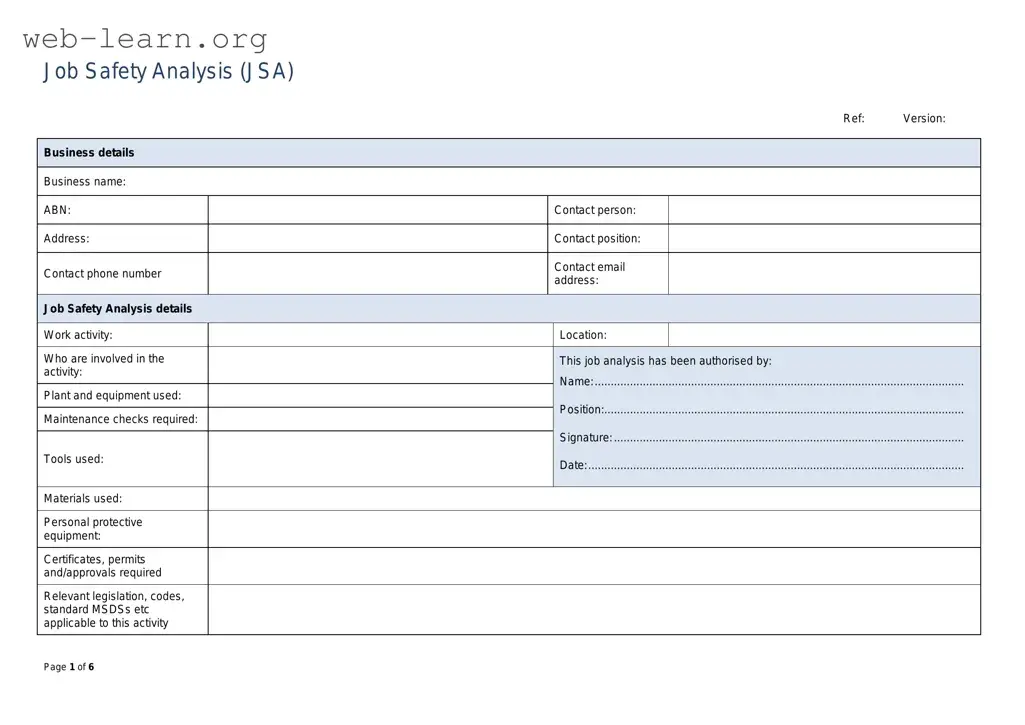
The Job Safety Analysis (JSA) form serves as a critical tool in ensuring workplace safety by systematically identifying potential hazards associated with specific job activities. This comprehensive document begins with essential business details, including the name, contact information, and address of the organization, ensuring clear communication channels. It outlines the work activity and location, identifying all personnel involved in the task. The form requires authorization from a designated individual, ensuring accountability. Key components also include the identification of plant and equipment, tools, materials, and personal protective equipment necessary for the job. Furthermore, the JSA incorporates a risk assessment section that utilizes a rating table to evaluate the likelihood and consequences of potential hazards, categorizing them into various risk levels. This assessment not only highlights the severity of risks but also guides the implementation of appropriate control measures, ranging from elimination and substitution to engineering controls and administrative policies. The inclusion of a hierarchy of controls emphasizes the importance of addressing risks effectively, while the documentation of responsible individuals ensures that accountability is maintained throughout the process. Overall, the JSA form is an indispensable resource for promoting safety and compliance in the workplace.

Job Safety Analysis (JSA)
|
|
|
|
Ref: |
Version: |
|
|
|
|
|
|
Business details |
|
|
|
|
|
|
|
|
|
|
|
Business name: |
|
|
|
|
|
|
|
|
|
|
|
ABN: |
|
|
Contact person: |
|
|
|
|
|
|
|
|
Address: |
|
|
Contact position: |
|
|
|
|
|
|
|
|
Contact phone number |
|
|
Contact email |
|
|
|
|
address: |
|
|
|
|
|
|
|
|
|
|
|
|
|
|
|
Job Safety Analysis details |
|
|
|
|
|
|
|
|
|
|
|
Work activity: |
|
|
Location: |
|
|
|
|
|
|
|
|
Who are involved in the |
|
|
This job analysis has been authorised by: |
|
|
activity: |
|
|
Name: |
||
|
|
|
|||
Plant and equipment used: |
|
|
|||
|
|
|
|
|
|
|
|
|
Position: |
|
|
Maintenance checks required: |
|
|
|||
|
|
|
|
|
|
|
|
|
Signature: |
|
|
Tools used: |
|
|
|||
|
|
Date: |
|||
|
|
|
|||
|
|
|
|
|
|
Materials used: |
|
|
|
|
|
|
|
|
|
|
|
Personal protective |
|
|
|
|
|
equipment: |
|
|
|
|
|
|
|
|
|
|
|
Certificates, permits |
|
|
|
|
|
and/approvals required |
|
|
|
|
|
|
|
|
|
|
|
Relevant legislation, codes, |
|
|
|
|
|
standard MSDSs etc |
|
|
|
|
|
applicable to this activity |
|
|
|
|
|
|
|
|
|
|
|
Page 1 of 6
Risk assessment
**Use the risk rating table to assess the level of risk for each job step.
|
|
|
|
|
|
|
|
|
Likelihood |
|
|
|
|
|
|
|
|
|
1 |
|
2 |
|
3 |
|
4 |
|
5 |
|
|||||
|
Consequence |
|
Rare |
|
Unlikely |
|
Moderate |
|
Likely |
|
Almost Certain |
|||||
|
|
The event may occur in |
|
The event could occur |
|
The event should occur |
|
The event will probably occur |
|
The event is expected to |
||||||
|
|
|
exceptional circumstances |
|
sometimes |
|
sometimes |
|
in most circumstances |
|
occur in most circumstances |
|||||
1 |
Insignificant |
|
LOW |
|
|
LOW |
|
|
LOW |
|
|
LOW |
|
|
MODERATE |
|
|
No injuries or health |
|
|
|
|
|
|
|
|
|
|
|||||
|
|
|
|
|
|
|
|
|
|
|
|
|
|
|
|
|
|
|
|
|
|
|
|
|
|
|
|
|
|
|
|
|
|
|
issues |
|
|
|
|
|
|
|
|
|
|
|
|
|
|
|
2 |
Minor |
|
|
|
|
|
|
|
|
|
|
|
|
|
|
|
|
First aid treatment |
|
LOW |
|
|
LOW |
|
|
MODERATE |
|
|
MODERATE |
|
|
HIGH |
|
|
|
|
|
|
|
|
|
|
|
|
|
|
|
|
|
|
|
|
|
|
|
|
|
|
|
|
|
|
|
|
|
|
|
|
|
|
|
|
|
|
|
|
|
|
|
|
|
|
|
|
3 |
Moderate |
|
|
|
|
|
|
|
|
|
|
|
|
|
|
|
|
Medical treatment, |
|
LOW |
|
|
MODERATE |
|
|
HIGH |
|
|
HIGH |
|
|
CRITICAL |
|
|
|
|
|
|
|
|
|
|
|
|
|
|
|
|
|
|
|
|
|
|
|
|
|
|
|
|
|
|
|
|
|
|
|
|
potential LTI |
|
|
|
|
|
|
|
|
|
|
|
|
|
|
|
4 |
Major |
|
|
|
|
|
|
|
|
|
|
|
|
|
|
|
|
Permanent disability or |
|
LOW |
|
|
MODERATE |
|
|
HIGH |
|
|
CRITICAL |
|
|
CATASTROPHIC |
|
|
|
|
|
|
|
|
|
|
|
|
|
|
|
|
|
|
|
|
|
|
|
|
|
|
|
|
|
|
|
|
|
|
|
|
disease |
|
|
|
|
|
|
|
|
|
|
|
|
|
|
|
5 |
Extreme |
|
|
|
|
|
|
|
|
|
|
|
|
|
|
|
|
Death |
|
MODERATE |
|
|
HIGH |
|
|
CRITICAL |
|
|
CATASTROPHIC |
|
|
CATASTROPHIC |
|
|
|
|
|
|
|
|
|
|
|
|
|
|
|
|
|
|
|
|
|
|
|
|
|
|
|
|
|
|
|
|
|
|
|
|
|
|
|
|
|
|
|
|
|
|
|
|
|
|
|
|
Risk rating:
Low risk:Acceptable risk and no further action required as long as risk has been minimised as possible. Risk needs to be reviewed periodically.
Moderate risk:Tolerable with further action required to minimise risk. Risk needs to be reviewed periodically.
High risk:Tolerable with further action required to minimise risk. Risk needs to be reviewed continuously.
Critical risk:Unacceptable risk and further action required immediately to minimise risk.
Catastrophic:Unacceptable risk and urgent action required to minimise risk.
Page 2 of 6
Risk controls
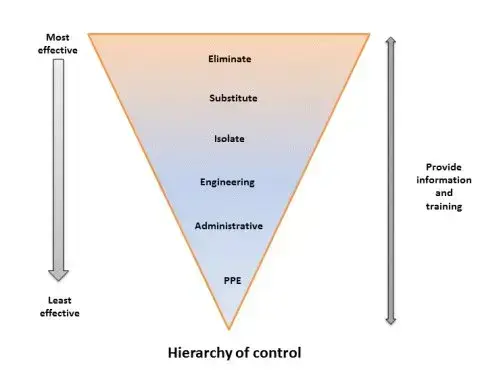
The hierarchy of control can be used as an effective tool to deal with health and safety issues at work. Use the type of control suggested as measures to deal with the hazard. Aim to use control measures from as high on the hierarchy of control list as possible. If that is not possible the next option down the list or a combination of the measures should be implemented. The least effective control measure is the use of personal protective equipment (PPE) and it should be used as a last resort or a support to other control measures. Information and training should be integrated with all levels of control to explain how controls work.
1.Eliminate – if it is possible, the hazard should be removed completely. For example, get rid of dangerous machines.
2.Substitute – replace something that produces the hazard with something that does not produce a hazard. For example, replacing solvent based paint with water based paint. Risk assessment on the substitution must be conducted to ensure that it will not pose another hazard.
3.Engineering control – isolate a person from the hazard by creating physical barrier or making changes to process, equipment or plant to reduce the hazard. For example, install ventilation systems.
4.Administrative control – change the way a person works by establishing policies and procedures to minimise the risks. For example, job scheduling to limit exposure and posting hazard signs.
5.Use personal protective equipment (PPE) – protect a person from the hazard by wearing PPE. For example, wearing gloves, safety glasses, hard hats and
Page 3 of 6

JSA – Action steps
|
Step No |
|
|
Job step details |
|
|
Potential hazards |
|
|
|
|
|
|
|
|||
|
|
|
|
|
|
|
|
|
|
|
|
|
|
|
|
|
|
|
|
|
|
|
|
|
|
|
Risk rating**
How to control risks***
Name of persons responsible for work
Review number: |
Version: |
Page 4 of 6

|
Step No |
|
|
Job step details |
|
|
Potential hazards |
|
|
|
|
|
|
|
|||
|
|
|
|
|
|
|
|
|
|
|
|
|
|
|
|
|
|
|
|
|
|
|
|
|
|
|
|
|
|
|
|
|
|
|
|
Risk rating**
How to control risks***
Name of persons responsible for work
Review number: |
Version: |
Page 5 of 6

This job safety analysis has been developed through consultation with our employees and has been read, understood and signed by all employees undertaking the works:
Print Names: |
Signatures: |
Dates: |
|
|
|
|
|
|
|
|
|
|
|
|
|
|
|
|
|
|
|
|
|
|
|
|
|
|
|
|
|
|
|
|
|
|
|
|
Review No |
01 |
02 |
03 |
04 |
05 |
06 |
07 |
08 |
09 |
|
|
|
|
|
|
|
|
|
|
Initial: |
|
|
|
|
|
|
|
|
|
|
|
|
|
|
|
|
|
|
|
Date: |
|
|
|
|
|
|
|
|
|
|
|
|
|
|
|
|
|
|
|
A10592057 |
|
|
|
|
|
|
|
|
|
Page 6 of 6
| Fact Name | Description |
|---|---|
| Purpose | The Job Safety Analysis (JSA) form is designed to identify and assess risks associated with specific job tasks, ensuring safety measures are in place. |
| Business Information | The JSA form requires essential business details such as name, ABN, contact person, and contact information to ensure accountability and communication. |
| Risk Assessment | It includes a risk assessment section that categorizes risks based on likelihood and consequence, helping to determine appropriate safety measures. |
| Hierarchy of Control | The form outlines a hierarchy of control measures, from elimination of hazards to the use of personal protective equipment, guiding users on effective risk management. |
| Governing Laws | In the U.S., the JSA form is often governed by OSHA regulations and state-specific safety laws, which vary by location. |
Completing the Job Safety Analysis (JSA) form is essential for ensuring safety in the workplace. The following steps will guide you through the process of filling out the form accurately and effectively.
What is a Job Safety Analysis (JSA)?
A Job Safety Analysis (JSA) is a process that helps identify potential hazards associated with specific job tasks. It aims to improve safety by assessing risks and implementing control measures. By analyzing each step of a job, the JSA promotes safer work practices and helps prevent accidents and injuries.
Why is it important to complete a JSA?
Completing a JSA is crucial for ensuring the safety of employees and compliance with workplace regulations. It allows teams to identify risks before work begins, ensuring that appropriate measures are in place. This proactive approach not only protects workers but also helps organizations avoid costly accidents and legal issues.
Who should be involved in the JSA process?
Involvement in the JSA process should include all individuals who will be performing the work, as well as supervisors and safety personnel. Their collective input ensures that all potential hazards are identified and that the control measures proposed are practical and effective.
How do you assess risks in a JSA?
Risks are assessed using a risk rating table that evaluates the likelihood and consequence of each identified hazard. Each job step is rated from 1 (insignificant) to 5 (extreme) based on its potential impact. This systematic approach helps prioritize which risks need immediate attention and which can be managed over time.
What are the different risk levels indicated in a JSA?
Risk levels in a JSA are categorized as follows:
What are the control measures outlined in a JSA?
Control measures are organized in a hierarchy of effectiveness:
How often should a JSA be reviewed?
A JSA should be reviewed regularly, especially when there are changes in the work process, equipment, or personnel. Regular reviews help ensure that the analysis remains relevant and effective in addressing any new hazards that may arise.
What documentation is required for a JSA?
A JSA typically requires documentation that includes details about the job activity, location, personnel involved, equipment used, and identified hazards. Additionally, signatures from authorized personnel are needed to confirm that the JSA has been reviewed and approved.
Filling out the Job Safety Analysis (JSA) form is a crucial step in ensuring workplace safety. However, many individuals make mistakes that can compromise the effectiveness of the analysis. Understanding these common pitfalls can help you complete the form accurately and comprehensively.
One frequent mistake is incomplete contact information. It is essential to provide full details such as the business name, contact person, and their position. Omitting any of this information can lead to confusion and hinder communication when safety issues arise.
Another common error is failing to clearly define the work activity and location. This information sets the context for the entire analysis. Without it, assessing risks specific to the job becomes challenging. Ensure that you describe the activity in detail and specify where it will take place.
Many people also overlook the importance of identifying all individuals involved in the activity. Not listing everyone who will be present can lead to gaps in safety measures and leave some workers unprotected. A thorough identification process ensures that everyone is accounted for in the risk assessment.
Another mistake is not using the risk rating table correctly. Each job step must be evaluated for both likelihood and consequence to determine the appropriate risk rating. Misjudging these factors can result in either underestimating or overestimating the risks associated with the job.
Additionally, individuals often fail to provide adequate risk controls. Simply listing hazards without suggesting control measures does not fulfill the purpose of the JSA. It is crucial to detail how each identified risk will be mitigated, using the hierarchy of control as a guide.
Some people neglect to include maintenance checks required for tools and equipment. This oversight can lead to unsafe working conditions. Regular maintenance is vital for ensuring that all equipment is functioning correctly and safely.
Another common error is not specifying the personal protective equipment (PPE) needed for the job. Without this information, workers may not be adequately protected against potential hazards. Clearly indicating what PPE is required helps ensure that everyone is prepared and safe.
Furthermore, failing to reference relevant legislation and standards can diminish the JSA's effectiveness. Compliance with laws and regulations is essential for workplace safety. Always include applicable guidelines to reinforce the analysis.
Finally, many individuals forget to sign and date the form. This step is crucial as it signifies that the JSA has been reviewed and authorized. Without a signature, the document lacks accountability, which can be problematic in case of an incident.
By avoiding these mistakes, you can ensure that your Job Safety Analysis is thorough and effective, ultimately contributing to a safer work environment.
The Job Safety Analysis (JSA) form is a crucial tool for identifying and mitigating risks associated with specific work activities. However, it often works in tandem with several other important documents that help ensure safety and compliance in the workplace. Below is a list of other forms and documents commonly used alongside the JSA form, each serving a unique purpose in the overall safety framework.
These forms and documents complement the JSA by providing a comprehensive approach to workplace safety. Together, they create a structured environment where risks are identified, assessed, and managed effectively. By utilizing these tools, organizations can foster a culture of safety and ensure the well-being of their employees.
When filling out the JSA form, it’s important to follow certain guidelines to ensure accuracy and compliance. Here’s a list of things you should and shouldn’t do:
This is not true. Any business, regardless of size, can benefit from a Job Safety Analysis. It helps identify hazards and implement safety measures in any work environment.
In reality, a JSA should be reviewed and updated regularly. Work conditions and processes can change, making it essential to keep the analysis current.
While it may seem complex, the JSA form is designed to be straightforward. With proper training, employees can easily understand and complete it.
In fact, all employees involved in the work activity should participate. Their insights are valuable for identifying hazards and suggesting controls.
PPE is important, but it should be the last line of defense. The JSA emphasizes the need for higher-level controls, such as elimination and substitution, before relying on PPE.
Even low-risk tasks can have hazards. Conducting a JSA helps ensure that all potential risks are assessed and managed, regardless of perceived risk level.
While physical hazards are a significant concern, the JSA also addresses ergonomic, chemical, and psychological hazards. A comprehensive approach is necessary for workplace safety.
Ongoing training is crucial. Employees must understand how to implement the findings of the JSA and stay informed about any changes in procedures or equipment.
Filling out and using the Job Safety Analysis (JSA) form is essential for ensuring workplace safety. Here are key takeaways to keep in mind:
Following these takeaways can help create a safer work environment and promote a culture of safety among all employees.