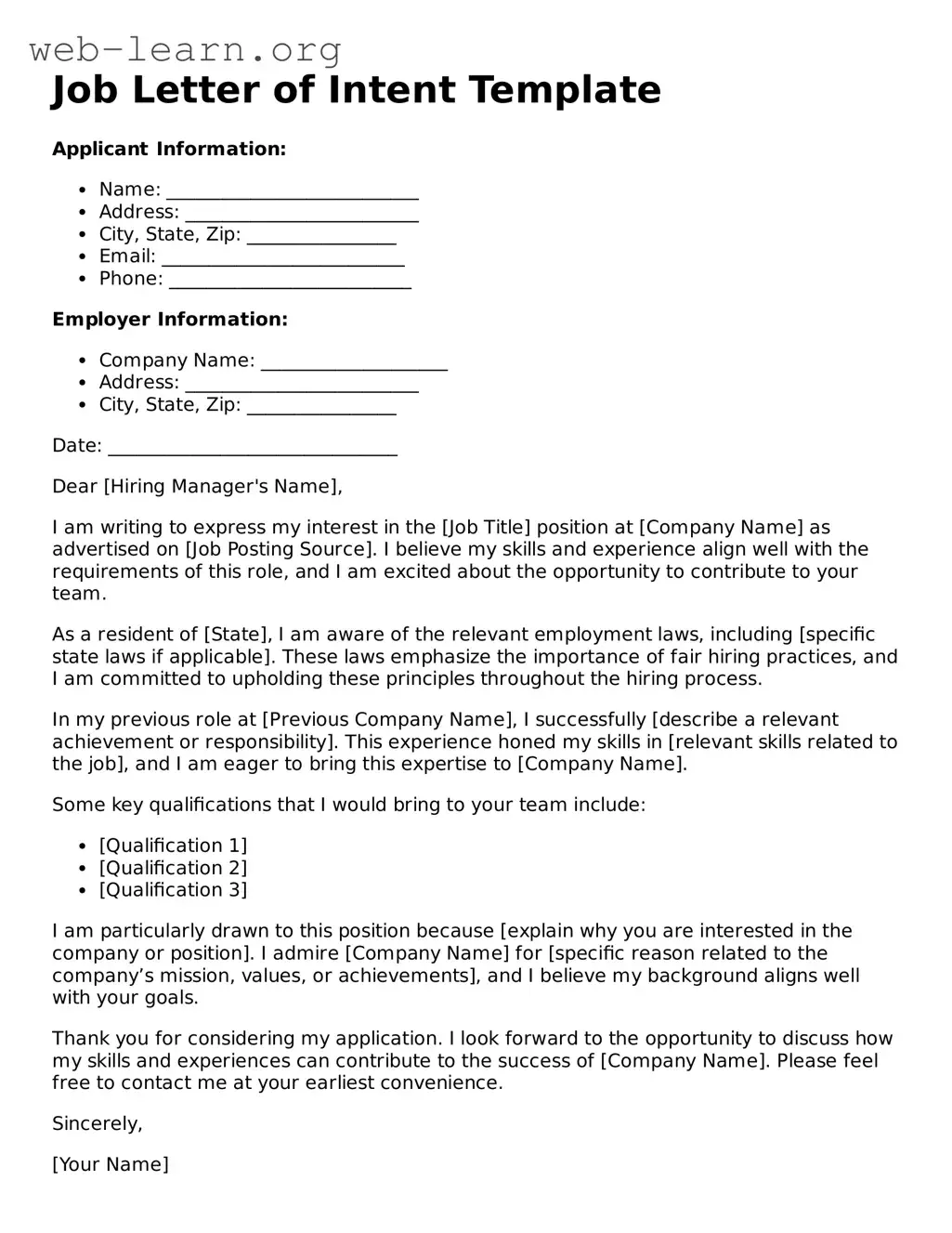
The Job Letter of Intent form serves as a critical tool for job seekers aiming to express their interest in a specific position within an organization. This form typically includes essential components such as the applicant's contact information, a brief introduction highlighting their qualifications, and a clear statement of intent regarding the job being sought. Additionally, it allows candidates to articulate their understanding of the company’s mission and how their skills align with its goals. By providing a structured way to convey enthusiasm and professionalism, the form not only helps applicants stand out but also aids employers in assessing potential fits for their team. Furthermore, it often includes a section for outlining relevant experiences and achievements, allowing candidates to succinctly showcase their value. Overall, the Job Letter of Intent form is an integral part of the application process, serving as both a formal declaration of interest and a marketing tool for job seekers.
Job Letter of Intent Template
Applicant Information:
Employer Information:
Date: _______________________________
Dear [Hiring Manager's Name],
I am writing to express my interest in the [Job Title] position at [Company Name] as advertised on [Job Posting Source]. I believe my skills and experience align well with the requirements of this role, and I am excited about the opportunity to contribute to your team.
As a resident of [State], I am aware of the relevant employment laws, including [specific state laws if applicable]. These laws emphasize the importance of fair hiring practices, and I am committed to upholding these principles throughout the hiring process.
In my previous role at [Previous Company Name], I successfully [describe a relevant achievement or responsibility]. This experience honed my skills in [relevant skills related to the job], and I am eager to bring this expertise to [Company Name].
Some key qualifications that I would bring to your team include:
I am particularly drawn to this position because [explain why you are interested in the company or position]. I admire [Company Name] for [specific reason related to the company’s mission, values, or achievements], and I believe my background aligns well with your goals.
Thank you for considering my application. I look forward to the opportunity to discuss how my skills and experiences can contribute to the success of [Company Name]. Please feel free to contact me at your earliest convenience.
Sincerely,
[Your Name]
| Fact Name | Details |
|---|---|
| Purpose | A Job Letter of Intent expresses an individual's interest in a specific job position. |
| Format | The letter typically follows a formal business letter format, including a header, salutation, body, and closing. |
| Content | It should include the applicant's qualifications, relevant experience, and reasons for interest in the position. |
| Length | A Job Letter of Intent is usually one page long, concise yet informative. |
| Submission | Applicants may submit the letter via email or as part of a job application package. |
| State-Specific Forms | Some states may have specific guidelines for job letters; always check local employment laws. |
| Governing Laws | For example, California's Fair Employment and Housing Act governs employment-related communications. |
| Follow-Up | After submission, it’s a good idea to follow up with the employer to express continued interest. |
Once you have the Job Letter of Intent form in front of you, it’s time to fill it out carefully. Completing this form accurately is important as it sets the stage for your potential employment. Follow these steps to ensure you provide all necessary information clearly and concisely.
After completing the form, you will be ready to submit it along with any other required documents. Make sure to follow the submission guidelines provided by the employer to ensure your application is considered.
What is a Job Letter of Intent?
A Job Letter of Intent is a formal document that expresses your interest in a specific job position. It serves as an introduction to your qualifications and can highlight your enthusiasm for the role and the organization. This letter often accompanies a resume and provides an opportunity to convey your personality and motivations in a way that a resume cannot.
When should I use a Job Letter of Intent?
You should consider using a Job Letter of Intent when applying for a job that is not explicitly advertised or when you want to express your interest in a position that may become available in the future. It can also be beneficial when you are networking or reaching out to a company you admire, even if they do not have current openings.
What should I include in my Job Letter of Intent?
Your Job Letter of Intent should include several key components:
How long should a Job Letter of Intent be?
A Job Letter of Intent should typically be one page long. It should be concise yet comprehensive enough to convey your key points. Aim for three to four paragraphs that clearly communicate your interest and qualifications without overwhelming the reader.
Can I customize my Job Letter of Intent for different positions?
Absolutely. Customizing your Job Letter of Intent for each position is highly recommended. Tailoring the letter allows you to address specific qualifications and experiences that align with the job description. It also demonstrates your genuine interest in the position and the company, which can make a positive impression on potential employers.
Filling out a Job Letter of Intent form can be a crucial step in the job application process. However, many applicants make common mistakes that can hinder their chances of success. Understanding these pitfalls can help individuals present themselves more effectively.
One frequent error is failing to tailor the letter to the specific job or organization. Generic letters lack impact. Each employer seeks candidates who demonstrate a clear understanding of their mission and values. A personalized letter shows genuine interest and effort, which can make a significant difference in the selection process.
Another mistake is neglecting to proofread the document. Spelling and grammatical errors can create a negative impression. They suggest a lack of attention to detail, which is often a critical quality employers look for. Taking the time to review the letter can help ensure clarity and professionalism.
Additionally, many applicants focus too much on their qualifications and experiences while neglecting to express their enthusiasm for the position. A Job Letter of Intent should not only outline skills but also convey passion and motivation. Employers appreciate candidates who are excited about the opportunity and can articulate why they want to join the team.
Some individuals also overlook the importance of a strong opening and closing. The first few sentences should grab the reader’s attention, while the conclusion should reinforce interest and prompt a follow-up. A compelling start and finish can leave a lasting impression, setting the candidate apart from others.
Finally, failing to follow the application instructions can be detrimental. Each job posting may have specific requirements regarding format, length, or content. Ignoring these guidelines can lead to immediate disqualification. Attention to detail in following instructions demonstrates professionalism and respect for the employer's process.
When applying for a job or expressing interest in a position, a Job Letter of Intent is often accompanied by various other documents. Each of these forms serves a specific purpose, enhancing your application and providing potential employers with a comprehensive view of your qualifications and intentions. Below is a list of commonly used documents alongside the Job Letter of Intent.
Each of these documents plays a vital role in the job application process. They work together to present a well-rounded picture of your qualifications, experiences, and aspirations. By carefully preparing and including these materials, you enhance your chances of making a positive impression on potential employers.
When filling out the Job Letter of Intent form, it’s important to follow certain guidelines to ensure your submission is effective and professional. Here are seven things to keep in mind:
Following these tips can help present a polished and professional image to potential employers.
When it comes to the Job Letter of Intent form, several misconceptions can lead to confusion and missteps. Understanding these misunderstandings can help applicants present themselves more effectively. Here are four common misconceptions:
By dispelling these misconceptions, applicants can approach the Job Letter of Intent with clarity and confidence, ultimately improving their chances of success in the job market.
Here are some key takeaways regarding the Job Letter of Intent form: