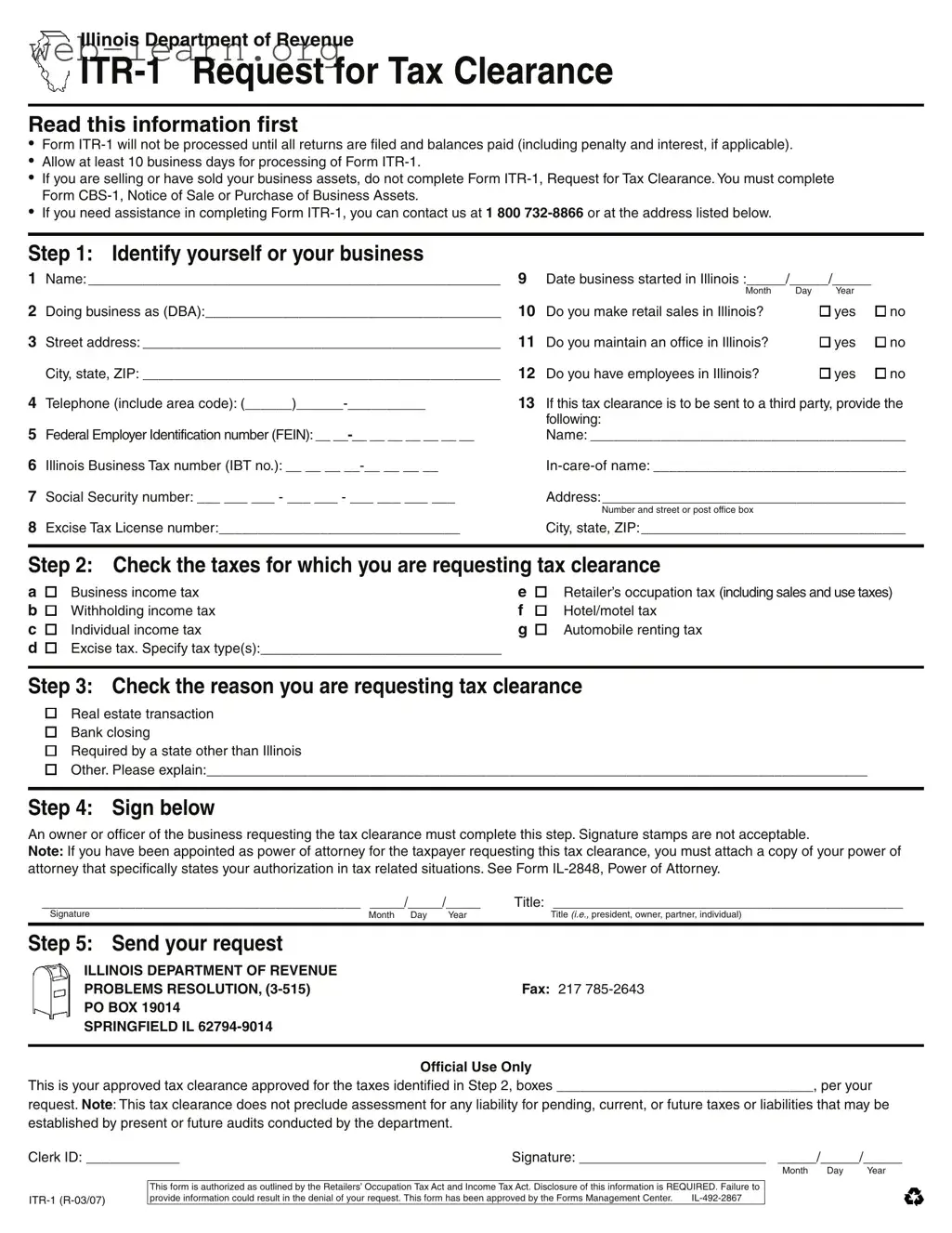
The ITR-1 form is an essential document for businesses in Illinois seeking tax clearance from the Illinois Department of Revenue. Before submitting the form, it is crucial to ensure that all tax returns have been filed and any outstanding balances, including penalties and interest, have been settled. The processing time for the ITR-1 is approximately ten business days, so planning ahead is advisable. Notably, if a business has sold or is in the process of selling its assets, the ITR-1 is not the appropriate form; instead, the CBS-1 form should be completed. The ITR-1 requires the requester to provide key details, such as the business name, address, and tax identification numbers. Additionally, it asks for information regarding the types of taxes for which clearance is sought, including business income, withholding income, and various excise taxes. A signature from an owner or officer is necessary to validate the request, and if a power of attorney is involved, proper documentation must be attached. Understanding these requirements will help ensure a smoother process in obtaining the necessary tax clearance.

Illinois Department of Revenue
Read this information first
•Form
•Allow at least 10 business days for processing of Form
•If you are selling or have sold your business assets, do not complete Form
•If you need assistance in completing Form
Step 1: Identify yourself or your business
1 |
Name: _____________________________________________________ |
9 |
Date business started in Illinois :_____/_____/_____ |
|
||
|
|
|
Month |
Day |
Year |
|
2 |
Doing business as (DBA):______________________________________ |
10 |
Do you make retail sales in Illinois? |
|
yes |
no |
3 |
Street address: ______________________________________________ |
11 |
Do you maintain an office in Illinois? |
|
yes |
no |
|
City, state, ZIP: ______________________________________________ |
12 |
Do you have employees in Illinois? |
|
yes |
no |
4 |
Telephone (include area code): |
13 |
If this tax clearance is to be sent to a third party, provide the |
|||
|
|
|
following: |
|
|
|
5 |
Federal Employer Identification number (FEIN): __ |
|
Name: ________________________________________ |
|||
6 |
Illinois Business Tax number (IBT no.): __ __ __ |
|
||||
7 |
Social Security number: ___ ___ ___ - ___ ___ - ___ ___ ___ ___ |
|
Address: _______________________________________ |
|||
|
|
|
Number and street or post office box |
|
|
|
8 |
Excise Tax License number:_______________________________ |
|
City, state, ZIP: __________________________________ |
|||
|
|
|
|
|
|
|
Step 2: Check the taxes for which you are requesting tax clearance
a b c d
Business income tax |
e |
Withholding income tax |
f |
Individual income tax |
g |
Excise tax. Specify tax type(s):_______________________________ |
|
Retailer’s occupation tax (including sales and use taxes) Hotel/motel tax
Automobile renting tax
Step 3: Check the reason you are requesting tax clearance
Real estate transaction Bank closing
Required by a state other than Illinois
Other. Please explain:_____________________________________________________________________________________
Step 4: Sign below
An owner or officer of the business requesting the tax clearance must complete this step. Signature stamps are not acceptable.
Note: If you have been appointed as power of attorney for the taxpayer requesting this tax clearance, you must attach a copy of your power of attorney that specifically states your authorization in tax related situations. See Form
_________________________________________ |
_____/_____/_____ |
Title: _____________________________________________ |
Signature |
Month Day Year |
Title (i.e., president, owner, partner, individual) |
|
|
|
Step 5: Send your request
ILLINOIS DEPARTMENT OF REVENUE |
|
PROBLEMS RESOLUTION, |
Fax: 217 |
PO BOX 19014 |
|
SPRINGFIELD IL |
|
|
|
|
Official Use Only |
This is your approved tax clearance approved for the taxes identified in Step 2, boxes _________________________________, per your
request. Note: This tax clearance does not preclude assessment for any liability for pending, current, or future taxes or liabilities that may be established by present or future audits conducted by the department.
Clerk ID: ____________ |
Signature: ________________________ _____/_____/_____ |
Month Day Year
This form is authorized as outlined by the Retailers’ Occupation Tax Act and Income Tax Act. Disclosure of this information is REQUIRED. Failure to
provide information could result in the denial of your request. This form has been approved by the Forms Management Center. |
| Fact Name | Description |
|---|---|
| Form Purpose | The ITR-1 form is used to request tax clearance from the Illinois Department of Revenue. |
| Processing Time | Allow at least 10 business days for the processing of the ITR-1 form. |
| Eligibility Criteria | Form ITR-1 will not be processed until all tax returns are filed and any balances, including penalties and interest, are paid. |
| Alternative Form | If selling business assets, use Form CBS-1 instead of ITR-1. |
| Contact Information | For assistance, contact the Illinois Department of Revenue at 1-800-732-8866. |
| Governing Laws | This form is authorized under the Retailers’ Occupation Tax Act and the Income Tax Act. |
Completing the ITR-1 form is a critical step for those seeking tax clearance in Illinois. Follow the steps outlined below to ensure accurate and timely submission. Remember, all returns must be filed and balances paid before processing begins. Allow at least 10 business days for processing once submitted.
Send your request:
Mail to:
ILLINOIS DEPARTMENT OF REVENUE
PROBLEMS RESOLUTION, (3-515)
PO BOX 19014
SPRINGFIELD IL 62794-9014
Fax: 217 785-2643
The ITR-1 form is a Request for Tax Clearance from the Illinois Department of Revenue. It is primarily used to confirm that all tax returns have been filed and all tax balances, including any penalties and interest, have been paid. This form is often required during the sale of a business or when applying for certain licenses.
The form should be completed by an owner or an officer of the business requesting the tax clearance. If you are acting on behalf of the taxpayer, you must provide a power of attorney that specifically grants you the authority to handle tax-related matters. Signature stamps are not acceptable; a handwritten signature is required.
Form ITR-1 will not be processed until all required tax returns are filed and any outstanding balances are paid. This includes any penalties and interest that may apply. If you attempt to submit the form without meeting these conditions, it will likely result in a delay or denial of your request.
Once submitted, you should allow at least 10 business days for the processing of Form ITR-1. During peak periods, processing times may vary, so it is advisable to submit your request well in advance of any deadlines.
If you are selling or have sold your business assets, you should not complete Form ITR-1. Instead, you must use Form CBS-1, which is the Notice of Sale or Purchase of Business Assets. This ensures that the correct procedures are followed for tax clearance in such transactions.
Filling out the ITR-1 Illinois form can be a straightforward process, but there are common mistakes that individuals and businesses often make. Understanding these errors can help ensure that your request for tax clearance is processed without delays.
One frequent mistake is failing to file all necessary tax returns before submitting the ITR-1 form. The Illinois Department of Revenue will not process your request until all returns are filed and any balances, including penalties and interest, are paid. It is crucial to verify that your tax obligations are fully met before proceeding with the clearance request.
Another common issue arises when individuals mistakenly complete the ITR-1 form when they should be using Form CBS-1. If you are selling or have sold your business assets, you need to use the Notice of Sale or Purchase of Business Assets instead. Using the wrong form can lead to unnecessary complications and delays in processing.
Inaccurate information can also cause problems. For instance, omitting your Federal Employer Identification Number (FEIN) or Illinois Business Tax number can lead to processing delays. Ensure that all identification numbers are correctly filled out. This includes your Social Security number if applicable.
People sometimes overlook the importance of providing complete contact information. This includes not just your name and address but also a valid phone number. If any issues arise during processing, the department needs to be able to reach you quickly.
Additionally, some applicants forget to specify the taxes for which they are requesting clearance. It is essential to check all applicable boxes in Step 2 of the form. Missing this step can result in an incomplete request, further delaying the process.
Another mistake involves the signature section. Only an owner or officer of the business can sign the form. Using a signature stamp is not acceptable, and if you are acting as a power of attorney, you must attach the appropriate documentation. This ensures that your authority to request tax clearance is clear and legitimate.
Lastly, sending the form to the wrong address can lead to significant delays. Make sure to send your request to the correct location as specified in the instructions. Double-checking this detail can save you time and prevent frustration.
By being aware of these common mistakes, you can streamline the process of obtaining your tax clearance and avoid unnecessary setbacks. Taking the time to review your form before submission can make a significant difference.
The ITR-1 form is a crucial document for businesses in Illinois seeking tax clearance. However, several other forms and documents often accompany it to ensure compliance with state regulations. Below is a list of these forms, each serving a specific purpose in the tax clearance process.
Each of these forms plays a vital role in the tax clearance process. Failing to submit the appropriate documentation may delay or complicate your request for tax clearance. Always ensure that all necessary forms are completed accurately and submitted in a timely manner.
The ITR-1 Illinois form serves as a request for tax clearance from the Illinois Department of Revenue. Several other forms share similarities with ITR-1, primarily in their purpose or the information they require. Below is a list of nine documents that are comparable to the ITR-1 form:
When filling out the ITR-1 Illinois form, it is essential to follow certain guidelines to ensure a smooth processing experience. Here are some do's and don'ts to keep in mind:
Understanding the ITR-1 Illinois form can be challenging. Here are ten common misconceptions about this form, along with clarifications to help you navigate the process more easily.
By clearing up these misconceptions, you can better understand how to properly complete and submit the ITR-1 Illinois form.
Here are some key takeaways about filling out and using the ITR-1 Illinois form:
By following these guidelines, you can ensure that your Form ITR-1 is completed correctly and submitted efficiently.