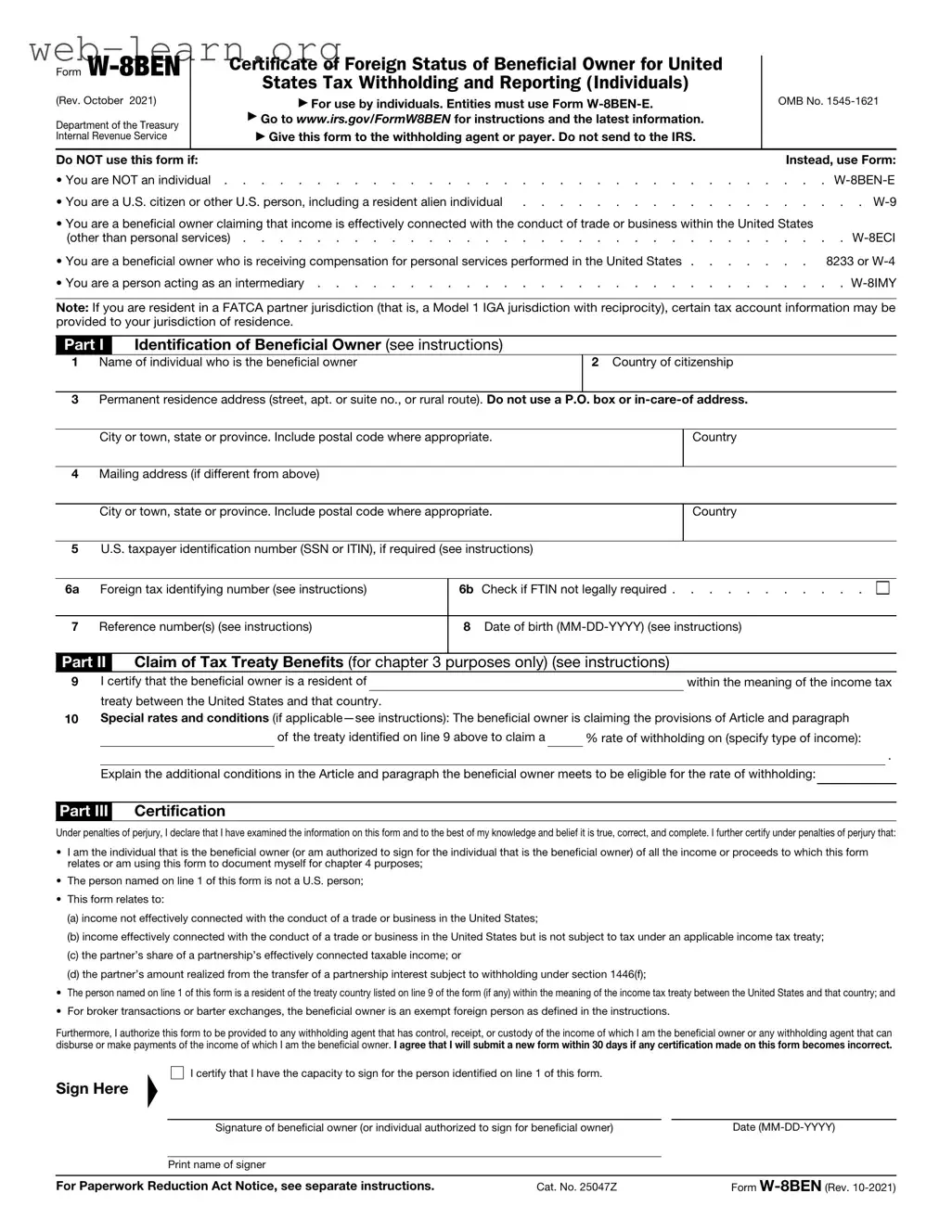
The IRS W-8BEN form plays a crucial role for non-U.S. persons receiving income from U.S. sources. It serves as a declaration of foreign status, allowing individuals and entities to claim a reduced rate of withholding tax under an applicable tax treaty. By submitting this form, foreign individuals can ensure that they are not subject to the standard withholding rates that apply to U.S. citizens and residents. The W-8BEN is not just a simple piece of paperwork; it requires careful attention to detail, including providing accurate personal information, such as name, country of citizenship, and tax identification number. Additionally, it’s essential to understand the implications of the form, as it must be updated periodically, especially if any personal details change. Navigating the intricacies of this form can seem daunting, but it is an important step in managing tax obligations effectively while engaging in business or earning income in the United States.
Form |
|
|
Certificate of Foreign Status of Beneficial Owner for United |
|
|
|
|
|
|
|
|
|
|
|
|
|
|||
|
|
|
States Tax Withholding and Reporting (Individuals) |
|
|
|
|
|
|
(Rev. October 2021) |
|
|
▶ For use by individuals. Entities must use Form |
|
|
OMB No. |
|||
Department of the Treasury |
|
|
▶ Go to www.irs.gov/FormW8BEN for instructions and the latest information. |
|
|
|
|
|
|
Internal Revenue Service |
|
|
▶ Give this form to the withholding agent or payer. Do not send to the IRS. |
|
|
|
|
|
|
|
|
|
|
|
|
|
|||
Do NOT use this form if: |
|
|
|
Instead, use Form: |
|||||
• You are NOT an individual |
. |
. |
. . |
. |
|||||
• You are a U.S. citizen or other U.S. person, including a resident alien individual |
. |
. |
. . |
. |
. |
. |
|||
• You are a beneficial owner claiming that income is effectively connected with the conduct of trade or business within the United States |
|
|
|
||||||
(other than personal services) |
. |
. |
. . |
. |
. |
||||
• You are a beneficial owner who is receiving compensation for personal services performed in the United States . . . |
. |
. |
. . |
|
8233 or |
||||
• You are a person acting as an intermediary |
. |
. |
. . |
. |
. |
||||
Note: If you are resident in a FATCA partner jurisdiction (that is, a Model 1 IGA jurisdiction with reciprocity), certain tax account information may be provided to your jurisdiction of residence.
Part I Identification of Beneficial Owner (see instructions)
1Name of individual who is the beneficial owner
2Country of citizenship
3Permanent residence address (street, apt. or suite no., or rural route). Do not use a P.O. box or
City or town, state or province. Include postal code where appropriate.
Country
4Mailing address (if different from above)
City or town, state or province. Include postal code where appropriate.
Country
5U.S. taxpayer identification number (SSN or ITIN), if required (see instructions)
6a Foreign tax identifying number (see instructions) |
6b Check if FTIN not legally required |
|
|
7 Reference number(s) (see instructions) |
8 Date of birth |
Part II Claim of Tax Treaty Benefits (for chapter 3 purposes only) (see instructions)
9 I certify that the beneficial owner is a resident of treaty between the United States and that country.
10Special rates and conditions (if
of the treaty identified on line 9 above to claim a |
% rate of withholding on (specify type of income): |
.
Explain the additional conditions in the Article and paragraph the beneficial owner meets to be eligible for the rate of withholding:
Part III Certification
Under penalties of perjury, I declare that I have examined the information on this form and to the best of my knowledge and belief it is true, correct, and complete. I further certify under penalties of perjury that:
•I am the individual that is the beneficial owner (or am authorized to sign for the individual that is the beneficial owner) of all the income or proceeds to which this form relates or am using this form to document myself for chapter 4 purposes;
•The person named on line 1 of this form is not a U.S. person;
•This form relates to:
(a)income not effectively connected with the conduct of a trade or business in the United States;
(b)income effectively connected with the conduct of a trade or business in the United States but is not subject to tax under an applicable income tax treaty;
(c)the partner’s share of a partnership’s effectively connected taxable income; or
(d)the partner’s amount realized from the transfer of a partnership interest subject to withholding under section 1446(f);
•The person named on line 1 of this form is a resident of the treaty country listed on line 9 of the form (if any) within the meaning of the income tax treaty between the United States and that country; and
•For broker transactions or barter exchanges, the beneficial owner is an exempt foreign person as defined in the instructions.
Furthermore, I authorize this form to be provided to any withholding agent that has control, receipt, or custody of the income of which I am the beneficial owner or any withholding agent that can disburse or make payments of the income of which I am the beneficial owner. I agree that I will submit a new form within 30 days if any certification made on this form becomes incorrect.
Sign Here
▲
I certify that I have the capacity to sign for the person identified on line 1 of this form.
|
Signature of beneficial owner (or individual authorized to sign for beneficial owner) |
|
Date |
|
|
|
|
|
|
|
Print name of signer |
|
|
|
|
|
|
|
|
For Paperwork Reduction Act Notice, see separate instructions. |
Cat. No. 25047Z |
|
Form |
|
| Fact Name | Description |
|---|---|
| Purpose | The W-8BEN form is used by non-U.S. persons to certify their foreign status and claim benefits under an income tax treaty. |
| Eligibility | Individuals who are not U.S. citizens or residents and who receive certain types of income from U.S. sources must file this form. |
| Validity Period | The form remains valid for three years from the date it is signed, unless there are changes in circumstances that affect its validity. |
| Tax Treaty Benefits | By submitting the W-8BEN, individuals may benefit from reduced withholding tax rates as specified in applicable tax treaties between the U.S. and their home countries. |
| Filing Requirements | The form must be submitted to the withholding agent or financial institution, not the IRS directly, to avoid unnecessary withholding on income. |
Once you have the IRS W-8BEN form, you can begin filling it out. Completing this form accurately is essential for your tax situation. Follow these steps to ensure you provide the necessary information correctly.
After completing the form, review it for accuracy. Once confirmed, submit it to the requester, usually a financial institution or business that requires it for tax purposes.
The IRS W-8BEN form is a document used by non-U.S. persons to certify their foreign status and claim any applicable tax treaty benefits. This form is essential for individuals or entities receiving income from U.S. sources, as it helps to establish that they are not subject to certain U.S. tax withholding requirements.
Non-U.S. residents or foreign entities that receive income from U.S. sources, such as dividends, interest, rents, or royalties, should complete the W-8BEN form. This includes individuals and businesses that are not established in the United States but have financial dealings with U.S. entities.
Completing the W-8BEN form involves several steps:
Once filled out, the form should be submitted to the U.S. withholding agent or financial institution, not the IRS directly.
The primary purpose of the W-8BEN form is to ensure that non-U.S. persons are not subjected to the default 30% withholding tax on certain types of U.S. income. By providing this form, individuals and entities can claim reduced withholding rates or exemptions based on tax treaties between the U.S. and their country of residence.
The W-8BEN form remains valid for a period of three years from the date it is signed. However, if there are any changes to your circumstances, such as a change in residency or the nature of the income, you must submit a new form to reflect those changes.
The completed W-8BEN form should be sent directly to the U.S. withholding agent or financial institution that requested it. It is important not to send the form to the IRS, as it is not meant for direct submission to the agency.
If you do not submit the W-8BEN form when required, the U.S. withholding agent may be obligated to withhold taxes at the maximum rate of 30% on your income. This can significantly reduce the amount of money you receive from U.S. sources.
Yes, the W-8BEN form can be used to claim benefits for multiple types of income, such as interest, dividends, and royalties, as long as they fall under the same tax treaty provisions. It is important to specify the types of income you are receiving and ensure that the information is accurate to avoid any issues with withholding.
Filling out the IRS W-8BEN form can be a straightforward process, but many individuals make common mistakes that can lead to delays or complications. One frequent error is failing to provide a complete and accurate name. It's essential to ensure that your name matches exactly with the documentation you are submitting. If there’s any discrepancy, it could raise questions or even lead to rejection of the form.
Another mistake is neglecting to include your country of citizenship. The form requires you to specify your country, and overlooking this detail can result in your submission being considered incomplete. Always double-check that this information is clearly stated.
Many people also forget to provide their permanent address. The W-8BEN requires a physical address in your country of residence. If you only provide a mailing address, it may not meet the IRS requirements. Ensure that your address is up-to-date and correctly formatted.
Using the wrong tax identification number is another common pitfall. If you are a foreign individual, you may need to provide your foreign tax identification number. Some mistakenly enter a U.S. Social Security Number instead. This can lead to processing issues, so it’s important to know which number to use.
Inaccurate information about the type of income you are receiving can also cause problems. The form asks for details regarding the specific income types, such as dividends or royalties. Misclassifying your income could lead to incorrect withholding rates being applied.
People often overlook the signature requirement. Submitting the form without a signature is a simple mistake that can halt the processing. Make sure to sign and date the form where indicated. This step is crucial for validating your submission.
Not keeping a copy of the completed form is another mistake that can be easily avoided. Retaining a copy for your records is essential, as it provides proof of what you submitted. This can be useful if any questions arise later.
Some individuals fail to submit the form to the correct entity. The W-8BEN is typically provided to the withholding agent or financial institution, not the IRS directly. Ensure you know where to send the form to avoid unnecessary delays.
Finally, misunderstanding the expiration of the form can lead to issues down the line. The W-8BEN is valid for a specific period, and if you don't update it when required, you may face increased withholding rates. Always be aware of when your form needs to be renewed.
The IRS W-8BEN form is essential for foreign individuals and entities to claim tax treaty benefits and certify their foreign status. However, it is often used alongside other forms and documents that facilitate international transactions and compliance with U.S. tax laws. Below is a list of documents that may be relevant when dealing with the W-8BEN form.
Understanding these forms and documents can help ensure compliance with U.S. tax regulations and optimize tax benefits. When dealing with international transactions, being informed is crucial for both individuals and businesses. Always consult a tax professional for guidance tailored to your specific situation.
When filling out the IRS W-8BEN form, it's essential to follow specific guidelines to ensure accuracy and compliance. Here’s a list of things you should and shouldn't do:
The IRS W-8BEN form is an important document for foreign individuals and entities receiving income from U.S. sources. However, several misconceptions surround its purpose and use. Here are five common misunderstandings:
Many believe that the W-8BEN form is exclusively for individual taxpayers. In reality, while it is primarily designed for individuals, foreign entities can use the W-8BEN-E form to claim similar benefits.
Some assume that filling out the W-8BEN automatically exempts them from U.S. taxes. However, the form only certifies foreign status and may reduce withholding rates based on tax treaties. It does not eliminate tax obligations entirely.
Individuals often think that submitting the W-8BEN is a one-time task. In fact, the form must be updated whenever there are changes in circumstances or every three years to remain valid.
Many believe that the W-8BEN is only necessary for large payments. In truth, it is required for any U.S. source income, regardless of the amount, to ensure proper tax withholding.
Some individuals view the process of completing the W-8BEN as daunting. However, the form is straightforward and can typically be filled out quickly, especially with clear instructions available.
Understanding these misconceptions can help individuals and entities navigate the complexities of U.S. tax compliance more effectively.
The IRS W-8BEN form is essential for non-U.S. persons receiving income from U.S. sources. Here are some key takeaways to keep in mind when filling it out and using it:
Understanding these points can help you navigate the process smoothly and ensure compliance with U.S. tax regulations.