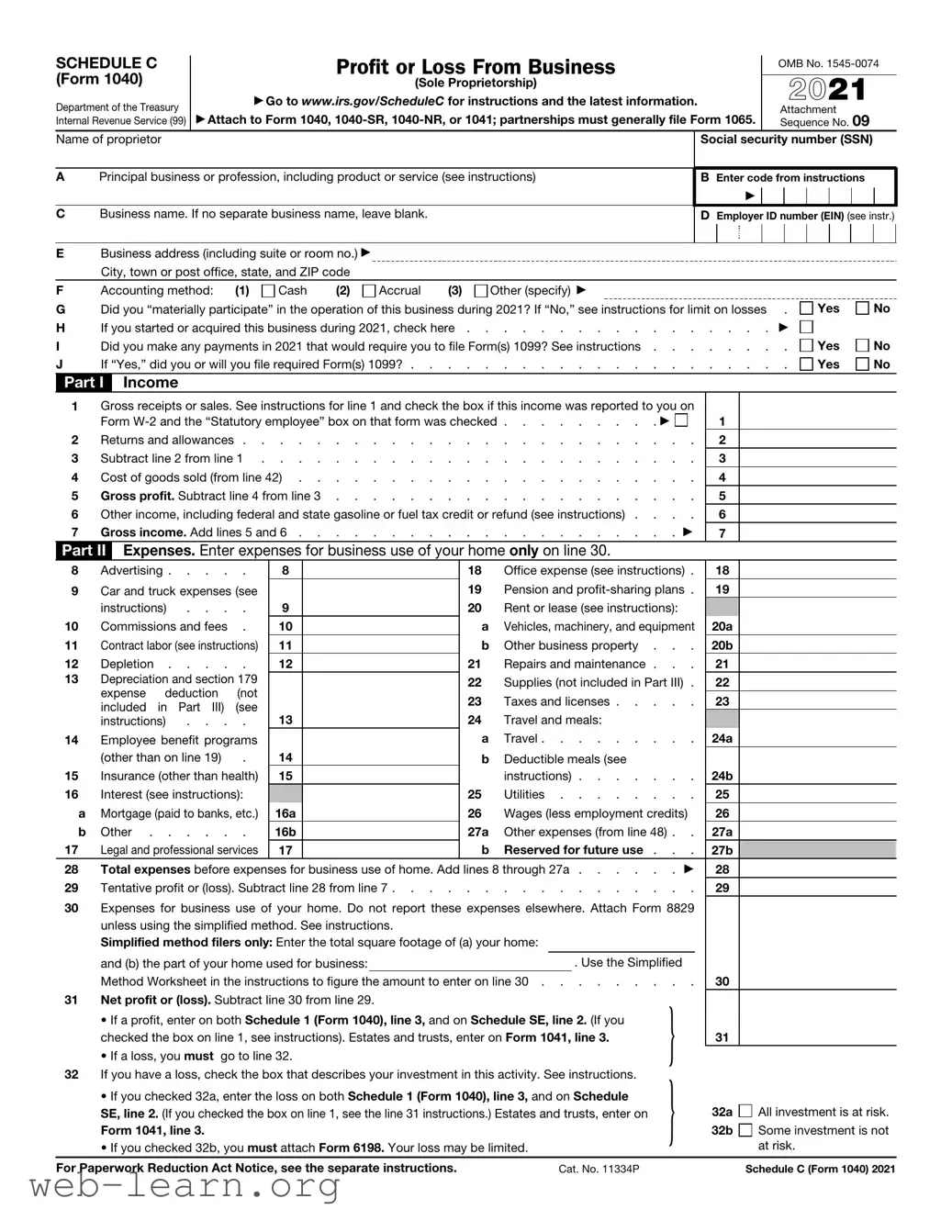
Homepage Blank IRS Schedule C 1040 Form
Contents

The IRS Schedule C (Form 1040) plays a crucial role for self-employed individuals and business owners. This form is designed to report income and expenses from a sole proprietorship, providing the IRS with a clear overview of your business's financial activity. Notably, it captures a variety of income types, reflecting everything from sales revenues to service fees. In addition to income reporting, Schedule C allows for detailed expense documentation, such as costs related to advertising, office supplies, and travel. Understanding how to accurately complete this form is essential, as it not only affects tax liability but also establishes the foundation for future financial planning and business assessments. With its combination of straightforward reporting and the opportunity for deductions, it is a vital element in managing a self-employed person’s financial responsibilities. Properly filling out Schedule C can help maximize eligible deductions, ultimately impacting the overall financial health of one's business.
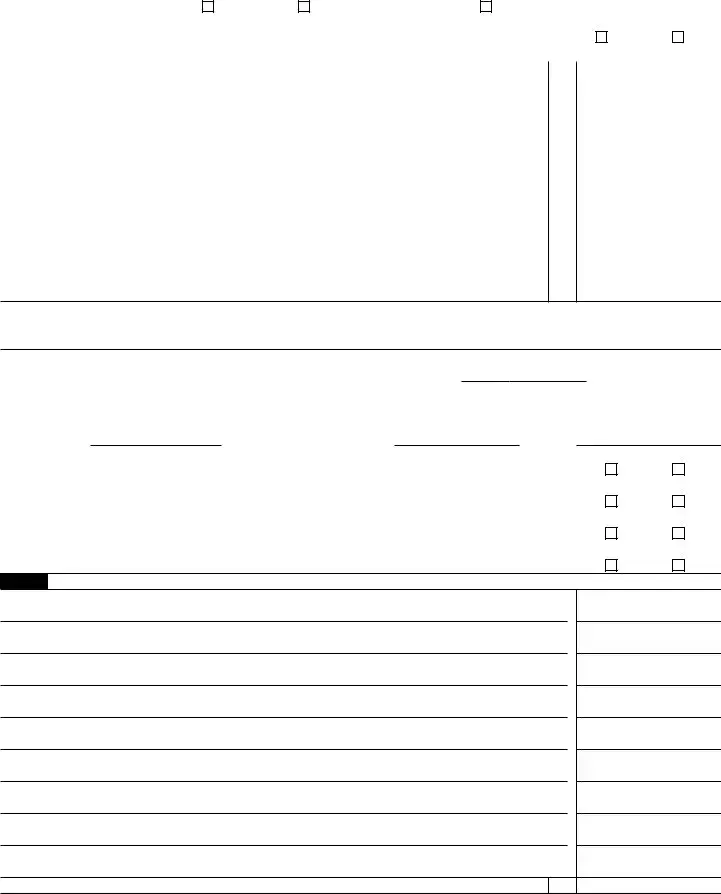
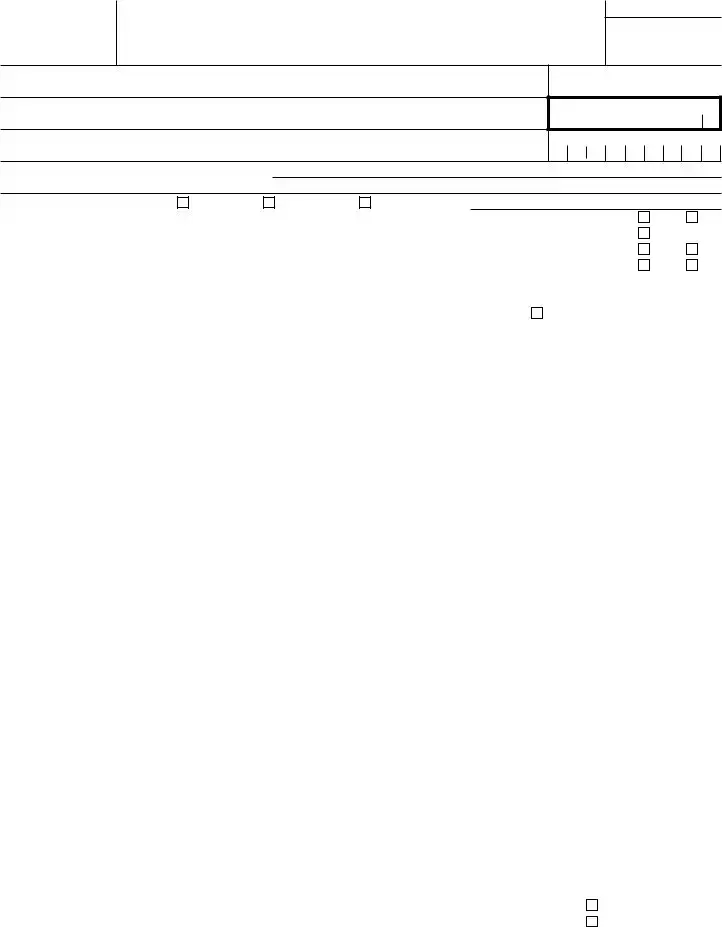
Sample - IRS Schedule C 1040 Form

SCHEDULE C
(Form 1040)
2025
Profit or Loss From Business
(Sole Proprietorship)
Department of the Treasury
Internal Revenue Service
Attach to Form 1040, 1040-SR, 1040-SS, 1040-NR, or 1041; partnerships must generally file Form 1065.
Go to www.irs.gov/ScheduleC for instructions and the latest information.
OMB No. 1545-0074
Attachment
Sequence No.
09
Name of proprietor Social security number (SSN)
A Principal business or profession, including product or service (see instructions)
B Enter code from instructions
C Business name. If no separate business name, leave blank.
D
Employer ID number (EIN) (see instr.)
E
Business address (including suite or room no.)
City, town or post office, state, and ZIP code
F Accounting method: (1)
Cash (2) Accrual (3) Other (specify)
G Did you “materially participate” in the operation of this business during 2025? If “No,” see instructions for limit on losses .
Yes No
H If you started or acquired this business during 2025, check here . . . . . . . . . . . . . . . . . .
I Did you make any payments in 2025 that would require you to file Form(s) 1099? See instructions . . . . . . . .
Yes No
J If “Yes,” did you or will you file required Form(s) 1099? . . . . . . . . . . . . . . . . . . . . .
Yes No
Part I Income
1 Gross receipts or sales. See instructions for line 1 and check the box if this income was reported to you on
Form W-2 and the “Statutory employee” box on that form was checked . . . . . . . . . 1
2 Returns and allowances . . . . . . . . . . . . . . . . . . . . . . . . . 2
3 Subtract line 2 from line 1 . . . . . . . . . . . . . . . . . . . . . . . . 3
4 Cost of goods sold (from line 42) . . . . . . . . . . . . . . . . . . . . . . 4
5 Gross profit. Subtract line 4 from line 3 . . . . . . . . . . . . . . . . . . . . 5
6 Other income, including federal and state gasoline or fuel tax credit or refund (see instructions) . . . . 6
7 Gross income. Add lines 5 and 6 . . . . . . . . . . . . . . . . . . . . . . 7
Part II
Expenses. Enter expenses for business use of your home only on line 30.
8 Advertising . . . . . 8
9 Car and truck expenses
(see instructions) . . . 9
10 Commissions and fees . 10
11
Contract labor (see instructions)
11
12 Depletion . . . . . 12
13
Depreciation and section 179
expense deduction (not
included in Part III) (see
instructions) . . . .
13
14 Employee benefit programs
(other than on line 19) . 14
15
Insurance (other than health)
15
16 Interest (see instructions):
a
Mortgage (paid to banks, etc.)
16a
b Other . . . . . . 16b
17
Legal and professional services
17
18 Office expense (see instructions) . 18
19 Pension and profit-sharing plans . 19
20 Rent or lease (see instructions):
a
Vehicles, machinery, and equipment
20a
b Other business property . . . 20b
21 Repairs and maintenance . . . 21
22 Supplies (not included in Part III) . 22
23 Taxes and licenses . . . . . 23
24 Travel and meals:
a Travel . . . . . . . . . 24a
b
Deductible meals (see instructions)
24b
25 Utilities . . . . . . . . 25
26 Wages (less employment credits) 26
27 a Energy efficient commercial bldgs
deduction (attach Form 7205) . . 27a
b Other expenses (from line 48) . . 27b
28 Total expenses before expenses for business use of home. Add lines 8 through 27b . . . . . . . 28
29 Tentative profit or (loss). Subtract line 28 from line 7 . . . . . . . . . . . . . . . . . 29
30 Expenses for business use of your home. Do not report these expenses elsewhere. Attach Form 8829
unless using the simplified method. See instructions.
Simplified method filers only: Enter the total square footage of (a) your home:
and (b) the part of your home used for business:
. Use the Simplified
Method Worksheet in the instructions to figure the amount to enter on line 30 . . . . . . . . .
30
31 Net profit or (loss). Subtract line 30 from line 29.
• If a profit, enter on both Schedule 1 (Form 1040), line 3, and on Schedule SE, line 2. (If you
checked the box on line 1, see instructions.) Estates and trusts, enter on Form 1041, line 3.
• If a loss, you must go to line 32.
}
31
32 If you have a loss, check the box that describes your investment in this activity. See instructions.
• If you checked 32a, enter the loss on both Schedule 1 (Form 1040), line 3, and on Schedule
SE, line 2. (
If you checked the box on line 1, see the line 31 instructions.)
Estates and trusts, enter on
Form 1041, line 3.
• If you checked 32b, you must attach Form 6198. Your loss may be limited.
}
32a All investment is at risk.
32b Some investment is not
at risk.
For Paperwork Reduction Act Notice, see the separate instructions.
Cat. No. 11334P Schedule C (Form 1040) 2025 Created 4/3/25
Schedule C (Form 1040) 2025
Page 2
Part III Cost of Goods Sold (see instructions)
33 Method(s) used to
value closing inventory: a
Cost b Lower of cost or market c Other (attach explanation)
34 Was there any change in determining quantities, costs, or valuations between opening and closing inventory?
If “Yes,” attach explanation . . . . . . . . . . . . . . . . . . . . . . . . . .
Yes No
35 Inventory at beginning of year. If different from last year’s closing inventory, attach explanation . . .
35
36 Purchases less cost of items withdrawn for personal use . . . . . . . . . . . . . . 36
37 Cost of labor. Do not include any amounts paid to yourself . . . . . . . . . . . . . . 37
38 Materials and supplies . . . . . . . . . . . . . . . . . . . . . . . . 38
39 Other costs . . . . . . . . . . . . . . . . . . . . . . . . . . . . 39
40 Add lines 35 through 39 . . . . . . . . . . . . . . . . . . . . . . . . 40
41 Inventory at end of year . . . . . . . . . . . . . . . . . . . . . . . . 41
42 Cost of goods sold. Subtract line 41 from line 40. Enter the result here and on line 4 . . . . . . 42
Part IV
Information on Your Vehicle. Complete this part only if you are claiming car or truck expenses on line 9 and
are not required to file Form 4562 for this business. See the instructions for line 13 to find out if you must file
Form 4562.
43 When did you place your vehicle in service for business purposes? (month/day/year)
/ /
44 Of the total number of miles you drove your vehicle during 2025, enter the number of miles you used your vehicle for:
a
Business b Commuting (see instructions) c Other
45 Was your vehicle available for personal use during off-duty hours? . . . . . . . . . . . . . . .
Yes No
46 Do you (or your spouse) have another vehicle available for personal use?. . . . . . . . . . . . . .
Yes No
47a Do you have evidence to support your deduction? . . . . . . . . . . . . . . . . . . . .
Yes No
b If “Yes,” is the evidence written? . . . . . . . . . . . . . . . . . . . . . . . . .
Yes No
Part V Other Expenses. List below business expenses not included on lines 8-27a, or line 30.
48 Total other expenses. Enter here and on line 27b . . . . . . . . . . . . . . . . 48
Schedule C (Form 1040) 2025

Form Information

Fact Name Description
Purpose IRS Schedule C, also known as "Profit or Loss from Business," is used by sole proprietors to report income and expenses from their business activities.
Eligibility This form is specifically for individuals who operate a business as a sole proprietor. Partnerships and corporations use different forms.
Filing Requirement Individuals must file Schedule C if they earn at least $400 in net earnings from self-employment during the tax year.
Deadline Schedule C must be submitted along with IRS Form 1040 by the tax filing deadline, typically April 15.
Income Reporting All business income must be reported, including cash, checks, and credit card payments. This total is reported on Line 1 of the form.
Expense Deductions Expenses such as operating costs, supplies, and other business-related deductions can be reported on the form, reducing taxable income.
Self-Employment Tax Self-employed individuals must also calculate and pay self-employment tax based on net earnings, which is reported on Schedule SE.
Record-Keeping Detailed records of income and expenses are crucial for accurate reporting on Schedule C and for potential audits.
State Variations Some states require additional forms for reporting business income, governed by state-specific tax laws that may include income tax or franchise tax regulations.
Importance of Accuracy Filling out Schedule C accurately is essential to avoid errors that may lead to penalties or increased scrutiny from the IRS.

Detailed Guide for Filling Out IRS Schedule C 1040

Completing the IRS Schedule C (Form 1040) is an essential part of reporting income for self-employed individuals. This process will guide you through the steps to ensure accurate and complete information. Take your time to gather the necessary documentation and fill out each section methodically.

  1. Begin by downloading or obtaining a copy of the IRS Schedule C form.
  2. Enter your name and Social Security number at the top of the form.
  3. Fill in your business name. If you operate under a different name, include that as well.
  4. Indicate your business address. This is generally your home address if you run your business from there.
  5. In Part I, report your gross receipts or sales. Use your business records to ensure accuracy.
  6. Deduct returns and allowances from your gross receipts to calculate your gross income.
  7. In Part II, list your business expenses. Include costs such as advertising, utilities, and supplies.
  8. Always separate personal expenses from business expenses to avoid errors.
  9. Complete Part III if you are involved in a business that has a cost of goods sold. Calculate the cost of goods sold if applicable.
  10. In Part IV, input information about your vehicle if you deduct car expenses. Choose between the standard mileage rate or actual vehicle expenses.
  11. For Part V, answer questions regarding your business. This includes ownership structure and the number of products sold.
  12. In Part VI, include additional information that may be relevant, such as payments to independent contractors.
  13. Recheck your entries for accuracy and completeness before signing and dating the form.
  14. Submit the filled-out Schedule C along with your Form 1040 and any other required filings to the IRS.

Following these steps will equip you to fill out the IRS Schedule C with confidence. Ensure that you keep copies of everything for your records, as this may be helpful in the future. Reach out to a tax professional if you need further assistance or clarification.

Obtain Answers on IRS Schedule C 1040

  1. What is IRS Schedule C?

    IRS Schedule C is a form used by sole proprietors to report income or loss from their business. It is part of the Form 1040 tax return. If you have a business that is not organized as a corporation, you'll typically need to file a Schedule C. By doing so, you detail the income your business generated as well as the expenses incurred in running it.

  2. Who needs to file Schedule C?

    Individuals who earn income from self-employment, freelancing, or running a business as a sole proprietor are required to file Schedule C. This includes anyone who is a contractor or has a side business, even if you only did it part-time. If your net profit from your business is $400 or more, you must file this schedule.

  3. What types of income do I report on Schedule C?

    You should report any income related to your business activities on Schedule C. This can include:

    • Sales of products or services
    • Freelance work
    • Income from businesses operated as sole proprietorships
    • Other income types directly associated with your business activities

    Make sure to keep accurate records of all income received so that you can accurately report it.

  4. What business expenses can I deduct on my Schedule C?

    Many business-related expenses are deductible, which can help lower your taxable income. Some common examples include:

    • Supplies and materials used for your business
    • Home office expenses, if applicable
    • Vehicle expenses for business use
    • Depreciation of assets
    • Advertising and marketing costs
    • Professional fees, such as legal or consulting services

    It's important to maintain receipts and records to substantiate these deductions.

  5. How do I calculate my net profit or loss?

    Your net profit or loss is calculated by subtracting your total business expenses from your total business income. If your expenses exceed your income, you will have a net loss. Conversely, if your income exceeds your expenses, you will show a profit. This figure is then reported on your Form 1040.

  6. Are there any special considerations for filing Schedule C?

    Yes, there are a few key considerations:

    • Keep detailed records of all income and expenses. This will help if you are audited.
    • If you’ve reported a net loss for several years, the IRS may classify your business as a hobby, which can limit your deductibility of expenses.
    • Consider speaking with a tax professional, especially if you have complex situations or significant expenses to report.

Common mistakes

Filling out the IRS Schedule C (Form 1040) can be tricky. Many people make common mistakes that can affect their tax filings. One major error occurs when individuals do not report all their income. Whether it’s cash payments or income from side gigs, every dollar counts. Missing even a small amount can cause issues with the IRS.

Another frequent mistake is claiming incorrect business expenses. Many people confuse personal expenses with business-related expenses. It’s vital to keep business and personal finances separate. This distinction ensures that only legitimate business costs are deducted, which can prevent potential audits.

People also often fail to keep adequate records. The IRS requires proof of income and expenses. Without receipts and documentation, it becomes challenging to support the claimed amounts. Good records not only simplify the filling process but also strengthen the validity of your claims if questioned.

Some taxpayers neglect to use the correct accounting method. Depending on the nature of the business, the cash basis or accrual basis accounting may be more appropriate. Selecting the wrong method can complicate tax calculations and lead to incorrect tax liability.

A common oversight is not filling in all required sections. Each part of the Schedule C has its purpose. Omitting information may not only result in processing delays but can also trigger an audit. It’s crucial to ensure that every applicable section is completed correctly.

Another mistake is misunderstanding the implications of self-employment tax. Many people are surprised to learn that self-employment income incurs additional taxes. Failing to anticipate these taxes can lead to unexpected liabilities come tax time.

Lastly, some who fill out Schedule C make mistakes while calculating their net profit or loss. Errors in addition or subtraction can have significant consequences. Taking the time to double-check calculations can help avoid unnecessary complications later.

Being aware of these common pitfalls can help smooth the Schedule C filing process. By paying careful attention to details and keeping organized records, taxpayers can better navigate their obligations and maximize their deductions.

Documents used along the form

The IRS Schedule C 1040 form is utilized by sole proprietors to report income or losses from a business operated or a profession practiced. Along with this form, there are several other documents that are commonly used to provide necessary information and support for tax reporting. The following is a list of some of those relevant forms and documents.

  • IRS Form 1040: This is the main individual income tax return form used by residents of the United States to file their annual income taxes.
  • IRS Schedule SE: This form calculates self-employment tax for individuals who have net earnings of $400 or more from self-employment.
  • IRS Form 4562: Used to claim depreciation and amortization for property placed in service during the tax year, this form is vital for business owners with significant assets.
  • IRS Form 1099-MISC: This form is utilized to report miscellaneous income. Businesses often use it to document payments made to independent contractors.
  • IRS Form W-2: If a business has employees, this form details the annual wages paid and taxes withheld for each employee.
  • Business Income Records: Keeping detailed records of all income is crucial for accurate reporting. This might include sales receipts, invoices, or bank statements.
  • Expense Receipts: Documenting various business-related expenses is important for tax deductions. Receipts for purchases and invoices for services should be maintained.
  • Profit and Loss Statement: This financial statement summarizes revenues, costs, and expenses incurred during a specific period, providing a clear picture of the business's profitability.
  • Form 8829: This is used to report expenses for business use of your home. If a portion of a home is used as a primary location for business, this form is necessary.
  • State Tax Forms: Depending on the state, additional forms may be required for state income tax reporting. Each state has its own regulations and needs.

These documents and forms provide essential support and context when filing taxes related to a business. Properly organizing and submitting them alongside the Schedule C 1040 form can lead to a smoother tax-filing process.

Similar forms

  • IRS Form 1065: This form is used by partnerships to report income, deductions, gains, losses, and other information about the business. Like Schedule C, it provides a comprehensive overview of the entity's financial performance, but it pertains to multi-member businesses.

  • IRS Form 1120: Corporations use this form to report their income tax. Similar to Schedule C, Form 1120 requires detailed descriptions of income and expenses. However, it specifically addresses corporate rather than individual business activities.

  • IRS Form 1120-S: This form is for S corporations and allows pass-through taxation. It shares similarities with Schedule C in its analysis of income and expenses, reflecting how both structures report their financial results to the IRS.

  • IRS Schedule E: Often used for reporting supplemental income or losses, Schedule E is similar in that it records income and related expenses, particularly from rental properties or partnerships. However, it focuses more on passive income streams.

  • IRS Schedule F: This form is for farmers. It closely resembles Schedule C as both document farming income and expenses. The major difference lies in the specific types of deductions and credits applicable in agricultural contexts.

  • IRS Form 1040: The 1040 is the individual income tax return form that summarizes all income sources. While Schedule C is attached to it for sole proprietors, both forms work in tandem to calculate overall tax obligations based on personal earnings.

  • IRS Form 4797: This form is used for reporting the sale of business property. It parallels Schedule C in its focus on business operations and financial performance but targets the sale and disposition of assets instead of ongoing business income.

  • IRS Form 8606: This form reports non-deductible contributions to traditional IRAs and distributions from Roth IRAs. Although it does not focus on business income, like Schedule C, it is critical for tracking financial investments and tax responsibilities for specific individual situations.

Dos and Don'ts

When completing the IRS Schedule C Form 1040, it is essential to approach the task with attention, as this form is used to report income or losses from a business you operated as a sole proprietor. Below is a list of helpful tips detailing what to do and what to avoid during this process.

Things to Do:

  • Gather all necessary documentation, including receipts, invoices, and bank statements, to support your income and expenses.
  • Ensure that you report all income accurately. Any amounts received should be included, even if not in the form of cash.
  • Clearly itemize your business expenses, separating them into categories such as supplies, utilities, and advertising.
  • Utilize the space provided to explain any unusual entries. Offering context can prevent confusion or errors during processing.
  • Review the form for accuracy before submission. Double-checking numbers can help avoid costly mistakes.
  • Consider electronic filing as this often speeds up processing times and reduces the chance of errors.
  • Keep a copy of your completed Schedule C form for your records, as you may need it for future reference.

Things to Avoid:

  • Do not neglect to include all income sources, even if they seem insignificant.
  • Avoid rounding numbers. Precision matters, as it reflects your accounting practices.
  • Do not mix personal and business expenses. Keep your records clear to ensure maximum accuracy.
  • Refrain from filing your taxes late, as this may lead to penalties and interest that could be avoided with timely submission.
  • Don’t forget to check the specific deadlines for filing. Not adhering to these can complicate your tax situation.
  • Do not leave questions on the form unanswered. Providing complete information is crucial to avoid complications.
  • Avoid submitting additional documentation unless explicitly requested. Unnecessary papers can create confusion and delay.

Misconceptions

Understanding IRS Schedule C (Form 1040) can be confusing. Many people hold misconceptions about this important tax form used by sole proprietors to report income or loss from their business. Here are four common misconceptions that often arise.

  • Schedule C is only for large businesses. Many believe that only extensive businesses need to file Schedule C. In fact, any sole proprietor, regardless of the size of their enterprise, must use this form to report income from their ventures.
  • You can only deduct expenses directly related to your business. Some think deductions are limited to expenses that are strictly business-related. However, certain indirect expenses, such as a portion of home office costs, can also be deducted, provided they meet specific IRS criteria.
  • Filing Schedule C guarantees a tax audit. There is a misconception that simply filing this form will trigger an audit. While the IRS reviews Schedule C forms closely, filing it does not guarantee that an audit will take place; audits are based on various factors including reported income and deductions.
  • All income must be reported. Many individuals mistakenly believe that they can ignore small amounts of income. However, all income must be reported, regardless of the amount. Neglecting to do so could lead to penalties or complications later on.

Recognizing and correcting these misconceptions can help ensure that business owners navigate their tax responsibilities effectively and with greater confidence.

Key takeaways

Understanding the IRS Schedule C (Form 1040) is crucial for anyone operating a sole proprietorship. Here are some key takeaways to help you navigate this essential document.

  • Purpose of Schedule C: This form is used to report income or loss from a business you operated or a profession you practiced as a sole proprietor.
  • Tracking Income: Ensure you accurately report all revenue generated from your business activities. This includes cash, checks, and credit card income.
  • Business Expenses Matter: Don't forget to deduct qualifying expenses. These could include costs for supplies, utilities, and even professional services.
  • Record Keeping: Maintain good records. Accurate documentation of income and expenses can simplify the process, especially if the IRS has questions.
  • Self-Employment Tax: Be aware that income reported on Schedule C is subject to self-employment tax. This tax contributes to Social Security and Medicare for your earnings.
  • Filing Deadlines: Pay attention to filing deadlines. Schedule C is typically due when your individual tax return is due, often on April 15th.

Be proactive in addressing these elements when filling out Schedule C. Your diligence can pave the way for a smoother tax season and help you maximize your benefits as a business owner.