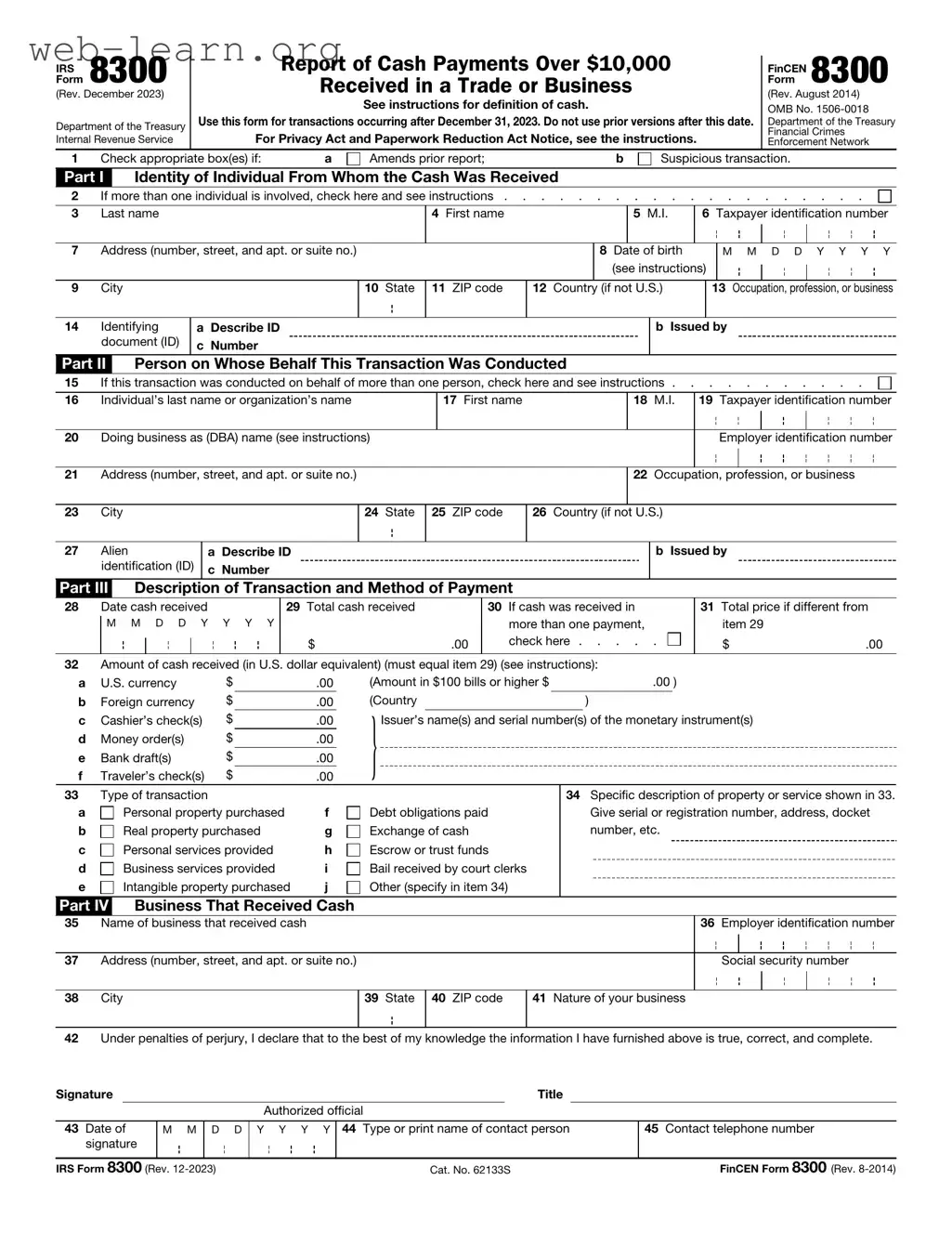
The IRS 8300 form plays a crucial role in the realm of financial transactions, particularly when large sums of cash are involved. This form is used by businesses to report cash payments exceeding $10,000 received in a single transaction or related transactions. By requiring this reporting, the IRS aims to combat money laundering and ensure compliance with tax regulations. When a business receives such payments, it must complete the form and submit it to the IRS within 15 days of the transaction. Additionally, businesses must provide a copy of the form to the individual or entity that made the payment. Understanding the requirements and implications of the IRS 8300 form is essential for any business dealing with significant cash transactions, as failure to comply can result in severe penalties. Awareness of this form not only helps in maintaining transparency but also fosters trust between businesses and regulatory authorities.
IRS 8300
Form
(Rev. December 2023)
Department of the Treasury Internal Revenue Service
Report of Cash Payments Over $10,000
Received in a Trade or Business
See instructions for definition of cash.
Use this form for transactions occurring after December 31, 2023. Do not use prior versions after this date.
For Privacy Act and Paperwork Reduction Act Notice, see the instructions.
FinCEN 8300 Form
(Rev. August 2014)
OMB No.
Department of the Treasury
Financial Crimes
Enforcement Network
1 Check appropriate box(es) if: |
a |
Amends prior report; |
b |
Part I Identity of Individual From Whom the Cash Was Received
Suspicious transaction.
2 |
If more than one individual is involved, check here and see instructions |
||||||||||
|
|
|
|
|
|
|
|
|
|
|
|
3 |
Last name |
|
4 First name |
|
|
5 M.I. |
6 Taxpayer identification number |
||||
|
|
|
|
|
|
|
|
|
|
|
|
|
|
|
|
|
|
|
|
|
|
|
|
7 |
Address (number, street, and apt. or suite no.) |
|
|
|
8 Date of birth |
|
|
M M D D Y Y Y Y |
|||
|
|
|
|
|
(see instructions) |
|
|||||
|
|
|
|
|
|
|
|
||||
|
|
|
|
|
|
|
|
|
|
||
9 |
City |
10 State |
11 ZIP code |
12 Country |
(if not U.S.) |
|
13 Occupation, profession, or business |
||||
|
|
|
|
|
|
|
|
|
|
|
|
14 Identifying |
a |
Describe ID |
document (ID) |
c |
Number |
Part II Person on Whose Behalf This Transaction Was Conducted
b Issued by
15 |
If this transaction was conducted on behalf of more than one person, check here and see instructions |
|||
|
|
|
|
|
16 |
Individual’s last name or organization’s name |
17 First name |
18 M.I. |
19 Taxpayer identification number |
20Doing business as (DBA) name (see instructions)
Employer identification number
21Address (number, street, and apt. or suite no.)
22Occupation, profession, or business
23City
24State
25ZIP code
26Country (if not U.S.)
27 Alien |
a |
Describe ID |
identification (ID) |
c |
Number |
Part III Description of Transaction and Method of Payment
b Issued by
28Date cash received
M M D D Y Y Y Y
29Total cash received
$.00
30If cash was received in more than one payment, check here . . . . .
31Total price if different from item 29
$.00
32Amount of cash received (in U.S. dollar equivalent) (must equal item 29) (see instructions):
a |
U.S. currency |
$ |
.00 |
(Amount in $100 bills or higher $ |
.00 ) |
||||
b |
Foreign currency |
$ |
.00 |
(Country |
) |
|
|||
|
|
$ |
|
} |
|
|
|
||
c |
Cashier’s check(s) |
.00 |
Issuer’s name(s) and serial number(s) of the monetary instrument(s) |
||||||
d |
Money order(s) |
$ |
.00 |
|
|
|
|
|
|
e |
Bank draft(s) |
$ |
.00 |
|
|
|
|
|
|
f |
Traveler’s check(s) |
$ |
.00 |
|
|
|
|
|
|
33Type of transaction
a |
Personal property purchased |
f |
b |
Real property purchased |
g |
c |
Personal services provided |
h |
d |
Business services provided |
i |
e |
Intangible property purchased |
j |
Part IV |
Business That Received Cash |
|
Debt obligations paid Exchange of cash Escrow or trust funds
Bail received by court clerks Other (specify in item 34)
34Specific description of property or service shown in 33. Give serial or registration number, address, docket number, etc.
35Name of business that received cash
36Employer identification number
37Address (number, street, and apt. or suite no.)
Social security number
38City
39State
40ZIP code
41Nature of your business
42Under penalties of perjury, I declare that to the best of my knowledge the information I have furnished above is true, correct, and complete.
Signature |
|
|
|
|
|
Title |
|
|
|
|
|
|
Authorized official |
|
|
||
|
|
|
|
|
|
|
||
43 Date of |
M M |
D D |
Y Y Y Y |
44 Type or print name of contact person |
|
45 Contact telephone number |
||
signature |
|
|
|
|
|
|
|
|
|
|
|
|
|
|
|
||
IRS Form 8300 (Rev. |
|
Cat. No. 62133S |
|
FinCEN Form 8300 (Rev. |
||||
IRS Form 8300 (Rev. |
Page 2 |
FinCEN Form 8300 (Rev. |
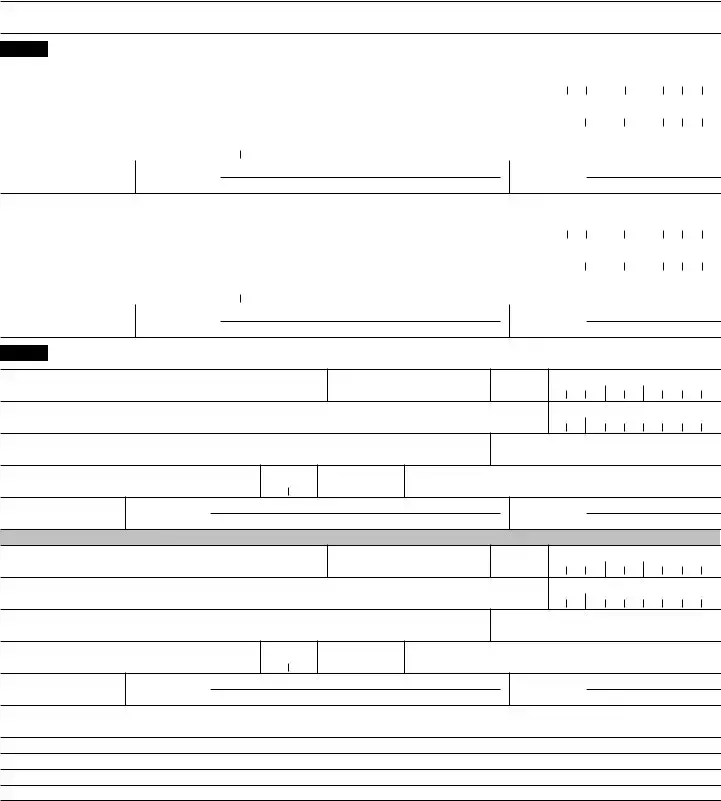
Multiple Parties
(Complete applicable parts below if box 2 or 15 on page 1 is checked.)
Part I
3 |
Last name |
|
|
4 First name |
|
5 M.I. |
6 Taxpayer identification number |
|||||
|
|
|
|
|
|
|
|
|
|
|
|
|
|
|
|
|
|
|
|
|
|
|
|
|
|
7 |
Address (number, street, and apt. or suite no.) |
|
|
8 |
Date of birth |
|
M M D D Y Y Y Y |
|||||
|
|
|
|
|
|
|
(see instructions) |
|
|
|
||
|
|
|
|
|
|
|
|
|
|
|||
|
|
|
|
|
|
|
|
|
|
|
|
|
9 |
City |
10 State |
11 ZIP code |
|
12 Country (if not U.S.) |
|
13 Occupation, profession, or business |
|||||
|
|
|
|
|
|
|
|
|
|
|
|
|
14Identifying document (ID)
aDescribe ID c Number
b Issued by
|
|
|
|
|
|
|
|
|
|
|
|
|
3 |
Last name |
|
|
4 First name |
|
5 M.I. |
6 Taxpayer identification number |
|||||
|
|
|
|
|
|
|
|
|
|
|
|
|
|
|
|
|
|
|
|
|
|
|
|
|
|
7 |
Address (number, street, and apt. or suite no.) |
|
|
8 |
Date of birth |
|
M M D D Y Y Y Y |
|||||
|
|
|
|
|
|
|
(see instructions) |
|
||||
|
|
|
|
|
|
|
|
|
|
|||
|
|
|
|
|
|
|
|
|
|
|
|
|
9 |
City |
10 State |
11 ZIP code |
|
12 Country (if not U.S.) |
|
13 Occupation, profession, or business |
|||||
|
|
|
|
|
|
|
|
|
|
|
|
|
14Identifying document (ID)
aDescribe ID c Number
b Issued by
Part II
16Individual’s last name or organization’s name
17First name
18M.I.
19Taxpayer identification number
20Doing business as (DBA) name (see instructions)
Employer identification number
21Address (number, street, and apt. or suite no.)
22Occupation, profession, or business
23City
24State
25ZIP code
26Country (if not U.S.)
27Alien identification (ID)
aDescribe ID c Number
b Issued by
16Individual’s last name or organization’s name
17First name
18M.I.
19Taxpayer identification number
20Doing business as (DBA) name (see instructions)
Employer identification number
21Address (number, street, and apt. or suite no.)
22Occupation, profession, or business
23City
24State
25ZIP code
26Country (if not U.S.)
27Alien identification (ID)
aDescribe ID c Number
b Issued by
Comments – Please use the lines provided below to comment on or clarify any information you entered on any line in Parts I, II, III, and IV
IRS Form 8300 (Rev. |
FinCEN Form 8300 (Rev. |
| Fact Name | Description |
|---|---|
| Purpose | The IRS Form 8300 is used to report cash payments received in a trade or business that exceed $10,000. |
| Filing Requirement | Businesses must file Form 8300 within 15 days of receiving cash payments that meet or exceed the $10,000 threshold. |
| Recipient Information | The form requires detailed information about the person or entity making the cash payment, including their name, address, and taxpayer identification number. |
| State-Specific Forms | Some states may have their own reporting requirements. For example, California has the California Cash Transaction Reporting (CCTR) law, which aligns with the federal requirement. |
| Penalties | Failure to file Form 8300 or filing it late can result in significant penalties, including fines and potential criminal charges for willful neglect. |
After gathering the necessary information, you can begin filling out the IRS Form 8300. This form is used to report cash payments over $10,000 received in a trade or business. Completing it accurately is essential for compliance with federal regulations.
What is the IRS Form 8300?
The IRS Form 8300 is a document that businesses must file when they receive more than $10,000 in cash in a single transaction or related transactions. This form helps the IRS track large cash transactions to prevent money laundering and other illegal activities. It is important to note that the definition of cash includes not only physical currency but also certain monetary instruments, like traveler's checks and money orders.
Who is required to file Form 8300?
Any business or individual engaged in a trade or business that receives cash payments exceeding $10,000 must file Form 8300. This requirement applies to a wide range of industries, including retail, real estate, and professional services. If you are unsure whether your transaction qualifies, it is best to err on the side of caution and file the form.
What information is needed to complete Form 8300?
To fill out Form 8300, you will need to provide specific information about the transaction, including:
Gathering this information ahead of time can streamline the filing process.
When is Form 8300 due?
Form 8300 must be filed within 15 days of receiving the cash payment. This deadline is crucial to ensure compliance with IRS regulations. If the 15th day falls on a weekend or holiday, the form should be filed on the next business day. Failure to file on time may result in penalties, so it is advisable to keep track of your transactions closely.
What happens if I don’t file Form 8300?
Not filing Form 8300 when required can lead to significant consequences. The IRS may impose penalties, which can be substantial. Additionally, failing to report large cash transactions may raise red flags during audits or investigations. It is always better to comply with IRS regulations to avoid potential legal issues.
Filling out the IRS 8300 form can be a daunting task for many individuals and businesses. This form is used to report cash transactions exceeding $10,000, and accuracy is crucial. Here are ten common mistakes people often make when completing the form.
One frequent error is incorrect identification of the payer. It’s essential to provide accurate details about the individual or entity making the cash payment. Missing or incorrect names can lead to processing delays and potential penalties.
Another mistake is failing to report all cash transactions. If multiple transactions occur over a short period, and the total exceeds $10,000, each transaction should be reported. Omitting any part of the cash received can result in compliance issues.
Many people also overlook the importance of the date. The form requires the date of the transaction, and inaccuracies here can cause confusion. Always double-check that the date matches the transaction date.
Providing incomplete addresses is another common pitfall. The form requires full addresses for both the payer and the recipient. Missing street numbers or zip codes can lead to difficulties in processing the form.
Some individuals mistakenly use the wrong form version. The IRS updates forms periodically, and using an outdated version can result in rejection. Always ensure you have the most current form from the IRS website.
Another common error is not signing the form. A signature is necessary to validate the submission. Without it, the form may be considered incomplete, leading to potential fines.
People often forget to keep a copy of the submitted form. This is crucial for record-keeping and can be helpful in case of future inquiries or audits. Always retain a copy for your records.
Providing incorrect monetary amounts is also a frequent issue. Double-check all figures to ensure accuracy. A simple typo can lead to significant problems down the line.
Some filers do not file the form on time. The IRS has strict deadlines for submitting the 8300 form. Late submissions can incur penalties, so it’s essential to be aware of the due dates.
Lastly, many individuals fail to understand the reporting requirements. It’s important to familiarize yourself with the rules surrounding cash transactions. Ignorance of these regulations can lead to costly mistakes.
By being aware of these common mistakes, individuals and businesses can better navigate the process of filling out the IRS 8300 form. Attention to detail is key, and taking the time to review the form can save headaches in the future.
The IRS Form 8300 is used to report cash payments over $10,000 received in a trade or business. It helps the IRS track large cash transactions to prevent money laundering and other illegal activities. When filing this form, you may need to gather additional documents to ensure everything is complete and accurate. Below is a list of other forms and documents often used alongside the IRS 8300.
Gathering these documents can streamline the process of filing Form 8300 and ensure compliance with IRS regulations. Keeping accurate records is essential for any business, especially when handling large cash transactions.
The IRS Form 8300 is primarily used to report cash payments over $10,000 received in a trade or business. Several other documents serve similar purposes in terms of reporting financial transactions or compliance with tax regulations. Here are six documents that share similarities with Form 8300:
When filling out the IRS 8300 form, it’s important to get it right. Here are some key do's and don'ts to keep in mind:
The IRS 8300 form is a crucial document for businesses and individuals who receive large amounts of cash. However, several misconceptions surround its purpose and use. Here are seven common misunderstandings about the IRS 8300 form:
Understanding these misconceptions can help individuals and businesses navigate their responsibilities regarding cash transactions more effectively. Awareness and compliance with the IRS 8300 form requirements are crucial for avoiding penalties and ensuring smooth financial operations.
Filling out the IRS 8300 form is an important responsibility for businesses that receive cash payments over a certain amount. Here are some key takeaways to keep in mind: