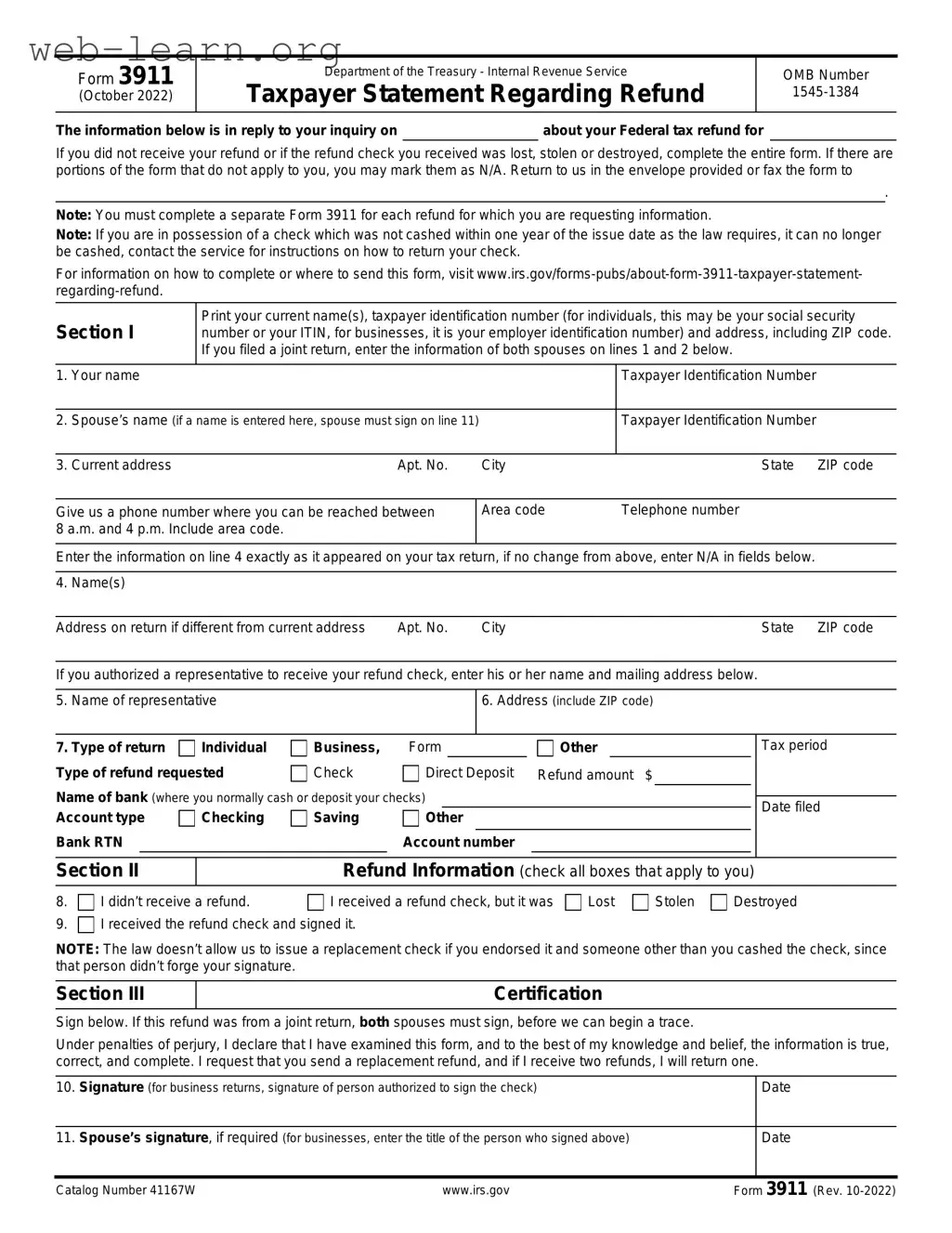
The IRS 3911 form serves as a crucial tool for taxpayers seeking to resolve issues related to their tax refunds. When individuals or businesses face challenges in receiving their expected refunds, this form provides a structured way to initiate an inquiry with the Internal Revenue Service. It is designed to help taxpayers track the status of their refunds and understand any delays that may have occurred. Completing the form involves providing personal information, such as the taxpayer's name, Social Security number, and details about the tax return in question. Additionally, the IRS 3911 form prompts individuals to specify the nature of their inquiry, allowing the IRS to address specific concerns effectively. Understanding how to properly fill out and submit this form can significantly enhance the chances of a timely resolution, ensuring that taxpayers receive the refunds they are entitled to. By navigating this process, individuals can gain clarity on their refund status and take proactive steps toward resolving any outstanding issues with the IRS.
Form 3911
(October 2022)
Department of the Treasury - Internal Revenue Service
Taxpayer Statement Regarding Refund
OMB Number
The information below is in reply to your inquiry on |
about your Federal tax refund for |
If you did not receive your refund or if the refund check you received was lost, stolen or destroyed, complete the entire form. If there are portions of the form that do not apply to you, you may mark them as N/A. Return to us in the envelope provided or fax the form to
.
Note: You must complete a separate Form 3911 for each refund for which you are requesting information.
Note: If you are in possession of a check which was not cashed within one year of the issue date as the law requires, it can no longer be cashed, contact the service for instructions on how to return your check.
For information on how to complete or where to send this form, visit
Section I
Print your current name(s), taxpayer identification number (for individuals, this may be your social security number or your ITIN, for businesses, it is your employer identification number) and address, including ZIP code. If you filed a joint return, enter the information of both spouses on lines 1 and 2 below.
1. Your name
Taxpayer Identification Number
2.Spouse’s name (if a name is entered here, spouse must sign on line 11)
Taxpayer Identification Number
3. Current address |
Apt. No. |
City |
State |
ZIP code |
Give us a phone number where you can be reached between 8 a.m. and 4 p.m. Include area code.
Area code |
Telephone number |
Enter the information on line 4 exactly as it appeared on your tax return, if no change from above, enter N/A in fields below.
4. Name(s)
Address on return if different from current address |
Apt. No. |
City |
|
|
|
|
|
|
|
|
State ZIP code |
|||||||
|
|
|
|
|
|
|
|
|
|
|
|
|||||||
If you authorized a representative to receive your refund check, enter his or her name and mailing address below. |
||||||||||||||||||
|
|
|
|
|
|
|
|
|
|
|
|
|
|
|
|
|||
5. |
Name of representative |
|
|
|
|
6. Address (include ZIP code) |
|
|
|
|
||||||||
|
|
|
|
|
|
|
|
|
|
|
|
|
|
|
|
|
|
|
7. |
Type of return |
Individual |
Business, |
Form |
|
|
|
|
Other |
|
|
|
|
|
Tax period |
|||
Type of refund requested |
Check |
Direct Deposit |
|
Refund amount |
$ |
|
|
|
|
|
||||||||
Name of bank (where you normally cash or deposit your checks) |
|
|
|
|
|
|
|
|
|
|
|
|
||||||
|
|
|
|
|
|
|
|
|
Date filed |
|||||||||
Account type |
Checking |
Saving |
Other |
|
|
|
|
|
|
|
|
|
||||||
|
|
|
|
|
|
|
|
|
|
|
||||||||
Bank RTN |
|
|
|
Account number |
|
|
|
|
|
|
|
|
|
|
||||
|
|
|
|
|
||||||||||||||
Section II |
|
Refund Information (check all boxes that apply to you) |
|
|
||||||||||||||
8. |
I didn’t receive a refund. |
I received a refund check, but it was |
Lost |
|
Stolen |
Destroyed |
||||||||||||
9. |
I received the refund check and signed it. |
|
|
|
|
|
|
|
|
|
|
|
|
|
|
|||
NOTE: The law doesn’t allow us to issue a replacement check if you endorsed it and someone other than you cashed the check, since that person didn’t forge your signature.
Section III
Certification
Sign below. If this refund was from a joint return, both spouses must sign, before we can begin a trace.
Under penalties of perjury, I declare that I have examined this form, and to the best of my knowledge and belief, the information is true, correct, and complete. I request that you send a replacement refund, and if I receive two refunds, I will return one.
10. |
Signature (for business returns, signature of person authorized to sign the check) |
|
Date |
|
|
|
|
|
|
11. |
Spouse’s signature, if required (for businesses, enter the title of the person who signed above) |
|
Date |
|
|
|
|
|
|
Catalog Number 41167W |
www.irs.gov |
Form 3911 (Rev. |
||

Privacy Act and Paperwork Reduction Act Notice
We ask for the information on this form to carry out the Internal Revenue laws of the United States.
You aren’t required to give us the information since the refund you claimed has already been issued. However, without the information we won’t be able to trace your refund, and may be unable to replace it. You may give us the information we need in a letter.
We need the information to ensure that you are complying with these laws and to allow us to determine the correctness of your refund or the right amount of payment. Your Social Security Number and the other information are being requested in order that the Department of the Treasury can process your refund. The authority of requesting your social security number is 26 United States Code, section 6109. If you cannot or will not furnish the information, the tracing of your refund may be delayed.
You are not required to provide the information requested on a form that is subject to the Paperwork Reduction Act unless the form displays a valid OMB control number. Books or record relating to a form or its instructions must be retained as long as their contents may become material in the administration of any Internal Revenue law. Generally, tax returns and return information are confidential, as required by Internal Revenue Code section 6103. The time needed to compete and file this form will vary depending on individual circumstances. The estimated average time is less than 5 minutes.
If you have comments concerning the accuracy of this time estimate or suggestions for making this form simpler, we would be happy to hear from you. You can write to the Internal Revenue Service, Attention: Tax Products Coordinating Committee, Western Area Distribution Center, Rancho Cordova, CA
Do not send this form to this office. Instead, please use the envelope provided or mail the form to the Internal Revenue Service center where you would normally file a paper tax return.
Catalog Number 41167W |
www.irs.gov |
Form 3911 (Rev. |
| Fact Name | Description |
|---|---|
| Purpose | The IRS Form 3911 is used to request a trace of a tax refund that has not been received. |
| Eligibility | Taxpayers who have not received their expected tax refund can use this form. |
| Filing Method | Form 3911 can be filed by mail or fax, depending on the specific instructions provided by the IRS. |
| Processing Time | It typically takes the IRS 6 to 8 weeks to process a request submitted on Form 3911. |
| State-Specific Forms | Some states have their own forms for tracing state tax refunds; check with your state's Department of Revenue. |
| Governing Laws | State laws governing tax refunds vary; refer to your state’s tax code for specific regulations. |
| Required Information | Taxpayers must provide their Social Security number, filing status, and the amount of the expected refund. |
| Contact Information | Include your current address and phone number to ensure the IRS can reach you regarding your request. |
| Submission Address | Mail or fax the completed Form 3911 to the address specified in the form instructions, based on your location. |
After obtaining the IRS 3911 form, you will be ready to provide the necessary information to process your request. Carefully follow the steps outlined below to ensure that the form is completed accurately.
Once you have submitted the form, the IRS will review your request and reach out to you for any additional information if needed. Keep an eye on your mailbox or email for updates regarding your inquiry.
What is the IRS Form 3911?
IRS Form 3911 is used to request a refund trace. If you believe that your tax refund has not been received, this form helps you track its status. It provides the IRS with the necessary information to locate your refund and determine what happened to it.
Who should use Form 3911?
This form is typically used by individuals who have filed their tax returns and are expecting a refund but have not received it within the expected timeframe. If you’ve checked the IRS “Where’s My Refund?” tool and still have concerns, you should consider submitting Form 3911.
How do I fill out Form 3911?
To fill out Form 3911, you will need to provide your personal information, including your name, Social Security number, and the tax year for which you are requesting a refund trace. The form also asks for details about your filing status and the amount of your expected refund. Ensure that all information is accurate to avoid delays.
What happens after I submit Form 3911?
After you submit Form 3911, the IRS will begin the process of tracing your refund. This can take several weeks, depending on the circumstances. You may receive a notice from the IRS with updates or additional information. If the IRS finds your refund, they will issue it to you as soon as possible.
Filling out the IRS Form 3911 can be a daunting task, and many individuals make common mistakes that can delay their tax refund or cause complications in the process. One frequent error is failing to provide accurate personal information. This includes your name, Social Security number, and address. If any of these details are incorrect, it can lead to significant delays in processing your claim.
Another mistake often seen is not signing the form. The IRS requires a signature to validate your request for a refund trace. Omitting this crucial step can result in the form being rejected or not processed at all. Ensure you take a moment to review the form before submission to confirm that all required fields are complete, including your signature.
People also tend to overlook the importance of selecting the correct box that corresponds to the reason for the refund trace. The IRS provides specific options, and choosing the wrong one can lead to confusion and delays. Take the time to read each option carefully and select the one that accurately reflects your situation.
In addition, many individuals neglect to provide sufficient details regarding the refund they are tracing. This includes the tax year, the amount expected, and any other relevant information. Without these specifics, the IRS may struggle to locate your refund, prolonging the process unnecessarily.
Another common pitfall is not keeping a copy of the completed form for personal records. This can lead to difficulties if you need to follow up on your request later. Having a copy allows you to reference what you submitted and can be helpful in discussions with IRS representatives.
Additionally, some people fail to submit the form through the correct channels. Ensure that you are sending the completed form to the appropriate IRS address. Using the wrong mailing address can cause delays, as your form may not reach the right department.
Finally, many individuals do not follow up on their submission. After sending in the IRS Form 3911, it is wise to check in with the IRS after a reasonable period. This proactive approach can help you stay informed about the status of your request and address any potential issues promptly.
The IRS 3911 form is used to request a trace of a refund. However, several other forms and documents may be necessary to support your request or to resolve related tax issues. Below is a list of commonly used forms and documents that can accompany the IRS 3911 form.
Having these forms and documents ready can streamline the process of tracing your refund and resolving any related issues. Each document serves a specific purpose and can provide valuable information to the IRS as well as support your request.
The IRS Form 3911 is used to request a refund trace for a tax refund that has not been received. Several other documents serve similar purposes in helping taxpayers manage their tax situations. Here are eight documents that share similarities with Form 3911:
When filling out the IRS 3911 form, it is crucial to follow certain guidelines to ensure accuracy and efficiency. Below is a list of things you should and shouldn't do:
The IRS 3911 form, also known as the "Taxpayer Statement Regarding Refund," can be confusing for many taxpayers. Here are six common misconceptions about this form, along with clarifications to help you better understand its purpose and use.
This is not true. While it is commonly used by taxpayers who have filed returns, anyone who believes they are entitled to a refund can use the form to inquire about their refund status.
Filing this form does not guarantee a faster refund. It simply allows you to inquire about the status of your refund. The actual processing time depends on various factors.
This form is specifically designed for federal tax refunds. State tax refunds have their own processes and forms, which differ from the IRS 3911.
Submitting the form does not mean the IRS will automatically issue a refund. The form is a request for information, not a claim for a refund.
While it can be used in cases of lost checks, the form is also helpful for anyone who has questions about their refund status, regardless of the situation.
Taxpayers can check their refund status online through the IRS website or by calling the IRS directly. The 3911 form is just one way to obtain information.
Understanding these misconceptions can help you navigate the process more effectively. If you have questions or concerns about your tax situation, seeking professional guidance can provide clarity and support.
The IRS 3911 form is an important document for taxpayers seeking to track their tax refunds. Here are some key takeaways to keep in mind when filling out and using this form:
By understanding these key points, you can navigate the process of using the IRS 3911 form more effectively and ensure that your concerns are addressed.