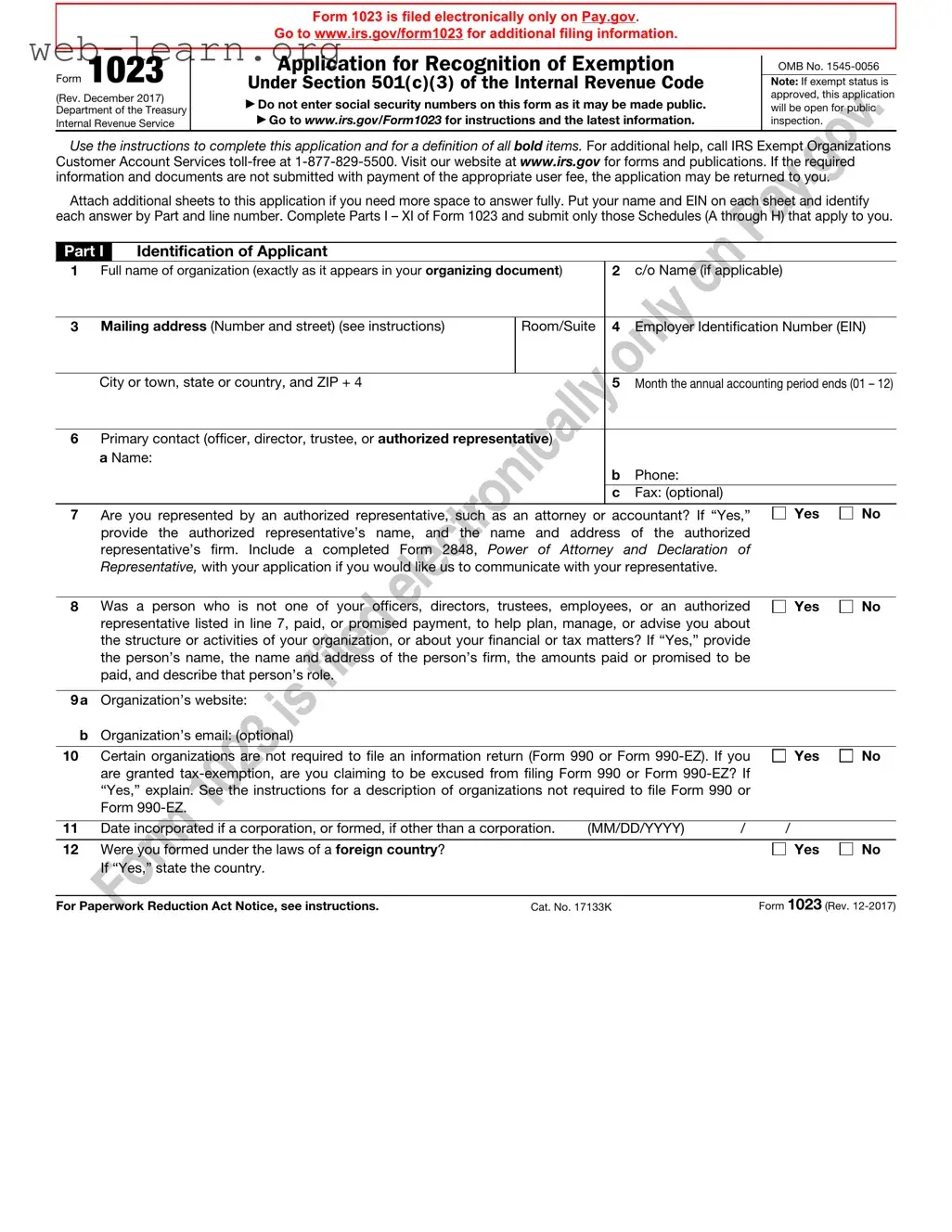
The IRS 1023 form serves as a crucial document for organizations seeking tax-exempt status under Section 501(c)(3) of the Internal Revenue Code. This form provides the Internal Revenue Service with detailed information about the organization’s structure, purpose, and activities. By completing the 1023, applicants outline their mission, governance, and financial plans, thereby demonstrating their eligibility for tax-exempt status. The form requires a comprehensive description of the organization’s programs and how they align with charitable purposes. Additionally, it necessitates the submission of supporting documents, such as articles of incorporation and bylaws, which further clarify the organization’s operational framework. Completing the IRS 1023 accurately is vital, as it can significantly impact an organization’s ability to receive donations and grants, as well as its overall financial sustainability. Understanding the nuances of this form is essential for any nonprofit aiming to navigate the complexities of federal tax regulations effectively.
Form 1023 is filed electronically only on Pay.gov.
Go to www.irs.gov/form1023 for additional filing information.
Form 1023
(Rev. December 2017)
Department of the Treasury
Internal Revenue Service
Application for Recognition of Exemption
Under Section 501(c)(3) of the Internal Revenue Code
▶Do not enter social security numbers on this form as it may be made public. ▶ Go to www.irs.gov/Form1023 for instructions and the latest information.
OMB No.
Note: If exempt status is approved, this application will be open for public inspection.
Use the instructions to complete this application and for a definition of all bold items. For additional help, call IRS Exempt Organizations Customer Account Services
Attach additional sheets to this application if you need more space to answer fully. Put your name and EIN on each sheet and identify each answer by Part and line number. Complete Parts I – XI of Form 1023 and submit only those Schedules (A through H) that apply to you.
Part I |
Identification of Applicant |
|
|
|
|
1 |
Full name of organization (exactly as it appears in your organizing document) |
2 |
c/o Name (if applicable) |
||
|
|
|
|
|
|
3 |
Mailing address (Number and street) (see instructions) |
Room/Suite |
4 |
Employer Identification Number (EIN) |
|
|
|
|
|
|
|
|
City or town, state or country, and ZIP + 4 |
|
5 |
Month the annual accounting period ends (01 – 12) |
|
|
|
|
|
||
6 |
Primary contact (officer, director, trustee, or authorized representative) |
|
|
||
|
a Name: |
|
|
|
|
|
|
|
|
b |
Phone: |
|
|
|
|
|
|
|
|
|
|
c |
Fax: (optional) |
7Are you represented by an authorized representative, such as an attorney or accountant? If “Yes,” provide the authorized representative’s name, and the name and address of the authorized representative’s firm. Include a completed Form 2848, Power of Attorney and Declaration of Representative, with your application if you would like us to communicate with your representative.
Yes
No
8Was a person who is not one of your officers, directors, trustees, employees, or an authorized representative listed in line 7, paid, or promised payment, to help plan, manage, or advise you about the structure or activities of your organization, or about your financial or tax matters? If “Yes,” provide the person’s name, the name and address of the person’s firm, the amounts paid or promised to be paid, and describe that person’s role.
Yes
No
9a Organization’s website:
bOrganization’s email: (optional)
10Certain organizations are not required to file an information return (Form 990 or Form
Yes
No
11 |
Date incorporated if a corporation, or formed, if other than a corporation. |
(MM/DD/YYYY) |
/ |
/ |
|
|
12 |
Were you formed under the laws of a foreign country? |
|
|
|
Yes |
No |
|
If “Yes,” state the country. |
|
|
|
|
|
|
|
|
|
|||
For Paperwork Reduction Act Notice, see instructions. |
Cat. No. 17133K |
|
Form 1023 (Rev. |
|||
Form 1023 (Rev. |
Name: |
EIN: |
Page 2 |
Part II Organizational Structure
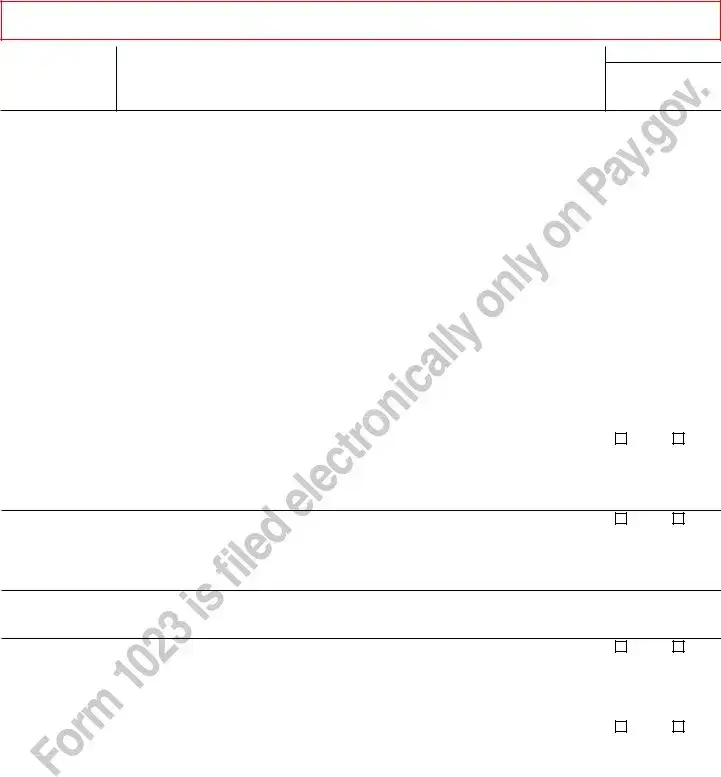
You must be a corporation (including a limited liability company), an unincorporated association, or a trust to be tax exempt.
See instructions. DO NOT file this form unless you can check “Yes” on lines 1, 2, 3, or 4.
1 |
Are you a corporation? If “Yes,” attach a copy of your articles of incorporation showing certification of |
Yes |
No |
|
|
|
filing with the appropriate state agency. Include copies of any amendments to your articles and be sure |
|
|
|
|
they also show state filing certification. |
|
|
|
|
|
|
|
2 |
Are you a limited liability company (LLC)? If “Yes,” attach a copy of your articles of organization showing |
Yes |
No |
|
|
|
certification of filing with the appropriate state agency. Also, if you adopted an operating agreement, attach |
|
|
|
|
a copy. Include copies of any amendments to your articles and be sure they show state filing certification. |
|
|
|
|
Refer to the instructions for circumstances when an LLC should not file its own exemption application. |
|
|
|
|
|
|
|
3 |
Are you an unincorporated association? If “Yes,” attach a copy of your articles of association, |
Yes |
No |
|
|
|
constitution, or other similar organizing document that is dated and includes at least two signatures. |
|
|
|
|
Include signed and dated copies of any amendments. |
|
|
|
|
|
|
|
|
4a |
Are you a trust? If “Yes,” attach a signed and dated copy of your trust agreement. Include signed and |
Yes |
No |
|
|
dated copies of any amendments. |
|
|
|
b |
Have you been funded? If “No,” explain how you are formed without anything of value placed in trust. |
Yes |
No |
|
5 |
Have you adopted bylaws? If “Yes,” attach a current copy showing date of adoption. If “No,” explain |
Yes |
No |
|
|
how your officers, directors, or trustees are selected. |
|
|
Part III Required Provisions in Your Organizing Document
The following questions are designed to ensure that when you file this application, your organizing document contains the required provisions to meet the organizational test under section 501(c)(3). Unless you can check the boxes in both lines 1 and 2, your organizing document does not meet the organizational test. DO NOT file this application until you have amended your organizing document. Submit your original and amended organizing documents (showing state filing certification if you are a corporation or an LLC) with your application.
1Section 501(c)(3) requires that your organizing document state your exempt purpose(s), such as charitable, religious, educational, and/or scientific purposes. Check the box to confirm that your organizing document meets this requirement. Describe specifically where your organizing document meets this requirement, such as a reference to a particular article or section in your organizing document. Refer to the instructions for exempt purpose language.
Location of Purpose Clause (Page, Article, and Paragraph):
2 a Section 501(c)(3) requires that upon dissolution of your organization, your remaining assets must be used exclusively for exempt purposes, such as charitable, religious, educational, and/or scientific purposes. Check the box on line 2a to confirm that your organizing document meets this requirement by express provision for the distribution of assets upon dissolution. If you rely on state law for your dissolution provision, do not check the box on line 2a and go to line 2c.
bIf you checked the box on line 2a, specify the location of your dissolution clause (Page, Article, and Paragraph). Do not complete line 2c if you checked box 2a.
c See the instructions for information about the operation of state law in your particular state. Check this box if you rely on operation of state law for your dissolution provision and indicate the state:
Part IV |
Narrative Description of Your Activities |
Using an attachment, describe your past, present, and planned activities in a narrative. If you believe that you have already provided some of this information in response to other parts of this application, you may summarize that information here and refer to the specific parts of the application for supporting details. You may also attach representative copies of newsletters, brochures, or similar documents for supporting details to this narrative. Remember that if this application is approved, it will be open for public inspection. Therefore, your narrative description of activities should be thorough and accurate. Refer to the instructions for information that must be included in your description.
Part V Compensation and Other Financial Arrangements With Your Officers, Directors, Trustees, Employees, and Independent Contractors
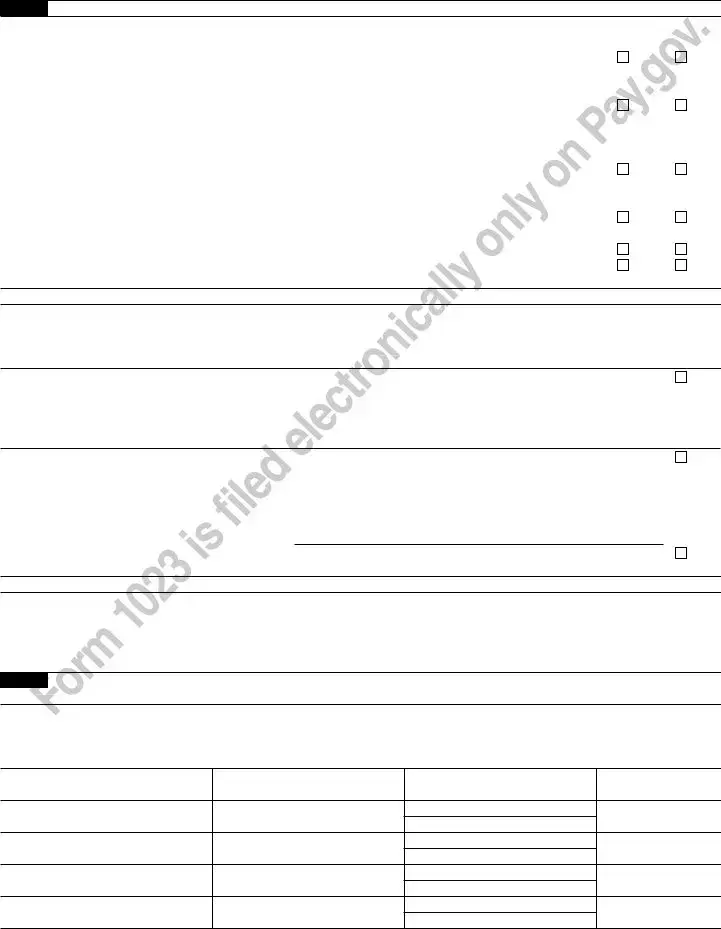
1a List the names, titles, and mailing addresses of all of your officers, directors, and trustees. For each person listed, state their total annual compensation, or proposed compensation, for all services to the organization, whether as an officer, employee, or other position. Use actual figures, if available. Enter “none” if no compensation is or will be paid. If additional space is needed, attach a separate sheet. Refer to the instructions for information on what to include as compensation.
Name
Title
Mailing address
Compensation amount (annual actual or estimated)
Form 1023 (Rev.
Form 1023 (Rev. |
Name: |
EIN: |
Page 3 |
|
Part V |
Compensation and Other Financial Arrangements With Your Officers, Directors, Trustees, Employees, |
|||
|
and Independent Contractors (Continued) |
|
|
|
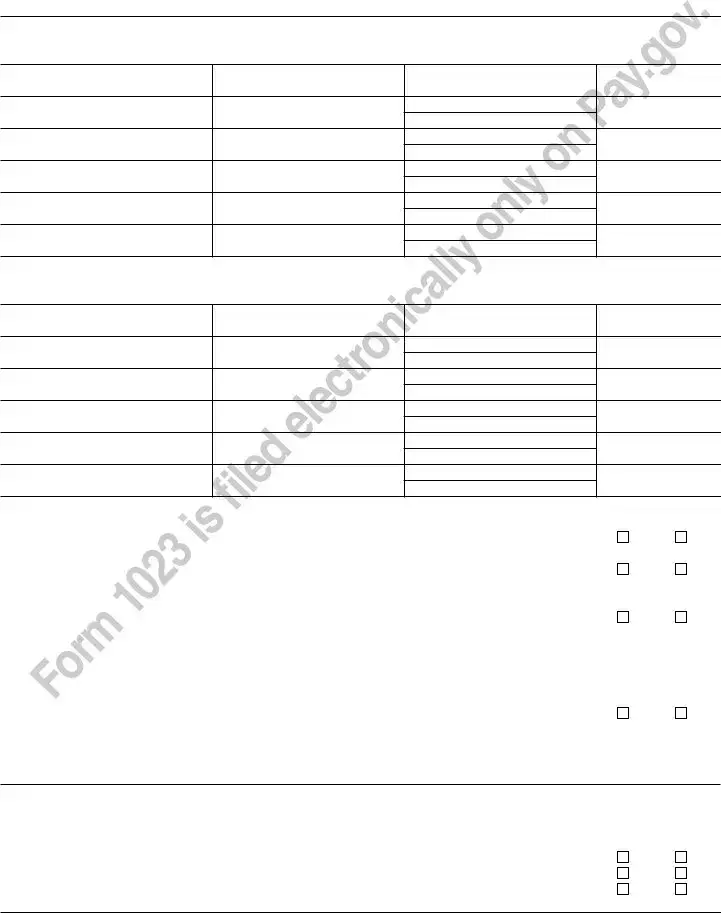
bList the names, titles, and mailing addresses of each of your five highest compensated employees who receive or will receive compensation of more than $50,000 per year. Use the actual figure, if available. Refer to the instructions for information on what to include as compensation. Do not include officers, directors, or trustees listed in line 1a.
Name
Title
Mailing address
Compensation amount (annual actual or estimated)
cList the names, names of businesses, and mailing addresses of your five highest compensated independent contractors that receive or will receive compensation of more than $50,000 per year. Use the actual figure, if available. Refer to the instructions for information on what to include as compensation.
Name
Title
Mailing address
Compensation amount (annual actual or estimated)
The following “Yes” or “No” questions relate to past, present, or planned relationships, transactions, or agreements with your officers, directors, trustees, highest compensated employees, and highest compensated independent contractors listed in lines 1a, 1b, and 1c.
2a |
Are any of your officers, directors, or trustees related to each other through family or business |
Yes |
No |
|
relationships? If “Yes,” identify the individuals and explain the relationship. |
|
|
b |
Do you have a business relationship with any of your officers, directors, or trustees other than through |
Yes |
No |
|
their position as an officer, director, or trustee? If “Yes,” identify the individuals and describe the business |
|
|
|
relationship with each of your officers, directors, or trustees. |
|
|
c |
Are any of your officers, directors, or trustees related to your highest compensated employees or highest |
Yes |
No |
|
compensated independent contractors listed on lines 1b or 1c through family or business relationships? If |
|
|
|
“Yes,” identify the individuals and explain the relationship. |
|
|
|
|
|
|
3 a |
For each of your officers, directors, trustees, highest compensated employees, and highest |
|
|
|
compensated independent contractors listed on lines 1a, 1b, or 1c, attach a list showing their name, |
|
|
|
qualifications, average hours worked, and duties. |
|
|
b |
Do any of your officers, directors, trustees, highest compensated employees, and highest compensated |
Yes |
No |
|
independent contractors listed on lines 1a, 1b, or 1c receive compensation from any other organizations, |
|
|
|
whether tax exempt or taxable, that are related to you through common control? If “Yes,” identify the |
|
|
|
individuals, explain the relationship between you and the other organization, and describe the |
|
|
|
compensation arrangement. |
|
|
4In establishing the compensation for your officers, directors, trustees, highest compensated employees, and highest compensated independent contractors listed on lines 1a, 1b, and 1c, the following practices are recommended, although they are not required to obtain exemption. Answer “Yes” to all the practices you use.
a |
Do you or will the individuals that approve compensation arrangements follow a conflict of interest policy? |
Yes |
No |
b |
Do you or will you approve compensation arrangements in advance of paying compensation? |
Yes |
No |
c |
Do you or will you document in writing the date and terms of approved compensation arrangements? |
Yes |
No |
Form 1023 (Rev.

Form 1023 (Rev. |
Name: |
EIN: |
Page 4 |
|
Part V |
Compensation and Other Financial Arrangements With Your Officers, Directors, Trustees, Employees, |
|||
|
and Independent Contractors (Continued) |
|
|
|
dDo you or will you record in writing the decision made by each individual who decided or voted on compensation arrangements?
eDo you or will you approve compensation arrangements based on information about compensation paid by similarly situated taxable or
Yes |
No |
Yes |
No |
f Do you or will you record in writing both the information on which you relied to base your decision and its |
Yes |
No |
source? |
|
|
gIf you answered “No” to any item on lines 4a through 4f, describe how you set compensation that is reasonable for your officers, directors, trustees, highest compensated employees, and highest compensated independent contractors listed in Part V, lines 1a, 1b, and 1c.
5a Have you adopted a conflict of interest policy consistent with the sample conflict of interest policy in |
Yes |
No |
Appendix A to the instructions? If “Yes,” provide a copy of the policy and explain how the policy has |
|
|
been adopted, such as by resolution of your governing board. If “No,” answer lines 5b and 5c. |
|
|
bWhat procedures will you follow to assure that persons who have a conflict of interest will not have influence over you for setting their own compensation?
cWhat procedures will you follow to assure that persons who have a conflict of interest will not have influence over you regarding business deals with themselves?
Note: A conflict of interest policy is recommended though it is not required to obtain exemption. Hospitals, see Schedule C, Section I, line 14.
6a |
Do you or will you compensate any of your officers, directors, trustees, highest compensated employees, and highest |
Yes |
No |
|
compensated independent contractors listed in lines 1a, 1b, or 1c through |
|
|
|
bonuses or |
|
|
|
amounts are determined, who is eligible for such arrangements, whether you place a limitation on total compensation, |
|
|
|
and how you determine or will determine that you pay no more than reasonable compensation for services. Refer to |
|
|
|
the instructions for Part V, lines 1a, 1b, and 1c, for information on what to include as compensation. |
|
|
b |
Do you or will you compensate any of your employees, other than your officers, directors, trustees, or your |
Yes |
No |
|
five highest compensated employees who receive or will receive compensation of more than $50,000 per |
|
|
|
year, through |
|
|
|
describe all |
|
|
|
is or will be eligible for such arrangements, whether you place or will place a limitation on total compensation, |
|
|
|
and how you determine or will determine that you pay no more than reasonable compensation for services. |
|
|
|
Refer to the instructions for Part V, lines 1a, 1b, and 1c, for information on what to include as compensation. |
|
|
|
|
|
|
7a |
Do you or will you purchase any goods, services, or assets from any of your officers, directors, trustees, highest |
Yes |
No |
|
compensated employees, or highest compensated independent contractors listed in lines 1a, 1b, or 1c? If “Yes,” |
|
|
|
describe any such purchase that you made or intend to make, from whom you make or will make such purchases, how |
|
|
|
the terms are or will be negotiated at arm’s length, and explain how you determine or will determine that you pay no |
|
|
|
more than fair market value. Attach copies of any written contracts or other agreements relating to such purchases. |
|
|
b |
Do you or will you sell any goods, services, or assets to any of your officers, directors, trustees, highest |
Yes |
No |
|
compensated employees, or highest compensated independent contractors listed in lines 1a, 1b, or 1c? If “Yes,” |
|
|
|
describe any such sales that you made or intend to make, to whom you make or will make such sales, how the |
|
|
|
terms are or will be negotiated at arm’s length, and explain how you determine or will determine you are or will be |
|
|
|
paid at least fair market value. Attach copies of any written contracts or other agreements relating to such sales. |
|
|
|
|
|
|
8a |
Do you or will you have any leases, contracts, loans, or other agreements with your officers, directors, |
Yes |
No |
|
trustees, highest compensated employees, or highest compensated independent contractors listed in |
|
|
lines 1a, 1b, or 1c? If “Yes,” provide the information requested in lines 8b through 8f.
bDescribe any written or oral arrangements that you made or intend to make.
cIdentify with whom you have or will have such arrangements.
dExplain how the terms are or will be negotiated at arm’s length.
eExplain how you determine you pay no more than fair market value or you are paid at least fair market value. f Attach copies of any signed leases, contracts, loans, or other agreements relating to such arrangements.
9a Do you or will you have any leases, contracts, loans, or other agreements with any organization in which |
Yes |
No |
any of your officers, directors, or trustees are also officers, directors, or trustees, or in which any individual officer, director, or trustee owns more than a 35% interest? If “Yes,” provide the information requested in lines 9b through 9f.
Form 1023 (Rev.

Form 1023 (Rev. |
Name: |
EIN: |
Page 5 |
|
Part V |
Compensation and Other Financial Arrangements With Your Officers, Directors, Trustees, |
|
||
|
Employees, and Independent Contractors (Continued) |
|
|
|
bDescribe any written or oral arrangements you made or intend to make.
cIdentify with whom you have or will have such arrangements.
dExplain how the terms are or will be negotiated at arm’s length.
eExplain how you determine or will determine you pay no more than fair market value or that you are paid at least fair market value.
fAttach a copy of any signed leases, contracts, loans, or other agreements relating to such arrangements.
Part VI |
Your Members and Other Individuals and Organizations That Receive Benefits From You |
The following “Yes” or “No” questions relate to goods, services, and funds you provide to individuals and organizations as part of your activities. Your answers should pertain to past, present, and planned activities. See instructions.
1 a In carrying out your exempt purposes, do you provide goods, services, or funds to individuals? If “Yes,” describe each program that provides goods, services, or funds to individuals.
bIn carrying out your exempt purposes, do you provide goods, services, or funds to organizations? If “Yes,” describe each program that provides goods, services, or funds to organizations.
Yes |
No |
Yes |
No |
2 |
Do any of your programs limit the provision of goods, services, or funds to a specific individual or group |
Yes |
No |
|
|
of specific individuals? For example, answer “Yes,” if goods, services, or funds are provided only for a |
|
|
|
|
particular individual, your members, individuals who work for a particular employer, or graduates of a |
|
|
|
|
particular school. If “Yes,” explain the limitation and how recipients are selected for each program. |
|
|
|
|
|
|
|
|
3 |
Do any individuals who receive goods, services, or funds through your programs have a family or |
Yes |
No |
|
|
business relationship with any officer, director, trustee, or with any of your highest compensated |
|
|
|
|
employees or highest compensated independent contractors listed in Part V, lines 1a, 1b, and 1c? If |
|
|
|
|
“Yes,” explain how these related individuals are eligible for goods, services, or funds. |
|
|
|
|
|
|
|
|
Part VII |
Your History |
|
|
|
The following “Yes” or “No” questions relate to your history. See instructions.
1 |
Are you a successor to another organization? Answer “Yes,” if you have taken or will take over the |
Yes |
No |
||
|
|
activities of another organization; you took over 25% or more of the fair market value of the net assets of |
|
|
|
|
|
another organization; or you were established upon the conversion of an organization from |
|
|
|
|
|
nonprofit status. If “Yes,” complete Schedule G. |
|
|
|
|
|
|
|
||
|
2 |
Are you submitting this application more than 27 months after the end of the month in which you were |
Yes |
No |
|
|
|
legally formed? If “Yes,” complete Schedule E. |
|
|
|
|
|
|
|
|
|
|
Part VIII |
Your Specific Activities |
|
|
|
The following “Yes” or “No” questions relate to specific activities that you may conduct. Check the appropriate box. Your answers should pertain to past, present, and planned activities. See instructions.
1 Do you support or oppose candidates in political campaigns in any way? If “Yes,” explain. |
Yes |
No |
|
2 a |
Do you attempt to influence legislation? If “Yes,” explain how you attempt to influence legislation and |
Yes |
No |
|
complete line 2b. If “No,” go to line 3a. |
|
|
b |
Have you made or are you making an election to have your legislative activities measured by |
Yes |
No |
|
expenditures by filing Form 5768? If “Yes,” attach a copy of the Form 5768 that was already filed or |
|
|
|
attach a completed Form 5768 that you are filing with this application. If “No,” describe whether your |
|
|
|
attempts to influence legislation are a substantial part of your activities. Include the time and money |
|
|
|
spent on your attempts to influence legislation as compared to your total activities. |
|
|
3a Do you or will you operate bingo or gaming activities? If “Yes,” describe who conducts them, and list all revenue received or expected to be received and expenses paid or expected to be paid in operating these activities. Revenue and expenses should be provided for the time periods specified in Part IX, Financial Data.
bDo you or will you enter into contracts or other agreements with individuals or organizations to conduct bingo or gaming for you? If “Yes,” describe any written or oral arrangements that you made or intend to make, identify with whom you have or will have such arrangements, explain how the terms are or will be negotiated at arm’s length, and explain how you determine or will determine you pay no more than fair market value or you will be paid at least fair market value. Attach copies or any written contracts or other agreements relating to such arrangements.
cList the states and local jurisdictions, including Indian Reservations, in which you conduct or will conduct gaming or bingo.
Yes |
No |
Yes |
No |
Form 1023 (Rev.

Form 1023 (Rev. |
Name: |
EIN: |
|
Page 6 |
|
Part VIII |
Your Specific Activities (Continued) |
|
|
|
|
4 a Do |
you or will you undertake fundraising? If “Yes,” check all the fundraising programs you do or will |
Yes |
No |
||
conduct. See instructions. |
|
|
|
||
|
mail solicitations |
|
phone solicitations |
|
|
|
email solicitations |
|
accept donations on your website |
|
|
|
personal solicitations |
receive donations from another organization’s website |
|
||
|
vehicle, boat, plane, or similar donations |
government grant solicitations |
|
|
|
|
foundation grant solicitations |
Other |
|
|
|
Attach a description of each fundraising program.
b Do you or will you have written or oral contracts with any individuals or organizations to raise funds for |
Yes |
No |
you? If “Yes,” describe these activities. Include all revenue and expenses from these activities and state |
|
|
who conducts them. Revenue and expenses should be provided for the time periods specified in Part IX, |
|
|
Financial Data. Also, attach a copy of any contracts or agreements. |
|
|
c Do you or will you engage in fundraising activities for other organizations? If “Yes,” describe these |
Yes |
No |
arrangements. Include a description of the organizations for which you raise funds and attach copies of |
|
|
all contracts or agreements. |
|
|
dList all states and local jurisdictions in which you conduct fundraising. For each state or local jurisdiction listed, specify whether you fundraise for your own organization, you fundraise for another organization, or another organization fundraises for you.
e |
Do you or will you maintain separate accounts for any contributor under which the contributor has the |
Yes |
No |
|
right to advise on the use or distribution of funds? Answer “Yes” if the donor may provide advice on the |
|
|
|
types of investments, distributions from the types of investments, or the distribution from the donor’s |
|
|
|
contribution account. If “Yes,” describe this program, including the type of advice that may be provided |
|
|
|
and submit copies of any written materials provided to donors. |
|
|
|
|
|
|
5 |
Are you affiliated with a governmental unit? If “Yes,” explain. |
Yes |
No |
6a |
Do you or will you engage in economic development? If “Yes,” describe your program. |
Yes |
No |
bDescribe in full who benefits from your economic development activities and how the activities promote exempt purposes.
7a |
Do or will persons other than your employees or volunteers develop your facilities? If “Yes,” describe |
Yes |
No |
|
each facility, the role of the developer, and any business or family relationship(s) between the developer |
|
|
|
and your officers, directors, or trustees. |
|
|
b |
Do or will persons other than your employees or volunteers manage your activities or facilities? If “Yes,” |
Yes |
No |
|
describe each activity and facility, the role of the manager, and any business or family relationship(s) |
|
|
|
between the manager and your officers, directors, or trustees. |
|
|
cIf there is a business or family relationship between any manager or developer and your officers, directors, or trustees, identify the individuals, explain the relationship, describe how contracts are negotiated at arm’s length so that you pay no more than fair market value, and submit a copy of any contracts or other agreements.
8 Do you or will you enter into joint ventures, including partnerships or limited liability companies |
Yes |
No |
treated as partnerships, in which you share profits and losses with partners other than section 501(c)(3) |
|
|
organizations? If “Yes,” describe the activities of these joint ventures in which you participate. |
|
|
9a Are you applying for exemption as a childcare organization under section 501(k)? If “Yes,” answer lines 9b through 9d. If “No,” go to line 10.
bDo you provide childcare so that parents or caretakers of children you care for can be gainfully employed (see instructions)? If “No,” explain how you qualify as a childcare organization described in section 501(k).
Yes |
No |
Yes |
No |
cOf the children for whom you provide childcare, are 85% or more of them cared for by you to enable their parents or caretakers to be gainfully employed (see instructions)? If “No,” explain how you qualify as a childcare organization described in section 501(k).
dAre your services available to the general public? If “No,” describe the specific group of people for whom your activities are available. Also, see the instructions and explain how you qualify as a childcare organization described in section 501(k).
Yes |
No |
Yes |
No |
10 Do you or will you publish, own, or have rights in music, literature, tapes, artworks, choreography, |
Yes |
No |
scientific discoveries, or other intellectual property? If “Yes,” explain. Describe who owns or will own any copyrights, patents, or trademarks, whether fees are or will be charged, how the fees are determined, and how any items are or will be produced, distributed, and marketed.
Form 1023 (Rev.

Form 1023 (Rev. |
Name: |
EIN: |
|
Page 7 |
||
Part VIII |
Your Specific Activities (Continued) |
|
|
|
||
11 |
Do you or will you accept contributions of: real property; conservation easements; closely held |
Yes |
No |
|||
|
securities; intellectual property such as patents, trademarks, and copyrights; works of music or art; |
|
|
|||
|
licenses; royalties; automobiles, boats, planes, or other vehicles; or collectibles of any type? If “Yes,” |
|
|
|||
|
describe each type of contribution, any conditions imposed by the donor on the contribution, and any |
|
|
|||
|
agreements with the donor regarding the contribution. |
|
|
|
||
12 a |
Do you or will you operate in a foreign country or countries? If “Yes,” answer lines 12b through 12d. If |
Yes |
No |
|||
|
“No,” go to line 13a. |
|
|
|
|
|
b |
Name the foreign countries and regions within the countries in which you operate. |
|
|
|
||
c |
Describe your operations in each country and region in which you operate. |
|
|
|
||
d |
Describe how your operations in each country and region further your exempt purposes. |
|
|
|
||
|
|
|
|
|||
13a |
Do you or will you make grants, loans, or other distributions to organization(s)? If “Yes,” answer lines 13b |
Yes |
No |
|||
|
through 13g. If “No,” go to line 14a. |
|
|
|
||
bDescribe how your grants, loans, or other distributions to organizations further your exempt purposes.
c Do you have written contracts with each of these organizations? If “Yes,” attach a copy of each contract. |
Yes |
No |
dIdentify each recipient organization and any relationship between you and the recipient organization.
eDescribe the records you keep with respect to the grants, loans, or other distributions you make.
fDescribe your selection process, including whether you do any of the following.
(i) |
Do you require an application form? If “Yes,” attach a copy of the form. |
Yes |
No |
(ii) |
Do you require a grant proposal? If “Yes,” describe whether the grant proposal specifies your |
Yes |
No |
|
responsibilities and those of the grantee, obligates the grantee to use the grant funds only for the |
|
|
|
purposes for which the grant was made, provides for periodic written reports concerning the use of |
|
|
|
grant funds, requires a final written report and an accounting of how grant funds were used, and |
|
|
|
acknowledges your authority to withhold and/or recover grant funds in case such funds are, or appear |
|
|
|
to be, misused. |
|
|
gDescribe your procedures for oversight of distributions that assure you the resources are used to further your exempt purposes, including whether you require periodic and final reports on the use of resources.
14 a Do you or will you make grants, loans, or other distributions to foreign organizations? If “Yes,” answer lines 14b through 14f. If “No,” go to line 15.
bProvide the name of each foreign organization, the country and regions within a country in which each foreign organization operates, and describe any relationship you have with each foreign organization.
cDoes any foreign organization listed in line 14b accept contributions earmarked for a specific country or specific organization? If “Yes,” list all earmarked organizations or countries.
dDo your contributors know that you have ultimate authority to use contributions made to you at your discretion for purposes consistent with your exempt purposes? If “Yes,” describe how you relay this information to contributors.
eDo you or will you make
fDo you or will you use any additional procedures to ensure that your distributions to foreign organizations are used in furtherance of your exempt purposes? If “Yes,” describe these procedures, including site visits by your employees or compliance checks by impartial experts, to verify that grant funds are being used appropriately.
Yes |
No |
Yes |
No |
Yes |
No |
Yes |
No |
Yes |
No |
Form 1023 (Rev.

|
Form 1023 (Rev. |
Name: |
EIN: |
|
Page 8 |
||
|
Part VIII |
Your Specific Activities (Continued) |
|
|
|
||
15 |
Do you have a close connection with any organizations? If “Yes,” explain. |
|
Yes |
No |
|||
|
16 |
Are you applying for exemption as a cooperative hospital service organization under section 501(e)? If |
Yes |
No |
|||
|
|
“Yes,” explain. |
|
|
|
|
|
|
|
|
|
|
|||
17 |
Are you applying for exemption as a cooperative service organization of operating educational |
Yes |
No |
||||
|
|
organizations under section 501(f)? If “Yes,” explain. |
|
|
|
||
|
|
|
|
||||
|
18 |
Are you applying for exemption as a charitable risk pool under section 501(n)? If “Yes,” explain. |
Yes |
No |
|||
|
19 |
Do you or will you operate a school? If “Yes,” complete Schedule B. Answer “Yes,” whether you operate |
Yes |
No |
|||
|
|
a school as your main function or as a secondary activity. |
|
|
|
||
|
|
|
|
||||
|
20 |
Is your main function to provide hospital or medical care? If “Yes,” complete Schedule C. |
Yes |
No |
|||
|
21 |
Do you or will you provide |
Yes |
No |
|||
|
|
complete Schedule F. |
|
|
|
|
|
|
|
|
|
|
|||
22 |
Do you or will you provide scholarships, fellowships, educational loans, or other educational grants to |
Yes |
No |
||||
|
|
individuals, including grants for travel, study, or other similar purposes? If “Yes,” complete |
Schedule H. |
|
|
||
Note: Private foundations may use Schedule H to request advance approval of individual grant procedures.
Form 1023 (Rev.
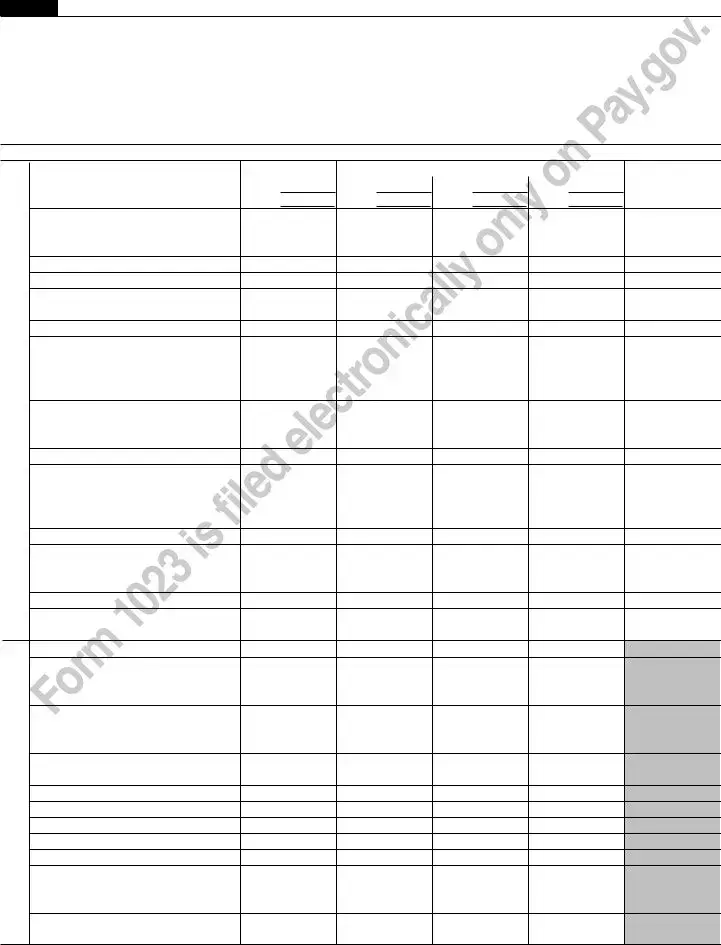
Form 1023 (Rev. |
Name: |
EIN: |
Page 9 |
|
Part IX |
Financial Data |
|
|
|
For purposes of this schedule, years in existence refer to completed tax years.
1.If in existence less than 5 years, complete the statement for each year in existence and provide projections of your likely revenues and expenses based on a reasonable and good faith estimate of your future finances for a total of:
a.Three years of financial information if you have not completed one tax year, or
b.Four years of financial information if you have completed one tax year. See instructions.
2.If in existence 5 or more years, complete the schedule for the most recent 5 tax years. You will need to provide a separate statement that includes information about the most recent 5 tax years because the data table in Part IX has not been updated to provide for a 5th year. See instructions.
A.Statement of Revenues and Expenses
Revenues
Expenses
Type of revenue or expense |
Current tax year |
|
3 prior tax years or 2 succeeding tax years |
|
|
|
|
|
|
|
|
|
(a) From |
(b) From |
(c) From |
(d) From |
(e) Provide Total for |
|
To |
To |
To |
To |
(a) through (d) |
1Gifts, grants, and contributions received (do not include unusual grants)
2Membership fees received
3Gross investment income
4Net unrelated business income
5Taxes levied for your benefit
6Value of services or facilities furnished by a governmental unit without charge (not including the value of services generally furnished to the public without charge)
7Any revenue not otherwise listed above or in lines
8Total of lines 1 through 7
9Gross receipts from admissions, merchandise sold or services performed, or furnishing of facilities in any activity that is related to your exempt purposes (attach itemized list)
10Total of lines 8 and 9
11Net gain or loss on sale of capital assets (attach schedule and see instructions)
12Unusual grants
13Total Revenue
Add lines 10 through 12
14 Fundraising expenses
15Contributions, gifts, grants, and similar amounts paid out (attach an itemized list)
16Disbursements to or for the benefit of members (attach an itemized list)
17Compensation of officers, directors, and trustees
18 Other salaries and wages
19 Interest expense
20 Occupancy (rent, utilities, etc.)
21 Depreciation and depletion
22 Professional fees
23Any expense not otherwise classified, such as program services (attach itemized list)
24Total Expenses
Add lines 14 through 23
Form 1023 (Rev.

|
Form 1023 (Rev. |
Name: |
EIN: |
|
|
Page 10 |
||
|
Part IX |
Financial Data (Continued) |
|
|
|
|
||
|
|
|
|
B. Balance Sheet (for your most recently completed tax year) |
|
|
Year End: |
|
|
|
|
|
Assets |
|
|
(Whole dollars) |
|
1 |
Cash |
1 |
|
|
||||
2 |
Accounts receivable, net |
2 |
|
|
||||
3 |
Inventories |
3 |
|
|
||||
4 |
Bonds and notes receivable (attach an itemized list) |
4 |
|
|
||||
5 |
Corporate stocks (attach an itemized list) |
5 |
|
|
||||
6 |
Loans receivable (attach an itemized list) |
6 |
|
|
||||
7 |
Other investments (attach an itemized list) |
7 |
|
|
||||
8 |
Depreciable and depletable assets (attach an itemized list) |
8 |
|
|
||||
9 |
Land |
9 |
|
|
||||
10 |
Other assets (attach an itemized list) |
10 |
|
|
||||
11 |
Total Assets (add lines 1 through 10) |
11 |
|
|
||||
|
|
|
|
Liabilities |
|
|
|
|
12 |
Accounts payable |
12 |
|
|
||||
13 |
Contributions, gifts, grants, etc. payable |
13 |
|
|
||||
14 |
Mortgages and notes payable (attach an itemized list) |
14 |
|
|
||||
15 |
Other liabilities (attach an itemized list) |
15 |
|
|
||||
16 |
Total Liabilities (add lines 12 through 15) |
16 |
|
|
||||
|
|
|
|
Fund Balances or Net Assets |
|
|
|
|
17 |
Total fund balances or net assets |
17 |
|
|
||||
18 |
Total Liabilities and Fund Balances or Net Assets (add lines 16 and 17) |
18 |
|
|
||||
|
19 |
Have there been any substantial changes in your assets or liabilities since the end of the period |
|
Yes |
No |
|||
|
|
shown above? If “Yes,” explain. |
|
|
|
|
||
Part X Public Charity Status
Part X is designed to classify you as an organization that is either a private foundation or a public charity. Public charity status is a more favorable tax status than private foundation status. If you are a private foundation, Part X is designed to further determine whether you are a private operating foundation. See instructions.
|
1 a |
Are you a private foundation? If “Yes,” go to line 1b. If “No,” go to line 5 and proceed as instructed. If you |
Yes |
No |
|
|
are unsure, see the instructions. |
|
|
|
b |
As a private foundation, section 508(e) requires special provisions in your organizing document in |
|
|
|
|
addition to those that apply to all organizations described in section 501(c)(3). Check the box to confirm |
|
|
|
|
that your organizing document meets this requirement, whether by express provision or by reliance on |
|
|
|
|
operation of state law. Attach a statement that describes specifically where your organizing document |
|
|
|
|
meets this requirement, such as a reference to a particular article or section in your organizing document |
|
|
|
|
or by operation of state law. See the instructions, including Appendix B, for information about the special |
|
|
|
|
provisions that need to be contained in your organizing document. Go to line 2. |
|
|
|
|
|
|
|
|
2 |
Are you a private operating foundation? To be a private operating foundation you must engage directly in |
Yes |
No |
|
|
the active conduct of charitable, religious, educational, and similar activities, as opposed to indirectly |
|
|
|
|
carrying out these activities by providing grants to individuals or other organizations. If “Yes,” go to line 3. |
|
|
|
|
If “No,” go to the signature section of Part XI. |
|
|
|
|
|
|
|
3 |
Have you existed for one or more years? If “Yes,” attach financial information showing that you are a |
Yes |
No |
|
|
|
private operating foundation; go to the signature section of Part XI. If “No,” continue to line 4. |
|
|
|
|
|
|
|
|
4 |
Have you attached either (1) an affidavit or opinion of counsel, (including a written affidavit or opinion |
Yes |
No |
|
|
from a certified public accountant or accounting firm with expertise regarding this tax law matter), that |
|
|
|
|
sets forth facts concerning your operations and support to demonstrate that you are likely to satisfy the |
|
|
|
|
requirements to be classified as a private operating foundation; or (2) a statement describing your |
|
|
|
|
proposed operations as a private operating foundation? |
|
|
5If you answered “No” to line 1a, indicate the type of public charity status you are requesting by checking one of the choices below. You may check only one box.
The organization is not a private foundation because it is:
a 509(a)(1) and
c509(a)(1) and
d
Form 1023 (Rev.
| Fact Name | Description |
|---|---|
| Purpose | The IRS Form 1023 is used to apply for recognition of exemption from federal income tax under Section 501(c)(3) of the Internal Revenue Code. |
| Eligibility | This form is specifically for organizations that are charitable, educational, religious, or scientific in nature. |
| Filing Deadline | Organizations must file Form 1023 within 27 months of their formation date to receive tax-exempt status retroactively. |
| Fees | As of 2023, the filing fee for Form 1023 is $600, while smaller organizations may qualify to use Form 1023-EZ, which has a reduced fee of $275. |
| State Requirements | In addition to federal requirements, many states have their own registration processes for nonprofits. Check with your state’s governing laws for specific forms and requirements. |
| Processing Time | The IRS typically takes about 3 to 6 months to process Form 1023, but this can vary based on the complexity of the application. |
Completing the IRS Form 1023 is an essential step for organizations seeking tax-exempt status. The process requires careful attention to detail and an understanding of the information needed to support your application. Below are the steps to guide you through filling out this important form.
The IRS Form 1023 is an application that organizations must submit to the Internal Revenue Service (IRS) to obtain recognition as a tax-exempt entity under Section 501(c)(3) of the Internal Revenue Code. This designation is crucial for nonprofits as it allows them to be exempt from federal income tax and enables donors to make tax-deductible contributions.
Any organization that seeks to operate as a nonprofit and wishes to be recognized as tax-exempt under Section 501(c)(3) must file Form 1023. This includes charities, educational institutions, religious organizations, and other entities that serve the public interest. If your organization is planning to solicit donations or apply for grants, obtaining this status is often essential.
The form requires detailed information about the organization, including:
Gathering this information can be time-consuming, but it is essential for a successful application.
The processing time for Form 1023 can vary significantly. Typically, it takes anywhere from 3 to 6 months for the IRS to review and respond to the application. However, during peak periods or if there are issues with the application, it may take longer. Organizations can expedite the process by ensuring that all required information is complete and accurate before submission.
Once the IRS approves Form 1023, the organization receives a determination letter confirming its tax-exempt status. This letter is important for several reasons:
Maintaining compliance with IRS regulations is crucial to retaining this status.
If the IRS denies the application, the organization will receive a letter explaining the reasons for the denial. Common reasons include insufficient information, failure to meet the requirements for tax-exempt status, or discrepancies in the application. Organizations can appeal the decision or address the issues outlined in the denial letter and reapply. Seeking assistance from a legal expert can be beneficial during this process.
Filing the IRS Form 1023 can be a complex process for organizations seeking tax-exempt status. Many applicants make mistakes that can lead to delays or even denials. One common error is failing to provide complete information about the organization’s structure. When sections are left blank or inadequately filled, it raises red flags for the IRS. Ensure that every section is thoroughly completed, as this is crucial for a smooth application process.
Another frequent mistake involves not clearly outlining the organization’s mission and activities. The IRS needs to understand the purpose of your organization and how it plans to achieve its goals. Vague descriptions or overly broad statements can lead to confusion. Be specific about your programs and how they align with your mission.
Many applicants also overlook the importance of financial information. Inaccurate or incomplete financial data can jeopardize your application. It’s essential to provide a detailed budget and financial projections for the next few years. This information helps the IRS assess the sustainability of your organization.
Some organizations fail to include all necessary supporting documents. This can include articles of incorporation, bylaws, and a detailed narrative of past and planned activities. Omitting these documents can result in delays or additional requests for information. Always double-check that you have included everything required.
Additionally, applicants sometimes misinterpret the eligibility requirements for tax-exempt status. Not all organizations qualify, and misunderstanding these criteria can lead to wasted time and effort. Make sure to review the IRS guidelines thoroughly to confirm that your organization meets all requirements.
Another mistake is neglecting to address potential conflicts of interest. The IRS expects organizations to have policies in place to manage conflicts effectively. Failing to disclose potential conflicts can create issues later on. Be transparent about any relationships that could be perceived as conflicts.
Many applicants also underestimate the importance of a well-prepared narrative description of activities. This section should detail the organization’s past and planned activities, demonstrating how they align with the exempt purpose. A lack of clarity or detail in this narrative can lead to misunderstandings about the organization’s goals.
Finally, some organizations do not seek professional help when needed. While it’s possible to complete the form independently, consulting with someone experienced in nonprofit law can provide valuable insights. This can help avoid common pitfalls and ensure a more robust application.
When applying for tax-exempt status under section 501(c)(3) of the Internal Revenue Code, the IRS Form 1023 is a crucial document. However, several other forms and documents often accompany this application to provide a comprehensive view of the organization’s structure and activities. Below is a list of these essential documents, each serving a specific purpose.
Submitting the IRS Form 1023 along with these additional documents can significantly strengthen your application for tax-exempt status. Each piece of documentation plays a vital role in presenting a complete picture of your organization’s mission, governance, and financial outlook.
The IRS Form 1023 is a crucial document for organizations seeking tax-exempt status under Section 501(c)(3). Several other forms share similarities with it, often in their purpose or structure. Below is a list of eight documents that are similar to the IRS 1023 form:
Understanding these documents can help organizations navigate the complex landscape of tax-exempt status and compliance.
When filling out the IRS 1023 form, it's important to follow certain guidelines to ensure your application is successful. Here are some things you should and shouldn't do:
The IRS Form 1023 is an important document for organizations seeking tax-exempt status under Section 501(c)(3) of the Internal Revenue Code. However, several misconceptions exist regarding this form. Below is a list of six common misconceptions along with clarifications.
This is not true. Form 1023 can be used by organizations of all sizes, including small nonprofits. The key factor is that the organization must meet the requirements for tax-exempt status, regardless of its size.
Filing the form does not automatically result in tax-exempt status. The IRS reviews the application and determines whether the organization qualifies based on its activities and structure.
Not all organizations are required to file this form. Some smaller organizations may qualify to file a simplified version called Form 1023-EZ, while others may not need to file at all if they do not seek tax-exempt status.
Organizations must adhere to ongoing compliance requirements. This includes filing annual returns, such as Form 990, to maintain their tax-exempt status.
While it is possible to file without legal assistance, consulting with a professional can help ensure that the application is completed accurately and comprehensively, potentially reducing the likelihood of delays or denials.
When filling out and using the IRS 1023 form, there are several important points to keep in mind. Here are five key takeaways: