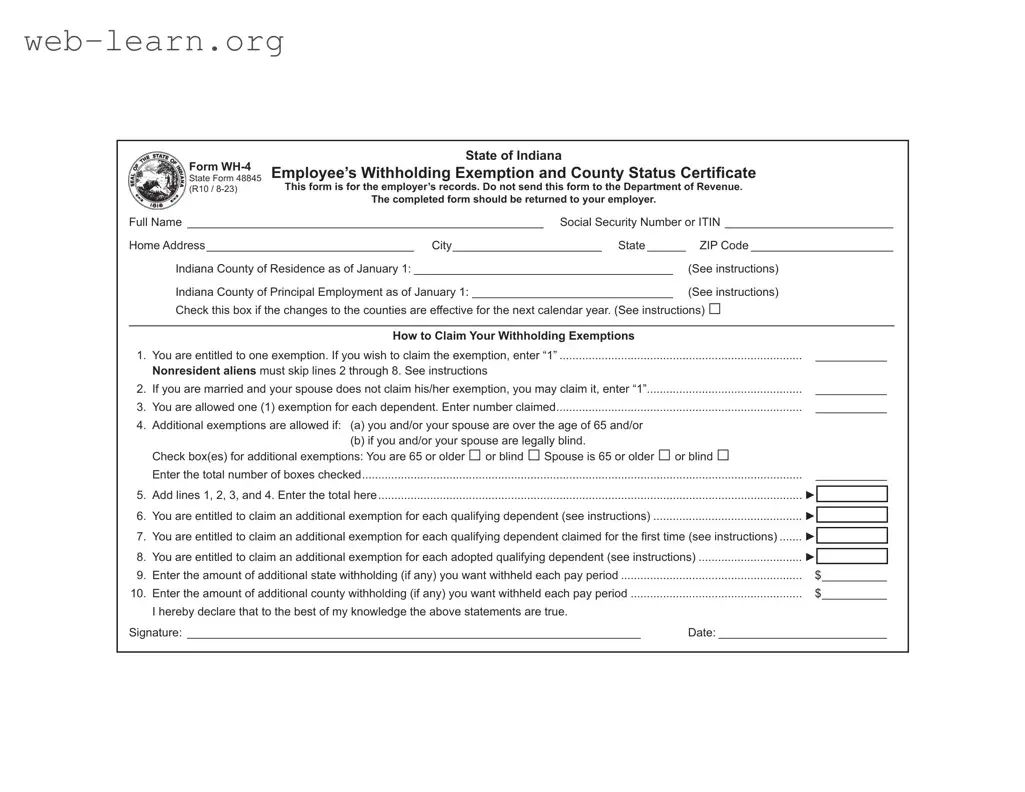
The Indiana WH-4 form, officially designated as the Employee’s Withholding Exemption and County Status Certificate, plays a critical role in the state’s tax system. Designed for both resident and nonresident employees, this form serves as a means for individuals to communicate their withholding exemptions to their employers, thus influencing the amount of state and county income tax withheld from their paychecks. Employees must provide essential personal information, including their full name, Social Security number or ITIN, and home address. Additionally, they are required to specify their county of residence and principal employment as of January 1 of the current year. The form allows individuals to claim various exemptions: one for themselves, one for a non-claiming spouse, and additional exemptions for dependents, as well as for individuals over the age of 65 or who are legally blind. Furthermore, employees have the option to request additional amounts to be withheld from their wages. It is important to note that the completed WH-4 should be returned directly to the employer and not submitted to the Indiana Department of Revenue. By accurately completing this form, employees can ensure that their tax withholding aligns with their financial circumstances, thereby avoiding potential under-withholding or over-withholding issues throughout the tax year.

Form
State Form 48845 (R10 /
State of Indiana
Employee’s Withholding Exemption and County Status Certificate
This form is for the employer’s records. Do not send this form to the Department of Revenue.
The completed form should be returned to your employer.
Full Name_ _______________________________________________________ Social Security Number or ITIN___________________________
Home Address_________________________________ City_______________________ State_______ |
ZIP Code_______________________ |
||||
|
Indiana County of Residence as of January 1:_________________________________________ |
(See instructions) |
|
|
|
|
Indiana County of Principal Employment as of January 1:________________________________ |
(See instructions) |
|
|
|
|
Check this box if the changes to the counties are effective for the next calendar year. (See instructions) □ |
|
|
|
|
_____________________________________________________________________________________________________________________________________ |
|||||
|
How to Claim Your Withholding Exemptions |
|
|
|
|
1. |
You are entitled to one exemption. If you wish to claim the exemption, enter “1” |
___________ |
|
||
|
Nonresident aliens must skip lines 2 through 8. See instructions |
|
|
|
|
2. |
If you are married and your spouse does not claim his/her exemption, you may claim it, enter “1” |
___________ |
|
||
3. |
You are allowed one (1) exemption for each dependent. Enter number claimed |
___________ |
|
||
4. |
Additional exemptions are allowed if: (a) you and/or your spouse are over the age of 65 and/or |
|
|
|
|
|
(b) if you and/or your spouse are legally blind. |
|
|
|
|
|
Check box(es) for additional exemptions: You are 65 or older □ or blind □ Spouse is 65 or older □ or blind □ |
|
|
|
|
|
Enter the total number of boxes checked |
___________ |
|
||
|
|
|
|
|
|
5. |
Add lines 1, 2, 3, and 4. Enter the total here |
► |
|
|
|
|
|
|
|
||
6. |
You are entitled to claim an additional exemption for each qualifying dependent (see instructions) |
► |
|
|
|
7. |
You are entitled to claim an additional exemption for each qualifying dependent claimed for the first time (see instructions) |
► |
|
|
|
|
|
||||
|
|
|
|||
8. |
.................................You are entitled to claim an additional exemption for each adopted qualifying dependent (see instructions) |
► |
|
|
|
9. |
Enter the amount of additional state withholding (if any) you want withheld each pay period |
$__________ |
|
||
10. |
Enter the amount of additional county withholding (if any) you want withheld each pay period |
$__________ |
|
||
|
I hereby declare that to the best of my knowledge the above statements are true. |
|
|
|
|
Signature:_ ______________________________________________________________________ |
Date:___________________________ |
||||

Instructions for Completing Form
This form should be completed by all resident and nonresident employees having income subject to Indiana state and/or county income tax.
Print or type your full name, Social Security number or ITIN and home address. Enter your Indiana county of residence and county of principal employment as of January 1 of the current year. If you neither lived nor worked in Indiana on January 1 of the current year, enter ‘not applicable’ on the line(s). If you move to (or work in) another county after January 1, your county status will not change until the next calendar year. Please check the box if you are requesting a change to a county of residence or work for the next calendar year.
Nonresident alien limitation. A nonresident alien is allowed to claim only one exemption for withholding tax purposes. If you are a nonresident alien, enter “1” on line 1, then skip to line 9. You are considered to be a nonresident alien if you are not a citizen of the United States and do not meet the green card test and the substantial presence test (get Publication 519 from www.irs.gov for information about these tests).
All other employees should complete lines 1 through 8.
Lines 1 & 2 - You are allowed to claim one exemption for yourself and one for your spouse (if he/she does not claim the exemption for him/herself). If a parent or legal guardian claims you on their federal tax return, you may still claim an exemption for yourself for Indiana purposes. You cannot claim more than the correct number of exemptions; however, you are permitted to claim a lesser number of exemptions if you wish additional withholding to be deducted.
Line 3 - Dependent Exemptions: You are allowed one exemption for each of your dependents based on state guidelines. To qualify as your dependent, a person must receive more than
Line 4 - Additional Exemptions. You are also allowed one exemption each for you and/or your spouse if either is 65 or older and/or blind. Line 5 - Add the total of exemptions claimed on lines 1, 2, 3, and 4. Enter the total in the box provided.
Line 6 - Additional Dependent Exemptions. An additional exemption is allowed for certain dependent children that are included on line 3. The dependent child must be a son, stepson, daughter, stepdaughter, foster child, and/or child for whom you are a legal guardian. The dependent must be under age 19 or must be both under age 24 and a
Line 7 -
Line 8 - Additional Adopted Dependent Exemptions. An additional exemption is allowed for certain dependent children that are included on lines 3 and 6 and have been adopted by you or your spouse. The dependent child must be a son, stepson, daughter, or stepdaughter. The dependent must be under age 19 or must be both under age 24 and a full- time student at a qualified educational institution during at least 5 months of the taxable year.
Lines 9 & 10 - If you would like an additional amount to be withheld from your wages each pay period, enter the amount on the line provided. NOTE: An entry on this line does not obligate your employer to withhold the amount. You are still liable for any additional taxes due at the end of the tax year. If the employer does withhold the additional amount, it should be submitted along with the regular state and county tax withholding.
You may file a new Form
(a)you divorce (or are legally separated from) your spouse for whom you have been claiming an exemption or your spouse claims him/herself on a separate Form
(b)someone else takes over the support of a dependent you claim or you no longer provide more than
(c)a dependent no longer qualifies for an additional dependent or an adopted dependent exemption.
Penalties are imposed for willingly supplying false information or information which would reduce the withholding exemption.
| Fact Name | Details |
|---|---|
| Form Purpose | The Indiana WH-4 form is used by employees to declare their withholding exemptions and county status for state and county income tax purposes. |
| Submission Guidelines | This form is for the employer's records only. Employees must return it to their employer and not send it to the Indiana Department of Revenue. |
| Exemption Claims | Employees are entitled to claim one exemption for themselves, one for their spouse (if applicable), and additional exemptions for dependents. |
| Nonresident Aliens | Nonresident aliens may only claim one exemption for withholding tax purposes and must skip certain lines on the form. |
| Additional Exemptions | Employees may claim additional exemptions if they or their spouse are over 65 years old or legally blind. |
| Dependent Exemptions | One exemption is allowed for each dependent, provided the dependent meets specific income and support criteria. |
| Withholding Amounts | Employees can specify additional amounts to be withheld from their wages for state and county taxes. |
| Form Updates | A new Form WH-4 must be filed within 10 days if the number of exemptions decreases due to life changes, such as divorce or changes in support for dependents. |
| Legal Implications | Providing false information on the WH-4 can result in penalties, emphasizing the importance of accuracy when completing the form. |
Once you have gathered the necessary information, you can proceed to fill out the Indiana WH-4 form. This form is essential for your employer’s records and should be returned directly to them after completion. Follow the steps below to ensure accurate submission.
What is the purpose of the Indiana WH-4 form?
The Indiana WH-4 form is used by employees to claim their withholding exemptions and to provide their county status to their employer. This form helps determine the correct amount of state and county income tax to withhold from an employee's paycheck. It is important to note that this form should not be sent to the Indiana Department of Revenue; rather, it should be returned directly to your employer.
Who needs to complete the WH-4 form?
All resident and nonresident employees who have income subject to Indiana state and/or county income tax must complete the WH-4 form. This includes anyone earning wages in Indiana, regardless of their residency status. If you neither lived nor worked in Indiana on January 1 of the current year, you can indicate ‘not applicable’ in the relevant sections.
How do I determine the number of exemptions I can claim?
You can claim one exemption for yourself. If you are married and your spouse does not claim an exemption, you may claim one for them as well. Additionally, you can claim one exemption for each dependent you support, provided they meet specific criteria. If you or your spouse is 65 or older or legally blind, you may also claim additional exemptions by checking the appropriate boxes on the form.
What if I am a nonresident alien?
Nonresident aliens are limited to claiming only one exemption for withholding tax purposes. If you are a nonresident alien, you should enter “1” on line 1 of the WH-4 form and then skip to line 7, where you can specify any additional amounts you wish to have withheld.
Can I change my exemptions after submitting the WH-4 form?
Yes, you can file a new WH-4 form at any time if the number of exemptions you wish to claim increases. However, if the number of exemptions decreases due to certain life changes—such as divorce or a change in who supports a dependent—you must submit a new form within 10 days to reflect the updated information.
What should I do if I want additional amounts withheld from my paycheck?
If you would like to have additional amounts withheld from your wages, you can specify that on lines 7 and 8 of the WH-4 form. This allows you to indicate how much extra state and county withholding you want taken from each paycheck. Keep in mind that this request does not obligate your employer to withhold the specified amount; you remain responsible for any taxes owed at the end of the year.
What happens if I provide false information on the WH-4 form?
Providing false information or knowingly misrepresenting your exemptions can lead to penalties. It is crucial to ensure that all information provided on the WH-4 form is accurate and truthful. Penalties can be imposed for willingly supplying incorrect information that would reduce your withholding exemptions.
Where can I find more information or assistance with the WH-4 form?
For additional guidance on completing the WH-4 form, you can refer to the instructions included with the form itself. Furthermore, resources are available on the Indiana Department of Revenue's website, where you can find more detailed information regarding exemptions, tax withholding, and related topics.
Completing the Indiana WH-4 form accurately is crucial for ensuring proper tax withholding. However, many individuals make common mistakes that can lead to issues with their tax obligations. Understanding these pitfalls can help prevent unnecessary complications.
One frequent mistake is failing to provide complete personal information. The form requires your full name, Social Security number or ITIN, and home address. Omitting any of these details can delay processing or lead to incorrect tax withholding. Ensure that all information is filled out clearly and correctly.
Another common error involves misunderstanding the exemption claims. Many people mistakenly believe they can claim more exemptions than they are entitled to. For instance, if you are married and your spouse does not claim their exemption, you may claim it. However, if your spouse does claim it, you cannot. It is essential to read the instructions carefully to understand your eligibility.
Some individuals neglect to account for their dependents accurately. Each dependent qualifies for one exemption, but not all dependents meet the requirements. To qualify, a dependent must receive more than half of their support from you and have a gross income below a certain threshold. Misunderstanding these criteria can lead to claiming too many exemptions.
Additionally, individuals often overlook the additional exemptions available for those over 65 or legally blind. If either you or your spouse fits these criteria, it is important to check the appropriate boxes on the form. Failing to do so means missing out on potential tax benefits.
Another mistake occurs when individuals skip lines or fail to perform necessary calculations. For example, line 5 requires you to add the total number of exemptions claimed. Neglecting to do this can result in incorrect withholding amounts. Always double-check your calculations to ensure accuracy.
Some people mistakenly believe that entering an amount for additional withholding on lines 7 and 8 is mandatory. This is not the case. If you do not wish to have additional amounts withheld, simply leave those lines blank. However, if you do choose to enter an amount, be aware that it does not obligate your employer to withhold it.
Another common oversight involves not updating the form when life changes occur. If your marital status changes or someone else begins to support a dependent you previously claimed, you must submit a new WH-4 within ten days. Failing to do so can lead to incorrect withholding and potential penalties.
Finally, individuals sometimes provide inaccurate information intentionally or unintentionally. This can lead to penalties and complications with the Indiana Department of Revenue. It is crucial to ensure that all information provided on the WH-4 form is truthful and complete.
By being aware of these common mistakes, individuals can better navigate the process of completing the Indiana WH-4 form and avoid potential issues with their tax withholding.
The Indiana WH-4 form is essential for employees to declare their withholding exemptions and county status for state income tax purposes. However, several other documents and forms often accompany it to ensure compliance with tax regulations and proper payroll processing. Below is a list of these commonly used forms and documents.
Understanding these forms and documents is vital for both employees and employers in Indiana. Proper completion and timely submission help ensure compliance with tax laws and avoid potential penalties. Always consult with a tax professional if you have questions about your specific situation.
The Indiana WH-4 form is essential for employees in Indiana to declare their withholding exemptions and county status. Several other documents serve similar purposes in different contexts. Here’s a look at five documents that share similarities with the Indiana WH-4 form:
Understanding these forms can help individuals navigate their tax responsibilities more effectively, ensuring they withhold the appropriate amounts throughout the year.
When filling out the Indiana WH-4 form, careful attention to detail can help ensure accuracy and compliance. Here’s a list of things you should and shouldn't do.
By following these guidelines, you can help ensure that your Indiana WH-4 form is filled out correctly and submitted without issues.
Understanding the Indiana WH-4 form is crucial for employees in the state. However, several misconceptions can lead to confusion. Here are ten common misunderstandings:
Addressing these misconceptions can help ensure that employees navigate their tax responsibilities effectively and avoid unnecessary complications.
Understanding the Indiana WH-4 form is crucial for employees subject to state and county income tax. Here are key takeaways to help you navigate the process effectively:
Being diligent in filling out the WH-4 form can help ensure that your tax withholding aligns with your financial situation. Stay informed and proactive to avoid penalties associated with incorrect information.