Homepage Attorney-Approved Vehicle Purchase Agreement Template Attorney-Approved Vehicle Purchase Agreement Document for the State of Indiana
Outline

When buying a vehicle in Indiana, understanding the Vehicle Purchase Agreement form is essential for both buyers and sellers. This form serves as a crucial document that outlines the terms and conditions of the sale, ensuring that both parties are on the same page. Key aspects of the agreement include the vehicle's identification details, such as the make, model, and VIN, which help to clearly define what is being sold. Additionally, the form specifies the purchase price and payment terms, providing clarity on how and when the transaction will occur. Buyers can find reassurance in the included warranty information, which may cover certain aspects of the vehicle's condition, while sellers can protect themselves by disclosing any known issues. The agreement also addresses any contingencies that may arise, such as financing approval or the need for a vehicle inspection. By capturing all these details, the Indiana Vehicle Purchase Agreement form not only facilitates a smoother transaction but also helps to prevent potential disputes down the line.

Sample - Indiana Vehicle Purchase Agreement Form

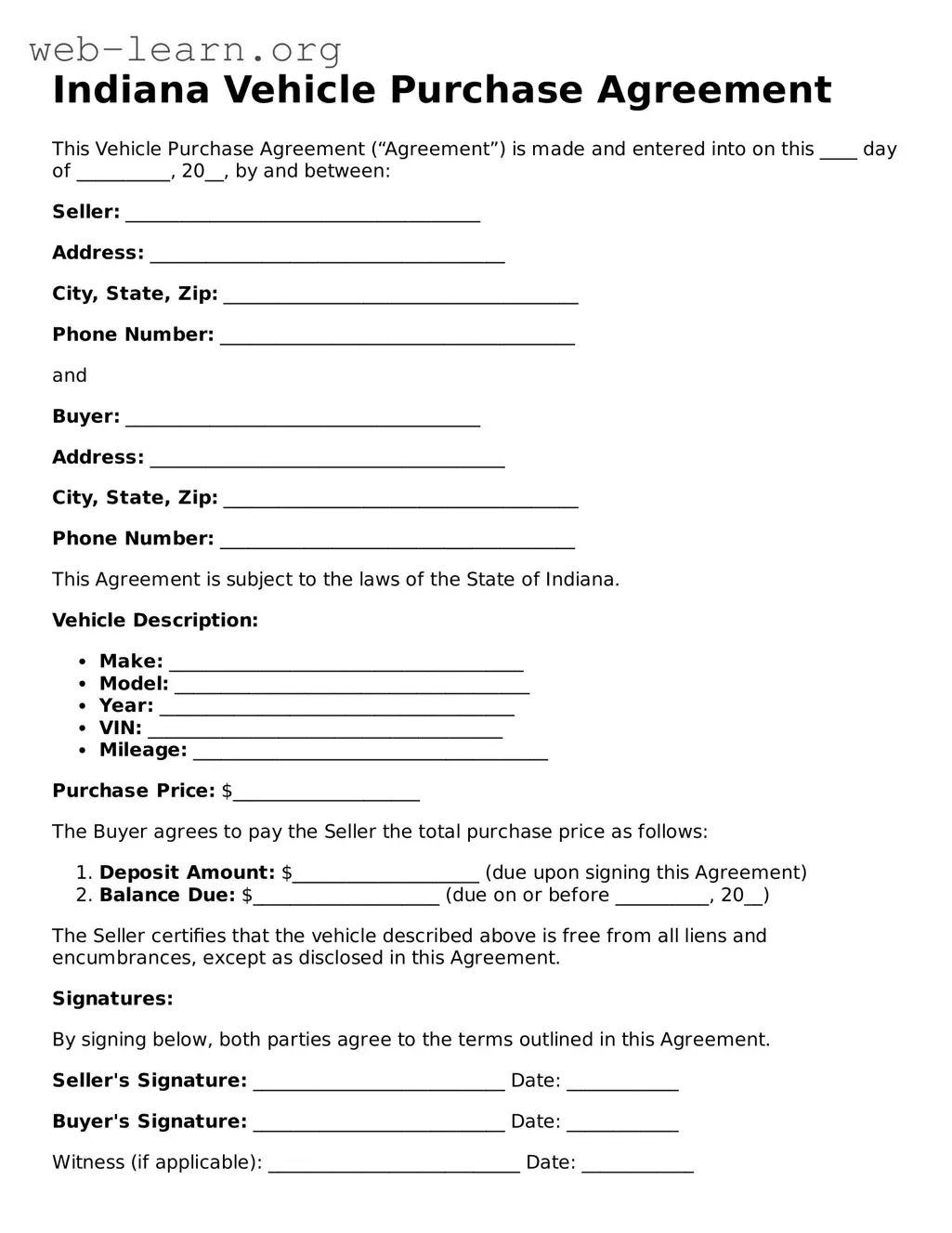
Indiana Vehicle Purchase Agreement

This Vehicle Purchase Agreement (“Agreement”) is made and entered into on this ____ day of __________, 20__, by and between:

Seller: ______________________________________

Address: ______________________________________

City, State, Zip: ______________________________________

Phone Number: ______________________________________

and

Buyer: ______________________________________

Address: ______________________________________

City, State, Zip: ______________________________________

Phone Number: ______________________________________

This Agreement is subject to the laws of the State of Indiana.

Vehicle Description:

  • Make: ______________________________________
  • Model: ______________________________________
  • Year: ______________________________________
  • VIN: ______________________________________
  • Mileage: ______________________________________

Purchase Price: $____________________

The Buyer agrees to pay the Seller the total purchase price as follows:

  1. Deposit Amount: $____________________ (due upon signing this Agreement)
  2. Balance Due: $____________________ (due on or before __________, 20__)

The Seller certifies that the vehicle described above is free from all liens and encumbrances, except as disclosed in this Agreement.

Signatures:

By signing below, both parties agree to the terms outlined in this Agreement.

Seller's Signature: ___________________________ Date: ____________

Buyer's Signature: ___________________________ Date: ____________

Witness (if applicable): ___________________________ Date: ____________

File Characteristics

Fact Name Description
Purpose The Indiana Vehicle Purchase Agreement form outlines the terms of sale between a buyer and seller for a vehicle.
Governing Law This agreement is governed by Indiana state law, specifically the Indiana Code Title 26, Article 2.
Key Components The form typically includes details such as vehicle identification number (VIN), purchase price, and buyer/seller information.
Signatures Both the buyer and seller must sign the agreement to make it legally binding.
Importance of Clarity Clear terms in the agreement help prevent disputes and misunderstandings about the sale.

Detailed Guide for Filling Out Indiana Vehicle Purchase Agreement

Filling out the Indiana Vehicle Purchase Agreement form is an important step in completing your vehicle purchase. This document serves as a record of the transaction between the buyer and the seller. Once the form is filled out correctly, both parties can proceed with the necessary steps to finalize the sale.

  1. Begin by entering the date of the agreement at the top of the form.
  2. Provide the buyer's full name, address, and contact information in the designated sections.
  3. Next, fill in the seller's full name, address, and contact information.
  4. In the vehicle description section, include the make, model, year, and Vehicle Identification Number (VIN) of the vehicle being sold.
  5. State the purchase price of the vehicle clearly in the appropriate space.
  6. Indicate the payment method being used, whether it is cash, check, or financing.
  7. If applicable, note any trade-in vehicle information, including its make, model, year, and VIN.
  8. Both the buyer and seller should sign and date the form at the bottom to confirm their agreement.

After completing these steps, ensure that both parties retain a copy of the signed agreement for their records. This will help in any future transactions or inquiries related to the vehicle sale.

Obtain Answers on Indiana Vehicle Purchase Agreement

  1. What is the Indiana Vehicle Purchase Agreement form?

    The Indiana Vehicle Purchase Agreement form is a legal document used to outline the terms and conditions of a vehicle sale in the state of Indiana. This agreement serves as a record of the transaction between the buyer and the seller, detailing essential information such as the vehicle's make, model, year, and identification number (VIN). It also specifies the purchase price, payment method, and any warranties or conditions related to the sale.

  2. Why is it important to use a Vehicle Purchase Agreement?

    Utilizing a Vehicle Purchase Agreement is crucial for several reasons:

    • It provides a clear record of the transaction, helping to prevent misunderstandings between the buyer and seller.
    • The agreement protects both parties by outlining their rights and responsibilities, including any warranties or guarantees.
    • In case of disputes, the document serves as evidence in legal matters, ensuring that both parties adhere to the agreed-upon terms.
  3. What information should be included in the agreement?

    When completing the Indiana Vehicle Purchase Agreement, it is essential to include the following information:

    • The full names and contact information of both the buyer and the seller.
    • A detailed description of the vehicle, including the make, model, year, color, and VIN.
    • The agreed-upon purchase price and payment method (cash, check, financing, etc.).
    • Any terms regarding warranties, as well as conditions for the sale, such as "as-is" or any repairs that will be made prior to the sale.
  4. Is the Vehicle Purchase Agreement required by law?

    While the Indiana Vehicle Purchase Agreement is not legally mandated, it is highly recommended for both buyers and sellers. Having this document provides a structured approach to the sale and ensures that all parties are on the same page. Additionally, it can help facilitate the transfer of ownership and registration with the Indiana Bureau of Motor Vehicles (BMV). Not using an agreement may lead to complications or disputes that could have been avoided.

Common mistakes

Filling out the Indiana Vehicle Purchase Agreement form can seem straightforward, but many people make common mistakes that can lead to confusion or even legal issues down the line. Understanding these pitfalls can help ensure a smoother transaction.

One frequent mistake is not providing accurate vehicle information. It's crucial to double-check the Vehicle Identification Number (VIN), make, model, and year of the vehicle. Errors in this section can create problems when registering the vehicle or transferring ownership.

Another common error is neglecting to include all necessary signatures. Both the buyer and the seller must sign the agreement for it to be valid. Sometimes, one party assumes the other will sign, leading to an incomplete document that could complicate the sale.

People often overlook the importance of detailing the purchase price. It's not just about writing down a number; the price should be clear and reflect any negotiations or agreements made. Failing to specify this can lead to disputes later.

Additionally, buyers frequently forget to review the payment terms. Whether paying in cash, financing, or trading in another vehicle, these details should be clearly outlined. Ambiguities can create misunderstandings regarding payment expectations.

Many individuals also skip over the section regarding warranties and “as-is” conditions. If the vehicle is sold without a warranty, this needs to be explicitly stated. Not doing so can lead to assumptions about the vehicle's condition and the seller's responsibilities.

Another mistake is not providing the correct date of the transaction. This may seem minor, but the date is essential for legal documentation and can affect the timeline for registration and title transfer.

Some buyers fail to include their contact information. While it may seem obvious, having clear contact details ensures that both parties can reach each other easily if any issues arise after the sale.

Finally, a lack of attention to detail in the terms and conditions can be problematic. Buyers and sellers should read through the entire agreement carefully to ensure they understand all the stipulations. Misinterpretations can lead to disputes that might have been easily avoided with a thorough review.

Documents used along the form

When purchasing a vehicle in Indiana, several documents accompany the Vehicle Purchase Agreement to ensure a smooth transaction. Each of these forms serves a specific purpose, helping both the buyer and seller navigate the process with clarity and security.

  • Bill of Sale: This document serves as proof of the transaction. It includes details about the vehicle, the purchase price, and the signatures of both the buyer and seller.
  • Title Transfer Form: This form is essential for transferring ownership of the vehicle from the seller to the buyer. It must be completed and submitted to the Indiana Bureau of Motor Vehicles (BMV).
  • Odometer Disclosure Statement: This statement confirms the vehicle's mileage at the time of sale. It protects against fraud and is required for vehicles less than ten years old.
  • Application for Certificate of Title: Buyers must fill out this application to obtain a new title in their name. It is submitted to the BMV along with the title transfer form.
  • Affidavit of Vehicle Identification Number (VIN): If the VIN is not clearly visible or if there are discrepancies, this affidavit helps confirm the vehicle's identity.
  • Sales Tax Exemption Certificate: If applicable, this certificate allows buyers to claim an exemption from sales tax on the purchase, often used by non-profit organizations.
  • Loan Agreement: For buyers financing their vehicle, this agreement outlines the terms of the loan, including payment schedules and interest rates.
  • Insurance Documents: Proof of insurance is typically required before registering the vehicle. These documents show that the buyer has adequate coverage.
  • Power of Attorney: If the seller cannot be present for the transaction, a power of attorney allows another person to sign the necessary documents on their behalf.

Having these documents ready can help streamline the vehicle purchase process in Indiana. Each form plays a vital role in protecting the interests of both the buyer and seller, ensuring a transparent and lawful transaction.

Similar forms

  • Bill of Sale: This document serves as proof of the transfer of ownership from the seller to the buyer. Like the Vehicle Purchase Agreement, it includes details about the vehicle, such as make, model, and VIN.
  • Purchase Order: A purchase order outlines the terms of a transaction and is often used in business contexts. Similar to a Vehicle Purchase Agreement, it specifies the item being purchased, price, and conditions of sale.
  • Lease Agreement: This document outlines the terms under which one party agrees to rent property owned by another party. Both agreements detail the duration, payment terms, and responsibilities of each party.
  • Title Transfer Form: Used to officially transfer the title of a vehicle from one owner to another, this form is closely related to the Vehicle Purchase Agreement as it is often a necessary step in the sale process.
  • Sales Contract: A sales contract is a broader document that can apply to any type of sale. Like the Vehicle Purchase Agreement, it includes essential terms of the sale, including price and delivery conditions.
  • Financing Agreement: This document outlines the terms of financing for a vehicle purchase. It shares similarities with the Vehicle Purchase Agreement in that it includes payment details and obligations of the buyer.
  • Warranty Agreement: A warranty agreement provides assurances regarding the condition of the vehicle after purchase. It complements the Vehicle Purchase Agreement by detailing what is covered and for how long.
  • Inspection Report: Often completed prior to the sale, an inspection report documents the condition of the vehicle. It is similar to the Vehicle Purchase Agreement in that both documents address the state of the vehicle at the time of sale.
  • Service Agreement: This document outlines the terms for ongoing maintenance or services related to the vehicle. It shares common ground with the Vehicle Purchase Agreement by establishing expectations between parties.
  • Escrow Agreement: Used to hold funds during a transaction, an escrow agreement ensures that the buyer and seller meet their obligations. This document is similar to the Vehicle Purchase Agreement in that it protects both parties during the sale process.

Dos and Don'ts

When filling out the Indiana Vehicle Purchase Agreement form, it is important to ensure accuracy and completeness. Here are some key dos and don'ts to keep in mind:

  • Do double-check all information for accuracy.
  • Do provide clear and legible handwriting or use a typewriter.
  • Do read the entire agreement before signing.
  • Do keep a copy of the signed agreement for your records.
  • Don't leave any required fields blank.
  • Don't rush through the form; take your time to ensure everything is correct.
  • Don't sign the document without reviewing all terms and conditions.
  • Don't forget to check the payment details and ensure they are accurate.

Misconceptions

When it comes to the Indiana Vehicle Purchase Agreement form, many people have misunderstandings that can lead to confusion. Here are seven common misconceptions, along with explanations to clarify the truth.

  • It's only necessary for private sales. Many believe this form is only required when buying from a private seller. In reality, it is also essential for transactions with dealerships to ensure both parties are protected.
  • All vehicle purchases require a notary. Some think that every Vehicle Purchase Agreement must be notarized. However, notarization is not always necessary unless specified by the parties involved or required for certain types of transactions.
  • Once signed, the agreement cannot be changed. A common belief is that signing the agreement makes it set in stone. In fact, both parties can negotiate changes before finalizing the sale, as long as both agree to the modifications.
  • The form guarantees a clean title. Many assume that completing the Vehicle Purchase Agreement ensures the seller has a clean title. This is not true; buyers should always verify the title status independently.
  • It's only for new vehicles. Some people think this form is only applicable to new vehicle purchases. However, it is equally important for used vehicles, ensuring all terms of the sale are documented.
  • You don’t need to keep a copy of the agreement. Many individuals believe that once the sale is complete, they can discard the agreement. In reality, keeping a copy is essential for future reference and potential disputes.
  • It's a complicated legal document. Some may feel intimidated by the idea of filling out a legal document. In truth, the Vehicle Purchase Agreement is designed to be straightforward and user-friendly, making it accessible for everyone.

Understanding these misconceptions can help ensure a smoother vehicle purchasing experience in Indiana. Always take the time to read and understand the agreement fully before signing.

Key takeaways

When filling out and using the Indiana Vehicle Purchase Agreement form, keep these key takeaways in mind:

  1. Accurate Information: Ensure that all details, including buyer and seller information, are correct. This helps prevent disputes later on.
  2. Vehicle Details: Include specific information about the vehicle, such as make, model, year, and VIN. This identifies the vehicle clearly.
  3. Purchase Price: Clearly state the agreed purchase price. This should be the total amount the buyer will pay.
  4. Signatures Required: Both the buyer and seller must sign the agreement. This confirms that both parties agree to the terms.
  5. Payment Terms: Specify how the payment will be made. Whether it’s cash, check, or financing, clarity is essential.
  6. As-Is Clause: Understand that most agreements include an "as-is" clause. This means the buyer accepts the vehicle's current condition.
  7. Keep Copies: After completing the form, make sure to keep copies for both parties. This serves as proof of the transaction.