The Indiana Transfer-on-Death Deed form is an innovative estate planning tool that allows property owners to designate beneficiaries who will inherit their real estate upon their death, without the need for probate. This form provides a straightforward way to transfer ownership, ensuring that the property passes directly to the named beneficiaries, thereby simplifying the process and potentially reducing costs. One of the key features of this deed is that it remains revocable during the property owner's lifetime; they can change or cancel the designation at any time. Additionally, the form must be properly executed and recorded to be effective, which involves signing it in the presence of a notary public and filing it with the county recorder's office. Understanding the nuances of this form is essential for anyone considering it as part of their estate planning strategy, as it can help avoid potential legal complications and ensure that loved ones receive their intended inheritance smoothly and efficiently.
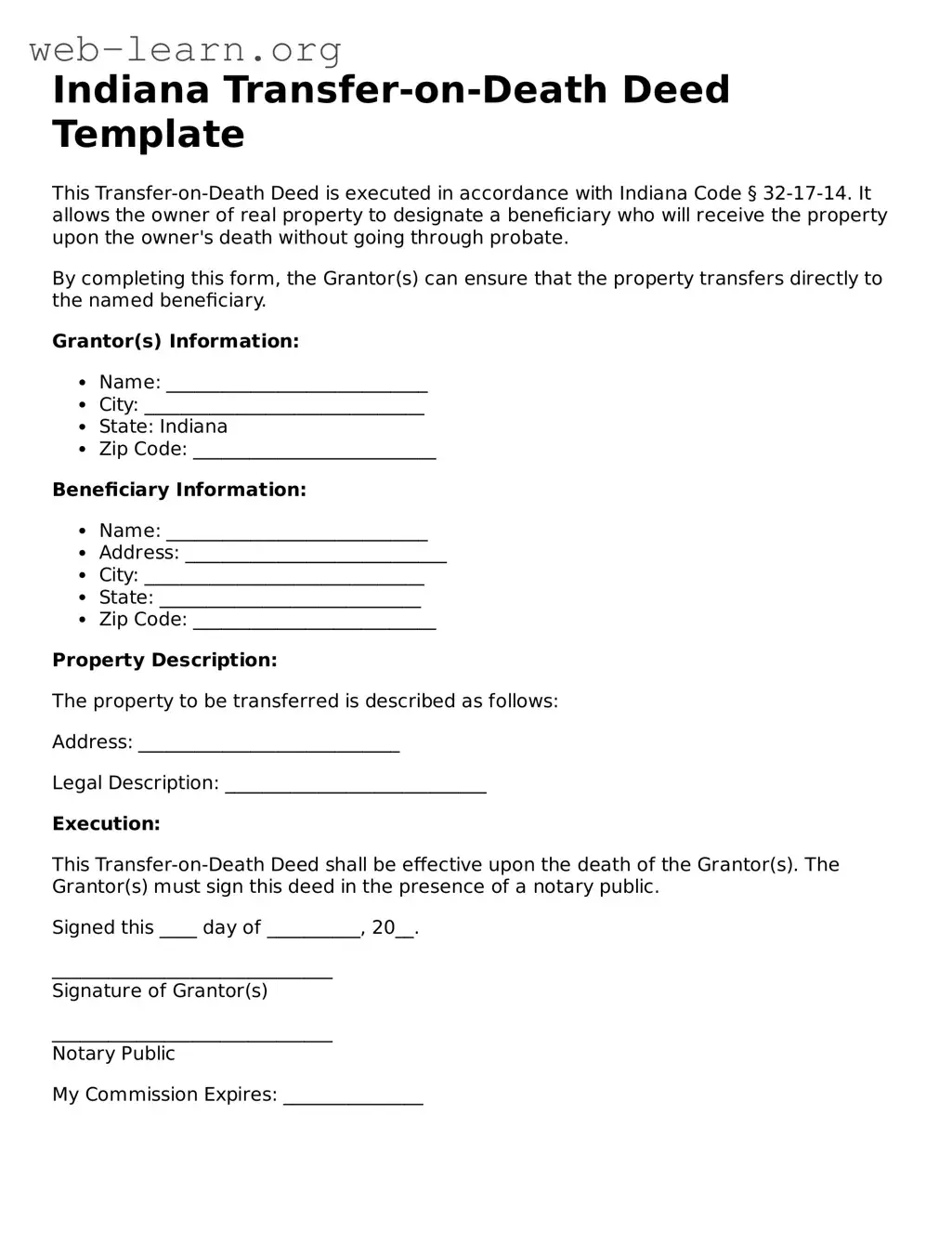
Indiana Transfer-on-Death Deed Template
This Transfer-on-Death Deed is executed in accordance with Indiana Code § 32-17-14. It allows the owner of real property to designate a beneficiary who will receive the property upon the owner's death without going through probate.
By completing this form, the Grantor(s) can ensure that the property transfers directly to the named beneficiary.
Grantor(s) Information:
Beneficiary Information:
Property Description:
The property to be transferred is described as follows:
Address: ____________________________
Legal Description: ____________________________
Execution:
This Transfer-on-Death Deed shall be effective upon the death of the Grantor(s). The Grantor(s) must sign this deed in the presence of a notary public.
Signed this ____ day of __________, 20__.
______________________________
Signature of Grantor(s)
______________________________
Notary Public
My Commission Expires: _______________
| Fact Name | Description |
|---|---|
| Definition | The Indiana Transfer-on-Death Deed allows property owners to transfer real estate to beneficiaries upon their death without going through probate. |
| Governing Law | This deed is governed by Indiana Code § 32-17-14. |
| Eligibility | Only individuals can create a Transfer-on-Death Deed; it cannot be executed by entities such as corporations or partnerships. |
| Revocation | Property owners can revoke or change the beneficiaries of the deed at any time before their death. |
| Recording Requirement | The deed must be recorded in the county where the property is located to be effective. |
| Beneficiary Rights | Beneficiaries do not have any rights to the property until the owner's death. |
| Multiple Beneficiaries | Property owners can name multiple beneficiaries, and they can specify how the property is to be divided among them. |
| Tax Implications | Transfer-on-Death Deeds do not affect property taxes during the owner's lifetime. |
| Limitations | Some types of property, such as property held in a trust or joint tenancy, cannot be transferred using this deed. |
| Legal Assistance | While legal assistance is not required, it is advisable to consult an attorney to ensure proper execution and understanding of the deed. |
Filling out the Indiana Transfer-on-Death Deed form is an important step in managing your property. After completing the form, you will need to file it with the county recorder in the county where the property is located. This ensures that your wishes regarding the transfer of property will be honored.
What is a Transfer-on-Death Deed in Indiana?
A Transfer-on-Death Deed (TOD Deed) is a legal document that allows property owners in Indiana to transfer their real estate to designated beneficiaries upon their death. This deed enables the property to bypass the probate process, which can be lengthy and costly. The property remains under the owner’s control during their lifetime, and they can revoke or change the deed at any time before their death.
How do I create a Transfer-on-Death Deed?
To create a Transfer-on-Death Deed in Indiana, follow these steps:
Can I change or revoke a Transfer-on-Death Deed?
Yes, property owners can change or revoke a Transfer-on-Death Deed at any time while they are alive. To do this, a new deed must be created and recorded, or a formal revocation must be executed and filed with the county recorder's office. It is important to ensure that any changes are properly documented to avoid confusion or disputes later on.
What happens if a beneficiary predeceases me?
If a beneficiary named in the Transfer-on-Death Deed dies before the property owner, the interest in the property typically does not transfer to that beneficiary's heirs. Instead, the property will pass to the remaining beneficiaries listed on the deed. If no beneficiaries remain, the property will be included in the owner's estate and subject to probate. It is advisable to review and update the deed regularly to reflect any changes in circumstances or preferences.
Filling out the Indiana Transfer-on-Death Deed form can be a straightforward process, but many people make common mistakes that can lead to complications later on. One frequent error is not providing a complete legal description of the property. This description must be precise to ensure that the property is correctly identified. Omitting details or using vague terms can create confusion and potentially invalidate the deed.
Another mistake is failing to properly identify the beneficiaries. It is essential to list the names of all individuals who will inherit the property. Using nicknames or incomplete names can lead to disputes among heirs. Clarity is crucial; always use the full legal names of the beneficiaries.
People often overlook the requirement for signatures. Both the owner of the property and a witness must sign the deed. Forgetting to include a witness signature can render the deed ineffective. Additionally, the deed must be notarized to ensure its legality. Skipping this step can lead to problems when the time comes to transfer the property.
Many individuals also make the mistake of not recording the deed with the county recorder’s office. Even if the form is filled out correctly, failing to file it means the deed has no legal effect. Recording the deed is necessary to put the public on notice of the transfer, which protects the rights of the beneficiaries.
Another common error is not updating the deed after significant life changes. For instance, if a beneficiary passes away or if there is a divorce, it’s vital to revise the deed accordingly. Ignoring these changes can lead to unintended consequences, such as disputes over who inherits the property.
Some people forget to check for existing liens or encumbrances on the property. If there are debts attached to the property, these may affect the transfer process. It's important to address any outstanding issues before executing the deed to avoid complications for the beneficiaries.
Additionally, individuals sometimes fail to consider tax implications. Transferring property through a Transfer-on-Death Deed can have tax consequences, which should be evaluated beforehand. Consulting with a tax professional can provide clarity and help avoid unexpected financial burdens.
Lastly, many people do not seek legal advice when needed. While the form may seem simple, the implications of filling it out incorrectly can be significant. Consulting with a legal expert can help ensure that all aspects of the deed are handled properly, safeguarding the interests of both the property owner and the beneficiaries.
The Indiana Transfer-on-Death Deed is a useful tool for individuals looking to transfer property to beneficiaries upon their passing without going through probate. However, there are several other forms and documents that may be necessary or helpful in conjunction with this deed. Below is a list of commonly used documents that can support the transfer process and ensure everything is in order.
Utilizing the Indiana Transfer-on-Death Deed along with these additional documents can help streamline the process of transferring property to beneficiaries. Being well-informed and prepared can make a significant difference in ensuring that your wishes are honored and that the transfer is executed smoothly.
When filling out the Indiana Transfer-on-Death Deed form, it's important to get it right. Here are some key things to do and avoid:
Understanding the Indiana Transfer-on-Death Deed (TODD) can be challenging. Here are ten common misconceptions about this legal tool:
It requires probate. Many believe that assets transferred via a TODD must go through probate. In fact, assets transfer directly to the beneficiaries without going through this process.
It can only be used for real estate. While the TODD is primarily for real estate, it can also apply to certain types of personal property, depending on state laws.
All heirs are automatically notified. Some think that the deed automatically informs heirs of the transfer. However, it is the responsibility of the beneficiaries to be aware of the deed's existence.
It cannot be revoked. Many assume that once a TODD is executed, it cannot be changed. In reality, the grantor can revoke or alter the deed at any time before death.
It eliminates estate taxes. Some people believe that using a TODD means avoiding estate taxes. However, the value of the property may still be included in the estate for tax purposes.
Beneficiaries must be named at the time of signing. There is a misconception that beneficiaries must be designated when the deed is created. You can name or change beneficiaries later.
It can only be used by individuals. Many think that only individuals can create a TODD. In fact, entities like trusts can also use this deed for transferring property.
It is a one-size-fits-all solution. Some believe a TODD is suitable for everyone. However, individual circumstances and estate plans vary, making it essential to consider personal needs.
It has no impact on Medicaid eligibility. Some assume that using a TODD will not affect Medicaid eligibility. However, transferring property can have implications for qualifying for benefits.
It guarantees a smooth transfer. Many think that a TODD ensures a hassle-free transfer of property. While it simplifies the process, disputes among heirs can still arise.
Filling out the Indiana Transfer-on-Death Deed form can be a straightforward process if you keep a few key points in mind. Here are some essential takeaways to help you navigate this important legal document:
By keeping these points in mind, you can ensure that your Transfer-on-Death Deed is executed properly, providing peace of mind for you and your loved ones.
Problems With Transfer on Death Deeds in Virginia - It is a straightforward document that can be completed without a lawyer in some states.
Problems With Transfer on Death Deeds California - Transfer-on-Death Deeds are recognized in many states across the U.S.
Beneficiary Deed Colorado - Upon the owner's death, the beneficiary can claim the property without legal hurdles.