Homepage Attorney-Approved Tractor Bill of Sale Document for the State of Indiana
Table of Contents

When it comes to purchasing or selling a tractor in Indiana, having the right documentation is essential for ensuring a smooth transaction. The Indiana Tractor Bill of Sale form serves as a crucial tool in this process, providing both the buyer and seller with a clear record of the sale. This form typically includes key information such as the names and addresses of both parties involved, a detailed description of the tractor being sold—including its make, model, year, and Vehicle Identification Number (VIN)—and the agreed-upon sale price. Additionally, it may outline any terms of the sale, such as warranties or conditions, which can help protect both parties' interests. Completing this form not only formalizes the agreement but also serves as proof of ownership transfer, which is vital for registration and future transactions. Understanding the importance of this document can help individuals navigate the complexities of buying or selling a tractor, ensuring that all legal requirements are met while fostering trust and transparency between the parties involved.

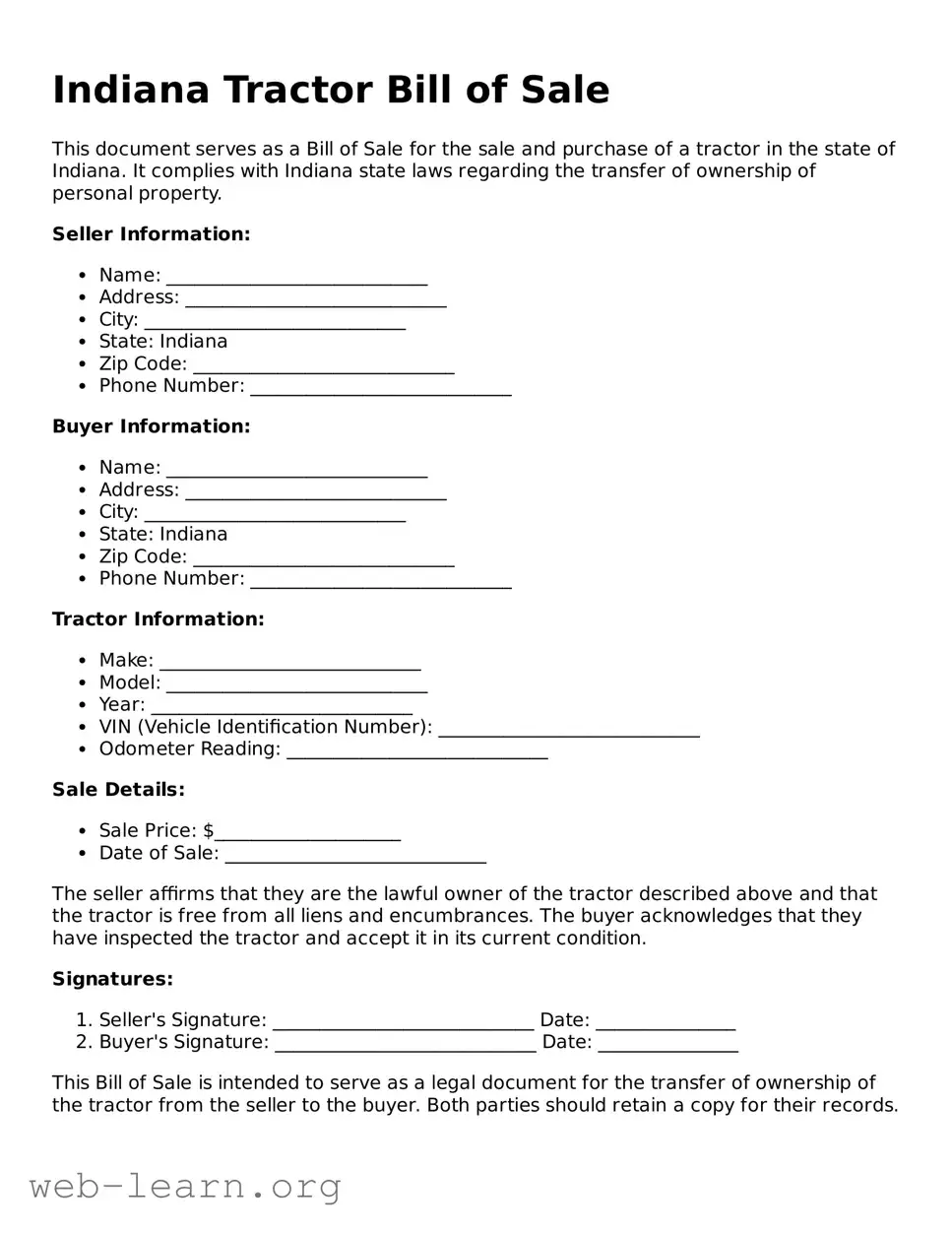
Sample - Indiana Tractor Bill of Sale Form

Indiana Tractor Bill of Sale

This document serves as a Bill of Sale for the sale and purchase of a tractor in the state of Indiana. It complies with Indiana state laws regarding the transfer of ownership of personal property.

Seller Information:

  • Name: ____________________________
  • Address: ____________________________
  • City: ____________________________
  • State: Indiana
  • Zip Code: ____________________________
  • Phone Number: ____________________________

Buyer Information:

  • Name: ____________________________
  • Address: ____________________________
  • City: ____________________________
  • State: Indiana
  • Zip Code: ____________________________
  • Phone Number: ____________________________

Tractor Information:

  • Make: ____________________________
  • Model: ____________________________
  • Year: ____________________________
  • VIN (Vehicle Identification Number): ____________________________
  • Odometer Reading: ____________________________

Sale Details:

  • Sale Price: $____________________
  • Date of Sale: ____________________________

The seller affirms that they are the lawful owner of the tractor described above and that the tractor is free from all liens and encumbrances. The buyer acknowledges that they have inspected the tractor and accept it in its current condition.

Signatures:

  1. Seller's Signature: ____________________________ Date: _______________
  2. Buyer's Signature: ____________________________ Date: _______________

This Bill of Sale is intended to serve as a legal document for the transfer of ownership of the tractor from the seller to the buyer. Both parties should retain a copy for their records.

File Characteristics

Fact Name Description
Purpose The Indiana Tractor Bill of Sale form is used to document the sale of a tractor between a buyer and a seller, providing proof of the transaction.
Governing Law This form is governed by Indiana state laws regarding the sale of personal property.
Information Required Essential details such as the buyer's and seller's names, contact information, tractor description, and sale price must be included.
Signatures Both the buyer and seller must sign the form to validate the sale, ensuring that both parties agree to the terms outlined.

Detailed Guide for Filling Out Indiana Tractor Bill of Sale

Filling out the Indiana Tractor Bill of Sale form is a straightforward process. After completing the form, you will have a record of the sale that can be useful for both the buyer and the seller. Ensure all information is accurate to avoid any issues later.

  1. Obtain the Form: Download the Indiana Tractor Bill of Sale form from a reliable source or request a hard copy from your local DMV.
  2. Fill in Seller Information: Provide the full name and address of the seller. This is the person or business selling the tractor.
  3. Fill in Buyer Information: Enter the full name and address of the buyer. This is the individual or entity purchasing the tractor.
  4. Describe the Tractor: Include details such as the make, model, year, and Vehicle Identification Number (VIN) of the tractor. This information helps identify the specific vehicle being sold.
  5. State the Sale Price: Clearly write down the agreed-upon sale price for the tractor. This should be the total amount paid by the buyer.
  6. Include Date of Sale: Write the date when the sale takes place. This is important for record-keeping purposes.
  7. Signatures: Both the seller and buyer must sign the form. This indicates that both parties agree to the terms of the sale.
  8. Keep Copies: Make copies of the completed form for both the buyer and seller. This ensures that both parties have a record of the transaction.

Obtain Answers on Indiana Tractor Bill of Sale

  1. What is the Indiana Tractor Bill of Sale form?

    The Indiana Tractor Bill of Sale form is a legal document that records the sale of a tractor between a buyer and a seller. This form includes important details about the transaction, such as the names and addresses of both parties, the tractor's identification information, and the sale price.

  2. Why do I need a Bill of Sale for a tractor?

    A Bill of Sale serves as proof of ownership transfer. It protects both the buyer and seller by documenting the transaction. This document can also be useful for registration purposes and may be required by the Indiana Bureau of Motor Vehicles (BMV) when registering the tractor.

  3. What information is required on the form?

    The form should include:

    • The names and addresses of the buyer and seller.
    • A description of the tractor, including make, model, year, and Vehicle Identification Number (VIN).
    • The sale price and payment method.
    • The date of the sale.
  4. Do I need to have the Bill of Sale notarized?

    No, notarization is not required for the Indiana Tractor Bill of Sale. However, having it notarized can add an extra layer of security and legitimacy to the document, especially if the transaction is significant.

  5. Can I use a generic Bill of Sale form?

    While a generic Bill of Sale can be used, it is recommended to use the specific Indiana Tractor Bill of Sale form. This ensures that all necessary information is included and complies with state requirements.

  6. What should I do after completing the Bill of Sale?

    After completing the form, both the buyer and seller should keep a copy for their records. The buyer will need to present the Bill of Sale when registering the tractor with the Indiana BMV.

  7. Is there a fee for registering the tractor after the sale?

    Yes, there may be fees associated with registering the tractor. These fees can vary based on the tractor's value and the county in which it is registered. It is advisable to check with the local BMV for specific fee information.

  8. What if there are issues after the sale?

    If any disputes arise after the sale, the Bill of Sale serves as a key piece of evidence. It can clarify the terms of the sale and the responsibilities of each party. If necessary, legal advice may be sought to resolve any issues.

Common mistakes

When filling out the Indiana Tractor Bill of Sale form, many individuals overlook crucial details that can lead to complications. One common mistake is failing to include accurate identification information for both the buyer and the seller. This includes names, addresses, and contact numbers. Without this information, it becomes difficult to establish ownership and may lead to disputes later on.

Another frequent error is neglecting to provide the correct description of the tractor being sold. This includes the make, model, year, and Vehicle Identification Number (VIN). If these details are incorrect or missing, it can create confusion regarding the specific tractor involved in the sale. Accurate descriptions help ensure that both parties are clear about what is being transferred.

Additionally, some people forget to include the sale price. This is a critical piece of information that should not be overlooked. The sale price not only reflects the agreed-upon amount but also serves as a record for tax purposes. Without it, the transaction may be questioned by tax authorities, leading to potential issues for both the buyer and seller.

Finally, many individuals fail to sign and date the form. Both parties must provide their signatures to validate the sale. Without signatures, the document may not hold up in legal situations. It is essential to ensure that all required signatures are present before submitting the form.

Documents used along the form

When purchasing or selling a tractor in Indiana, several documents may accompany the Tractor Bill of Sale form. These documents help ensure a smooth transaction and provide necessary information for both parties involved. Below is a list of commonly used forms and documents.

  • Title Transfer Form: This document is essential for transferring ownership of the tractor. It includes details about the seller, buyer, and the tractor itself.
  • Vehicle Identification Number (VIN) Verification: This form verifies the VIN of the tractor, confirming its identity and ensuring it is not stolen or salvaged.
  • Odometer Disclosure Statement: Required by federal law, this statement records the tractor's mileage at the time of sale, protecting against fraud.
  • Affidavit of Sale: This sworn statement can be used to affirm the sale occurred and may be required in certain situations for legal protection.
  • Sales Tax Exemption Certificate: If the buyer qualifies for a sales tax exemption, this certificate must be completed to avoid tax charges on the transaction.
  • Power of Attorney: If the seller cannot be present for the transaction, this document allows another person to act on their behalf, facilitating the sale.
  • Insurance Documents: Proof of insurance may be necessary to ensure the tractor is covered during the transfer and after the sale.

Having these documents prepared and organized can simplify the process of buying or selling a tractor in Indiana. Ensuring all necessary paperwork is in order protects both parties and helps avoid potential legal issues in the future.

Similar forms

The Tractor Bill of Sale form serves as an important document in the transaction of agricultural machinery. It is similar to various other documents used in the sale or transfer of ownership for different types of property. Here are ten documents that share similarities with the Tractor Bill of Sale:

  • Vehicle Bill of Sale: This document is used for the sale of automobiles and serves to transfer ownership from the seller to the buyer, just like the Tractor Bill of Sale does for tractors.
  • Boat Bill of Sale: Similar to the Tractor Bill of Sale, this form is used when buying or selling a boat. It provides proof of ownership transfer and includes details about the vessel.
  • Motorcycle Bill of Sale: This document outlines the sale of a motorcycle, detailing the transaction and transferring ownership in a manner akin to that of a tractor.
  • Real Estate Purchase Agreement: While more complex, this document facilitates the sale of real property. It includes terms and conditions similar to those found in a Tractor Bill of Sale, such as buyer and seller information and purchase price.
  • Equipment Bill of Sale: This form is used for various types of equipment sales, including construction and industrial machinery. It serves the same purpose as the Tractor Bill of Sale by documenting the transfer of ownership.
  • RV Bill of Sale: This document is specifically for the sale of recreational vehicles. It shares the same fundamental purpose of proving the transfer of ownership as the Tractor Bill of Sale.
  • Livestock Bill of Sale: Used in agricultural transactions, this form records the sale of livestock. It documents the details of the sale, similar to how a Tractor Bill of Sale does for tractors.
  • Aircraft Bill of Sale: This document is utilized in the sale of aircraft. It serves to transfer ownership and includes similar elements to the Tractor Bill of Sale, such as identification of the buyer and seller.
  • Personal Property Bill of Sale: This general document can be used for various personal items, providing proof of sale and ownership transfer, much like the Tractor Bill of Sale does for tractors.
  • Business Asset Purchase Agreement: This is used when purchasing business assets, including equipment and machinery. It outlines the terms of sale and ownership transfer, similar to the Tractor Bill of Sale.

Each of these documents serves a similar function in that they facilitate the transfer of ownership, providing legal proof of the transaction while detailing the specifics of the sale.

Dos and Don'ts

When filling out the Indiana Tractor Bill of Sale form, it is important to follow certain guidelines to ensure accuracy and compliance. Here are nine things to keep in mind:

  • Do provide complete and accurate information about the tractor, including make, model, year, and VIN.
  • Don't leave any fields blank. Incomplete information can lead to issues later on.
  • Do include the sale price clearly. This helps establish the value of the transaction.
  • Don't use vague descriptions. Be specific about the tractor's condition and any included accessories.
  • Do have both the buyer and seller sign the form. Signatures are essential for validating the sale.
  • Don't forget to date the document. The date of the transaction is crucial for record-keeping.
  • Do make copies of the completed form for both parties. This ensures everyone has a record of the sale.
  • Don't overlook any local regulations. Check if additional paperwork is required in your area.
  • Do keep the form in a safe place after filling it out. It may be needed for future reference.

Misconceptions

Many people have misunderstandings about the Indiana Tractor Bill of Sale form. Here are five common misconceptions:

  • It's not necessary for private sales. Some believe that a bill of sale is only needed for dealership transactions. In reality, having a bill of sale protects both the buyer and seller, regardless of the sale type.
  • It must be notarized. While notarization can add an extra layer of security, it is not a legal requirement for the Indiana Tractor Bill of Sale. A simple signed document is often sufficient.
  • Only the seller needs to keep a copy. Many think only the seller should retain a copy of the bill of sale. However, both parties should keep a copy for their records to avoid future disputes.
  • It doesn’t need to include details about the tractor. Some people assume that a basic agreement is enough. In fact, including specific details about the tractor, such as its make, model, and VIN, is crucial for clarity.
  • It can be verbal. There is a belief that a verbal agreement suffices. However, a written bill of sale is always recommended to ensure that all terms are clear and documented.

Understanding these misconceptions can help ensure a smooth transaction when buying or selling a tractor in Indiana.

Key takeaways

When filling out and using the Indiana Tractor Bill of Sale form, there are several important points to consider. Here are some key takeaways:

  • The form serves as a legal document that records the sale of a tractor.
  • Both the seller and buyer must complete their respective sections of the form.
  • Make sure to include detailed information about the tractor, such as the make, model, year, and Vehicle Identification Number (VIN).
  • Both parties should sign and date the document to validate the sale.
  • Keep a copy of the completed form for your records, as it may be needed for future reference.
  • Check local regulations to ensure compliance with any additional requirements related to the sale.