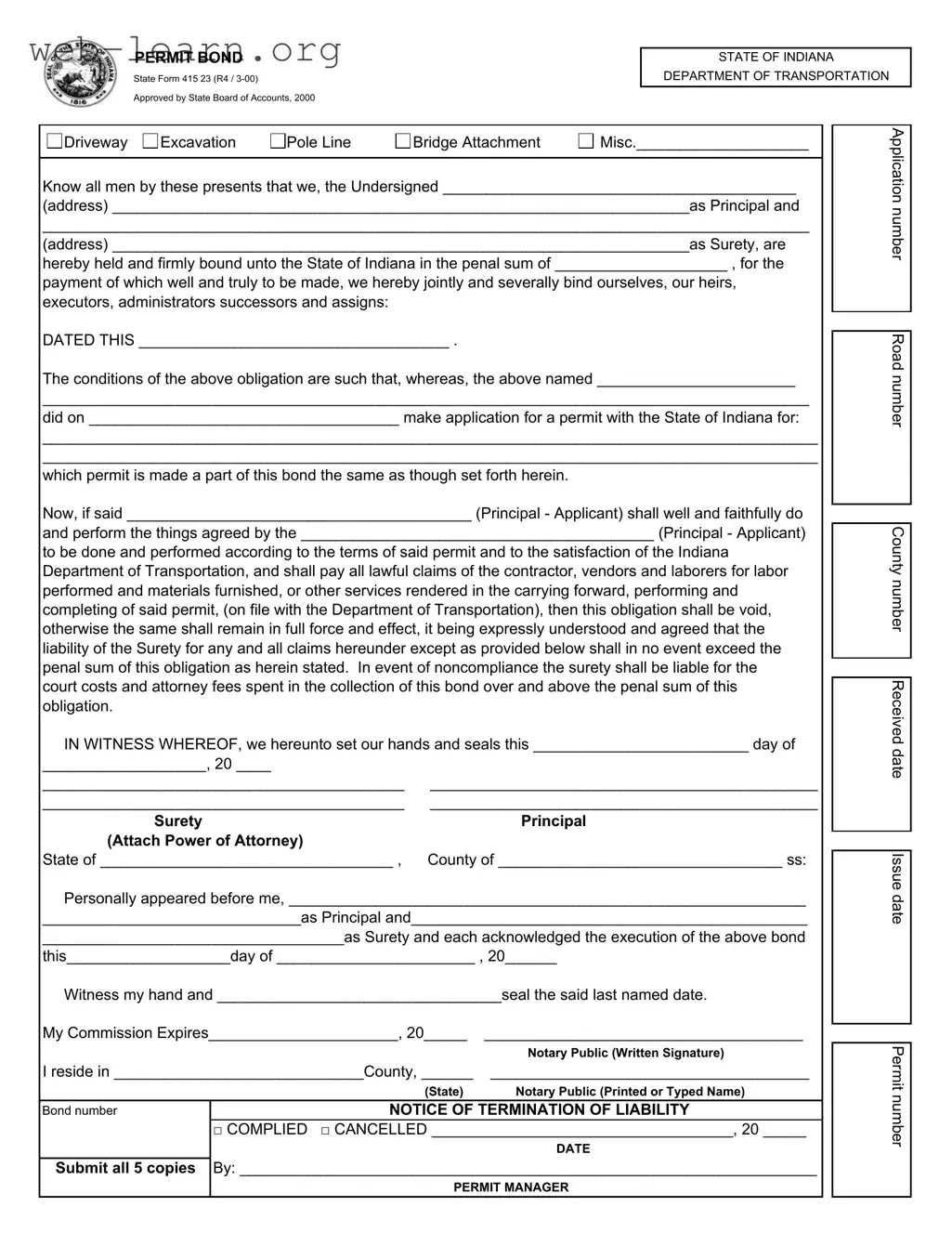
The Indiana State 415 23 form, also known as the Permit Bond, plays a crucial role in ensuring that individuals or companies comply with state regulations when undertaking specific projects. This form is primarily used in the context of applications for permits related to driveway excavation, pole line installations, and bridge attachments, among other miscellaneous projects. When filling out the form, the applicant, referred to as the Principal, must provide their name and address, along with the Surety, who guarantees the obligations of the Principal. The bond amount is specified, and it binds both parties to fulfill the terms of the permit to the satisfaction of the Indiana Department of Transportation. If the Principal fails to meet these obligations, the Surety is responsible for covering any claims related to labor, materials, or services rendered. The form includes sections for notarization and must be submitted in multiple copies. This structure ensures that all parties are held accountable, protecting the interests of the state and those involved in the project.
PERMIT BOND
State Form 415 23 (R4 /
Approved by State Board of Accounts, 2000
STATE OF INDIANA
DEPARTMENT OF TRANSPORTATION
Driveway |
Excavation |
Pole Line |
Bridge Attachment |
Misc.____________________ |
Know all men by these presents that we, the Undersigned _________________________________________
(address) ___________________________________________________________________as Principal and
_________________________________________________________________________________________
(address) ___________________________________________________________________as Surety, are
hereby held and firmly bound unto the State of Indiana in the penal sum of ____________________ , for the
payment of which well and truly to be made, we hereby jointly and severally bind ourselves, our heirs, executors, administrators successors and assigns:
DATED THIS ____________________________________ .
The conditions of the above obligation are such that, whereas, the above named _______________________
_________________________________________________________________________________________
did on ____________________________________ make application for a permit with the State of Indiana for:
__________________________________________________________________________________________
__________________________________________________________________________________________
which permit is made a part of this bond the same as though set forth herein.
Now, if said ________________________________________ (Principal - Applicant) shall well and faithfully do
and perform the things agreed by the _________________________________________ (Principal - Applicant)
to be done and performed according to the terms of said permit and to the satisfaction of the Indiana Department of Transportation, and shall pay all lawful claims of the contractor, vendors and laborers for labor performed and materials furnished, or other services rendered in the carrying forward, performing and completing of said permit, (on file with the Department of Transportation), then this obligation shall be void, otherwise the same shall remain in full force and effect, it being expressly understood and agreed that the liability of the Surety for any and all claims hereunder except as provided below shall in no event exceed the penal sum of this obligation as herein stated. In event of noncompliance the surety shall be liable for the court costs and attorney fees spent in the collection of this bond over and above the penal sum of this obligation.
IN WITNESS WHEREOF, we hereunto set our hands and seals this _________________________ day of
___________________, 20 ____ |
|
__________________________________________ |
_____________________________________________ |
__________________________________________ |
_____________________________________________ |
Surety |
Principal |
(Attach Power of Attorney) |
|
State of __________________________________ , |
County of _________________________________ ss: |
Personally appeared before me, ____________________________________________________________
______________________________as Principal and______________________________________________
___________________________________as Surety and each acknowledged the execution of the above bond
this___________________day of _______________________ , 20______
Witness my hand and _________________________________seal the said last named date.
My Commission Expires______________________, 20_____ |
_____________________________________ |
|
|
|
Notary Public (Written Signature) |
I reside in _____________________________County, ______ |
_____________________________________ |
|
|
(State) |
Notary Public (Printed or Typed Name) |
Bond number |
NOTICE OF TERMINATION OF LIABILITY |
|
□COMPLIED □ CANCELLED ___________________________________, 20 _____
DATE
Submit all 5 copies By: ___________________________________________________________________
PERMIT MANAGER
Application number
Road number
County number Received date
Issue date
Permit number
| Fact Name | Description |
|---|---|
| Form Title | The form is officially titled "Permit Bond State Form 415 23." |
| Approval | This form was approved by the State Board of Accounts in 2000. |
| Governing Law | The form is governed by Indiana state law regarding permits and bonds. |
| Purpose | The form serves as a bond for various activities, including driveway excavation and bridge attachments. |
| Principal and Surety | The bond requires a Principal (the applicant) and a Surety (the guarantor). |
| Liability | The Surety is liable for claims related to the permit, up to the penal sum stated in the bond. |
| Noncompliance Consequences | If the Principal does not comply with the terms, the Surety must cover court costs and attorney fees. |
| Notary Requirement | The form must be notarized, confirming the identities of the Principal and Surety. |
Filling out the Indiana State 415 23 form requires careful attention to detail. This form is important for ensuring compliance with state regulations. After completing the form, it must be submitted along with any required attachments to the appropriate authorities.
What is the Indiana State 415 23 form?
The Indiana State 415 23 form is a permit bond required by the Indiana Department of Transportation. It serves as a guarantee that the principal (the applicant) will fulfill the obligations outlined in their permit application, such as performing work related to driveway excavation, pole line installation, or other projects. The bond ensures that all lawful claims from contractors, vendors, and laborers will be satisfied.
Who needs to fill out this form?
This form must be filled out by individuals or entities applying for a permit from the Indiana Department of Transportation. If you are planning to conduct activities that fall under the jurisdiction of this department, such as construction or excavation, you will need to complete this form as part of your application process.
What information is required on the form?
The form requires several key pieces of information, including:
What happens if the principal does not comply with the permit terms?
If the principal fails to comply with the terms of the permit, the surety is obligated to cover any lawful claims up to the penal sum stated in the bond. Additionally, the surety may also be responsible for court costs and attorney fees incurred during the collection of the bond beyond the penal sum.
How many copies of the form need to be submitted?
A total of five copies of the Indiana State 415 23 form must be submitted. This ensures that all parties involved, including the Indiana Department of Transportation, have the necessary documentation for their records.
Is notarization required for this form?
Yes, the Indiana State 415 23 form must be notarized. The signatures of both the principal and the surety need to be acknowledged by a notary public, who will also provide their commission expiration date. This adds an extra layer of validity to the bond.
What should I do if I need to cancel the bond?
If you need to cancel the bond, you must indicate this on the form in the designated area for “Notice of Termination of Liability.” Ensure that you complete this section accurately and submit it to the appropriate authorities to formally terminate the bond.
Filling out the Indiana State 415 23 form can be a straightforward process, but several common mistakes can lead to delays or complications. One frequent error occurs when individuals fail to provide complete and accurate information in the designated fields. Each section must be filled out thoroughly, as incomplete submissions may result in the application being rejected.
Another mistake is neglecting to include the correct penal sum. This figure represents the amount of money for which the surety is liable. Misstating this amount can create confusion and may affect the bond's validity. It is essential to verify that this figure matches the requirements of the specific permit being applied for.
People often overlook the importance of signatures. Both the Principal and the Surety must sign the form. Without these signatures, the bond is not legally binding. Additionally, the form requires a notary public’s acknowledgment. Failing to have the document notarized can invalidate the bond, causing further complications in the application process.
Another common error is related to the selection of the type of permit. The form allows for multiple permit types, such as driveway excavation or bridge attachment. Misidentifying the permit type can lead to processing delays or even denial of the application. It is crucial to ensure that the chosen permit aligns with the intended project.
Individuals sometimes forget to attach the necessary documentation, such as the Power of Attorney. This document is essential for the Surety to act on behalf of the Principal. Without it, the Surety may not be recognized, and the bond could be deemed ineffective.
Additionally, applicants frequently neglect to check the expiration date of the notary's commission. If the notary's commission has expired at the time of signing, it can render the notarization invalid. It is advisable to confirm that the notary is authorized to perform their duties at the time of the bond's execution.
Another mistake involves not submitting all required copies of the form. The Indiana State 415 23 form requires multiple copies to be submitted to the appropriate authorities. Failing to provide the correct number of copies can result in delays in processing the application.
Lastly, individuals may overlook the importance of reviewing the completed form for any typographical errors. Simple mistakes, such as misspelled names or incorrect addresses, can lead to significant issues down the line. A thorough review can help catch these errors before submission.
The Indiana State Form 415 23 is a Permit Bond used primarily for projects that require permits from the Indiana Department of Transportation. Several other forms and documents are often utilized in conjunction with this bond to ensure compliance and facilitate the permitting process. Below is a list of these documents, each with a brief description.
These documents collectively support the permitting process, ensuring that all legal and regulatory obligations are met. Proper completion and submission of each form are essential for the smooth operation of construction and related activities in Indiana.
The Indiana State Form 415 23 is a permit bond used in various situations related to construction and excavation. Several other documents serve similar purposes in ensuring compliance and protecting parties involved in construction or service agreements. Here are eight documents that share similarities with the Indiana State 415 23 form:
When filling out the Indiana State Form 415 23, it is essential to approach the task with care and attention to detail. Here are five important dos and don'ts to consider:
By following these guidelines, you can navigate the process of completing the Indiana State Form 415 23 with greater confidence and clarity.
This form applies to a variety of activities, including smaller projects like driveway excavations and utility pole installations. It is not limited to large-scale construction.
While having a licensed contractor can be beneficial, individuals can also apply for permits using this form. The key is ensuring compliance with local regulations.
The penal sum of the bond can vary based on the scope of the project. It is determined during the application process and can be adjusted as necessary.
The surety's liability is limited to the penal sum stated in the bond. Additional costs, such as attorney fees, may be covered in specific circumstances.
Submitting the bond does not end the obligations. The principal must fulfill all terms of the permit to avoid penalties or claims against the bond.
The Department reviews the bond as part of the permit application process to ensure compliance with state regulations and standards.
This form is also necessary for private projects that may impact public infrastructure or require permits from the state.
A notary public must witness the signing of the bond to ensure its validity. This step is crucial for legal enforcement.
When filling out and using the Indiana State 415 23 form, there are several important considerations to keep in mind: