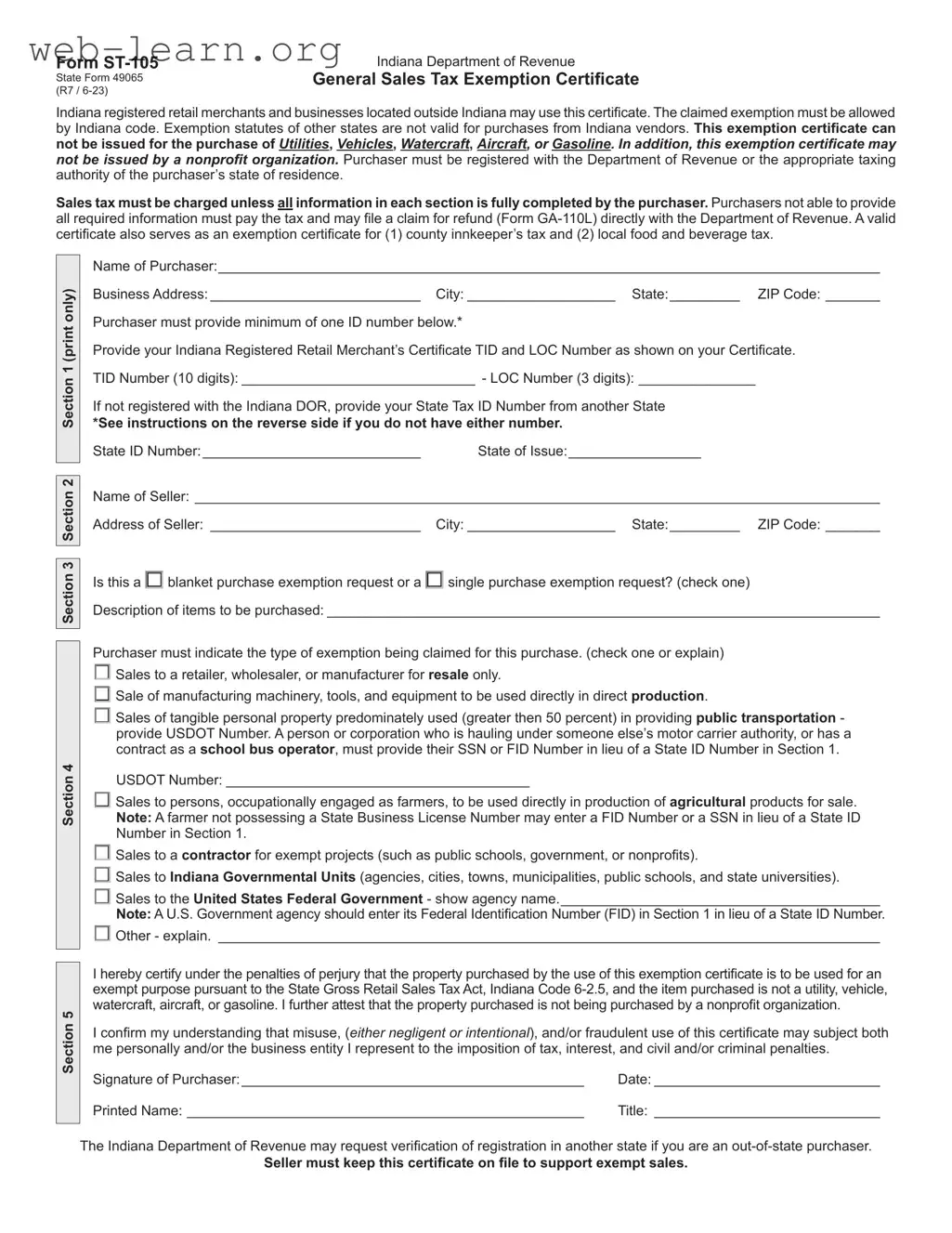
The Indiana ST-105 form is an essential document for businesses looking to claim sales tax exemptions on eligible purchases. This certificate is specifically designed for Indiana-registered retail merchants and businesses located outside of Indiana. It allows them to make tax-exempt purchases as long as the exemption complies with Indiana law. However, it is crucial to note that exemptions from other states do not apply to purchases from Indiana vendors. The form cannot be used for certain items, including liquor, vehicles, watercraft, or aircraft. To use the ST-105, purchasers must provide their Indiana Registered Retail Merchant's Certificate Taxpayer Identification Number (TID) and a Location (LOC) number. If a business is not registered in Indiana, it must provide a State Tax ID from its home state. Each section of the form must be filled out completely to avoid sales tax charges. Incomplete forms will require the purchaser to pay the tax upfront and potentially file for a refund later. The form also includes various categories of exemptions, such as sales for resale, sales to non-profit organizations, and sales to government entities. It is vital for sellers to keep this certificate on file to support exempt sales, as any misuse of the form could lead to penalties. Understanding the ST-105 is crucial for businesses to navigate their tax obligations effectively.

Form |
Indiana Department of Revenue |
State Form 49065 |
General Sales Tax Exemption Certificate |
(R7 / |
|
Indiana registered retail merchants and businesses located outside Indiana may use this certificate. The claimed exemption must be allowed by Indiana code. Exemption statutes of other states are not valid for purchases from Indiana vendors. This exemption certificate can not be issued for the purchase of Utilities, Vehicles, Watercraft, Aircraft, or Gasoline. In addition, this exemption certificate may not be issued by a nonprofit organization. Purchaser must be registered with the Department of Revenue or the appropriate taxing authority of the purchaser’s state of residence.
Sales tax must be charged unless all information in each section is fully completed by the purchaser. Purchasers not able to provide all required information must pay the tax and may file a claim for refund (Form
Section 1 (print only)
Name of Purchaser:_____________________________________________________________________________________
Business Address:____________________________ City:____________________ State:__________ ZIP Code:________
Purchaser must provide minimum of one ID number below.*
Provide your Indiana Registered Retail Merchant’s Certificate TID and LOC Number as shown on your Certificate.
TID Number (10 digits):_______________________________ - LOC Number (3 digits):________________
If not registered with the Indiana DOR, provide your State Tax ID Number from another State
*See instructions on the reverse side if you do not have either number.
State ID Number:_____________________________ |
State of Issue:_________________ |
Section 3 Section 2
Section 4
Section 5
Name of Seller:_________________________________________________________________________________________
Address of Seller:_ ___________________________ City:____________________ State:__________ ZIP Code:________
Is this a □ blanket purchase exemption request or a □ single purchase exemption request? (check one)
Description of items to be purchased:________________________________________________________________________
□Sales to a retailer, wholesaler, or manufacturer for resale only.
□Sale of manufacturing machinery, tools, and equipment to be used directly in direct production.
□Sales of tangible personal property predominately used (greater then 50 percent) in providing public transportation - provide USDOT Number. A person or corporation who is hauling under someone else’s motor carrier authority, or has a contract as a school bus operator, must provide their SSN or FID Number in lieu of a State ID Number in Section 1.
USDOT Number:________________________________________
□Sales to persons, occupationally engaged as farmers, to be used directly in production of agricultural products for sale. Note: A farmer not possessing a State Business License Number may enter a FID Number or a SSN in lieu of a State ID Number in Section 1.
□Sales to a contractor for exempt projects (such as public schools, government, or nonprofits).
□Sales to Indiana Governmental Units (agencies, cities, towns, municipalities, public schools, and state universities).
□Sales to the United States Federal Government - show agency name._________________________________________
Note: A U.S. Government agency should enter its Federal Identification Number (FID) in Section 1 in lieu of a State ID Number.
□Other - explain._ _____________________________________________________________________________________Purchaser must indicate the type of exemption being claimed for this purchase. (check one or explain)
I hereby certify under the penalties of perjury that the property purchased by the use of this exemption certificate is to be used for an exempt purpose pursuant to the State Gross Retail Sales Tax Act, Indiana Code
I confirm my understanding that misuse, (either negligent or intentional), and/or fraudulent use of this certificate may subject both me personally and/or the business entity I represent to the imposition of tax, interest, and civil and/or criminal penalties.
Signature of Purchaser:_____________________________________________ |
Date:______________________________ |
Printed Name:____________________________________________________ |
Title:_ _____________________________ |
The Indiana Department of Revenue may request verification of registration in another state if you are an
Seller must keep this certificate on file to support exempt sales.
Instructions for Completing Form
All five sections of the
Section 1
A)This section requires an identification number. In most cases this number will be an Indiana Department of Revenue issued Taxpayer Identification Number (TID - see note below) used for Indiana sales and/or withholding tax reporting. If the purchaser is from another state and does not possess an Indiana TID Number, a resident state’s business license, or State issued ID Number must be provided.
B)Exceptions - For a purchaser not possessing either an Indiana TID Number or another State ID Number, the following may be used in lieu of this requirement.
Federal Government – place your FID Number in the State ID Number space.
Farmer – place your SSN or FID Number in the State ID Number space. Please complete the Agricultural Equipment Exemption Usage Questionnaire (Form
Section 2
A)Enter the seller’s name and address.
Section 3
A)Check a box to indicate if this is a single purchase or blanket exemption.
B)Describe product being purchased.
Section 4
A)Purchaser must check the reason for exemption.
B)Purchaser must be able to provide additional information if requested.
Section 5
A)Purchaser must sign and date the form.
B)Printed name and title of signer must be shown.
Note: The Indiana Taxpayer Identification Number (TID) is a ten digit number followed by a three digit LOC Number. The TID is also known as the following:
a)Registered Retail Merchant Certificate
b)Tax Exempt Identification Number
c)Sales Tax Identification Number
d)Withholding Tax Identification Number
The Registered Retail Merchant Certificate issued by the Indiana Department of Revenue shows the TID (10 digits) and the LOC (3 digits) at the top right of the certificate.
| Fact Name | Fact Description |
|---|---|
| Purpose | The Indiana ST-105 form is a General Sales Tax Exemption Certificate used by registered retail merchants and out-of-state businesses to claim sales tax exemptions on eligible purchases in Indiana. |
| Governing Law | This form is governed by the Indiana Code, specifically the State Cross Retail Sales Tax Act, Indiana Code 6-2.5. |
| Ineligible Purchases | Purchases of utilities, vehicles, watercraft, and aircraft cannot be exempted using this certificate. |
| Registration Requirement | The purchaser must be registered with the Indiana Department of Revenue or their home state’s taxing authority to use this exemption certificate. |
| Information Completion | All sections of the ST-105 form must be fully completed; otherwise, sales tax will be charged, and the purchaser may need to file a refund claim. |
| Seller's Responsibility | Sellers must retain the ST-105 certificate on file to validate exempt sales and ensure compliance with Indiana sales tax laws. |
Filling out the Indiana ST-105 form is a straightforward process that requires careful attention to detail. Ensure that all required information is accurately provided to avoid any issues with tax exemptions. Follow these steps to complete the form correctly.
After completing the form, ensure that it is submitted to the seller. The seller is responsible for keeping this certificate on file to support exempt sales. If you have any questions or require further clarification, you may reach out to the Indiana Department of Revenue for assistance.
What is the Indiana ST-105 form?
The Indiana ST-105 form is a General Sales Tax Exemption Certificate issued by the Indiana Department of Revenue. It allows Indiana-registered retail merchants and businesses located outside Indiana to claim exemptions from sales tax for certain purchases. However, the exemption must comply with Indiana law, and exemptions from other states are not valid for purchases from Indiana vendors.
Who can use the ST-105 form?
Both Indiana-registered businesses and out-of-state purchasers can use the ST-105 form. However, out-of-state purchasers must provide their state tax identification number or a federal identification number if they do not have an Indiana TID. The form cannot be used for purchases of liquor, vehicles, watercraft, or aircraft.
What information is required to complete the ST-105 form?
To complete the ST-105 form, the purchaser must provide:
All sections must be fully completed for the exemption to be valid.
What happens if the form is not filled out correctly?
If the ST-105 form is incomplete or incorrect, the seller is responsible for collecting the Indiana sales tax. Purchasers who fail to provide all required information must pay the tax and can file a claim for a refund using Form GA-1101 directly with the Department of Revenue.
Can the ST-105 form be used for multiple purchases?
The ST-105 form can be used as a blanket exemption certificate for multiple purchases, or it can be used for a single purchase. The purchaser must indicate their choice on the form. If using it for multiple purchases, the description of items must still be provided.
What are the penalties for misuse of the ST-105 form?
Misuse of the ST-105 form, whether through negligence or intent, may result in penalties for both the individual and the business entity involved. This can include the imposition of taxes, interest, and civil or criminal penalties. It is crucial to ensure that the certificate is used correctly and only for exempt purchases.
Filling out the Indiana ST-105 form can be a straightforward process, but many people make mistakes that can lead to delays or complications. One common error is failing to provide a valid identification number. This number is essential for the form to be accepted. Without it, the exemption cannot be processed, and the purchaser may end up paying sales tax.
Another frequent mistake involves not checking the correct box for the type of exemption being claimed. The form requires that the purchaser indicate whether it is a single purchase or a blanket exemption. If this step is overlooked, the seller may not have the necessary documentation to support the exempt sale, which can lead to tax liabilities.
Many individuals also neglect to describe the items being purchased. The form specifically asks for a description of the products, and failing to provide this information can result in rejection of the exemption claim. It’s crucial to be clear and detailed in this section to avoid any misunderstandings.
Additionally, purchasers often forget to sign and date the form. This is a vital step. Without a signature, the form is incomplete and cannot be processed. The printed name and title of the signer must also be included, as these details provide essential context for the transaction.
Another mistake is not understanding the implications of the exemption. Some people mistakenly believe that any purchase qualifies for an exemption. However, the form clearly states that certain items, like vehicles and alcohol, do not qualify. Being aware of these limitations can save time and prevent errors.
Lastly, individuals sometimes fail to keep a copy of the completed form for their records. This can create problems if the Indiana Department of Revenue requests verification later. Keeping a copy ensures that you have the necessary documentation to support your claim if needed.
The Indiana ST-105 form is a crucial document for claiming sales tax exemptions in the state. However, several other forms and documents often accompany it to ensure compliance with tax regulations. Below is a list of related documents that may be necessary for various transactions.
Understanding these forms and their purposes can simplify the process of claiming tax exemptions in Indiana. Proper documentation helps prevent issues with tax compliance and ensures that eligible purchases are processed correctly.
When filling out the Indiana ST-105 form, it is crucial to follow specific guidelines to ensure your exemption is valid. Here are six important do's and don'ts to keep in mind:
By adhering to these guidelines, you can help ensure a smoother process and avoid potential issues with your exemption claim.
Misconceptions about the Indiana ST-105 form can lead to confusion and potential issues when making tax-exempt purchases. Here are nine common misunderstandings, along with clarifications for each:
Understanding these misconceptions can help businesses navigate the tax-exempt purchasing process more effectively and avoid potential pitfalls.
Key Takeaways for Using the Indiana ST-105 Form: