
The Indiana St 103 form serves as a crucial tool for businesses to report their sales tax obligations accurately. It is designed for record-keeping purposes and should not be submitted to the Indiana Department of Revenue. This form outlines a series of steps that guide users through the process of calculating total sales, exemptions, and taxable sales for a specified period. It requires businesses to enter their total sales figures, excluding sales tax, and to detail any exemptions or deductions they may claim. The form also includes calculations for total tax due, applicable discounts for timely payments, and use tax for items purchased without sales tax. Additionally, it addresses penalties and interest for late payments, ensuring that businesses understand their financial responsibilities. The final amount due is determined by adding various lines and adjusting for any payments made via Electronic Funds Transfer (EFT). This structured approach helps businesses remain compliant while providing options for electronic filing and payment, thereby streamlining the process for taxpayers.
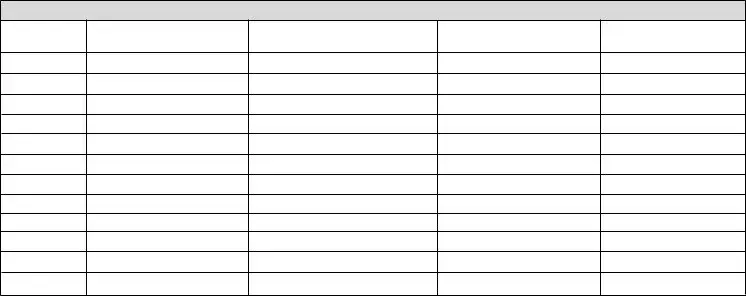
For your records only. Do not send to the Indiana Department of Revenue.
Month |
Amount of |
Amount of |
Date Paid |
Check Number |
|
Tax Due |
Tax Paid |
||||
|
|
January
February
March
April
May
June
July
August
September
October
November
December
Sales Tax Vouchers and/or Electronic Funds Transfer Credit Recap |
Filing Status |
Instructions for completing Form ST−103 |
All |
|
1.Total Sales − Enter the total sales from activities for the period specified on the form. Do not include any other periods of sales activities. Sales activities include retail, wholesale, manufacturing, and out−of−state sales. The figure entered on this line cannot include sales tax.
2.Exemptions/Deductions − Enter the total amount of exemptions and/or deductions for the period.
3.Taxable Sales − Subtract Line 2 from Line 1.
4.Total Tax Due − Multiply Line 3 by the Current Sales Tax Rate to compute the sales tax due. See the voucher for the current sales tax rate.
5.Discount (Collection Allowance) − Use this line only if your voucher is postmarked or your EFT payments were made on or before the due date. The discount is available only when the payment is remitted timely. Your collection allowance is .0083. It is based on your total sales tax liability accrued during July 1, 2006 through June 30, 2007. For further information, please refer to this Web site: www.in.gov/dor/reference/notices/pdfs/dn25.pdf
Utilities are not eligible for the discount.
6.Use Tax Due − Use tax is due on any purchase(s) where no sales tax was paid and the property was not held for resale or for another exempt purpose. If an item is (a) removed from inventory for personal use, (b) used as a giveaway, or (c) used as a display model or promotional item not for sale, and no sales tax was paid when purchased, then use tax is due. Multiply your cost by the Current Use Tax Rate. See the voucher for the current use tax rate.
7.Interest Due − Payments made after the due date are subject to interest. Interest is computed from the tax due date to the date payment is made. Interest must be computed on the total of Line 4 plus Line 6. Do not compute interest on any late payment penalty entered on Line 8. If you make a late payment by EFT, do not calculate and enter interest due on this line. An assessment notice for late payment interest and penalty due will be issued automatically.
8.Penalty Due − Payments made after the due date are also subject to a 10 percent penalty. The penalty must be computed by multiplying 10 percent times the total of Line 4 plus Line 6, or $5.00, whichever is greater. Do not compute penalty on the interest amount due entered on Line 7. If you make a late payment by EFT, do not calculate and enter penalty on this line. An assessment notice for late payment interest and penalty will be issued automatically. EFT taxpayers do not use Line 7 or Line 8 to compute penalty and interest.
9.Payment Previously Made (EFT) − Enter the total amount paid by EFT for all months within the quarter. If you are mailing this recap before you have initiated the final EFT payment for the quarter, you should claim the EFT payment you will be initiating on this line. Do not enter the final EFT payment for the quarter on Line 10.
10. Amount Due − Add Lines 4, 6, 7 and 8 and subtract Lines 5 and 9. Pay this amount. Do not send cash.
EFT taxpayers must remit payments on or before the due date specified by the department−assigned filing frequency.
Although the EFT recap is filed quarterly, the payments may be due monthly by the twentieth or thirtieth depending on the filing frequency.
If you begin paying by EFT in the middle of a quarter, only include the months paid by EFT on the recap.
Interested in Filing Electronically or Online?
Visit www.INtax.in.gov to learn about Indiana’s online filing program, INtax. You may register to file returns and make tax payments electronically online. INtax may be used to file taxes for Indiana sales tax, withholding tax, and tire fee.
For information about Indiana’s other electronic payment options, visit www.in.gov/dor and select Electronic Services.
| Fact Name | Details |
|---|---|
| Purpose | The Indiana ST-103 form is used for reporting sales tax and is for record-keeping only; it should not be sent to the Indiana Department of Revenue. |
| Governing Law | This form is governed by Indiana sales tax laws, specifically under Title 6 of the Indiana Code. |
| Filing Frequency | Although the recap is filed quarterly, payments may be due monthly based on the assigned filing frequency. |
| Discount Availability | A collection allowance of .0083 is available only if payments are made on or before the due date. Utilities do not qualify for this discount. |
| Use Tax | Use tax applies to purchases where no sales tax was paid, and it must be calculated based on the current use tax rate. |
| Interest and Penalty | Late payments incur interest and a 10% penalty, calculated based on the total tax due and use tax. |
| Electronic Filing | Taxpayers can file electronically through the INtax program, which allows for online tax payments and returns. |
Filling out the Indiana ST 103 form is an important step in managing your sales tax obligations. This form helps you report your sales and calculate the amount of tax due. Follow these steps to ensure accurate completion.
Once you have completed the form, ensure you keep a copy for your records. Payments should be made according to the due dates specified by your filing frequency. For those interested in electronic filing, consider exploring Indiana's online filing program, INtax, for a more streamlined process.
The Indiana ST-103 form serves as a recap of sales tax activities for a specified period. It is intended for record-keeping purposes only and should not be submitted to the Indiana Department of Revenue. This form allows businesses to summarize their total sales, exemptions, and tax liabilities, providing a clear picture of their sales tax obligations.
To calculate the total tax due, follow these steps:
If a payment is made after the due date, it will incur interest and a penalty. The interest is calculated from the tax due date to the date the payment is made and is applied to the total of Lines 4 and 6. Additionally, a 10 percent penalty applies to late payments, calculated on the total of Lines 4 and 6 or $5.00, whichever is greater. It is important to note that an assessment notice for late payment interest and penalties will be issued automatically.
A discount, known as a collection allowance, is available only if your payment is postmarked or made electronically on or before the due date. This allowance is calculated at 0.0083 of your total sales tax liability accrued during the specified period. However, it is important to note that utilities are not eligible for this discount.
Yes, Indiana offers an online filing program called INtax, which allows businesses to file returns and make tax payments electronically. This program can be used for various taxes, including sales tax, withholding tax, and tire fees. To learn more about INtax and other electronic payment options, visit the Indiana Department of Revenue's website.
When filling out the Indiana ST 103 form, individuals often make several common mistakes that can lead to complications or delays. Understanding these mistakes can help ensure a smoother filing process.
One common error is failing to report the total sales accurately. It is crucial to enter only the sales figures for the specified period. This means excluding any sales from previous periods. Many people mistakenly include sales tax in this total, which is not permitted. The total sales figure should reflect only the gross sales from activities such as retail and wholesale.
Another frequent mistake is miscalculating exemptions and deductions. Individuals sometimes overlook certain exemptions or misinterpret what qualifies as a deduction. It is important to carefully review the guidelines to ensure that only eligible amounts are deducted from total sales.
When calculating taxable sales, some filers forget to subtract the exemptions and deductions from the total sales. This step is essential, as it determines the amount of sales that is subject to tax. Failing to perform this calculation correctly can lead to an inaccurate tax liability.
Additionally, individuals often overlook the current sales tax rate when calculating the total tax due. It is vital to refer to the voucher provided with the form to ensure the correct rate is applied. Using an outdated rate can result in underpayment or overpayment of taxes.
Another mistake involves the collection allowance. This discount applies only if payments are made on time. Many people either forget to apply this discount or incorrectly assume they qualify without verifying their payment date. Remember, utilities are not eligible for this discount, which can lead to further confusion.
Calculating use tax due can also pose challenges. Individuals sometimes fail to recognize that use tax is applicable on purchases where no sales tax was paid. This includes items removed from inventory for personal use or promotional purposes. It's essential to understand what qualifies for use tax to avoid penalties.
Interest due on late payments is another area where mistakes can occur. Some individuals do not compute interest correctly, either by misunderstanding how it is calculated or failing to include all relevant lines. Interest is based on the total tax due and use tax, not on penalties.
The penalty due is often misunderstood as well. Many filers mistakenly calculate penalties on the interest amount instead of just on the tax due and use tax. It is important to follow the instructions carefully to avoid additional charges.
Lastly, when reporting payment previously made by electronic funds transfer (EFT), individuals sometimes confuse this with their final payment for the quarter. It is crucial to report only the total amount paid by EFT for the months included in the recap, not the final payment.
By being aware of these common mistakes, individuals can take steps to ensure accurate completion of the Indiana ST 103 form, leading to a more efficient tax filing experience.
The Indiana ST-103 form is essential for reporting sales tax, but it is often accompanied by several other documents that facilitate accurate tax filing. Understanding these forms can help ensure compliance and streamline the filing process.
Familiarity with these forms and documents is vital for any business operating in Indiana. Proper preparation and timely submission can prevent penalties and ensure compliance with state tax regulations.
The Indiana State Form ST-103 is a sales tax return form that shares similarities with several other tax-related documents. Below is a list of nine documents that are comparable to the ST-103 form, along with explanations of their similarities.
When filling out the Indiana ST 103 form, there are important dos and don'ts to keep in mind. Here’s a helpful list:
Understanding the Indiana ST-103 form is crucial for businesses to ensure compliance with tax regulations. However, several misconceptions often lead to confusion. Here are nine common myths about the Indiana ST-103 form, along with clarifications to help you navigate the process.
This form is for your records only. You do not need to send it to the Department of Revenue.
Only sales from retail, wholesale, manufacturing, and out-of-state activities for the specified period should be included. Do not mix in sales from other periods.
It is essential to accurately report all exemptions and deductions for the period. Failure to do so can lead to incorrect tax calculations.
The discount is only available if your voucher is postmarked or your electronic funds transfer (EFT) payments are made on or before the due date.
Use tax applies to any purchases where no sales tax was paid, regardless of whether the item was bought in-state or out-of-state.
Interest is computed on the total tax due and use tax due, but not on any penalties incurred for late payments.
The penalty is 10 percent of the total of tax due and use tax due, or $5.00, whichever is greater. It’s not a fixed amount.
EFT taxpayers do not use the lines for calculating interest and penalties on the ST-103 form. An assessment notice will be issued automatically for any late payments.
It’s important to enter the total amount paid by EFT for all months within the quarter on the form. This ensures accurate reporting of your tax obligations.
By addressing these misconceptions, businesses can better manage their tax responsibilities and avoid potential pitfalls. Always consult the latest guidelines or a tax professional for specific advice tailored to your situation.
When filling out and using the Indiana ST-103 form, it is essential to understand the following key points:
By keeping these takeaways in mind, you can ensure accurate completion of the Indiana ST-103 form and compliance with state tax requirements.