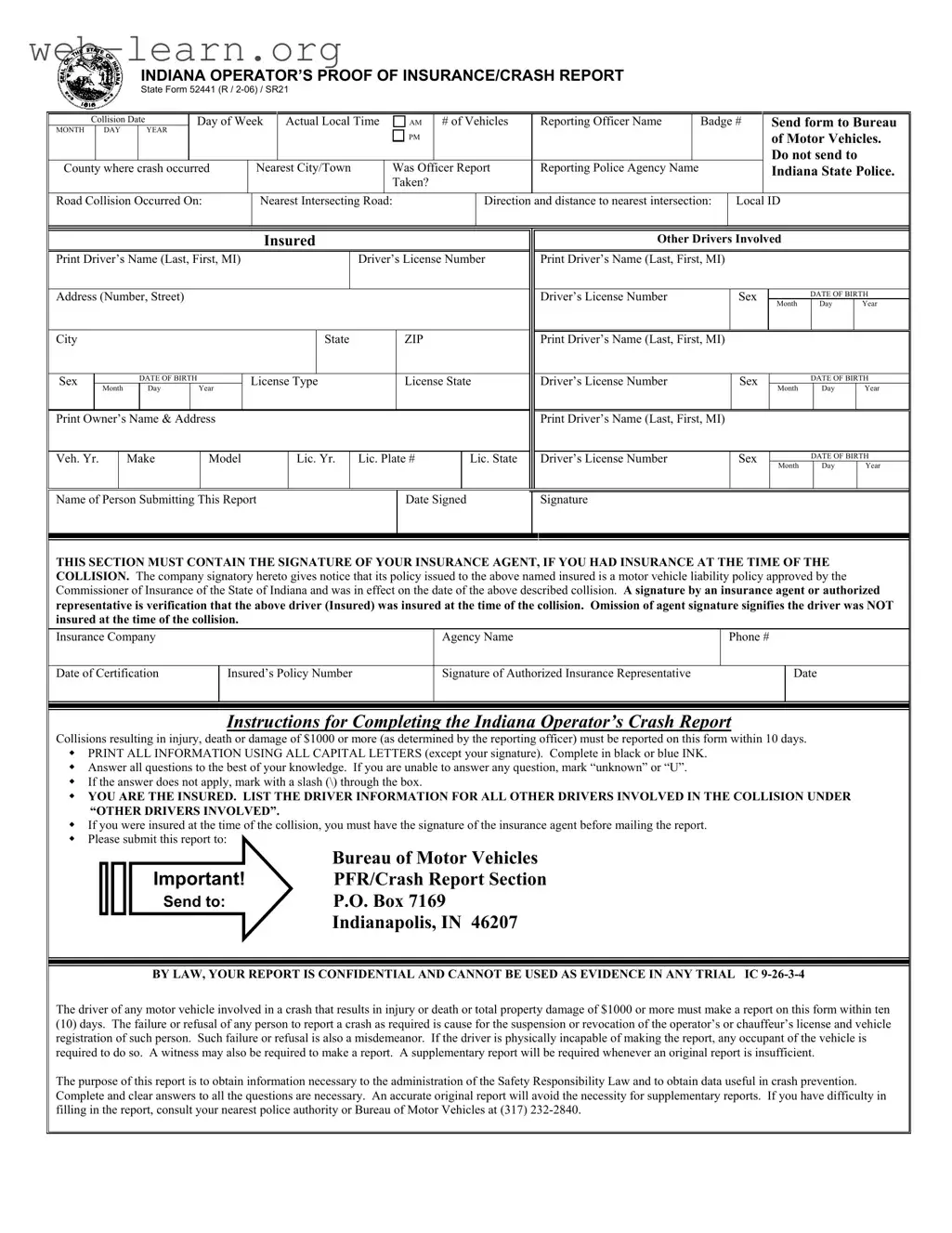
The Indiana SR21 form serves a crucial role in the aftermath of a vehicle collision, particularly for those involved in accidents that result in injury, death, or property damage exceeding $1,000. This form, officially titled the Operator’s Proof of Insurance/Crash Report, must be submitted to the Bureau of Motor Vehicles within ten days of the incident. It captures essential details such as the date and time of the collision, the identities of all drivers involved, and their insurance information. The report requires signatures from both the insured driver and their insurance agent, affirming that the necessary coverage was in place at the time of the crash. Furthermore, it is important to note that the information collected through the SR21 form is confidential and cannot be used as evidence in court. Completing the form accurately is vital, as incomplete submissions may lead to the need for supplementary reports. The Indiana State Police or local authorities can assist individuals who may find it challenging to fill out the form. Understanding the requirements and implications of the SR21 form is essential for drivers in Indiana, as failing to report an accident appropriately can result in serious legal consequences, including the suspension of driving privileges.
INDIANA OPERATOR’S PROOF OF INSURANCE/CRASH REPORT
STATE FORM 52441 (R /
Collision Date |
|
Day of Week |
Actual Local Time |
AM |
# of Vehicles |
Reporting Officer Name |
|
Badge # |
Send form to Bureau |
||||||
MONTH |
DAY |
|
YEAR |
|
|
|
|
PM |
|
|
|
|
|
|
of Motor Vehicles. |
|
|
|
|
|
|
|
|
|
|
|
|
|
|
||
|
|
|
|
|
|
|
|
|
|
|
|
|
|
|
Do not send to |
County where crash occurred |
|
Nearest City/Town |
Was Officer Report |
Reporting Police Agency Name |
|
|
Indiana State Police. |
||||||||
|
|
|
|
|
|
|
|
Taken? |
|
|
|
|
|
|
|
|
|
|
|
|
|
|
|
|
|
|
|
|
|
|
|
|
|
|
|
|
|
|
|
|
|||||||
Road Collision Occurred On: |
|
Nearest Intersecting Road: |
|
Direction and distance to nearest intersection: |
Local ID |
||||||||||
|
|
|
|
|
|
|
|
|
|
|
|
|
|
|
|
Insured
Print Driver’s Name (Last, First, MI) |
|
|
|
Driver’s License Number |
||||||||
|
|
|
|
|
|
|
|
|
|
|
|
|
Address (Number, Street) |
|
|
|
|
|
|
|
|||||
|
|
|
|
|
|
|
|
|
|
|
|
|
City |
|
|
|
|
|
|
State |
|
ZIP |
|
||
|
|
|
|
|
|
|
|
|
|
|
|
|
Sex |
|
|
|
DATE OF BIRTH |
|
License Type |
|
License State |
||||
|
Month |
|
Day |
|
Year |
|
|
|
|
|
|
|
|
|
|
|
|
|
|
|
|
|
|
|
|
Print Owner’s Name & Address |
|
|
|
|
|
|
||||||
|
|
|
|
|
|
|
|
|
|
|||
Veh. Yr. |
|
Make |
Model |
|
Lic. Yr. |
Lic. Plate # |
Lic. State |
|||||
|
|
|
|
|
|
|
|
|
|
|
|
|
Other Drivers Involved
Print Driver’s Name (Last, First, MI)
Driver’s License Number |
Sex |
|
DATE OF BIRTH |
|
|
|
Month |
Day |
Year |
|
|
|
|
|
Print Driver’s Name (Last, First, MI) |
|
|
|
|
|
|
|
|
|
Driver’s License Number |
Sex |
|
DATE OF BIRTH |
|
|
|
Month |
Day |
Year |
|
|
|
|
|
Print Driver’s Name (Last, First, MI) |
|
|
|
|
|
|
|
|
|
Driver’s License Number |
Sex |
|
DATE OF BIRTH |
|
|
|
Month |
Day |
Year |
|
|
|
|
|
Name of Person Submitting This Report
Date Signed
Signature
THIS SECTION MUST CONTAIN THE SIGNATURE OF YOUR INSURANCE AGENT, IF YOU HAD INSURANCE AT THE TIME OF THE COLLISION. The company signatory hereto gives notice that its policy issued to the above named insured is a motor vehicle liability policy approved by the Commissioner of Insurance of the State of Indiana and was in effect on the date of the above described collision. A signature by an insurance agent or authorized representative is verification that the above driver (Insured) was insured at the time of the collision. Omission of agent signature signifies the driver was NOT insured at the time of the collision.
Insurance Company
Agency Name
Phone #
Date of Certification
Insured’s Policy Number
Signature of Authorized Insurance Representative
Date
Instructions for Completing the Indiana Operator’s Crash Report
Collisions resulting in injury, death or damage of $1000 or more (as determined by the reporting officer) must be reported on this form within 10 days. PRINT ALL INFORMATION USING ALL CAPITAL LETTERS (except your signature). Complete in black or blue INK.
Answer all questions to the best of your knowledge. If you are unable to answer any question, mark “unknown” or “U”. If the answer does not apply, mark with a slash (\) through the box.
YOU ARE THE INSURED. LIST THE DRIVER INFORMATION FOR ALL OTHER DRIVERS INVOLVED IN THE COLLISION UNDER “OTHER DRIVERS INVOLVED”.
If you were insured at the time of the collision, you must have the signature of the insurance agent before mailing the report.
Please submit this report to:
Bureau of Motor Vehicles
Important! PFR/Crash Report Section
Send to: P.O. Box 7169
Indianapolis, IN 46207
BY LAW, YOUR REPORT IS CONFIDENTIAL AND CANNOT BE USED AS EVIDENCE IN ANY TRIAL IC
The driver of any motor vehicle involved in a crash that results in injury or death or total property damage of $1000 or more must make a report on this form within ten
(10)days. The failure or refusal of any person to report a crash as required is cause for the suspension or revocation of the operator’s or chauffeur’s license and vehicle registration of such person. Such failure or refusal is also a misdemeanor. If the driver is physically incapable of making the report, any occupant of the vehicle is required to do so. A witness may also be required to make a report. A supplementary report will be required whenever an original report is insufficient.
The purpose of this report is to obtain information necessary to the administration of the Safety Responsibility Law and to obtain data useful in crash prevention. Complete and clear answers to all the questions are necessary. An accurate original report will avoid the necessity for supplementary reports. If you have difficulty in filling in the report, consult your nearest police authority or Bureau of Motor Vehicles at (317)
| Fact Name | Description |
|---|---|
| Form Purpose | The Indiana SR21 form serves as the Operator’s Proof of Insurance and a crash report for motor vehicle collisions. |
| Filing Deadline | Drivers must file the SR21 form within 10 days of a collision resulting in injury, death, or property damage exceeding $1,000. |
| Confidentiality | Reports submitted using the SR21 form are confidential and cannot be used as evidence in court trials. |
| Signature Requirement | If the driver had insurance at the time of the collision, the form must include the signature of an authorized insurance agent. |
| Governing Law | This form is governed by Indiana Code IC 9-26-3-4, which outlines the reporting requirements for motor vehicle crashes. |
| Submission Address | The completed form should be mailed to the Bureau of Motor Vehicles at P.O. Box 7169, Indianapolis, IN 46207. |
| Driver Information | All drivers involved in the collision must be listed on the form, including their license numbers and personal details. |
| Supplementary Reports | A supplementary report is required if the original SR21 form is insufficient or if additional information is needed. |
After gathering the necessary information, follow these steps to fill out the Indiana SR21 form accurately. Completing this form promptly and correctly is essential, as it must be submitted within ten days of the collision.
Once you have filled out the form completely, mail it to the Bureau of Motor Vehicles at the specified address. Ensure that you keep a copy for your records. Timely submission is crucial to avoid penalties related to failure to report the collision.
The Indiana SR21 form, officially known as the Operator’s Proof of Insurance/Crash Report, is a document required by the state of Indiana. It must be completed by drivers involved in a motor vehicle collision that results in injury, death, or property damage exceeding $1,000. This form serves to report the details of the crash and verify insurance coverage at the time of the incident.
You must submit the SR21 form within 10 days of the collision. This is a legal requirement for any crash that results in injury, death, or significant property damage. Timely submission helps avoid potential penalties, including the suspension of your driver's license or vehicle registration.
The driver of the vehicle involved in the crash is primarily responsible for completing the SR21 form. However, if the driver is unable to do so due to physical incapacity, any occupant of the vehicle may fulfill this responsibility. In some cases, a witness may also be required to report the incident.
The form requires detailed information about the collision, including:
Completing all sections accurately is crucial for the report's validity.
If you were not insured at the time of the collision, you must still complete the SR21 form. However, it is important to note that the signature of your insurance agent is not required in this case. The absence of insurance coverage may have legal implications, so it is advisable to consult with a legal expert if you have questions about your situation.
Once you have completed the SR21 form, it should be mailed to the Bureau of Motor Vehicles at the following address:
Bureau of Motor Vehicles
PFR/Crash Report Section
P.O. Box 7169
Indianapolis, IN 46207
Do not send the form to the county where the crash occurred.
Yes, the information provided on the SR21 form is confidential. By law, it cannot be used as evidence in any trial. This confidentiality is intended to protect the privacy of all individuals involved in the collision.
When filling out the Indiana SR21 form, many individuals make common mistakes that can lead to complications down the line. Understanding these pitfalls can help ensure a smoother process. Here are six frequent errors to avoid.
One major mistake is failing to provide the insurance agent's signature. If you were insured at the time of the collision, this signature is crucial. Without it, the form may indicate that you were not insured, potentially leading to legal issues or fines. Always double-check that this section is signed before submitting the report.
Another common error is neglecting to use capital letters throughout the form. The instructions specifically state that all information must be printed in capital letters, except for your signature. Using lowercase letters can create confusion and may lead to misinterpretation of your information.
Many people also overlook the importance of completing all sections of the form. Each question should be answered to the best of your ability. If you cannot answer a question, mark it as “unknown” instead of leaving it blank. Incomplete forms may be rejected or require additional follow-up, complicating the process further.
Providing incorrect vehicle information is another frequent mistake. Ensure that the vehicle year, make, model, and license plate number are accurate. Errors in this section can lead to complications in processing your report and could affect insurance claims or legal proceedings.
People often forget to include information about all drivers involved in the collision. It is essential to list the names and details of all other drivers, as this information is necessary for a complete report. Failing to do so can create misunderstandings or delays in resolving the incident.
Lastly, many individuals fail to submit the report to the correct address. The form must be sent to the Bureau of Motor Vehicles, not the county where the crash occurred. Double-check the submission details to ensure your report reaches the right destination promptly.
Avoiding these common mistakes can help streamline the reporting process and reduce the likelihood of complications. Take your time to fill out the Indiana SR21 form accurately and completely for the best results.
The Indiana SR21 form is essential for reporting vehicle collisions involving injuries, deaths, or significant property damage. Alongside this form, several other documents may be needed to ensure a complete understanding of the incident and to comply with state laws. Here’s a brief overview of these related forms and documents.
These documents work together to provide a comprehensive view of the circumstances surrounding a vehicle collision. Properly completing and submitting them can help ensure that all parties involved receive the necessary support and resolution following an accident.
Things to Do When Filling Out the Indiana SR21 Form:
Things Not to Do When Filling Out the Indiana SR21 Form:
This form must be completed for any collision resulting in injury, death, or property damage of $1,000 or more. It’s not limited to severe incidents.
The SR21 form should be sent to the Bureau of Motor Vehicles, not the county where the crash took place.
If the damage exceeds $1,000 or there are injuries, you are legally required to report it using this form.
The report must include information about all drivers involved in the collision, ensuring complete documentation.
If you had insurance at the time of the collision, the signature of your insurance agent is mandatory for the report to be valid.
The law requires that the form be submitted within 10 days of the collision. Delays can lead to penalties.
This report is confidential and cannot be used as evidence in any trial, protecting the privacy of those involved.
The instructions specify that the form must be completed in black or blue ink to ensure clarity and legibility.
You should answer all questions to the best of your knowledge. If unsure, mark “unknown” or “U” to indicate that.
If the driver is unable to make the report, any occupant or witness may be required to do so, ensuring that all relevant information is documented.
Filling out the Indiana SR21 form is an essential step for drivers involved in a collision. Here are some key takeaways to help you navigate the process:
Understanding these points can make the process smoother and ensure compliance with Indiana law. Stay informed and prepared!