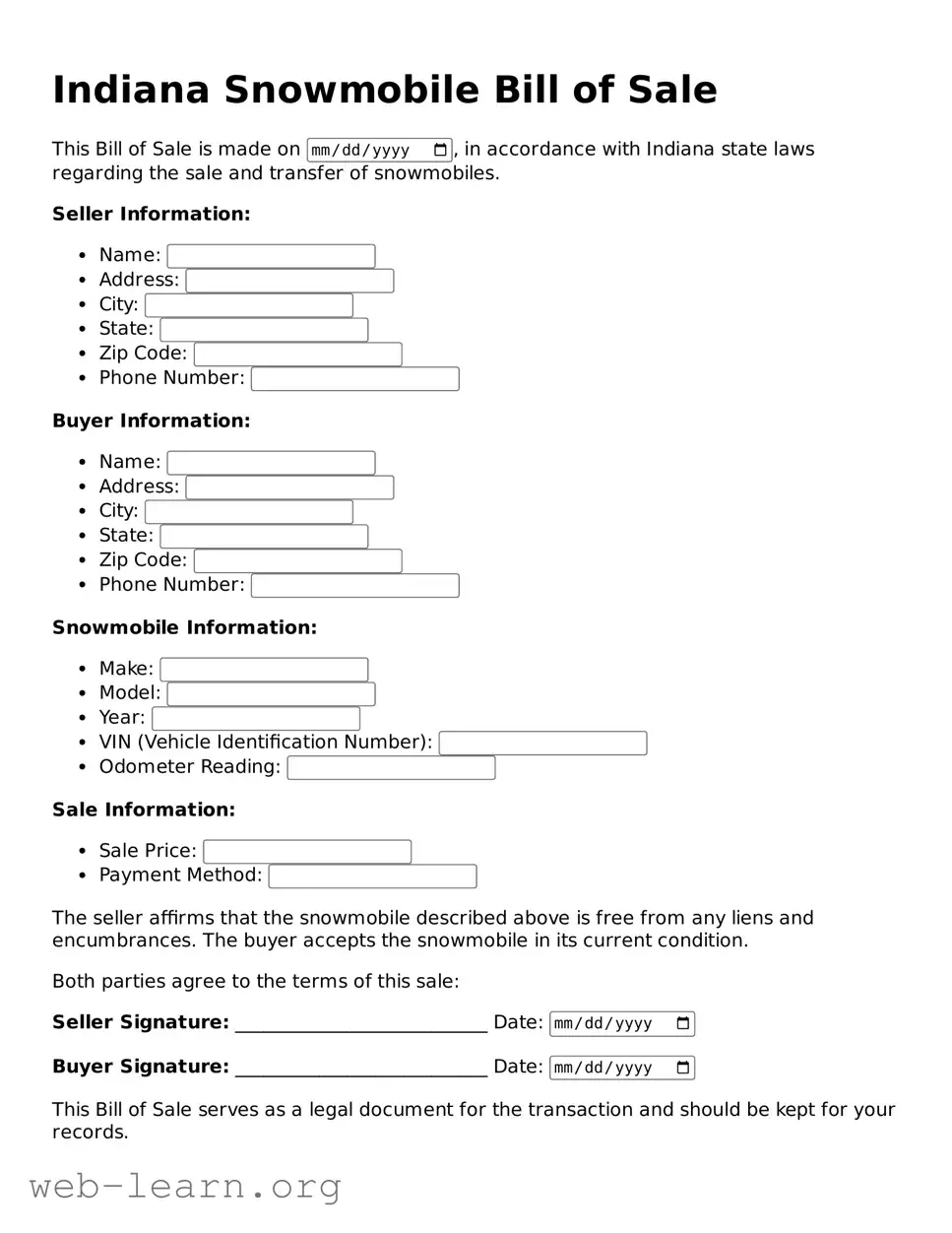
The Indiana Snowmobile Bill of Sale form serves as a crucial document for individuals engaged in the buying or selling of snowmobiles within the state. This form provides essential details about the transaction, including the names and addresses of both the buyer and the seller, as well as the snowmobile's make, model, year, and Vehicle Identification Number (VIN). Additionally, it outlines the sale price and the date of the transaction, ensuring that both parties have a clear understanding of the agreement. By documenting the transfer of ownership, this form helps protect the rights of both the buyer and the seller, offering a layer of security in what can sometimes be a complex transaction. Furthermore, it may also include information regarding any warranties or representations made by the seller, which can be important for the buyer’s peace of mind. In summary, the Indiana Snowmobile Bill of Sale is an indispensable tool that facilitates a smooth exchange and helps ensure compliance with state regulations.
Indiana Snowmobile Bill of Sale
This Bill of Sale is made on , in accordance with Indiana state laws regarding the sale and transfer of snowmobiles.
Seller Information:
Buyer Information:
Snowmobile Information:
Sale Information:
The seller affirms that the snowmobile described above is free from any liens and encumbrances. The buyer accepts the snowmobile in its current condition.
Both parties agree to the terms of this sale:
Seller Signature: ___________________________ Date:
Buyer Signature: ___________________________ Date:
This Bill of Sale serves as a legal document for the transaction and should be kept for your records.
| Fact Name | Description |
|---|---|
| Purpose | The Indiana Snowmobile Bill of Sale form is used to document the sale of a snowmobile, ensuring both buyer and seller have a record of the transaction. |
| Governing Laws | This form is governed by Indiana Code Title 9, Article 32, which covers snowmobiles and all-terrain vehicles. |
| Required Information | Essential details include the buyer's and seller's names, addresses, the snowmobile's make, model, year, and Vehicle Identification Number (VIN). |
| Signatures | Both the buyer and seller must sign the form to validate the sale and transfer of ownership. |
| Record Keeping | It is recommended that both parties keep a copy of the completed Bill of Sale for their records. |
| Usage | This form is not only useful for private sales but may also be required for registration purposes with the Indiana Bureau of Motor Vehicles. |
Filling out the Indiana Snowmobile Bill of Sale form is a straightforward process. Once completed, this document serves as proof of the transaction between the buyer and seller. It’s important to ensure all details are accurate to avoid any issues in the future.
What is a Snowmobile Bill of Sale in Indiana?
A Snowmobile Bill of Sale is a legal document that records the transfer of ownership of a snowmobile from one party to another. It includes essential details such as the buyer's and seller's information, the snowmobile's description, and the sale price.
Why do I need a Bill of Sale for my snowmobile?
A Bill of Sale provides proof of the transaction. It protects both the buyer and seller by documenting the sale, which can help resolve any disputes that may arise later. Additionally, it may be required for registration purposes with the Indiana Department of Natural Resources.
What information should be included in the Bill of Sale?
The Bill of Sale should include:
Do I need to have the Bill of Sale notarized?
Notarization is not required for a Snowmobile Bill of Sale in Indiana. However, having it notarized can add an extra layer of security and authenticity to the document.
Can I create my own Bill of Sale?
Yes, you can create your own Bill of Sale. Ensure that it includes all necessary information and clearly states the terms of the sale. You can also find templates online that can be customized to fit your needs.
Is there a specific format for the Bill of Sale?
There is no specific format mandated by law for the Bill of Sale in Indiana. However, it should be clear, legible, and contain all relevant details to avoid any confusion.
What should I do after completing the Bill of Sale?
Once the Bill of Sale is completed and signed by both parties, each party should keep a copy for their records. The buyer should also take the Bill of Sale to the Indiana Department of Natural Resources to register the snowmobile.
Are there any fees associated with registering a snowmobile?
Yes, there are fees associated with registering a snowmobile in Indiana. The amount can vary based on the type of registration and the length of time for which it is valid. Check with the Indiana Department of Natural Resources for the most current fee schedule.
What if I lose my Bill of Sale?
If you lose your Bill of Sale, it is advisable to contact the seller to obtain a duplicate. Having a copy is important for registration and proof of ownership. If the seller is unavailable, you may need to consult legal assistance to establish ownership.
Can I use the Bill of Sale for other purposes?
Yes, the Bill of Sale can serve as proof of ownership for various purposes, such as insurance claims or resale. It is a useful document to have on hand for any situation involving the snowmobile.
Filling out the Indiana Snowmobile Bill of Sale form can seem straightforward, but many people make common mistakes that can lead to confusion or even legal issues down the road. One frequent error is neglecting to include all necessary information about the snowmobile itself. This includes the make, model, year, and Vehicle Identification Number (VIN). Without this critical data, the bill of sale may not be recognized as valid, causing problems during registration.
Another mistake often made is failing to accurately identify the buyer and seller. It’s essential to provide full names, addresses, and contact information for both parties. Omitting any of this information can create complications, especially if any disputes arise after the sale. Always double-check that all details are correct and legible.
People sometimes forget to include the sale price. While it might seem obvious, having a clearly stated amount on the bill of sale is vital. This figure not only reflects the agreed-upon price but also serves as a reference for tax purposes. Leaving it blank can lead to misunderstandings or complications with the Indiana Department of Natural Resources.
Additionally, many individuals overlook the importance of signatures. Both the buyer and seller must sign the document for it to be legally binding. Failing to do so can render the bill of sale invalid, which might lead to issues when attempting to register the snowmobile or if any disputes arise later.
Another common error is not providing a date on the bill of sale. The date is crucial as it marks when the transaction took place. This can be important for both tax purposes and for establishing ownership. Without a date, it can create confusion about when the sale was finalized.
People also sometimes forget to keep a copy of the bill of sale for their records. It’s wise to retain a copy for personal documentation, as it serves as proof of the transaction. This can be invaluable if questions about ownership arise in the future.
Lastly, some individuals fail to check local laws and regulations regarding snowmobile sales. Each state may have specific requirements or additional forms that need to be completed. Being unaware of these regulations can lead to complications, so it’s always best to do a little research beforehand.
When purchasing or selling a snowmobile in Indiana, several additional forms and documents may be necessary to ensure a smooth transaction. These documents help clarify ownership, provide proof of registration, and confirm compliance with state regulations. Below is a list of commonly used forms alongside the Indiana Snowmobile Bill of Sale.
These documents play an essential role in the buying and selling process of snowmobiles in Indiana. Ensuring that all necessary paperwork is completed can help prevent potential disputes and facilitate a successful transaction.
When filling out the Indiana Snowmobile Bill of Sale form, it's essential to ensure accuracy and completeness. Here are some important dos and don'ts to keep in mind:
By following these guidelines, you can help ensure a smooth transfer of ownership and protect both parties involved in the sale.
Understanding the Indiana Snowmobile Bill of Sale form is essential for anyone involved in buying or selling a snowmobile. However, several misconceptions can lead to confusion. Here are five common misconceptions:
Many believe that a Bill of Sale is optional. In reality, having a Bill of Sale is crucial. It serves as proof of the transaction and protects both the buyer and seller in case of disputes.
Some think that the Bill of Sale is only required for snowmobiles that are already registered. However, it is important for all transactions, whether the snowmobile is registered or not.
There is a misconception that only the seller's signature is necessary. Both parties should sign the Bill of Sale to ensure that the transaction is legally binding and to avoid future complications.
Some people believe that they can skip filling out certain sections of the form. In fact, providing complete and accurate information is essential for the validity of the document.
Many assume that private sales do not require a Bill of Sale. This is incorrect. Even in private transactions, a Bill of Sale is recommended to document the sale and protect both parties.
By addressing these misconceptions, individuals can navigate the process of buying or selling a snowmobile with confidence. Proper documentation is key to a smooth transaction.
When filling out and using the Indiana Snowmobile Bill of Sale form, it’s important to keep a few key points in mind to ensure a smooth transaction. Here are some essential takeaways:
By following these guidelines, you can navigate the process of buying or selling a snowmobile in Indiana with confidence.