When dealing with the passing of a loved one, the last thing anyone wants is to face a complicated legal process. In Indiana, the Small Estate Affidavit form offers a streamlined way to handle the affairs of someone who has died without a will, or whose estate is below a certain value. This form allows heirs to claim assets without going through the lengthy probate process, saving time and reducing stress. It is designed for estates valued at $50,000 or less, making it accessible for many families. By using this affidavit, individuals can transfer property and settle debts efficiently. Understanding how to complete this form correctly can make a significant difference during a challenging time, ensuring that the deceased’s wishes are honored while providing a clear path for the heirs to follow.
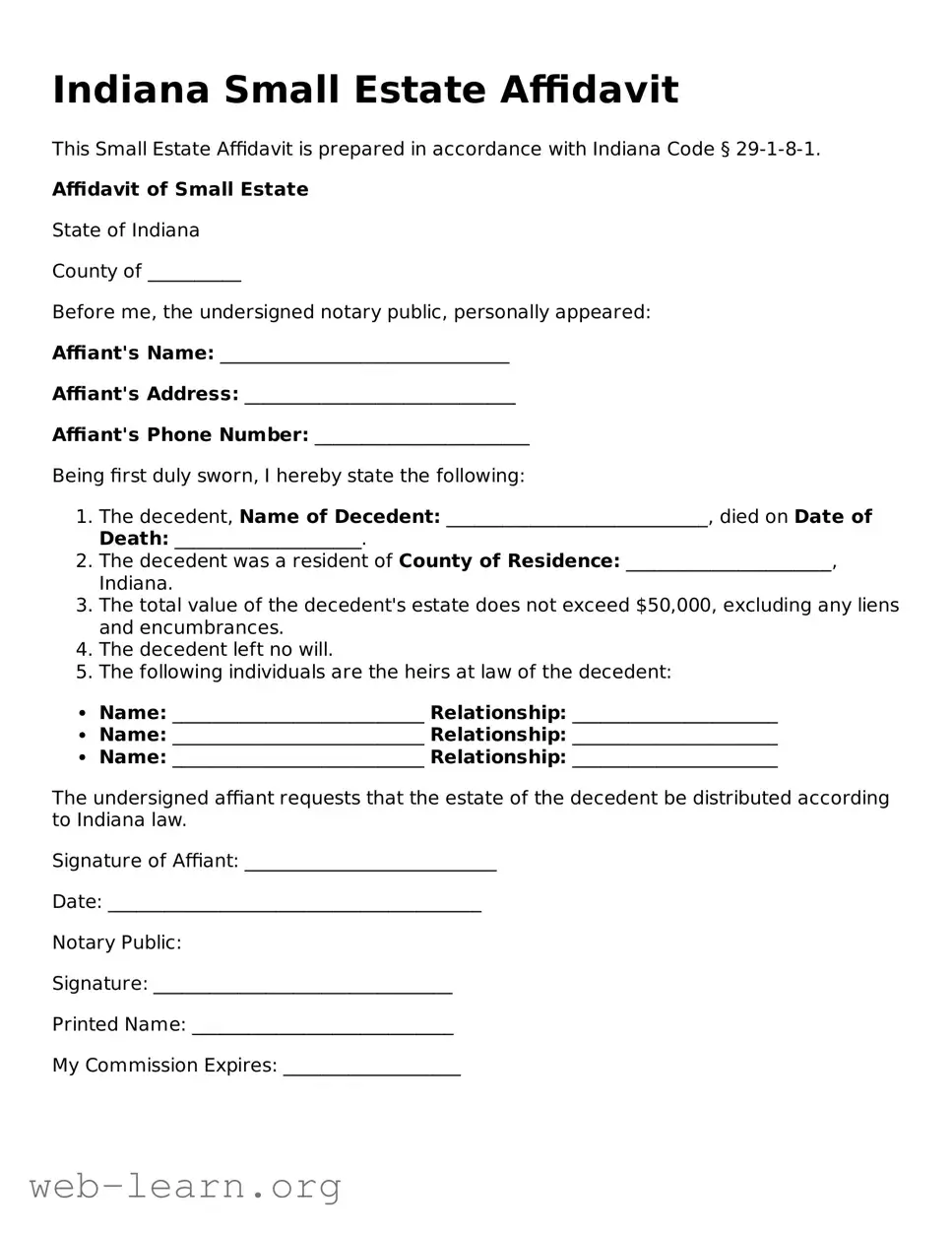
Indiana Small Estate Affidavit
This Small Estate Affidavit is prepared in accordance with Indiana Code § 29-1-8-1.
Affidavit of Small Estate
State of Indiana
County of __________
Before me, the undersigned notary public, personally appeared:
Affiant's Name: _______________________________
Affiant's Address: _____________________________
Affiant's Phone Number: _______________________
Being first duly sworn, I hereby state the following:
The undersigned affiant requests that the estate of the decedent be distributed according to Indiana law.
Signature of Affiant: ___________________________
Date: ________________________________________
Notary Public:
Signature: ________________________________
Printed Name: ____________________________
My Commission Expires: ___________________
| Fact Name | Description |
|---|---|
| Purpose | The Indiana Small Estate Affidavit is used to simplify the transfer of assets from a deceased person's estate when the total value is below a certain threshold. |
| Value Limit | As of 2023, the total value of the estate must not exceed $50,000 for personal property or $100,000 for real property. |
| Eligibility | Only heirs or beneficiaries of the deceased can use the Small Estate Affidavit. |
| Governing Law | The Indiana Small Estate Affidavit is governed by Indiana Code § 29-1-8-1. |
| Filing Requirements | The affidavit must be signed by all heirs and filed with the local probate court. |
| Asset Transfer | The affidavit allows for the direct transfer of assets without going through formal probate proceedings. |
| Time Frame | The affidavit should be filed within 45 days of the deceased's passing. |
| Notarization | The affidavit must be notarized to ensure its validity. |
| Use of Form | The form can be obtained from the Indiana state government or local probate court websites. |
Once you have the Indiana Small Estate Affidavit form, you'll need to fill it out carefully to ensure that all necessary information is provided. After completing the form, you will typically file it with the appropriate court or authority in your county. This process helps to settle the estate of a deceased person without going through the full probate process.
What is the Indiana Small Estate Affidavit?
The Indiana Small Estate Affidavit is a legal document that allows individuals to settle the estate of a deceased person without going through the formal probate process. This is particularly useful for estates that do not exceed a certain value, making it a simpler and more cost-effective option for heirs.
Who can use the Small Estate Affidavit in Indiana?
Typically, any individual who is an heir or a beneficiary of the deceased can use the Small Estate Affidavit. This includes spouses, children, parents, or other relatives named in the will or recognized by law. However, it is essential to ensure that the total value of the estate falls within the legal limits set by Indiana law.
What is the maximum value of an estate that qualifies for the Small Estate Affidavit?
As of the latest guidelines, the total value of the estate must not exceed $50,000, excluding certain types of property such as real estate. It is crucial to check for any updates or changes in this threshold, as these figures can change over time.
What assets can be included in the Small Estate Affidavit?
Assets that can typically be included are personal property, bank accounts, and vehicles. However, real estate is generally excluded from this process. It is important to accurately assess the value of the assets to ensure they fall within the allowable limit.
How do I complete the Small Estate Affidavit?
To complete the Small Estate Affidavit, you will need to provide details about the deceased, the assets, and the heirs. The form must be signed under oath, and it may require notarization. Ensure that all information is accurate and complete to avoid delays in the process.
Where do I file the Small Estate Affidavit?
The completed Small Estate Affidavit should be filed with the probate court in the county where the deceased person lived at the time of their death. This filing initiates the process of transferring the assets to the heirs.
Is there a fee to file the Small Estate Affidavit?
Yes, there is typically a filing fee associated with submitting the Small Estate Affidavit. The fee may vary by county, so it is advisable to check with the local probate court for the exact amount. Some courts may also offer fee waivers for individuals facing financial hardship.
How long does the Small Estate Affidavit process take?
The timeline for processing a Small Estate Affidavit can vary. Generally, once filed, it may take a few weeks for the court to review and approve the affidavit. However, this can depend on the court's caseload and any potential issues that may arise during the review.
What happens after the Small Estate Affidavit is approved?
Once the Small Estate Affidavit is approved, heirs can begin to collect and transfer the assets listed in the affidavit. This includes accessing bank accounts, transferring vehicle titles, and distributing personal property. It is important to keep a record of all transactions for future reference.
Can the Small Estate Affidavit be contested?
Yes, the Small Estate Affidavit can be contested, especially if there are disputes among heirs or if someone believes they have a rightful claim to the estate. If a contest arises, it may lead to further legal proceedings, which could complicate the process. Seeking legal advice in such situations is advisable.
Filling out the Indiana Small Estate Affidavit form can be a straightforward process, but mistakes can lead to delays or complications. One common error is providing incorrect information about the deceased. It is crucial to ensure that the name, date of death, and other personal details are accurate. Even minor discrepancies can raise questions and potentially invalidate the affidavit.
Another frequent mistake is failing to list all assets owned by the deceased. The form requires a comprehensive inventory of the estate's assets. Omitting any significant items, such as bank accounts or real estate, can result in legal issues later on. It is essential to double-check the list to ensure that everything is accounted for.
Many individuals also overlook the importance of including the correct signatures. The affidavit must be signed by all heirs and interested parties. Neglecting to obtain these signatures can cause the affidavit to be rejected. It is advisable to have everyone involved review the document before submission.
Inaccurate valuations of the estate's assets can also lead to problems. The form requires a reasonable estimation of the value of each asset. Underestimating or overestimating values can create disputes among heirs and may even attract scrutiny from the court. Providing fair market values is essential for a smooth process.
Additionally, individuals often fail to provide the necessary supporting documentation. The affidavit may require attachments, such as death certificates or proof of asset ownership. Not including these documents can delay the processing of the affidavit and may necessitate additional steps to correct the oversight.
Lastly, misunderstanding the eligibility criteria for using the Small Estate Affidavit can result in wasted time and effort. Not all estates qualify for this simplified process. It is important to confirm that the estate meets the requirements, such as the value of assets and the number of heirs, before proceeding with the affidavit.
The Indiana Small Estate Affidavit is a useful tool for simplifying the probate process for small estates. However, it is often accompanied by other forms and documents that help streamline the transfer of assets and clarify the legal standing of the estate. Below is a list of commonly used forms that may accompany the Small Estate Affidavit in Indiana.
These documents work together to ensure that the estate is managed properly and that the wishes of the deceased are honored. Having the right forms in place can significantly ease the probate process for all involved parties.
When filling out the Indiana Small Estate Affidavit form, it is important to follow specific guidelines to ensure accuracy and compliance with state laws. Here are six things you should and shouldn't do:
Following these guidelines can help facilitate a smoother process when dealing with small estates in Indiana.
The Indiana Small Estate Affidavit is a useful tool for settling the estates of individuals who have passed away, particularly when the estate's value is below a certain threshold. However, several misconceptions often arise regarding its use. Here are four common misunderstandings:
This is not true. The Small Estate Affidavit is specifically designed for estates valued at $50,000 or less for personal property or $100,000 or less for real property. If the estate exceeds these limits, a different legal process must be followed.
While it can be beneficial to consult with a lawyer, it is not a requirement. Many individuals successfully complete the affidavit on their own. However, understanding the process and requirements is crucial to avoid potential pitfalls.
This is misleading. The affidavit does not absolve the estate of its debts. Creditors still have the right to claim what is owed from the estate before any assets can be distributed to heirs.
While it simplifies the process for small estates, it does not address all estate-related matters. Complex situations, such as disputes among heirs or tax issues, may require additional legal action.
When dealing with the Indiana Small Estate Affidavit form, it’s important to understand its purpose and how to fill it out correctly. Here are some key takeaways:
By keeping these points in mind, you can navigate the process of using the Indiana Small Estate Affidavit more smoothly.