When renting a home in Indiana, having a clear and comprehensive Residential Lease Agreement is essential for both landlords and tenants. This document outlines the terms of the rental arrangement, ensuring that both parties understand their rights and responsibilities. Key aspects of the form include the rental amount, security deposit details, and lease duration. It also specifies the rules regarding maintenance, repairs, and property usage, helping to prevent misunderstandings. Additionally, the agreement addresses issues such as late fees, pet policies, and the process for terminating the lease. By covering these critical elements, the Indiana Residential Lease Agreement provides a solid foundation for a successful landlord-tenant relationship.
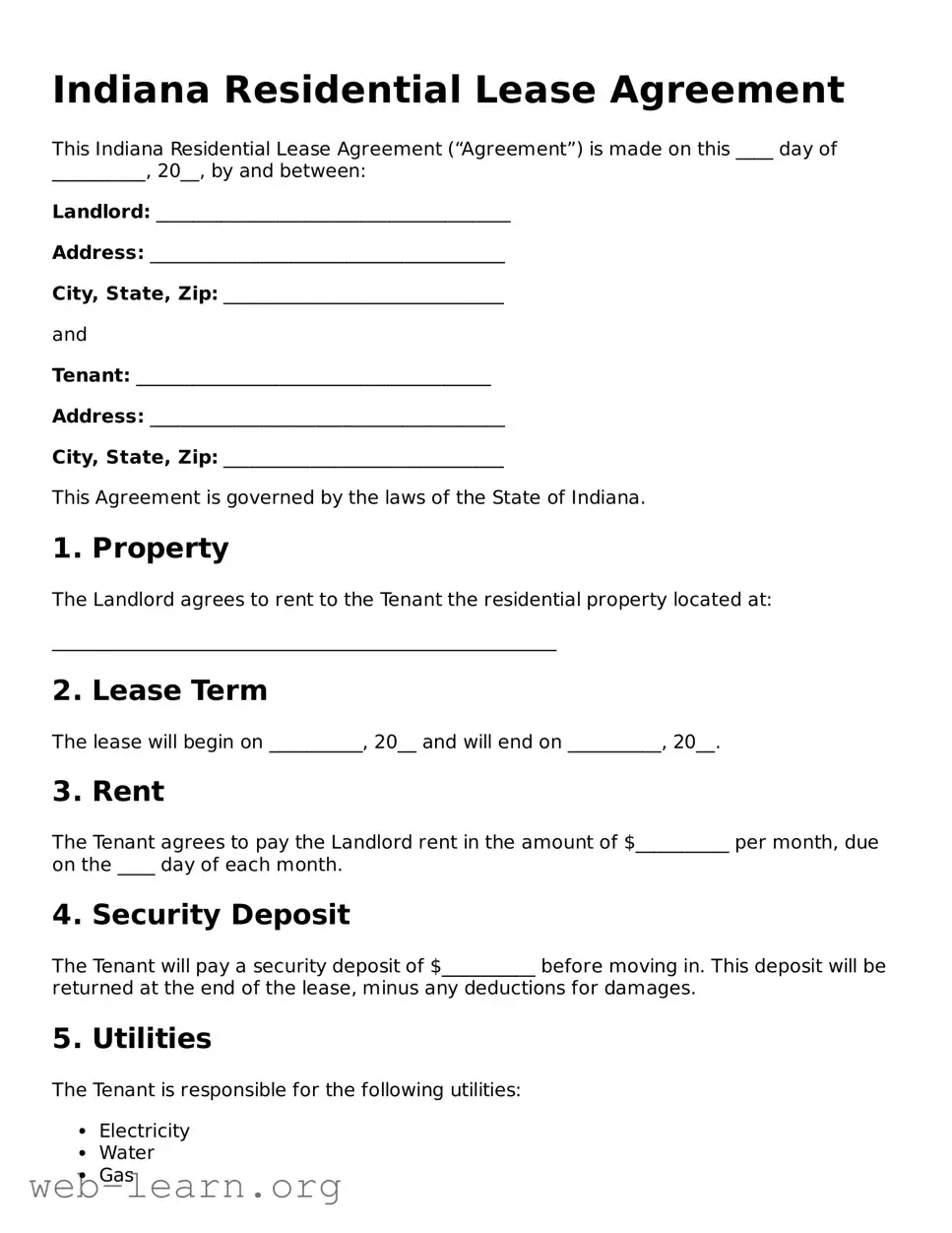
Indiana Residential Lease Agreement
This Indiana Residential Lease Agreement (“Agreement”) is made on this ____ day of __________, 20__, by and between:
Landlord: ______________________________________
Address: ______________________________________
City, State, Zip: ______________________________
and
Tenant: ______________________________________
Address: ______________________________________
City, State, Zip: ______________________________
This Agreement is governed by the laws of the State of Indiana.
1. Property
The Landlord agrees to rent to the Tenant the residential property located at:
______________________________________________________
2. Lease Term
The lease will begin on __________, 20__ and will end on __________, 20__.
3. Rent
The Tenant agrees to pay the Landlord rent in the amount of $__________ per month, due on the ____ day of each month.
4. Security Deposit
The Tenant will pay a security deposit of $__________ before moving in. This deposit will be returned at the end of the lease, minus any deductions for damages.
5. Utilities
The Tenant is responsible for the following utilities:
6. Maintenance and Repairs
The Tenant must keep the property clean and report any needed repairs to the Landlord promptly.
7. Pets
Pets are not allowed without written permission from the Landlord.
8. Termination
Either party may terminate this Agreement by providing written notice at least 30 days before the desired termination date.
9. Governing Law
This Agreement will be governed by the laws of the State of Indiana.
By signing below, both parties agree to the terms of this Agreement:
Landlord Signature: ___________________________ Date: __________
Tenant Signature: ____________________________ Date: __________
| Fact Name | Description |
|---|---|
| Governing Law | The Indiana Residential Lease Agreement is governed by Indiana state law, specifically the Indiana Code Title 32, Article 31. |
| Parties Involved | The agreement involves at least two parties: the landlord (lessor) and the tenant (lessee). |
| Property Description | The form requires a clear description of the rental property, including the address and any specific details about the unit. |
| Lease Term | The lease term specifies the duration of the rental agreement, which can be month-to-month or for a fixed term. |
| Rent Amount | The agreement must state the amount of rent due, the due date, and acceptable payment methods. |
| Security Deposit | Indiana law regulates the security deposit amount and its return, typically not exceeding one month's rent. |
| Maintenance Responsibilities | The lease outlines the responsibilities for property maintenance, clarifying what the landlord and tenant must manage. |
| Termination Conditions | The agreement includes conditions under which either party may terminate the lease, such as notice requirements. |
| Additional Provisions | Parties can include additional provisions, such as pet policies or rules regarding subleasing, as long as they comply with state law. |
Completing the Indiana Residential Lease Agreement form requires careful attention to detail. After filling out the form, both the landlord and tenant will have a clear understanding of their rights and responsibilities. Follow these steps to ensure accurate completion of the document.
What is the purpose of the Indiana Residential Lease Agreement form?
The Indiana Residential Lease Agreement form is a legal document that outlines the terms and conditions between a landlord and a tenant for renting a residential property. This agreement serves to protect the rights of both parties by clearly defining responsibilities, payment terms, and the duration of the lease. It helps to prevent misunderstandings and disputes by providing a written record of the agreed-upon terms.
What essential elements should be included in the lease agreement?
A comprehensive Indiana Residential Lease Agreement should include the following key elements:
Including these elements ensures that both parties have a clear understanding of their obligations and rights throughout the rental period.
Can a landlord make changes to the lease agreement after it has been signed?
Once the Indiana Residential Lease Agreement is signed by both parties, it becomes a binding contract. Any changes to the lease must be agreed upon by both the landlord and the tenant. This can be done through a written amendment that outlines the specific changes and is signed by both parties. Verbal agreements or unapproved modifications may not hold legal weight, so it is crucial to document any changes formally.
What should a tenant do if they need to break the lease early?
If a tenant needs to break the lease before its expiration, they should first review the lease agreement for any specific terms regarding early termination. Commonly, tenants are required to provide written notice to the landlord, typically 30 days in advance. Depending on the lease terms, the tenant may be responsible for paying rent until a new tenant is found or may incur additional fees. Open communication with the landlord can often lead to a mutually agreeable solution.
Filling out the Indiana Residential Lease Agreement can be straightforward, but many people make common mistakes that can lead to issues later on. One frequent error is not providing accurate tenant information. Ensure that all names, contact details, and identification numbers are correct. Missing or incorrect information can complicate communication and legal processes.
Another common mistake is overlooking the lease term. Tenants and landlords often fail to specify the start and end dates of the lease. This omission can create confusion about when the lease begins and ends. Clearly stating these dates is essential for both parties to understand their obligations.
Many people also neglect to include specific terms regarding rent payments. This includes the amount due, the payment method, and the due date. Without these details, misunderstandings can arise, leading to late payments or disputes. Clarity on financial terms is crucial for a smooth landlord-tenant relationship.
Additionally, some individuals forget to address security deposits. The lease should clearly outline the amount of the deposit, the conditions for its return, and any deductions that may apply. Failing to specify these details can lead to disputes when the lease ends.
Another mistake is not including maintenance responsibilities. It’s important to define who is responsible for repairs and maintenance. Without this clarity, both parties may have different expectations, leading to frustration and unresolved issues.
Finally, many overlook the importance of signatures. All parties must sign the lease for it to be legally binding. Incomplete signatures can render the agreement invalid. Always ensure that everyone involved has signed and dated the document.
When entering into a rental agreement in Indiana, several additional forms and documents may be necessary to ensure a clear understanding between landlords and tenants. These documents help outline responsibilities, clarify terms, and protect the rights of both parties. Below is a list of commonly used forms alongside the Indiana Residential Lease Agreement.
These forms and documents are crucial for maintaining a smooth landlord-tenant relationship. They provide clarity and protection for both parties, ensuring that everyone is on the same page throughout the rental process.
When filling out the Indiana Residential Lease Agreement form, it's important to keep a few key points in mind. Here’s a straightforward list of what you should and shouldn’t do:
Understanding the Indiana Residential Lease Agreement form is crucial for both landlords and tenants. However, several misconceptions can lead to confusion. Here are four common misunderstandings:
Many people assume that all residential lease agreements are identical. In reality, each lease can vary significantly based on the property, the landlord's preferences, and local laws. It's essential to read and understand the specific terms of your lease.
Some believe that a verbal agreement is enough to establish a lease. However, without a written document, both parties may face difficulties enforcing their rights. A written lease provides clarity and protection for everyone involved.
There's a common belief that security deposits cannot be refunded. In Indiana, tenants can recover their security deposits if they fulfill the lease terms and leave the property in good condition. Understanding the conditions for refund is vital.
Some individuals think they can modify a lease agreement whenever they want. Changes to the lease must be agreed upon by both parties and documented in writing. Unilateral changes can lead to disputes and misunderstandings.
When filling out and using the Indiana Residential Lease Agreement form, there are several important points to keep in mind. These takeaways can help ensure a smooth leasing experience for both landlords and tenants.
By keeping these key points in mind, both landlords and tenants can navigate the leasing process with greater confidence and clarity.