In the realm of real estate transactions, the Indiana Quitclaim Deed form serves as a crucial tool for property owners looking to transfer their interests in a property without guaranteeing the title's validity. Unlike other types of deeds, a quitclaim deed does not provide any warranties or assurances about the property’s condition or ownership history. This means that the person receiving the property, known as the grantee, accepts it "as-is," which can be both a benefit and a risk. The form is particularly useful in situations such as transferring property between family members, clearing up title issues, or facilitating quick transactions. Understanding the key components of the Indiana Quitclaim Deed is essential. It typically includes details like the names of the parties involved, a legal description of the property, and the signature of the person relinquishing their claim. By grasping the nuances of this form, individuals can navigate the complexities of property transfers with greater confidence and clarity.
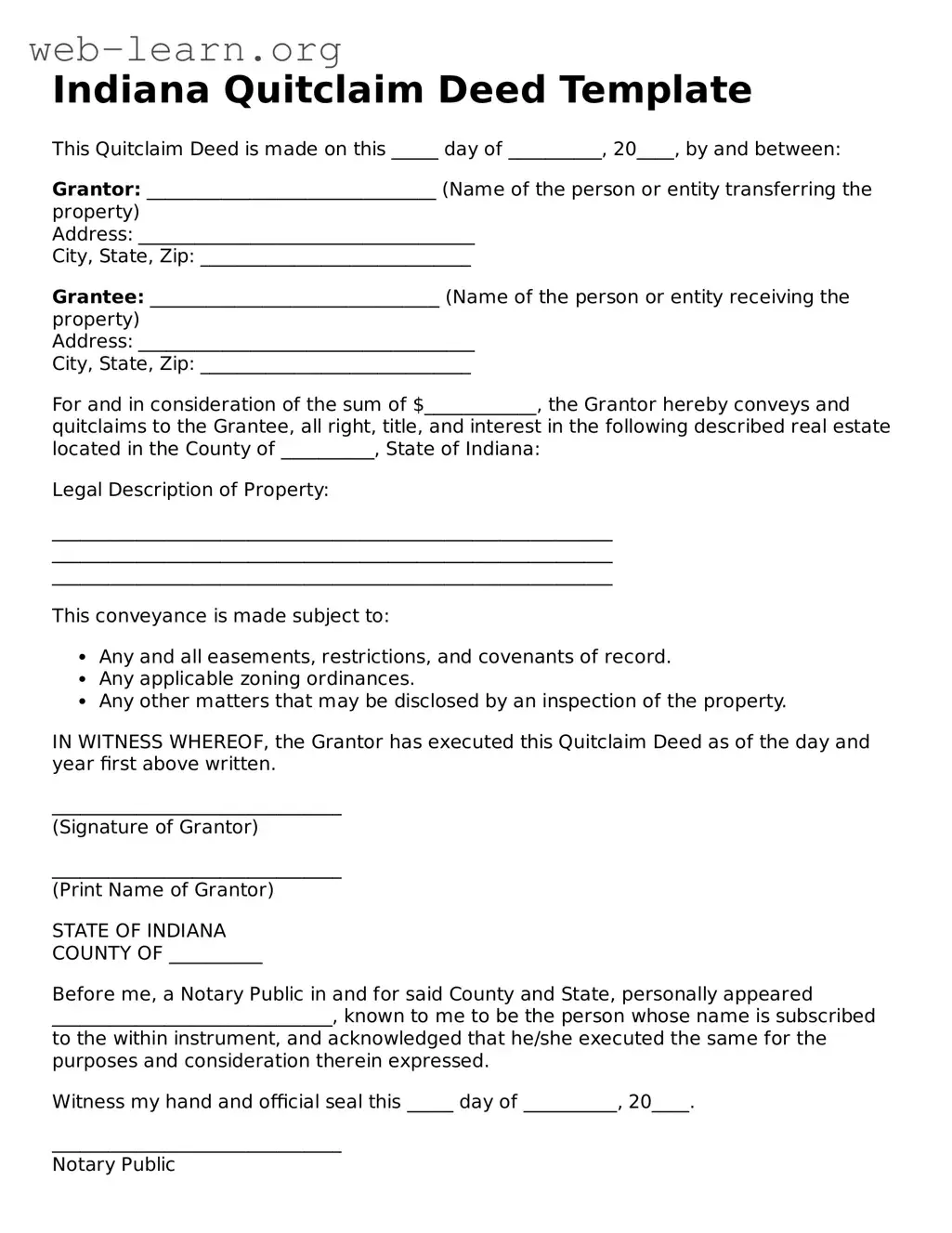
Indiana Quitclaim Deed Template
This Quitclaim Deed is made on this _____ day of __________, 20____, by and between:
Grantor: _______________________________ (Name of the person or entity transferring the property)
Address: ____________________________________
City, State, Zip: _____________________________
Grantee: _______________________________ (Name of the person or entity receiving the property)
Address: ____________________________________
City, State, Zip: _____________________________
For and in consideration of the sum of $____________, the Grantor hereby conveys and quitclaims to the Grantee, all right, title, and interest in the following described real estate located in the County of __________, State of Indiana:
Legal Description of Property:
____________________________________________________________
____________________________________________________________
____________________________________________________________
This conveyance is made subject to:
IN WITNESS WHEREOF, the Grantor has executed this Quitclaim Deed as of the day and year first above written.
_______________________________
(Signature of Grantor)
_______________________________
(Print Name of Grantor)
STATE OF INDIANA
COUNTY OF __________
Before me, a Notary Public in and for said County and State, personally appeared ______________________________, known to me to be the person whose name is subscribed to the within instrument, and acknowledged that he/she executed the same for the purposes and consideration therein expressed.
Witness my hand and official seal this _____ day of __________, 20____.
_______________________________
Notary Public
My Commission Expires: ________________
County of Residence: ____________________
| Fact Name | Details |
|---|---|
| Definition | An Indiana Quitclaim Deed is a legal document used to transfer ownership of real estate without any warranties. |
| Governing Law | The Indiana Quitclaim Deed is governed by Indiana Code Title 32, Article 21. |
| Parties Involved | The deed involves a grantor (the person transferring the property) and a grantee (the person receiving the property). |
| Consideration | While a monetary consideration is often included, it is not required for the deed to be valid. |
| Legal Description | The property must be clearly described within the deed to ensure proper identification. |
| Execution Requirements | The deed must be signed by the grantor and acknowledged before a notary public. |
| Recording | To protect the grantee's interest, the deed should be recorded with the county recorder's office. |
| Limitations | Quitclaim deeds do not provide any guarantees regarding the title; thus, the grantee assumes the risk of any title issues. |
| Use Cases | Commonly used in divorce settlements, transfers between family members, or clearing up title issues. |
After obtaining the Indiana Quitclaim Deed form, you will need to fill it out carefully. Once completed, the form will require signatures and may need to be filed with the county recorder's office. Ensure all information is accurate to avoid delays.
What is a Quitclaim Deed?
A Quitclaim Deed is a legal document used to transfer ownership of real estate from one party to another. It provides no guarantees about the title or ownership rights. The grantor, or seller, relinquishes any claim they may have to the property, but does not guarantee that they actually own it or that there are no liens or encumbrances on the property.
When should I use a Quitclaim Deed?
Quitclaim Deeds are commonly used in situations such as:
Consider using a Quitclaim Deed when the parties involved trust each other and the property's title is clear.
How do I complete an Indiana Quitclaim Deed?
To complete an Indiana Quitclaim Deed, follow these steps:
Ensure all information is accurate to avoid future disputes.
Do I need to record the Quitclaim Deed?
Yes, it is advisable to record the Quitclaim Deed with the county recorder's office where the property is located. Recording the deed provides public notice of the transfer and protects the grantee's ownership rights. Failing to record may lead to complications in the future.
Are there any fees associated with filing a Quitclaim Deed in Indiana?
Yes, there are typically fees for recording a Quitclaim Deed. These fees vary by county. It is important to check with the local county recorder’s office for the exact amount and any additional requirements.
Can I revoke a Quitclaim Deed once it is executed?
Once a Quitclaim Deed is executed and recorded, it cannot be revoked. The transfer of ownership is final. If you wish to regain ownership, you would need to execute a new deed transferring the property back to you or seek legal remedies.
Filling out the Indiana Quitclaim Deed form can seem straightforward, but many people make common mistakes that can lead to complications down the line. One frequent error is neglecting to provide accurate property descriptions. A precise description is essential for identifying the property being transferred. Without it, the deed may be deemed invalid, leading to potential disputes.
Another mistake involves incorrect names or misspellings. It’s crucial to ensure that the names of both the grantor (the person transferring the property) and the grantee (the person receiving the property) are spelled correctly and match their legal documents. Any discrepancies can create confusion and may hinder the transfer process.
People often forget to sign the deed. A Quitclaim Deed must be signed by the grantor to be valid. If the signature is missing, the deed will not be recognized by the county recorder’s office. Additionally, failing to have the deed notarized can also invalidate it. Notarization is a necessary step that adds an extra layer of authenticity.
Another common issue is not including the proper date of execution. The date indicates when the deed was signed, which is important for establishing the timeline of ownership. Omitting this date can lead to challenges regarding the validity of the transfer.
It’s also important to remember that the Quitclaim Deed must be filed with the appropriate county office. Many individuals mistakenly believe that simply completing the form is sufficient. To ensure the transfer is legally recognized, it must be recorded in the county where the property is located.
Lastly, people often overlook the tax implications of transferring property. While a Quitclaim Deed itself may not incur taxes, it’s essential to understand any potential tax liabilities that may arise from the transfer. Consulting with a tax professional can provide clarity and help avoid unexpected financial consequences.
When handling property transfers in Indiana, the Quitclaim Deed form is often accompanied by other important documents. Each of these documents plays a crucial role in ensuring a smooth and legally sound transaction. Here’s a list of commonly used forms and documents.
Having these documents prepared and organized can streamline the property transfer process. Always ensure that you understand each document and its purpose to avoid complications down the line.
A Quitclaim Deed is a legal document used to transfer ownership of property. While it serves a specific purpose, it shares similarities with several other documents in real estate and property law. Below are five documents that are comparable to a Quitclaim Deed, along with explanations of their similarities:
When filling out the Indiana Quitclaim Deed form, it is essential to approach the task with care and attention to detail. Below is a list of important dos and don'ts to keep in mind.
By following these guidelines, individuals can help ensure that the Quitclaim Deed is completed accurately and effectively. This can prevent potential issues in the future regarding property ownership.
When it comes to the Indiana Quitclaim Deed form, several misconceptions can lead to confusion. Understanding these common misunderstandings is crucial for anyone considering using this legal document.
This is true. A quitclaim deed allows the seller to transfer their interest in the property without making any promises about the title's validity. Buyers should be aware that they may not have any legal recourse if issues arise.
While it is often used in family transactions, quitclaim deeds can be utilized in various situations, such as transferring property between friends or in divorce settlements. The form is versatile and not limited to familial relationships.
This is incorrect. A warranty deed provides guarantees about the title and protects the buyer from claims against the property. In contrast, a quitclaim deed offers no such assurances, making it a riskier option for buyers.
This is misleading. While a quitclaim deed does not come with any warranties, obtaining title insurance is still advisable. Title insurance can protect buyers from potential claims or issues that may arise after the transfer.
When filling out and using the Indiana Quitclaim Deed form, several important points should be considered to ensure a smooth process.
Quick Claim Deed Florida - A Quitclaim Deed is often faster and cheaper than a warranty deed.
Idaho Quit Claim Deed Form - Once executed, the Quitclaim Deed must be filed with the appropriate local government office to be effective.
Quick Deed Process - This document is often preferred for its simplicity and speed.
Louisiana Quitclaim Deed - A Quitclaim Deed can be revoked if not recorded.