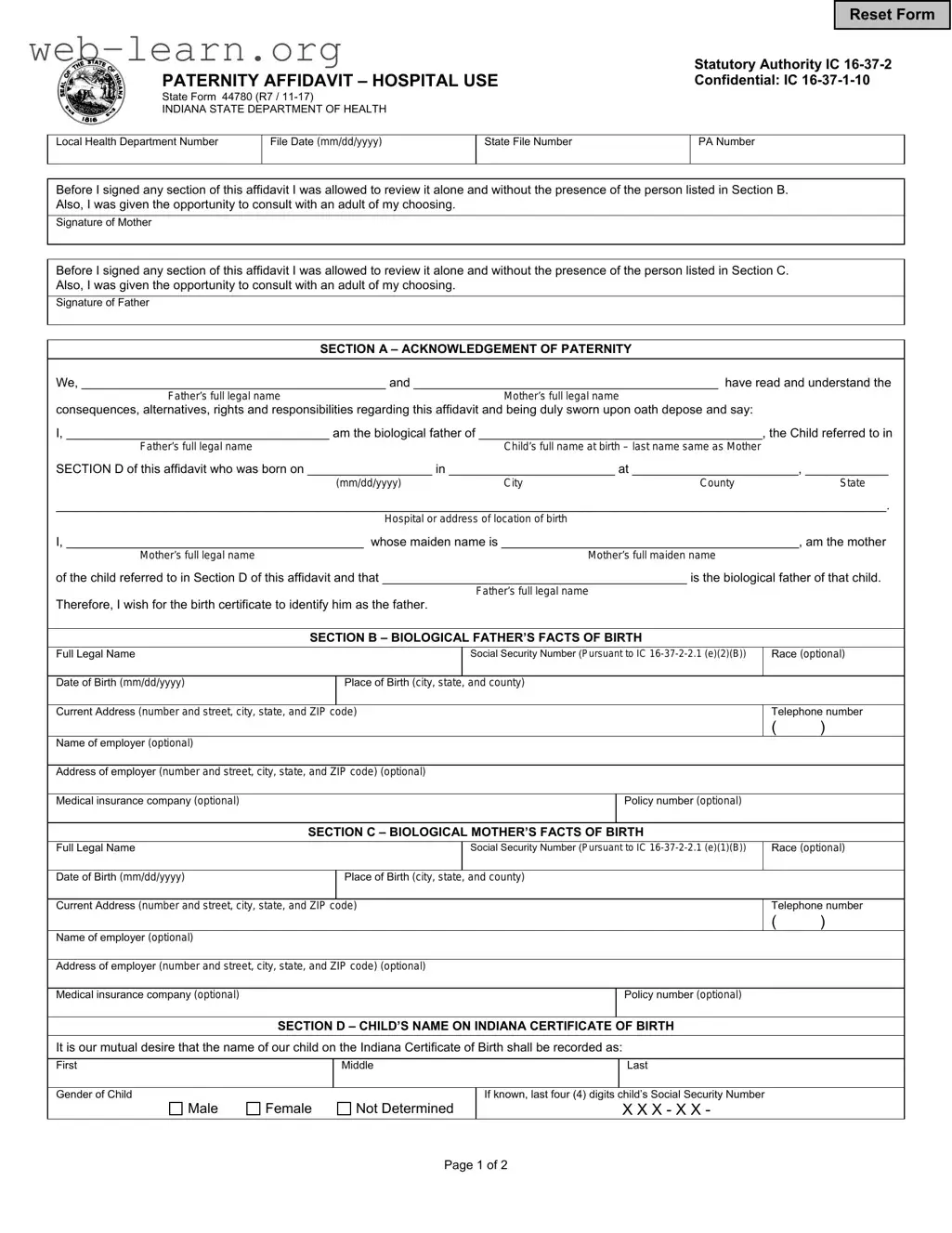
The Indiana Paternity Affidavit 44780 form plays a crucial role in establishing legal parentage in the state of Indiana. This form is primarily used by parents who wish to affirm paternity when a child is born to unmarried individuals. Completing this affidavit can simplify various legal processes, such as child support, custody, and visitation rights. It serves as a voluntary acknowledgment of paternity, allowing the father to take responsibility for the child and ensuring that the child has access to benefits that come from having a legally recognized father. The form requires specific information, including the names of both parents, the child's details, and the signatures of both parties, which must be witnessed or notarized. Understanding the implications of this affidavit is essential for unmarried parents, as it not only affects their rights and responsibilities but also the legal status of their child. By filing this form, parents can help secure their child's future and establish a formal relationship that is recognized by the state.

PATERNITY AFFIDAVIT – HOSPITAL USE
State Form 44780 (R7 /
INDIANA STATE DEPARTMENT OF HEALTH
Local Health Department Number |
File Date (mm/dd/yyyy) |
State File Number |
|
|
|
Reset Form
Statutory Authority IC
PA Number
Before I signed any section of this affidavit I was allowed to review it alone and without the presence of the person listed in Section B. Also, I was given the opportunity to consult with an adult of my choosing.
Signature of Mother
Before I signed any section of this affidavit I was allowed to review it alone and without the presence of the person listed in Section C. Also, I was given the opportunity to consult with an adult of my choosing.
Signature of Father
SECTION A – ACKNOWLEDGEMENT OF PATERNITY
We, ____________________________________________ and ____________________________________________ have read and understand the
Father’s full legal name |
Mother’s full legal name |
consequences, alternatives, rights and responsibilities regarding this affidavit and being duly sworn upon oath depose and say:
I, ______________________________________ am the biological father of _________________________________________, the Child referred to in
Father’s full legal nameChild’s full name at birth – last name same as Mother
SECTION D of this affidavit who was born on __________________ in ________________________ at ________________________, ____________
(mm/dd/yyyy)CityCountyState
________________________________________________________________________________________________________________________.
Hospital or address of location of birth
I, ___________________________________________ whose maiden name is ___________________________________________, am the mother
Mother’s full legal nameMother’s full maiden name
of the child referred to in Section D of this affidavit and that ____________________________________________ is the biological father of that child.
Father’s full legal name
Therefore, I wish for the birth certificate to identify him as the father.
SECTION B – BIOLOGICAL FATHER’S FACTS OF BIRTH
Full Legal Name |
|
|
Social Security Number (Pursuant to IC |
|
Race (optional) |
||||
|
|
|
|
|
|
|
|
|
|
Date of Birth (mm/dd/yyyy) |
|
Place of Birth (city, state, |
and county) |
|
|
|
|||
|
|
|
|
|
|
|
|
||
Current Address (number and street, city, state, and ZIP |
code) |
|
|
|
|
|
Telephone number |
||
|
|
|
|
|
|
|
|
( |
) |
Name of employer (optional) |
|
|
|
|
|
|
|
|
|
|
|
|
|
|
|
|
|
|
|
Address of employer (number and street, city, state, and ZIP code) (optional) |
|
|
|
|
|
|
|
||
|
|
|
|
|
|
Policy number (optional) |
|
|
|
Medical insurance company (optional) |
|
|
|
|
|
|
|||
|
|
|
|
|
|
|
|
||
|
SECTION C – BIOLOGICAL MOTHER’S FACTS OF BIRTH |
|
|
||||||
Full Legal Name |
|
|
Social Security Number (Pursuant to IC |
|
Race (optional) |
||||
|
|
|
|
|
|
|
|
|
|
Date of Birth (mm/dd/yyyy) |
|
Place of Birth (city, state, |
and county) |
|
|
|
|||
|
|
|
|
|
|
|
|
||
Current Address (number and street, city, state, and ZIP |
code) |
|
|
|
|
|
Telephone number |
||
|
|
|
|
|
|
|
|
( |
) |
Name of employer (optional) |
|
|
|
|
|
|
|
|
|
|
|
|
|
|
|
|
|
|
|
Address of employer (number and street, city, state, and ZIP code) (optional) |
|
|
|
|
|
|
|
||
|
|
|
|
|
|
Policy number (optional) |
|
|
|
Medical insurance company (optional) |
|
|
|
|
|
|
|||
|
|
|
|
|
|
|
|
||
|
SECTION D – CHILD’S NAME ON INDIANA CERTIFICATE OF BIRTH |
|
|
||||||
It is our mutual desire that the name of our child on the Indiana Certificate of Birth shall be recorded as: |
|
|
|||||||
|
|
|
|
|
|
|
|
|
|
First |
|
Middle |
|
|
|
Last |
|
|
|
|
|
|
|
|
|
|
|
||
Gender of Child |
|
|
|
If known, last four (4) digits |
child’s Social Security Number |
|
|
||
Male |
Female |
Not Determined |
|
|
|
X X X - X X - |
|
|
|
Page 1 of 2

Local Health Department Number
File Date (mm/dd/yyyy)
State File Number
PA Number
SECTION E – NOTICE OF CONSEQUENCES, ALTERNATIVES, RIGHTS AND RESPONSIBILITIES
By signing this affidavit, I acknowledge that I have read and understand all of the following:
1.A man should NOT sign this form if he is not sure he is the biological father. I may seek a genetic test before signing this form. Signing a Paternity Affidavit is voluntary. I may not be able to reverse paternity and the legal responsibilities of support associated with it, once I sign a Paternity Affidavit.
2.I may sign a Paternity Affidavit at the local Health Department at any time before the child’s emancipation, as long as there is no father listed on the birth certificate.
3.A woman who knowingly or intentionally falsely names a man as the child’s biological father commits a Class A misdemeanor.
4.I received both written and verbal information about the legal effects of signing a Paternity Affidavit.
5.Since this form has legal consequences, I may want to consult an attorney before signing.
6.This affidavit is void if signed more than
7.If I am the presumed father and do not establish paternity now, but want the right to notice and a hearing regarding any adoption of the child, I must register with the Indiana Putative Father Registry through the Indiana State Department of Health.
8.If the mother is receiving or plans to receive public assistance (TANF or Medicaid), she may be required to cooperate in establishing paternity and obtaining a support order or face losing those benefits.
9.If I do not sign a Paternity Affidavit and am unsure about the paternity of the child, I may contact the Prosecuting Attorney’s office in my county for help establishing paternity. They will help arrange tests to establish paternity.
10.The custodial party may contact the Prosecuting Attorney’s Office in their county for the child support services below through the
● |
Establishing paternity |
● |
Getting a court order for the payment of child support and medical support |
● |
Finding the absent parent |
● |
Enforcing child support and medical support orders |
11.The completion of this legal document establishes paternity with no further court action required and gives the mother or the
12.The father will have parenting time as outlined by the Indiana Parenting Time Guidelines, unless a court rules differently. See www.in.gov/judiciary/rules/parenting.
13.A man has the right to withdraw/rescind his acknowledgment of paternity only within sixty (60) days of the date the Paternity Affidavit is completed. To do so he must file an action in a court with jurisdiction over paternity and may need to submit to and pay for genetic testing per IC
Signature of Mother
Signature of Father
Date (mm/dd/yyyy)
Date (mm/dd/yyyy)
SECTION F – ESTABLISHMENT OF JOINT LEGAL CUSTODY
If both mother and father agree, they may complete this section of the Paternity Affidavit to elect to share joint legal custody of the child named in Section D. Joint legal custody means both mother and father share authority and responsibility for the major decisions concerning the child’s upbringing, including the child’s education, health care and religious training. Also mother and father have equal access to the child’s school and medical records.
(Both signatures are required to share joint legal custody.)
1.
I wish to share joint legal custody of this child with the father listed in Section B of this affidavit.
Signature of Mother (go to 2, then 3): ____________________________________________________
I wish to share joint legal custody of this child with the mother listed in Section C of this affidavit. Signature of Father (go to 2, then 3): _____________________________________________________
2.If you have chosen to share joint legal custody, the mother still has primary physical custody of the child unless another determination is made in a
court proceeding under Indiana Code |
Initials of Mother: _________ Initials of Father: _________ |
3.If you agree to share joint legal custody, you MUST submit the results of a genetic test, performed by an accredited laboratory no later than sixty (60) days after the child’s birth, that indicate the father listed in Section B is the biological father of the child. Otherwise, your agreement to share joint legal custody will be void. However the establishment of paternity IS still VALID. Initials of Mother: _________ Initials of Father: _________
4. I do NOT wish to share joint legal custody of this child and I understand this affidavit may still be used to establish paternity if the other sections are properly completed. (Only one signature is required but both may sign.)
Signature of Mother (go to 5): ____________________________________________________
Signature of Father (go to 5): ____________________________________________________
5.If you have chosen NOT to share joint legal custody, the mother has SOLE legal custody unless another determination is made in a court proceeding under Indiana Code
Initials of Mother: _________ Initials of Father: _________
Subscribed and sworn to before me, the undersigned, a Notary Public, in and for said county, this ________ day of _______________, 2________.
Signature of Notary
Printed Name of Notary
My Commission Expires (mm,dd,yyyy)
County of Residence
Page 2 of 2
| Fact Name | Details |
|---|---|
| Purpose | The Indiana Paternity Affidavit 44780 form establishes the legal father of a child when the parents are not married. |
| Governing Law | Indiana Code § 16-37-2-2 governs the use of paternity affidavits in the state. |
| Eligibility | Both parents must voluntarily sign the affidavit to establish paternity. |
| Filing Location | The completed form should be filed with the local health department or the hospital where the child was born. |
| Legal Rights | Signing the affidavit grants the father legal rights and responsibilities, including custody and child support obligations. |
| Timeframe | The affidavit can be signed at the time of the child's birth or within a specified period thereafter. |
| Revocation | There are procedures in place for revoking the affidavit, typically within a certain timeframe after signing. |
| Notarization | While notarization is not required, it is recommended to ensure the authenticity of the signatures. |
| Impact on Benefits | Establishing paternity can impact eligibility for benefits such as health insurance and social security. |
Filling out the Indiana Paternity Affidavit 44780 form is an important step in establishing paternity. Once completed, you will submit this form to the appropriate authorities to formalize the recognition of a child's father. Follow these steps to ensure the form is filled out correctly.
The Indiana Paternity Affidavit 44780 form is a legal document used to establish the paternity of a child in the state of Indiana. This form is typically completed by both parents and serves as a formal acknowledgment of the biological father’s relationship to the child. By signing this affidavit, the father accepts legal responsibility for the child, which can include financial support and other parental rights.
Both the mother and the father of the child should fill out the Indiana Paternity Affidavit 44780 form. It is important that both parties are in agreement regarding the paternity of the child. This form can be completed at the hospital when the child is born or later at a local health department or child support office.
The affidavit requires several pieces of information, including:
Additional information may also be requested, such as Social Security numbers, but this can vary by location.
Once the Indiana Paternity Affidavit 44780 form is signed and submitted, it is filed with the Indiana State Department of Health. This filing creates a legal record of paternity, which can be important for various reasons, including child support, custody, and inheritance rights. It is advisable to keep a copy of the signed affidavit for personal records.
Yes, the Indiana Paternity Affidavit can be challenged or revoked under certain circumstances. If either party believes that the affidavit was signed under duress or if new evidence arises that questions paternity, a court may be involved to resolve the matter. It is important to consult with a legal professional if you are considering revocation or modification of the affidavit.
Filling out the Indiana Paternity Affidavit 44780 form is a critical step for establishing paternity. However, many individuals make common mistakes that can lead to complications down the line. One frequent error is not providing accurate personal information. This includes names, addresses, and dates of birth. Any discrepancies can cause delays in processing or even result in the affidavit being rejected.
Another mistake often seen is failing to have the form notarized. The Indiana Paternity Affidavit requires notarization to be legally valid. Without this step, the affidavit may not hold up in court or be recognized by state agencies. It's essential to ensure that both parents sign the document in the presence of a notary public.
Some individuals overlook the importance of providing complete information about the child. This includes the child’s full name and date of birth. Omitting this information can create confusion and may require additional steps to rectify the situation. It's crucial to double-check that all details about the child are accurate and clearly stated.
Additionally, people sometimes neglect to read the instructions carefully. Each section of the form has specific requirements. Misunderstanding these can lead to incomplete submissions. Taking the time to thoroughly review the instructions can help avoid this pitfall.
Another common error is not understanding the implications of signing the affidavit. By signing, both parents are acknowledging legal responsibilities and rights regarding the child. Some individuals may not fully grasp the long-term consequences, which can affect custody and child support arrangements. It’s advisable to seek guidance if there are any uncertainties.
Furthermore, individuals often fail to keep copies of the completed affidavit. After submission, having a personal record is vital. This can be useful for future reference or in case any issues arise later. Keeping a copy ensures that both parents have access to the same information.
Lastly, some people mistakenly believe that the affidavit alone is sufficient for establishing paternity. While it is an important step, further legal actions may be necessary to secure parental rights or responsibilities. Consulting with a legal professional can provide clarity on the next steps after submitting the affidavit.
When navigating the process of establishing paternity in Indiana, several important documents often accompany the Indiana Paternity Affidavit 44780. Each of these forms plays a vital role in ensuring that the rights and responsibilities of all parties involved are clearly defined. Here’s a brief overview of some commonly used documents.
Understanding these documents and their purposes can simplify the process of establishing paternity and ensure that both parents are on the same page. Being well-prepared can lead to smoother interactions and better outcomes for everyone involved.
Filling out the Indiana Paternity Affidavit 44780 form is an important step in establishing paternity. To ensure that the process goes smoothly, here are some key things to do and avoid.
By following these guidelines, you can help ensure that the Indiana Paternity Affidavit is filled out correctly and efficiently.
The Indiana Paternity Affidavit 44780 form is an important document used to establish paternity in the state of Indiana. However, several misconceptions surround its use and implications. Below is a list of ten common misunderstandings about this form, along with explanations to clarify each point.
Understanding these misconceptions can help individuals navigate the paternity process more effectively. It is essential to have accurate information to make informed decisions regarding parental rights and responsibilities.
Here are some key takeaways about filling out and using the Indiana Paternity Affidavit 44780 form:
Completing the Indiana Paternity Affidavit 44780 form is an important step in establishing a child's legal relationship with both parents.