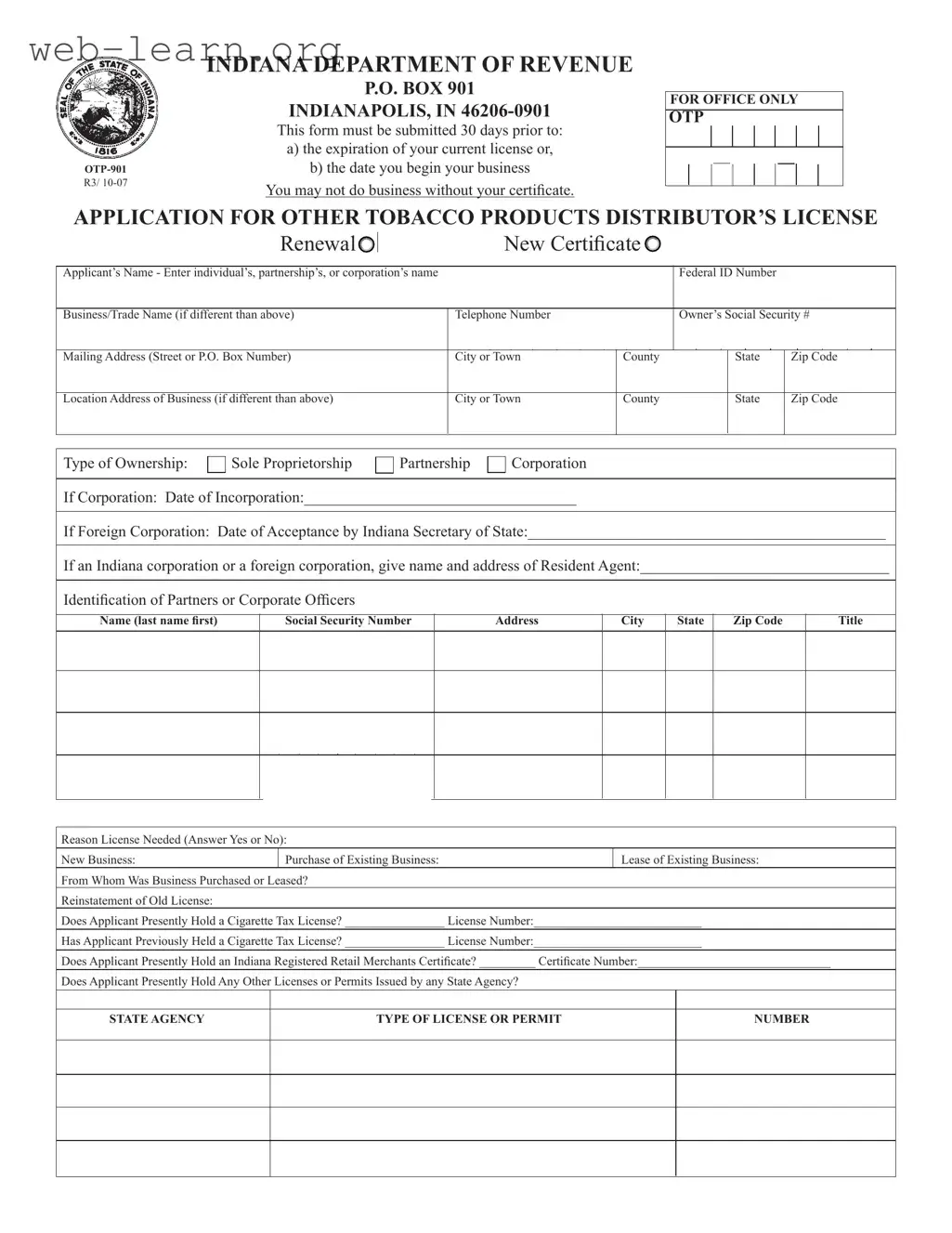
The Indiana OTP 901 form is a crucial document for businesses involved in the distribution of other tobacco products within the state. It must be submitted to the Indiana Department of Revenue at least 30 days before either the expiration of an existing license or the commencement of new business activities. Without this certificate, businesses are prohibited from operating legally. The form requires detailed information about the applicant, including the name of the individual or entity, federal identification number, and business address. Additionally, it asks for specifics regarding ownership structure, whether it be a sole proprietorship, partnership, or corporation. If the applicant is a corporation, further details such as the date of incorporation and the name of the resident agent are necessary. The OTP 901 also inquires about the applicant's history with cigarette tax licenses and other relevant permits, ensuring that all necessary compliance measures are met. Furthermore, it collects audit information and details regarding suppliers, which are essential for regulatory oversight. Completing this form accurately is vital for maintaining compliance with Indiana's tobacco distribution laws.

INDIANA DEPARTMENT OF REVENUE
R3/
P.O. BOX 901
INDIANAPOLIS, IN
This form must be submitted 30 days prior to:
a)the expiration of your current license or,
b)the date you begin your business
You may not do business without your certificate.
FOR OFFICE ONLY
OTP
APPLICATION FOR OTHER TOBACCO PRODUCTS DISTRIBUTOR’S LICENSE
|
|
Renewal |
|
|
|
|
New Certificate |
|
|
|
|
|
|
|
||||
|
|
|
|
|
|
|
|
|
|
|
|
|
|
|
|
|
|
|
Applicant’s Name - Enter individual’s, partnership’s, or corporation’s name |
|
|
|
|
|
|
Federal ID Number |
|
|
|
||||||||
|
|
|
|
|
|
|
|
|
|
|
|
|
|
|
|
|
|
|
Business/Trade Name (if different than above) |
|
|
|
Telephone Number |
|
|
|
Owner’s Social Security # |
||||||||||
|
|
|
|
|
|
|
|
|
|
|
|
|
|
|
|
|
|
|
Mailing Address (Street or P.O. Box Number) |
|
|
|
City or Town |
County |
|
|
State |
Zip Code |
|||||||||
|
|
|
|
|
|
|
|
|
|
|
|
|
|
|
|
|
|
|
Location Address of Business (if different than above) |
|
|
|
City or Town |
County |
|
|
State |
Zip Code |
|||||||||
|
|
|
|
|
|
|
|
|
|
|
|
|
|
|
|
|
|
|
|
|
|
|
|
|
|
|
|
|
|
|
|
|
|
|
|
|
|
Type of Ownership: |
|
Sole Proprietorship |
|
|
Partnership |
|
Corporation |
|
|
|
|
|
|
|
|
|
||
|
|
|
|
|
|
|
|
|
|
|
|
|
||||||
If Corporation: Date of Incorporation:___________________________________
If Foreign Corporation: Date of Acceptance by Indiana Secretary of State:______________________________________________
If an Indiana corporation or a foreign corporation, give name and address of Resident Agent:________________________________
Identifi cation of Partners or Corporate Officers
Name (last name fi rst)
Social Security Number
Address
City
State |
Zip Code |
|
|
Title
Reason License Needed (Answer Yes or No):
New Business: |
Purchase of Existing Business: |
Lease of Existing Business: |
From Whom Was Business Purchased or Leased?
Reinstatement of Old License:
Does Applicant Presently Hold a Cigarette Tax License? ________________ License Number:___________________________
Has Applicant Previously Held a Cigarette Tax License? ________________ License Number:___________________________
Does Applicant Presently Hold an Indiana Registered Retail Merchants Certifi cate? _________ Certificate Number:_______________________________
Does Applicant Presently Hold Any Other Licenses or Permits Issued by any State Agency?
STATE AGENCY
TYPE OF LICENSE OR PERMIT
NUMBER

Audit Information:
Location Where Records Will Be Available For Audit:
Phone Number of Location Of Audit Records:
Phone Number of Business Location:
Indicate Address of Each Location In Which You Have Other Tobacco Products in Storage
Location
OTP License Number
Indicate Name, Address, Phone Number and Estimated Annual Purchases from Whom You Currently Purchase and/or Expect to Purchase Other Tobacco Products: (A Computer Generated List Which Includes All Requested Information Will Be Accepted)
Supplier’s Name
Address
Phone Number
Estimated Annual Purchases
TOTAL:
If Necessary Attach Additional List.
Does Your Company Expect to Sell Other Tobacco Products Into Another State?___________________________________________________________________
List States: _________________________________________________________________________________________________________________________
Today’s Date
I declare under penalties of perjury that the information contained in this application and any attachments is true, correct and complete to the best of my knowledge and belief.
Signature of Taxpayer or Authorized Agent, Title |
Telephone Number |
| Fact Name | Details |
|---|---|
| Form Purpose | The OTP-901 form is used to apply for or renew an Other Tobacco Products Distributor’s License in Indiana. |
| Submission Deadline | This form must be submitted at least 30 days before the expiration of the current license or the start date of the business. |
| Governing Law | The form is governed by Indiana Code Title 6, Article 7, which regulates tobacco products in the state. |
| Required Information | Applicants must provide personal, business, and ownership details, including the Federal ID Number and Social Security Number. |
| Audit Information | Applicants must indicate where records will be available for audit, including the location and phone number. |
Completing the Indiana OTP-901 form is a straightforward process. This form is essential for obtaining or renewing a distributor’s license for other tobacco products. Make sure to gather all necessary information before you begin. Follow these steps to ensure your application is filled out correctly.
What is the purpose of the Indiana OTP 901 form?
The Indiana OTP 901 form is used to apply for a distributor's license for other tobacco products. This form must be submitted to the Indiana Department of Revenue at least 30 days before the expiration of an existing license or before starting a new business. Without a valid certificate, businesses cannot legally operate.
Who needs to fill out the OTP 901 form?
Any individual, partnership, or corporation looking to distribute other tobacco products in Indiana must complete this form. This includes new businesses, those purchasing existing businesses, and those reinstating old licenses.
What information is required on the form?
The form requires various details, including:
How long does it take to process the OTP 901 form?
The processing time can vary. It is advisable to submit the form at least 30 days before any deadlines to ensure that there is sufficient time for processing. Delays may occur if additional information is needed or if there are issues with the application.
What happens if I do not submit the form on time?
If the OTP 901 form is not submitted within the required timeframe, the applicant may be unable to legally conduct business related to other tobacco products. This could result in penalties or fines, as operating without a valid license is against state regulations.
Where do I send the completed OTP 901 form?
The completed form should be sent to the Indiana Department of Revenue, P.O. Box 901, Indianapolis, IN 46206-0901. Ensure that all required information is accurate and complete to avoid processing delays.
Filling out the Indiana OTP 901 form can be straightforward, but mistakes often occur that may delay the application process or lead to complications. One common mistake is failing to submit the form within the required timeframe. The form must be submitted 30 days prior to either the expiration of the current license or the date the business begins. Missing this deadline can result in the inability to operate legally.
Another frequent error is not providing complete and accurate information regarding the applicant’s name and business details. This includes the Federal ID number and the business or trade name, if it differs from the applicant’s name. Incomplete or incorrect information can lead to processing delays or rejection of the application.
Many applicants overlook the section regarding the type of ownership. It is essential to clearly indicate whether the business is a sole proprietorship, partnership, or corporation. Additionally, corporations must provide specific details such as the date of incorporation and the name and address of the resident agent. Failing to do so can create confusion and may require resubmission of the form.
Providing the correct social security numbers for all partners or corporate officers is crucial. Errors in this section can cause significant delays, as the Indiana Department of Revenue needs accurate identification to process the application. Each officer’s title should also be included to ensure clarity.
Another mistake is neglecting to answer questions regarding existing licenses. Applicants must indicate if they currently hold a cigarette tax license or have held one in the past. Inaccuracies in this section can lead to complications in verifying the applicant's history with tobacco licensing.
Some applicants fail to provide adequate information about the location of audit records. It is essential to specify where records will be available for audit, including the phone number of that location. This information is necessary for compliance and can expedite the review process.
Applicants sometimes forget to include details about other tobacco products in storage. It is important to list each location where products are stored, along with the associated OTP license numbers. Omitting this information can lead to compliance issues and delays in processing.
Lastly, failing to declare the intention to sell tobacco products in other states can be problematic. Applicants should clearly list any states where they expect to sell products. This information is crucial for regulatory purposes and can affect the approval of the application.
The Indiana OTP 901 form is essential for businesses involved in distributing other tobacco products. To ensure compliance with state regulations, several other forms and documents may be required alongside the OTP 901. Here’s a brief overview of these commonly used documents:
Each of these documents plays a vital role in ensuring that businesses comply with both state and federal regulations. By preparing these forms alongside the OTP 901, businesses can streamline their application process and avoid potential legal issues.
When filling out the Indiana OTP-901 form, it is essential to adhere to specific guidelines to ensure proper processing. Below are six things you should and shouldn't do:
This is not true. The form must be submitted at least 30 days before either the expiration of your current license or the date you plan to start your business. Late submissions may lead to delays in obtaining your certificate.
This is incorrect. You cannot conduct business without your certificate. It is essential to have this document in place before you start selling other tobacco products.
This is misleading. The form is necessary for various situations, including renewals, purchasing existing businesses, or reinstating an old license. It applies to anyone involved in the distribution of other tobacco products.
This is false. The form can be filled out by individuals, partnerships, or corporations. Each type of ownership has specific requirements, but all must complete the form to obtain a license.
This is a dangerous assumption. Declaring false information can lead to penalties, including fines or even criminal charges. Honesty is crucial when completing the application.
When filling out the Indiana OTP 901 form, keep the following key points in mind:
By following these takeaways, you can ensure a smoother application process for your tobacco products distributor's license in Indiana.