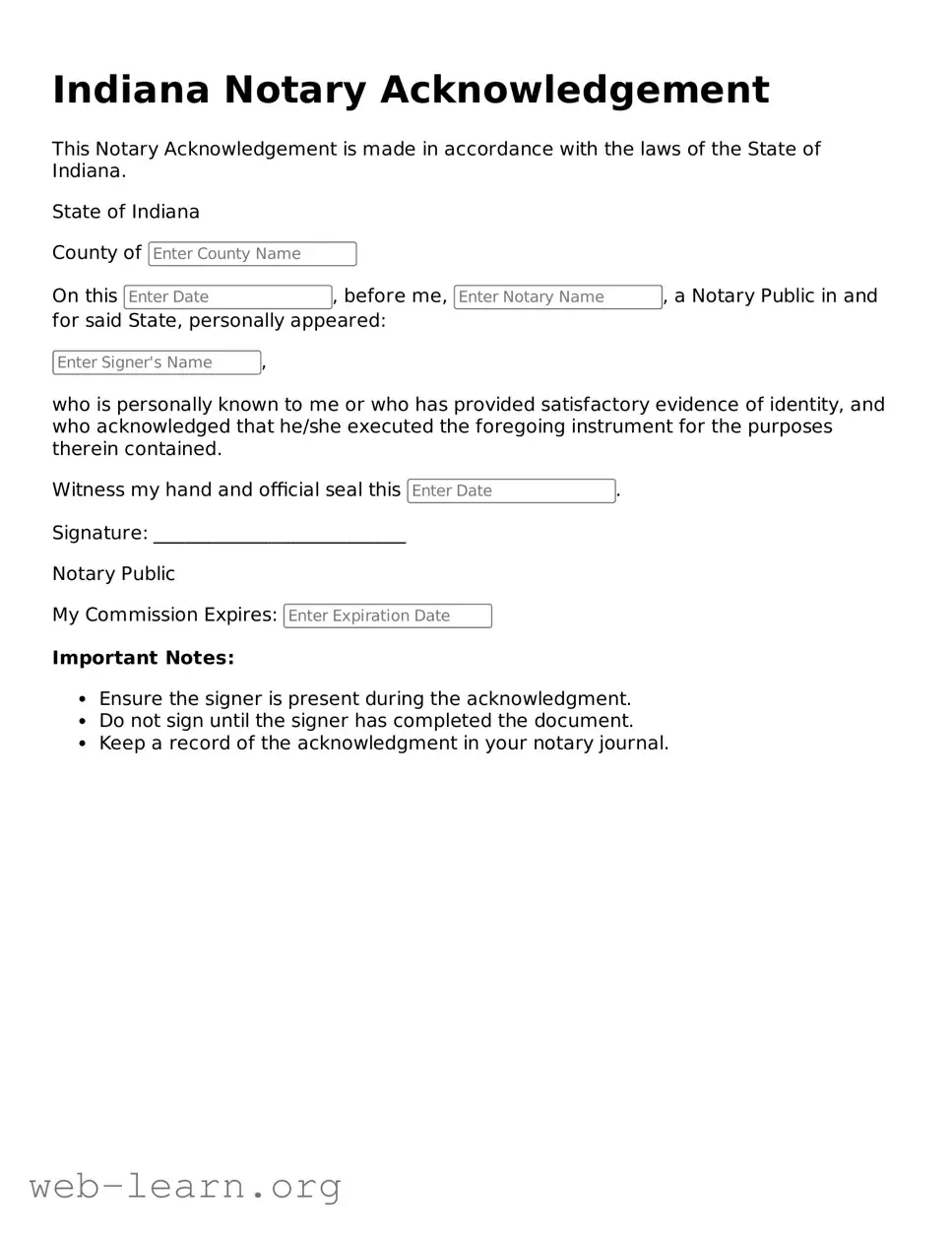
The Indiana Notary Acknowledgment form plays a vital role in various legal and official transactions within the state. This document serves as a formal declaration that a notary public has verified the identity of the signers involved in a particular transaction. It is essential for ensuring that the signatures on important documents are authentic and that the individuals signing them have done so willingly and with an understanding of the implications. The form typically includes details such as the date of the acknowledgment, the names of the parties involved, and the notary's signature and seal. Additionally, it provides a space for the notary to confirm that the signers appeared before them, further reinforcing the integrity of the process. Understanding the significance of this form can help individuals navigate legal requirements more effectively, ensuring that their documents hold up in court and are recognized by various institutions. Whether you are involved in real estate transactions, power of attorney agreements, or other legal matters, familiarity with the Indiana Notary Acknowledgment form is crucial for protecting your interests.
Indiana Notary Acknowledgement
This Notary Acknowledgement is made in accordance with the laws of the State of Indiana.
State of Indiana
County of
On this , before me, , a Notary Public in and for said State, personally appeared:
,
who is personally known to me or who has provided satisfactory evidence of identity, and who acknowledged that he/she executed the foregoing instrument for the purposes therein contained.
Witness my hand and official seal this .
Signature: ___________________________
Notary Public
My Commission Expires:
Important Notes:
| Fact Name | Details |
|---|---|
| Purpose | The Indiana Notary Acknowledgment form is used to verify the identity of a signer and confirm their willingness to sign a document. |
| Governing Law | This form is governed by Indiana Code Title 33, Article 42, which outlines notarial acts and requirements. |
| Signature Requirement | The signer must personally appear before the notary public to acknowledge their signature. |
| Identification | The notary must verify the identity of the signer using an acceptable form of identification, such as a driver's license or passport. |
| Notary Seal | The notary must affix their official seal to the acknowledgment form to validate it. |
| Record Keeping | Notaries are required to maintain a record of all notarial acts performed, including the acknowledgment. |
| Expiration | The acknowledgment remains valid as long as the underlying document is valid and not revoked. |
| Multiple Signers | If there are multiple signers, each must sign in the presence of the notary for their own acknowledgment. |
| Form Variations | While the basic acknowledgment form is standard, variations may exist depending on the type of document being notarized. |
After obtaining the Indiana Notary Acknowledgement form, you will need to fill it out carefully to ensure it is completed correctly. Once filled out, the form will be ready for the notary public to sign and seal, making it an official document.
What is an Indiana Notary Acknowledgement form?
The Indiana Notary Acknowledgement form is a document used to verify that a person has signed a document in the presence of a notary public. This form serves as proof that the signer is who they claim to be and that they willingly signed the document.
Why do I need a Notary Acknowledgement?
A Notary Acknowledgement is often required for legal documents, such as contracts, deeds, and powers of attorney. It helps to prevent fraud by ensuring that the signature is authentic and that the signer understands what they are signing.
How do I complete the Notary Acknowledgement form?
To complete the form, you need to provide the following information:
Once the information is filled out, the signer must appear before the notary to sign the document in their presence.
Who can act as a notary public in Indiana?
In Indiana, a notary public must be at least 18 years old, a resident of Indiana or have a place of employment or practice in the state, and must complete the required training and application process. They are appointed by the Secretary of State.
Is there a fee for notarization?
Yes, notaries in Indiana can charge a fee for their services. The maximum fee is typically set by state law, but it can vary depending on the notary. Always ask about fees before proceeding.
How long is a Notary Acknowledgement valid?
The validity of a Notary Acknowledgement does not have a specific time limit. However, the document itself may have its own expiration or validity period, depending on the type of document and the context in which it is used.
Can a Notary Acknowledgement be done remotely?
Indiana has provisions for remote notarization under certain circumstances. However, both the signer and the notary must comply with specific regulations. It’s best to check the latest guidelines to ensure compliance.
What happens if a Notary Acknowledgement is not properly completed?
If a Notary Acknowledgement is not properly completed, the document may be deemed invalid. This could lead to legal issues or complications, especially if the document is challenged in court. Always double-check the details before finalizing any notarization.
Where can I find a Notary Public in Indiana?
You can find a notary public in Indiana through various sources, including:
Many notaries also offer mobile services, so you may be able to arrange for them to come to your location.
Filling out the Indiana Notary Acknowledgement form can seem straightforward, but many people make common mistakes that can lead to delays or even the rejection of documents. One frequent error is failing to include the correct date. Notaries must indicate the date when the acknowledgment is made, and omitting this information can create confusion and undermine the validity of the notarization.
Another common mistake is not providing the full name of the person whose signature is being notarized. The form requires the notary to clearly state the name of the signer. If the name is incomplete or misspelled, it may cause issues later on, particularly if the document is used in legal proceedings.
Many individuals also overlook the importance of the notary’s signature and seal. The notary must sign and affix their official seal on the form to authenticate it. If either of these elements is missing, the notarization may not be considered valid. This is a crucial step that should not be neglected.
Additionally, people sometimes forget to check the identification of the signer. A notary must verify the identity of the individual before completing the acknowledgment. Failing to do so can lead to questions about the legitimacy of the notarization, which can have serious implications.
Lastly, some individuals mistakenly believe that they can notarize their own signatures. This is not allowed. A notary cannot act as a witness for their own signature. It’s important to have another individual present to ensure that the process adheres to legal standards. Understanding these common pitfalls can help ensure that the notarization process goes smoothly and that documents are properly executed.
When working with the Indiana Notary Acknowledgment form, several other documents may be needed to complete various legal processes. Each of these documents serves a specific purpose and can help ensure that transactions are valid and recognized by the law.
These documents, when used alongside the Indiana Notary Acknowledgment form, can help facilitate various legal transactions. Always consider consulting with a legal professional to ensure that all necessary forms are completed correctly and appropriately notarized.
The Notary Acknowledgment form serves an important purpose in verifying the identity of individuals signing documents. There are several other documents that share similarities with this form, particularly in their function of affirming signatures and ensuring the authenticity of agreements. Here are four documents that are similar to the Notary Acknowledgment form:
When filling out the Indiana Notary Acknowledgement form, it's essential to follow certain guidelines to ensure accuracy and compliance. Here’s a list of what you should and shouldn’t do:
By adhering to these guidelines, you can help ensure that your Notary Acknowledgement form is processed smoothly and without issues.
Understanding the Indiana Notary Acknowledgment form can be challenging, and misconceptions often arise. Here are five common misunderstandings about this important document:
Many people believe that notaries are legal professionals who can offer advice on legal matters. In reality, notaries are not authorized to give legal guidance. Their primary role is to witness signatures and verify identities.
Some individuals think that every document must be notarized to be valid. However, not all documents require a notary acknowledgment. Only specific legal documents, such as deeds or certain contracts, may need this form of verification.
There is a common misconception that notary acknowledgment and notarization are interchangeable terms. While both involve a notary, acknowledgment specifically refers to the process of confirming the identity of the signer and their intent to sign, whereas notarization encompasses a broader range of notary services.
Some believe that any notary can notarize any type of document, regardless of its content. In truth, notaries must comply with state laws, and some documents may have specific requirements or restrictions that limit who can notarize them.
Many people think that notary acknowledgment is optional for legal documents. In fact, for certain documents, a notary acknowledgment is mandatory to ensure the document is legally binding and accepted by courts or other entities.
Being aware of these misconceptions can help individuals navigate the process of using the Indiana Notary Acknowledgment form more effectively. Understanding the role of a notary and the requirements for notarization is crucial in ensuring that your documents are valid and enforceable.
When filling out and using the Indiana Notary Acknowledgement form, keep these key takeaways in mind: