In the competitive landscape of Indiana's job market, employers often seek to protect their business interests through the use of non-compete agreements. These agreements serve as a crucial tool to prevent employees from sharing sensitive information or engaging in direct competition after their employment ends. Key aspects of the Indiana Non-compete Agreement form include the duration of the restriction, the geographic area covered, and the specific activities that are prohibited. Employers must carefully consider these elements to ensure the agreement is enforceable under Indiana law. Additionally, employees should understand their rights and the implications of signing such a document. Balancing the interests of both parties is essential for fostering a fair working environment while safeguarding business assets. As the legal landscape continues to evolve, staying informed about the nuances of non-compete agreements in Indiana is more important than ever.
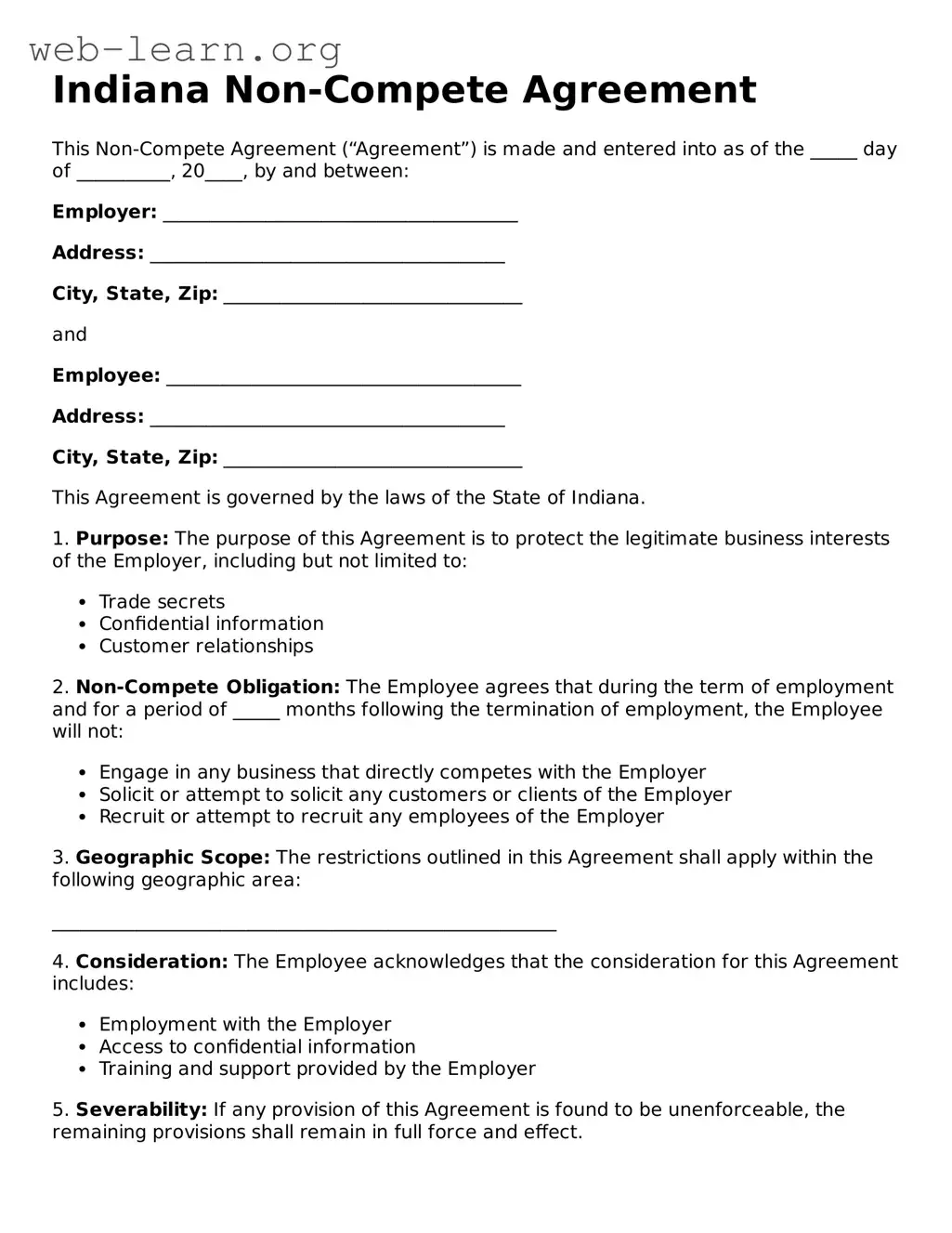
Indiana Non-Compete Agreement
This Non-Compete Agreement (“Agreement”) is made and entered into as of the _____ day of __________, 20____, by and between:
Employer: ______________________________________
Address: ______________________________________
City, State, Zip: ________________________________
and
Employee: ______________________________________
Address: ______________________________________
City, State, Zip: ________________________________
This Agreement is governed by the laws of the State of Indiana.
1. Purpose: The purpose of this Agreement is to protect the legitimate business interests of the Employer, including but not limited to:
2. Non-Compete Obligation: The Employee agrees that during the term of employment and for a period of _____ months following the termination of employment, the Employee will not:
3. Geographic Scope: The restrictions outlined in this Agreement shall apply within the following geographic area:
______________________________________________________
4. Consideration: The Employee acknowledges that the consideration for this Agreement includes:
5. Severability: If any provision of this Agreement is found to be unenforceable, the remaining provisions shall remain in full force and effect.
6. Governing Law: This Agreement shall be governed by and construed in accordance with the laws of the State of Indiana.
IN WITNESS WHEREOF, the parties hereto have executed this Non-Compete Agreement as of the date first above written.
Employer Signature: ____________________________
Date: ______________________________________
Employee Signature: ____________________________
Date: ______________________________________
| Fact Name | Description |
|---|---|
| Governing Law | The Indiana Non-compete Agreement is governed by Indiana state law. |
| Enforceability | Non-compete agreements are generally enforceable in Indiana if they are reasonable in scope and duration. |
| Duration | Typically, a non-compete can last up to two years, but this can vary based on the nature of the employment. |
| Geographic Scope | The agreement must specify a reasonable geographic area where the restrictions apply. |
| Consideration | To be valid, a non-compete must be supported by adequate consideration, such as employment or a promotion. |
| Public Policy | Indiana courts may refuse to enforce non-compete agreements that violate public policy or are overly restrictive. |
| Trade Secrets | Non-compete agreements are often used to protect trade secrets and proprietary information. |
| Employee Rights | Employees should understand their rights before signing a non-compete agreement. |
| Legal Advice | Consulting with a legal professional before entering into a non-compete agreement is advisable. |
Once you have the Indiana Non-compete Agreement form in hand, you will need to provide specific information to ensure it is filled out correctly. Follow these steps to complete the form accurately.
After completing the form, review all entries for accuracy. Ensure both parties understand the terms before finalizing the agreement.
A non-compete agreement is a legal contract between an employer and an employee. This contract restricts the employee from working for competitors or starting a competing business for a specified period after leaving the company. The goal is to protect the employer's business interests, including trade secrets and client relationships.
Yes, non-compete agreements can be enforceable in Indiana, but they must meet certain criteria. The agreement must be reasonable in scope, duration, and geographic area. Courts will assess whether the restrictions are necessary to protect the employer’s legitimate business interests without unfairly restricting the employee's ability to find work.
A non-compete agreement is generally considered reasonable if:
In Indiana, the duration of a non-compete agreement is often limited to two years. However, the length may vary depending on the nature of the business and the specific circumstances. Courts will evaluate whether the duration is appropriate based on the context of the employment.
Yes, employees can negotiate the terms of a non-compete agreement before signing it. It is advisable to discuss any concerns regarding the restrictions with the employer. Modifications may include reducing the duration, geographic scope, or specific activities covered by the agreement.
If an employee violates a non-compete agreement, the employer may take legal action. This could include seeking an injunction to prevent the employee from working for a competitor or pursuing monetary damages. The consequences can vary based on the specifics of the agreement and the situation.
Yes, non-compete agreements can also apply to independent contractors. However, the enforceability may depend on the nature of the relationship and the specifics of the agreement. It is essential to clearly outline the terms in the contract to ensure that they are enforceable.
If you are uncertain about your non-compete agreement, consider seeking legal advice. An attorney can help you understand your rights and obligations under the agreement. They can also assist in negotiating terms or addressing any concerns you may have.
Filling out the Indiana Non-compete Agreement form can be a complex process, and mistakes can lead to unenforceable agreements or unintended consequences. One common mistake is failing to clearly define the scope of the non-compete. Without a precise description of what activities are restricted, the agreement may be too broad or vague, making it difficult to enforce.
Another frequent error involves neglecting to specify the duration of the non-compete. A reasonable time frame is essential for the agreement's validity. If the duration is excessively long, a court may deem it unreasonable and unenforceable. It is important to strike a balance between protecting business interests and allowing individuals the freedom to work.
People often overlook the geographical area that the non-compete covers. A mistake in this area can render the agreement ineffective. A non-compete that restricts someone from working in an entire state may be seen as overly restrictive, while a more localized restriction might be more acceptable.
Additionally, failing to consider the specific industry or field can lead to complications. If the non-compete does not clearly outline the relevant industry, it may inadvertently limit the individual's ability to find employment in a related field. This can create unnecessary barriers and lead to disputes.
Another common mistake is not including adequate consideration for the agreement. In legal terms, consideration refers to something of value exchanged between the parties. Without proper consideration, such as a job offer or a promotion, the agreement may lack enforceability.
People sometimes forget to review the agreement with legal counsel. Legal advice can provide valuable insights and help identify potential issues before they become problems. Skipping this step can lead to misunderstandings and complications down the line.
Finally, individuals may fail to keep a copy of the signed agreement. This oversight can create challenges if disputes arise in the future. Having a copy ensures that both parties are aware of the terms and can refer back to them if necessary.
When entering into a Non-compete Agreement in Indiana, several other documents may be relevant to ensure clarity and enforceability. Each of these documents serves a specific purpose in the context of employment and business relationships.
These documents work together to protect both the employer's interests and the employee's rights. Understanding each of these forms can help ensure a smooth business relationship and minimize potential legal disputes.
A Non-compete Agreement is a legal document designed to protect a business's interests by restricting an employee's ability to work in competing businesses for a certain period after leaving the company. While this document serves a specific purpose, several other agreements share similar characteristics. Here’s a look at nine documents that are akin to a Non-compete Agreement:
Understanding these agreements can be crucial for both employers and employees. Each document serves to protect interests, maintain confidentiality, and ensure a fair business environment. Always consider seeking legal advice when drafting or signing any of these agreements.
When filling out the Indiana Non-compete Agreement form, it is important to follow certain guidelines to ensure accuracy and compliance. Here are five do's and don'ts to consider:
Non-compete agreements are often misunderstood, leading to confusion for both employers and employees. Here are four common misconceptions about the Indiana Non-compete Agreement form:
Many people believe that if a non-compete agreement is signed, it is automatically enforceable. However, Indiana law requires that these agreements meet specific criteria to be valid. They must be reasonable in scope, duration, and geographic area. If they are too restrictive, a court may refuse to enforce them.
Another misconception is that all employees must sign a non-compete agreement. In reality, these agreements are typically reserved for certain positions, particularly those involving sensitive information or client relationships. Not every employee will be required to enter into such an agreement.
Some individuals think that non-compete agreements only take effect once they leave a job. However, the restrictions outlined in the agreement can also apply during employment, affecting an employee's ability to seek new opportunities while still working for the employer.
Many fear that signing a non-compete will permanently bar them from their industry. While these agreements can limit where and how one can work, they do not necessarily prevent all future employment in the field. The key is understanding the specific terms and limitations of the agreement.
Understanding these misconceptions can help both employers and employees navigate the complexities of non-compete agreements in Indiana more effectively.
Understanding the Indiana Non-compete Agreement form is essential for both employers and employees. Here are some key takeaways to consider:
By keeping these points in mind, both employers and employees can navigate the Indiana Non-compete Agreement form more effectively.
Are Non Competes Enforceable in Kentucky - These agreements are most common in industries where intellectual property and customer relationships are critical to success.
Do Non Competes Hold Up in Colorado - A Non-compete Agreement can help safeguard trade secrets and sensitive information from being shared with competitors.
Are Non Competes Enforceable in California - Non-compete agreements can be a double-edged sword, offering protection for businesses while limiting employee freedom.