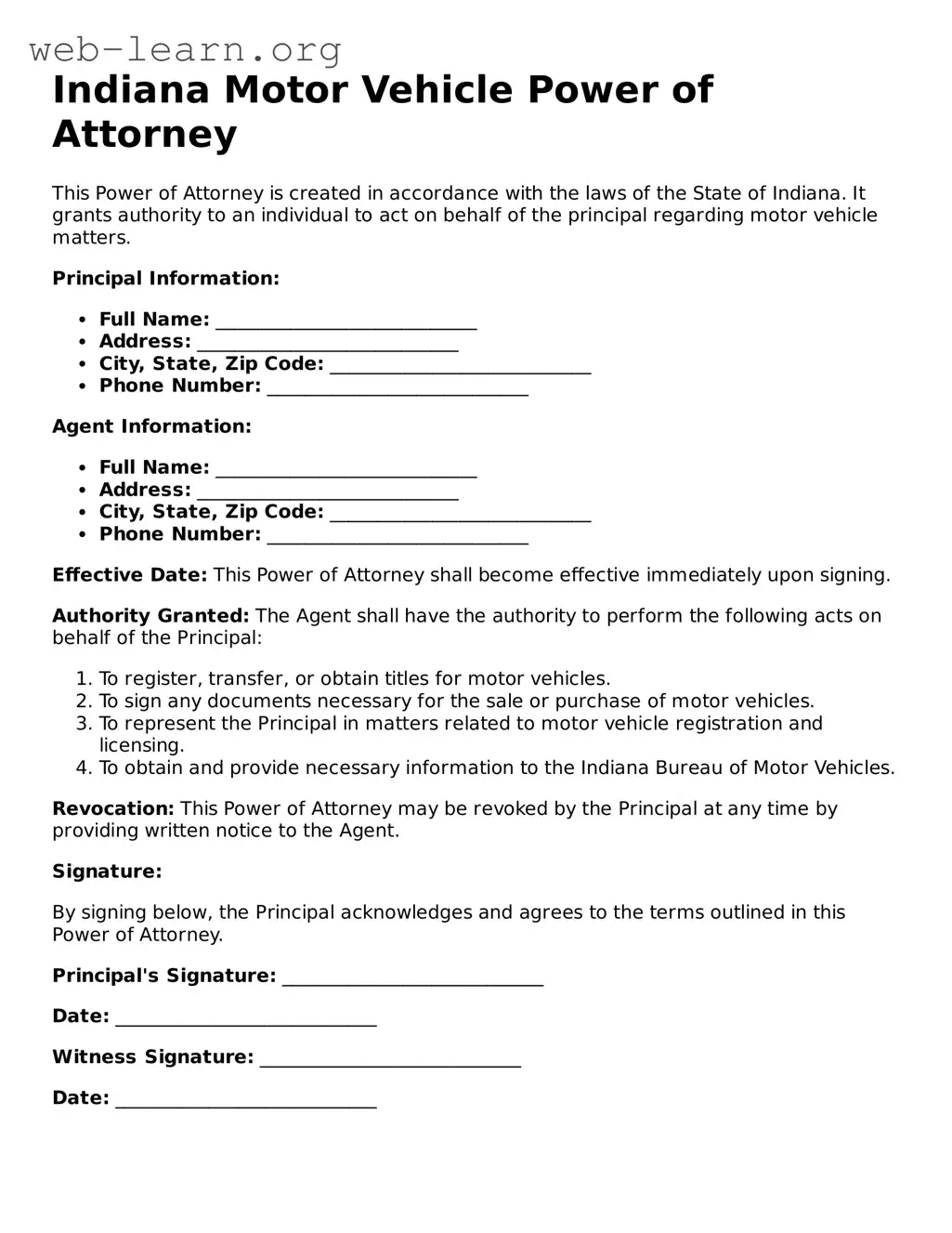
The Indiana Motor Vehicle Power of Attorney form serves as a crucial document for individuals who need to delegate authority regarding their motor vehicle transactions. This form allows one person, known as the principal, to appoint another individual, referred to as the agent, to handle specific tasks related to their vehicle. These tasks can include signing titles, registering vehicles, and completing necessary paperwork for sales or transfers. It is particularly useful when the principal cannot be present to complete these transactions themselves, whether due to distance, health issues, or scheduling conflicts. By utilizing this form, vehicle owners can ensure that their interests are represented and that transactions proceed smoothly. The document must be completed accurately, and both the principal and agent need to sign it to make it legally binding. Understanding the requirements and implications of this form can help individuals navigate the complexities of vehicle ownership and transactions in Indiana.
Indiana Motor Vehicle Power of Attorney
This Power of Attorney is created in accordance with the laws of the State of Indiana. It grants authority to an individual to act on behalf of the principal regarding motor vehicle matters.
Principal Information:
Agent Information:
Effective Date: This Power of Attorney shall become effective immediately upon signing.
Authority Granted: The Agent shall have the authority to perform the following acts on behalf of the Principal:
Revocation: This Power of Attorney may be revoked by the Principal at any time by providing written notice to the Agent.
Signature:
By signing below, the Principal acknowledges and agrees to the terms outlined in this Power of Attorney.
Principal's Signature: ____________________________
Date: ____________________________
Witness Signature: ____________________________
Date: ____________________________
| Fact Name | Details |
|---|---|
| Purpose | The Indiana Motor Vehicle Power of Attorney form allows an individual to designate another person to handle motor vehicle transactions on their behalf. |
| Governing Law | This form is governed by Indiana Code § 32-17-1, which outlines the legal framework for powers of attorney in the state. |
| Signatures Required | The form must be signed by the principal (the person granting authority) and may require notarization for certain transactions. |
| Duration | The authority granted by this form remains in effect until revoked by the principal or until the specified transaction is completed. |
| Usage | This form can be used for various motor vehicle-related tasks, including title transfers, registration, and obtaining duplicate titles. |
| Revocation | The principal can revoke the power of attorney at any time by providing written notice to the agent and any relevant parties. |
Filling out the Indiana Motor Vehicle Power of Attorney form is a straightforward process. Once completed, this form allows someone you trust to handle specific tasks related to your vehicle on your behalf. Follow the steps below to ensure the form is filled out correctly.
After filling out the form, it’s important to keep a copy for yourself and provide one to the person you appointed. This ensures that both parties have access to the document when needed.
What is a Motor Vehicle Power of Attorney in Indiana?
A Motor Vehicle Power of Attorney (POA) in Indiana allows one person, known as the principal, to authorize another person, referred to as the attorney-in-fact, to act on their behalf regarding motor vehicle transactions. This can include buying, selling, registering, or transferring ownership of a vehicle.
Who can be designated as an attorney-in-fact?
Any adult can be designated as an attorney-in-fact. This can be a family member, friend, or even a professional. However, it’s essential to choose someone you trust, as they will have the authority to make decisions related to your vehicle.
What transactions can the attorney-in-fact perform?
The attorney-in-fact can handle various transactions, including:
Do I need to have the Motor Vehicle Power of Attorney notarized?
Yes, in Indiana, the Motor Vehicle Power of Attorney must be notarized to be considered valid. This step helps ensure that the document is legally binding and protects both the principal and the attorney-in-fact.
How long is the Motor Vehicle Power of Attorney valid?
The validity of the Motor Vehicle Power of Attorney can vary based on the terms set by the principal. It can be effective for a specific transaction or for an indefinite period until revoked. If the principal decides to revoke it, they must do so in writing.
Can I revoke a Motor Vehicle Power of Attorney?
Yes, you can revoke a Motor Vehicle Power of Attorney at any time. To do this, you should provide a written notice to the attorney-in-fact and any relevant parties, such as the BMV. It’s wise to keep a copy of the revocation for your records.
What happens if the attorney-in-fact cannot perform their duties?
If the attorney-in-fact is unable to fulfill their responsibilities, the principal may need to appoint a new attorney-in-fact. It’s advisable to have a backup designated in the original POA document or to create a new one if necessary.
Is there a fee associated with filing the Motor Vehicle Power of Attorney?
There is no specific fee for creating a Motor Vehicle Power of Attorney in Indiana. However, there may be fees associated with notarization and any vehicle transactions that the attorney-in-fact undertakes on your behalf.
Where can I obtain the Motor Vehicle Power of Attorney form?
You can obtain the Motor Vehicle Power of Attorney form from the Indiana Bureau of Motor Vehicles (BMV) website or at any local BMV office. It’s important to ensure you have the most current version of the form to avoid any issues.
Filling out the Indiana Motor Vehicle Power of Attorney form can be a straightforward process, but several common mistakes can lead to complications. One significant error is failing to provide complete information about the principal. The principal must include their full name, address, and contact information. Omitting any of these details can render the document invalid.
Another frequent mistake involves the selection of the attorney-in-fact. It is crucial to choose someone trustworthy and capable of handling the responsibilities assigned. If the chosen individual is not clearly identified, this may lead to confusion or disputes later on.
People often neglect to specify the scope of authority granted to the attorney-in-fact. The form allows for specific powers to be designated, such as the ability to sell or transfer the vehicle. Failing to outline these powers can limit the effectiveness of the document, leading to potential issues when the attorney-in-fact attempts to act on behalf of the principal.
Additionally, individuals sometimes forget to sign and date the form. A signature is essential for the document to be legally binding. Without it, the form may not hold up in legal situations, which could create significant delays in processing vehicle transactions.
Another common oversight is not having the document notarized. While notarization is not always required, it adds an extra layer of validity and can help prevent disputes regarding the authenticity of the document. Notarizing the form is a step that should not be overlooked.
Some people also fail to keep copies of the completed form. Having a record of the Power of Attorney can be vital for both the principal and the attorney-in-fact. In case of any disputes or questions, having a copy readily available can help clarify intentions and agreements.
Lastly, individuals may overlook the need to update the form if circumstances change. If the principal moves, changes their mind about the attorney-in-fact, or if the vehicle is sold, it is important to revise the document accordingly. Keeping the Power of Attorney current ensures that it reflects the principal's current wishes and circumstances.
When dealing with motor vehicle transactions in Indiana, the Motor Vehicle Power of Attorney form is just one important document. There are several other forms and documents that often accompany it to ensure a smooth process. Here’s a quick overview of some of these essential documents:
Having these documents ready can significantly streamline the process of transferring ownership or handling other vehicle-related matters. It’s always a good idea to ensure that you have everything in order before proceeding with any transactions.
The Motor Vehicle Power of Attorney form allows an individual to designate someone else to handle specific tasks related to their vehicle. Several other documents serve similar purposes in different contexts. Here are six such documents:
Filling out the Indiana Motor Vehicle Power of Attorney form can be a straightforward process if you keep a few important points in mind. Below is a list of things you should and shouldn't do to ensure everything goes smoothly.
By following these guidelines, you can ensure that your Indiana Motor Vehicle Power of Attorney form is completed correctly and efficiently. This will help you avoid any potential issues down the line.
Understanding the Indiana Motor Vehicle Power of Attorney form can be challenging. Here are nine common misconceptions that people often have about this important legal document:
Many believe that the Motor Vehicle Power of Attorney can only be used for selling a vehicle. In reality, it can also authorize someone to handle various tasks, such as registering a vehicle or obtaining title transfers.
Some think that notarization is mandatory for the form to be effective. While notarization can add an extra layer of authenticity, it is not strictly required in Indiana.
People often assume that any individual can serve as their agent. However, it is essential to choose someone trustworthy and capable of managing vehicle-related affairs.
There is a misconception that the Power of Attorney automatically expires after a set time. In fact, it remains valid until the principal revokes it or until the specified tasks are completed.
Some individuals think that the form applies to all vehicles, including motorcycles and boats. However, it is specifically designed for motor vehicles, which may exclude other types of vehicles.
While the form is specific to Indiana, many people believe it is only valid within state lines. In some cases, it may be recognized in other states, but this can vary.
Many think that signing the form is a permanent decision. In truth, the principal can revoke or amend the Power of Attorney at any time, as long as they are competent to do so.
Some people feel that they must hire a lawyer to fill out the form. However, it is designed to be user-friendly, allowing individuals to complete it on their own with proper guidance.
Lastly, many confuse the Motor Vehicle Power of Attorney with a general Power of Attorney. The former is limited to vehicle-related matters, while the latter can cover a broader range of financial and legal issues.
By clearing up these misconceptions, individuals can better understand how the Indiana Motor Vehicle Power of Attorney form works and how it can serve their needs effectively.
When filling out and using the Indiana Motor Vehicle Power of Attorney form, there are several important points to keep in mind. Here are key takeaways to guide you through the process:
How to Get Power of Attorney in Hawaii - Designate an agent to act in your best interest regarding your motor vehicle.
Power of Attorney Car Title Transfer - Ensuring the form is properly filled out can help prevent legal issues down the line.
Ga Limited Power of Attorney - This Power of Attorney is useful for managing vehicle titles and liens.