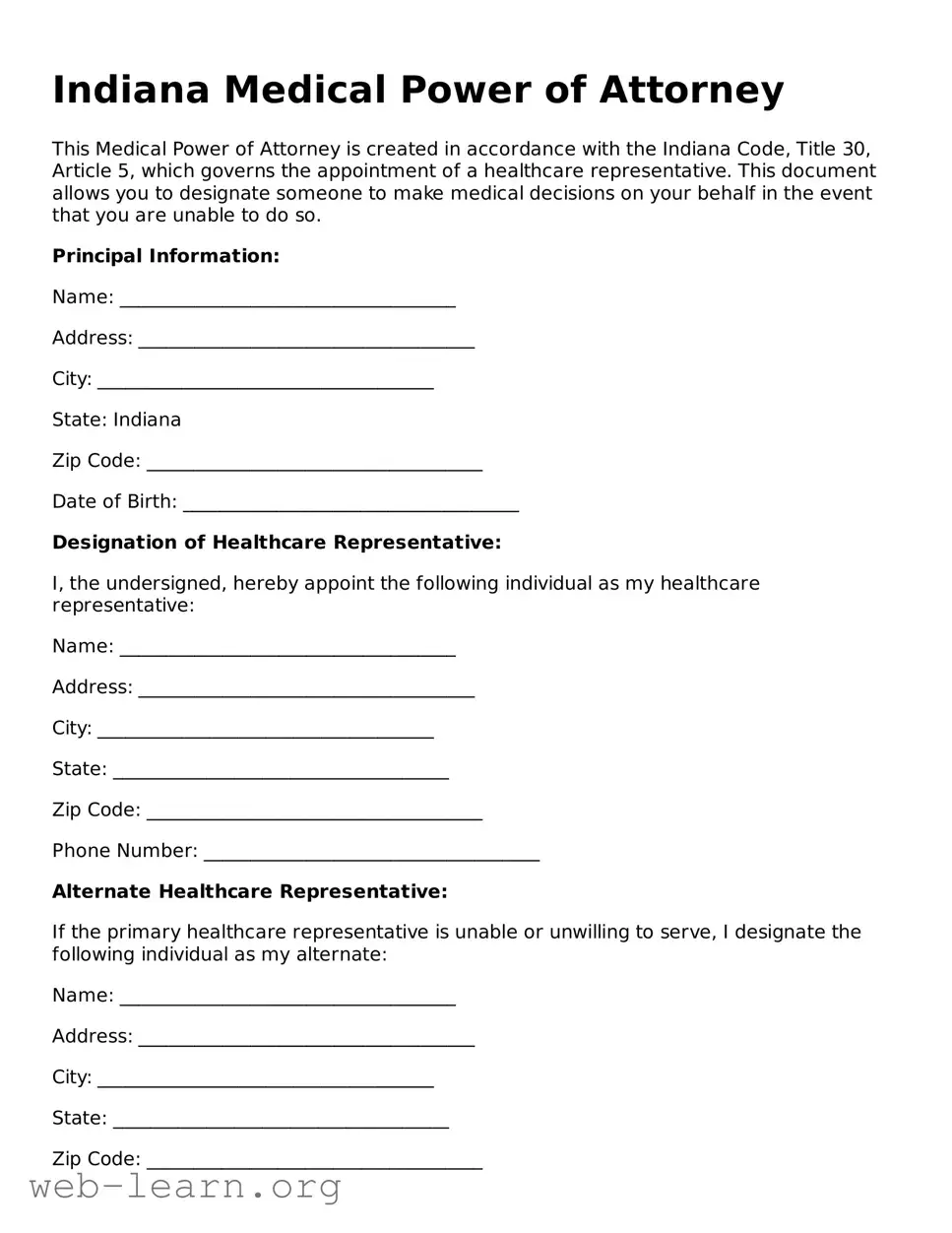
The Indiana Medical Power of Attorney form plays a crucial role in ensuring that individuals can make their healthcare preferences known, even when they are unable to communicate those wishes themselves. This legally binding document allows a person, often referred to as the "principal," to designate a trusted individual, known as the "agent," to make medical decisions on their behalf. The form outlines the specific powers granted to the agent, which can include decisions about medical treatments, surgeries, and end-of-life care. Importantly, it also provides the principal an opportunity to express their values and preferences regarding healthcare, guiding the agent in making choices that align with the principal's wishes. Additionally, the Indiana Medical Power of Attorney form can be customized to fit individual needs, allowing for a more personalized approach to healthcare decisions. Understanding the nuances of this form is essential for anyone looking to ensure their medical preferences are respected in times of crisis.
Indiana Medical Power of Attorney
This Medical Power of Attorney is created in accordance with the Indiana Code, Title 30, Article 5, which governs the appointment of a healthcare representative. This document allows you to designate someone to make medical decisions on your behalf in the event that you are unable to do so.
Principal Information:
Name: ____________________________________
Address: ____________________________________
City: ____________________________________
State: Indiana
Zip Code: ____________________________________
Date of Birth: ____________________________________
Designation of Healthcare Representative:
I, the undersigned, hereby appoint the following individual as my healthcare representative:
Name: ____________________________________
Address: ____________________________________
City: ____________________________________
State: ____________________________________
Zip Code: ____________________________________
Phone Number: ____________________________________
Alternate Healthcare Representative:
If the primary healthcare representative is unable or unwilling to serve, I designate the following individual as my alternate:
Name: ____________________________________
Address: ____________________________________
City: ____________________________________
State: ____________________________________
Zip Code: ____________________________________
Phone Number: ____________________________________
Healthcare Decisions:
I authorize my healthcare representative to make decisions regarding my medical treatment, including but not limited to:
Effective Date:
This Medical Power of Attorney shall become effective immediately upon execution unless I indicate otherwise:
Effective Date: ____________________________________
Revocation:
This document may be revoked at any time by me, provided that I communicate my intent to revoke to my healthcare representative and any healthcare providers involved in my care.
Signature:
Principal’s Signature: ___________________________
Date: ____________________________________
Witnesses:
Two witnesses must sign below, and they must not be related to the principal or the healthcare representative:
This document is intended to ensure that your healthcare preferences are respected and followed. It is advisable to discuss your wishes with your healthcare representative and family members.
| Fact Name | Details |
|---|---|
| Governing Law | The Indiana Medical Power of Attorney is governed by Indiana Code § 30-5-1-1 et seq. |
| Purpose | This form allows an individual to designate another person to make medical decisions on their behalf if they become incapacitated. |
| Principal | The person creating the Medical Power of Attorney is known as the principal. |
| Agent | The designated individual who will make decisions is referred to as the agent or attorney-in-fact. |
| Requirements | The form must be signed by the principal in the presence of a notary public or two witnesses. |
| Revocation | The principal can revoke the Medical Power of Attorney at any time, as long as they are competent. |
| Durability | This power of attorney remains effective even if the principal becomes incapacitated. |
Filling out the Indiana Medical Power of Attorney form is an important step in ensuring that your healthcare wishes are respected. This document allows you to appoint someone to make medical decisions on your behalf if you become unable to do so. The following steps will guide you through the process of completing the form accurately.
What is a Medical Power of Attorney in Indiana?
A Medical Power of Attorney is a legal document that allows you to appoint someone to make healthcare decisions on your behalf if you become unable to make those decisions yourself. This person, known as your agent, will have the authority to make medical choices in line with your wishes and best interests.
Who can be my agent?
Your agent must be an adult who is capable of making informed decisions. This can be a family member, friend, or anyone you trust to act in your best interests. However, certain individuals, such as your healthcare provider or an employee of your healthcare provider, cannot serve as your agent unless they are related to you.
How do I create a Medical Power of Attorney in Indiana?
To create a Medical Power of Attorney, you must fill out the appropriate form, which is available through various legal resources or state websites. After completing the form, you must sign it in the presence of a notary public or two witnesses. This ensures that the document is legally binding and recognized by healthcare providers.
Can I revoke my Medical Power of Attorney?
Yes, you can revoke your Medical Power of Attorney at any time as long as you are mentally competent. To do this, you should notify your agent and any healthcare providers who have a copy of the document. It is advisable to put the revocation in writing and keep a copy for your records.
What happens if I don’t have a Medical Power of Attorney?
If you do not have a Medical Power of Attorney and become unable to make your own healthcare decisions, your family members may need to go through a legal process to determine who can make decisions on your behalf. This can lead to disputes and delays, potentially affecting your medical care.
Is a Medical Power of Attorney the same as a Living Will?
No, a Medical Power of Attorney and a Living Will serve different purposes. A Medical Power of Attorney designates someone to make decisions for you, while a Living Will outlines your preferences for medical treatment in specific situations, such as end-of-life care. Both documents are important for comprehensive healthcare planning.
Filling out the Indiana Medical Power of Attorney form can be a straightforward process, but mistakes can lead to complications. One common error is failing to choose a suitable agent. The agent you select should be someone you trust completely to make healthcare decisions on your behalf. If the person you choose is not reliable or does not understand your wishes, it can create problems when decisions need to be made.
Another frequent mistake is not clearly specifying your wishes. It’s essential to communicate your healthcare preferences in detail. Vague instructions can lead to confusion and may not reflect your true desires. Take the time to outline your preferences regarding medical treatments and interventions.
Some individuals overlook the importance of signatures. The form must be signed by you, the principal, and may require the signatures of witnesses or a notary. Ensure that all necessary signatures are present and correctly dated. Missing signatures can invalidate the document.
People often forget to review the completed form for accuracy. Double-checking the information can prevent errors that may affect the validity of your Medical Power of Attorney. Simple mistakes, such as typos or incorrect dates, can lead to complications when the document is needed.
Another mistake is not discussing the document with your chosen agent. Open communication is vital. Make sure your agent understands your wishes and is willing to act on your behalf. This discussion can help avoid misunderstandings and ensure your preferences are honored.
Lastly, failing to keep the document updated can be detrimental. Life circumstances change, and so might your preferences or the people you trust. Regularly review and, if necessary, revise your Medical Power of Attorney to reflect your current wishes and situation. Keeping the document current ensures that it remains effective when you need it most.
When preparing a Medical Power of Attorney in Indiana, it's essential to consider additional forms and documents that can complement this directive. These documents can help ensure that your healthcare preferences are clearly communicated and respected. Here are five important forms to consider:
These documents work together to provide a clear framework for your healthcare decisions. By preparing them, you can ensure that your wishes are honored and that your loved ones have the guidance they need during difficult times.
When filling out the Indiana Medical Power of Attorney form, it is important to consider certain best practices to ensure that your intentions are clearly communicated and legally valid. Below are some guidelines on what to do and what to avoid.
Things You Should Do:
Things You Shouldn't Do:
Here are four common misconceptions about the Indiana Medical Power of Attorney form:
This is incorrect. The Indiana Medical Power of Attorney can be used whenever an individual is unable to make their own medical decisions, regardless of their health status.
This misconception is false. Any competent adult can be designated as an agent, including friends or trusted individuals, not just family members.
This is misleading. The form can be customized to reflect specific wishes and preferences regarding medical treatment, making it unique to each individual.
This is not entirely true. While notarization can enhance the document's validity, in Indiana, the form can also be valid if signed by two witnesses who meet certain criteria.
Filling out and using the Indiana Medical Power of Attorney form is an important step in ensuring that your healthcare preferences are respected. Here are some key takeaways to keep in mind:
By following these guidelines, you can help ensure that your medical care aligns with your wishes, even when you are unable to communicate them yourself.