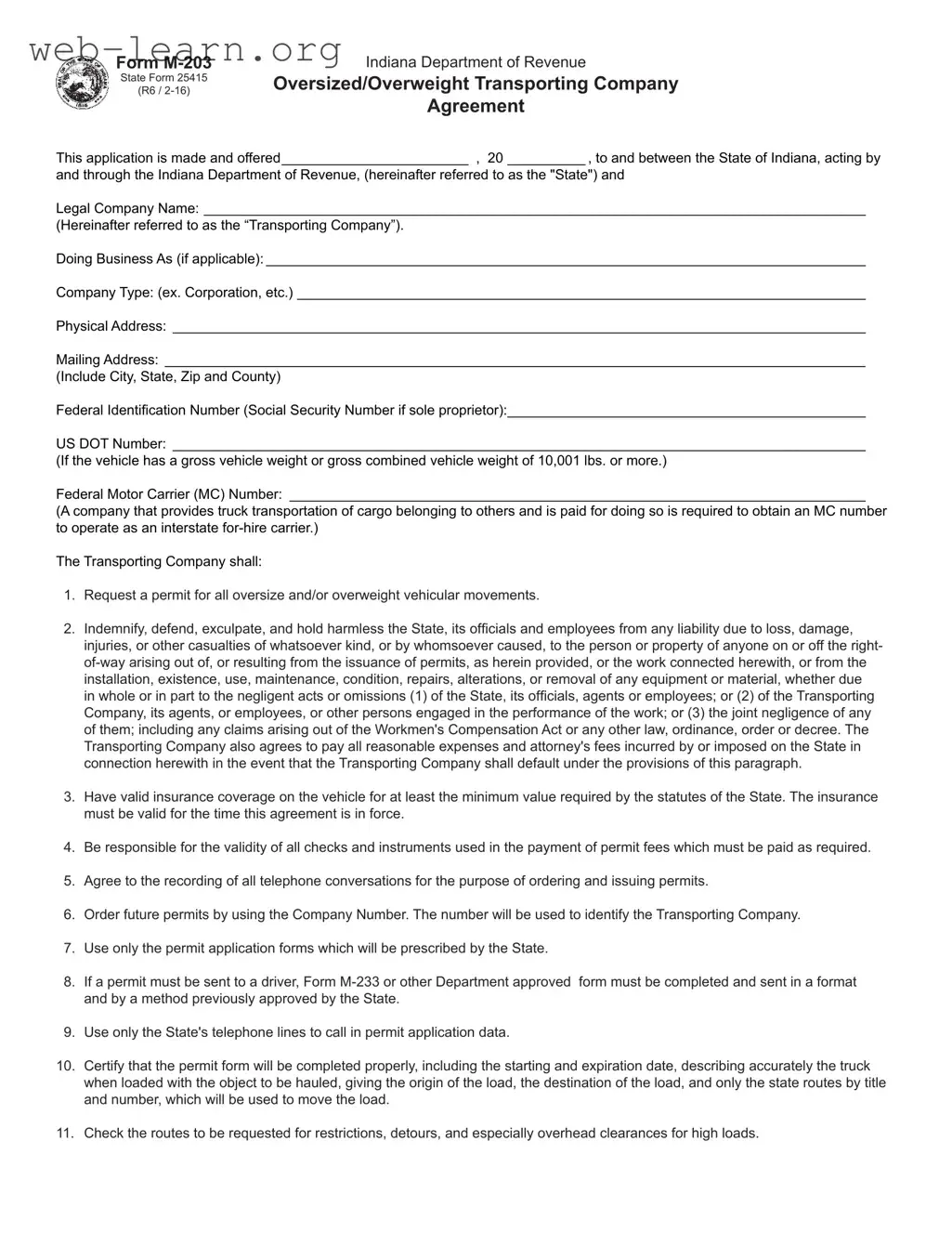
The Indiana M203 form, officially recognized as State Form 25415, serves a crucial role for companies engaged in the transportation of oversized or overweight loads within the state. This agreement is established between the Indiana Department of Revenue and the transporting company, outlining essential responsibilities and requirements for both parties. Key elements include the necessity for the transporting company to request permits for vehicular movements that exceed standard weight and size limits, as well as to maintain valid insurance coverage for their vehicles. The form also emphasizes the importance of indemnifying the state against any liabilities arising from the transportation process. Furthermore, it stipulates the use of prescribed application forms and mandates that all relevant details, such as load dimensions and route restrictions, are accurately recorded and communicated. The agreement remains in effect until canceled or modified due to changes in ownership or corporate structure, ensuring that both the transporting company and the state remain informed and compliant throughout the permitting process. Understanding the intricacies of the Indiana M203 form is vital for any transporting company aiming to operate legally and efficiently in Indiana.

Form |
Indiana Department of Revenue |
State Form 25415 |
Oversized/Overweight Transporting Company |
(R6 / |
|
|
Agreement |
This application is made and offered________________________ , 20___________ , to and between the State of Indiana, acting by
and through the Indiana Department of Revenue, (hereinafter referred to as the "State") and
Legal Company Name:______________________________________________________________________________________
(Hereinafter referred to as the “Transporting Company”).
Doing Business As (if applicable):______________________________________________________________________________
Company Type: (ex. Corporation, etc.)__________________________________________________________________________
Physical Address:_ _________________________________________________________________________________________
Mailing Address:_ __________________________________________________________________________________________
(Include City, State, Zip and County)
Federal Identification Number (Social Security Number if sole proprietor):______________________________________________
US DOT Number:_ _________________________________________________________________________________________
(If the vehicle has a gross vehicle weight or gross combined vehicle weight of 10,001 lbs. or more.)
Federal Motor Carrier (MC) Number:_ __________________________________________________________________________
(A company that provides truck transportation of cargo belonging to others and is paid for doing so is required to obtain an MC number to operate as an interstate
The Transporting Company shall:
1.Request a permit for all oversize and/or overweight vehicular movements.
2.Indemnify, defend, exculpate, and hold harmless the State, its officials and employees from any liability due to loss, damage, injuries, or other casualties of whatsoever kind, or by whomsoever caused, to the person or property of anyone on or off the right-
3.Have valid insurance coverage on the vehicle for at least the minimum value required by the statutes of the State. The insurance must be valid for the time this agreement is in force.
4.Be responsible for the validity of all checks and instruments used in the payment of permit fees which must be paid as required.
5.Agree to the recording of all telephone conversations for the purpose of ordering and issuing permits.
6.Order future permits by using the Company Number. The number will be used to identify the Transporting Company.
7.Use only the permit application forms which will be prescribed by the State.
8.If a permit must be sent to a driver, Form
9.Use only the State's telephone lines to call in permit application data.
10.Certify that the permit form will be completed properly, including the starting and expiration date, describing accurately the truck when loaded with the object to be hauled, giving the origin of the load, the destination of the load, and only the state routes by title and number, which will be used to move the load.
11.Check the routes to be requested for restrictions, detours, and especially overhead clearances for high loads.
12.Explain the General Provisions and any Special Provisions to the driver and any escorts. Any Special Provisions provided over the telephone must be written on the application in the appropriate blank. Have the driver read and sign at the bottom of the form.
13.Give written notice to the State in order to cancel this agreement, effective upon expiration of any outstanding permit.The
Transporting Company will also give notice and complete a new agreement if any ownership or corporate change occurs. This agreement is valid until canceled for cause, or until an ownership or corporate change occur, whichever occurs first.
The State will:
1.Give written notice to the Transporting Company in order to cancel this agreement on the effective date stated in the written notice.
2.Provide to the Transporting Company information on routes, load dimension limits and all other matters pertaining to the issuance of permits for oversize and/or overweight loads.
3.Provide Special Provisions as required.
4.Make every effort to assure that the Company Number is not compromised. If either party is aware of any compromise, a new number will be issued.
The Transporting Company understands and agrees that:
1)Review of bridge clearances is for height only from shoulder to shoulder (travel lanes only). It is the company/driver’s responsibility to make sure there is enough height clearance to use the shoulder, or beyond, due to obstruction or an accident.
2)All permits cover only travel on interstates, U.S. routes, and state highways. Permits issued do not cover any city streets or county roads. You must contact the city or municipality for approval to travel on their maintained roads.
The undersigned warrants that he is the applicant, or that he is the authorized representative, agent, member, or responsible officer of the applicant, that he has not, nor has any other member, employee, representative, agent or officer of the firm, company, corporation or partnership represented by him, directly or indirectly, entered into or offered to enter into any combination, collusion or agreement to receive or pay, and that he has not received or paid, any sum of money or other consideration for the execution of the annexed contract other than that which appears upon the face of the contract.
Under penalties of perjury, I declare that I have examined this document and to the best of my knowledge and belief, it is true, correct, and complete.
_________________________________________________________ |
________________________________ |
|
Written Signature |
Date |
Daytime Phone Number |
_________________________________________________________ |
________________________________ |
|
Printed or Typed Name and Title |
|
Fax Number |
|
|
________________________________ |
|
|
Email Address |
Mail this form to: Indiana Department of Revenue 7811 Milhouse Rd, Suite M Indianapolis, IN
| Fact Name | Details |
|---|---|
| Form Title | Indiana M203 Form, also known as State Form 25415. |
| Governing Law | This form is governed by Indiana state laws regarding oversized and overweight vehicle transportation. |
| Purpose | The form serves as an agreement between the State of Indiana and a transporting company for the issuance of permits. |
| Insurance Requirement | The transporting company must maintain valid insurance coverage as mandated by Indiana statutes. |
| Permit Request | All oversize and overweight vehicular movements require a permit request from the transporting company. |
| Indemnification Clause | The transporting company agrees to indemnify the State against any liabilities arising from permit issuance. |
| Company Identification | A unique Company Number will be assigned to identify the transporting company in future permit requests. |
| Route Restrictions | Permits cover only travel on interstates, U.S. routes, and state highways, excluding city streets and county roads. |
| Cancellation Notice | Written notice is required for cancellation of the agreement, effective upon the expiration of any outstanding permit. |
| Signature Requirement | The form must be signed by an authorized representative of the transporting company, affirming its accuracy and completeness. |
Filling out the Indiana M203 form is a straightforward process that requires careful attention to detail. Once completed, this form needs to be submitted to the Indiana Department of Revenue, ensuring that all necessary information is provided accurately. Below are the steps to successfully fill out the form.
The Indiana M203 form is an application used by transporting companies to request permits for oversized or overweight vehicular movements. This agreement is made between the transporting company and the Indiana Department of Revenue, outlining the responsibilities and requirements for both parties.
Any transporting company that intends to move oversized or overweight vehicles in Indiana must complete the M203 form. This includes companies that operate vehicles with a gross vehicle weight or gross combined vehicle weight of 10,001 lbs. or more.
The form requires various details, including:
The transporting company must:
The transporting company can order future permits by using their assigned Company Number. This number serves as a unique identifier for the company during the permit application process.
If there are any changes in ownership or corporate structure, the transporting company must notify the State and complete a new agreement. This ensures that the State has up-to-date information regarding the company responsible for transporting oversized or overweight loads.
The permits issued under the M203 form cover travel on interstates, U.S. routes, and state highways only. Transporting companies need to contact local municipalities for permission to travel on city streets or county roads.
Failure to comply with the terms outlined in the M203 form can result in penalties. This includes liability for any damages or injuries that occur during the transportation process, as well as potential legal fees incurred by the State.
The completed M203 form should be mailed to the Indiana Department of Revenue at the following address:
Indiana Department of Revenue
7811 Milhouse Rd, Suite M
Indianapolis, IN 46241-9612
Filling out the Indiana M203 form can be straightforward, but several common mistakes can lead to delays or issues. One frequent error is failing to provide the correct legal company name. The name must match the registered name with the Indiana Secretary of State. Any discrepancies can cause the application to be rejected, so double-check this detail before submission.
Another common mistake involves the Federal Identification Number. Applicants sometimes confuse their Federal ID with their Social Security Number. For sole proprietors, the Social Security Number is appropriate, but corporations must use their Federal Identification Number. Ensure that the correct number is entered to avoid processing delays.
Additionally, many individuals overlook the requirement for a valid US DOT Number. This number is mandatory for vehicles weighing 10,001 pounds or more. Failing to include this information can lead to immediate rejection of the application, as it is a critical component for compliance with federal regulations.
Another area where mistakes frequently occur is in the completion of insurance coverage details. The form requires proof of valid insurance that meets state minimums. If this section is left incomplete or if the insurance is not valid for the duration of the agreement, the application will not be processed.
Applicants also often neglect to check the routes for restrictions. It’s essential to review any potential detours or overhead clearances before submitting the application. Ignoring this step can lead to complications during transport, which may result in fines or additional permits being required.
Lastly, many fail to provide a signature and date on the application. This oversight may seem minor, but without a signature, the form is not considered valid. Ensure that the individual signing the form is authorized to do so, and that the date is clearly indicated to avoid any confusion.
When dealing with the Indiana M203 form, several other documents may be required to ensure compliance with state regulations. Each of these forms plays a specific role in the process of securing permits for oversized and overweight vehicles. Below are four commonly associated documents.
Understanding these documents is essential for any transporting company operating in Indiana. Proper preparation and adherence to state requirements will help facilitate smoother operations and compliance with regulations.
The Indiana M203 form, which serves as an agreement for oversized and overweight transportation, shares similarities with several other important documents in the realm of transport and logistics. Here’s a look at four documents that are comparable to the M203 form:
Understanding these documents can help streamline the process of transporting oversized loads, ensuring compliance and safety on the roads.
When filling out the Indiana M203 form, attention to detail is crucial. Here are some important dos and don’ts to keep in mind:
Following these guidelines will help streamline the process and avoid unnecessary delays. Take the time to review your application before submission.
When it comes to the Indiana M203 form, there are several misconceptions that can lead to confusion for transporting companies. Understanding the facts can help ensure compliance and smooth operations. Here are five common misconceptions:
By dispelling these misconceptions, transporting companies can better navigate the regulations surrounding the Indiana M203 form, ensuring compliance and reducing potential legal issues.
When filling out and using the Indiana M203 form, keep these key takeaways in mind:
Following these guidelines will help streamline the process and ensure compliance with Indiana regulations.