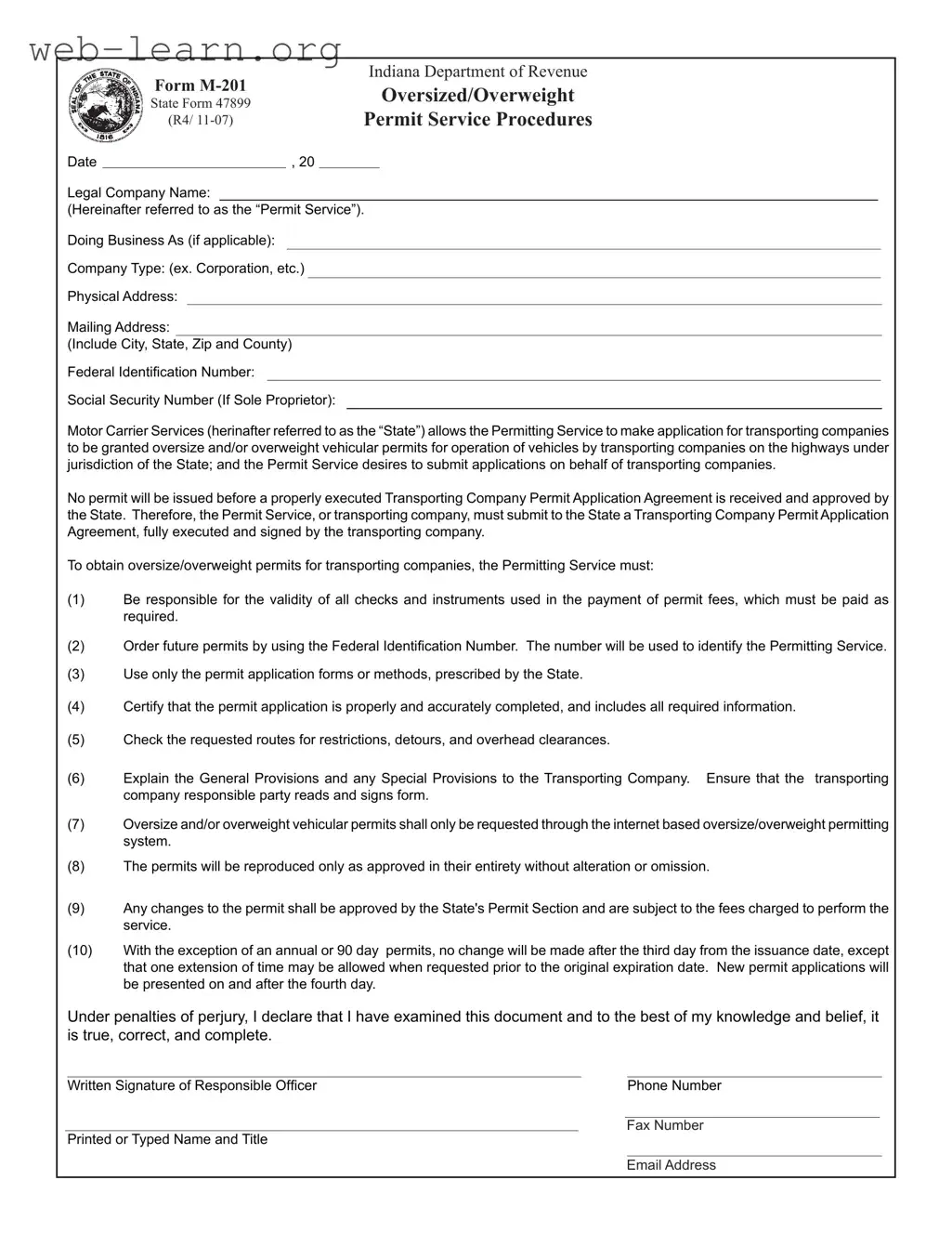
The Indiana M 201 form serves as a crucial document for companies seeking to obtain permits for oversize and overweight vehicles operating on state highways. This form is specifically designed for Permit Services, which act on behalf of transporting companies to facilitate the application process. It requires detailed information, including the legal name of the company, business type, and both physical and mailing addresses. Additionally, the form mandates the inclusion of a Federal Identification Number and, if applicable, a Social Security Number for sole proprietors. To successfully acquire the necessary permits, the Permit Service must adhere to several key requirements. These include ensuring the validity of payment methods, utilizing only approved application forms, and certifying that all information provided is accurate and complete. The form also emphasizes the importance of route checks for any restrictions and the necessity of explaining both general and special provisions to the transporting company. Importantly, permits can only be requested through an online system, and any modifications to the permits must receive prior approval from the State's Permit Section. The Indiana M 201 form encapsulates the procedural framework that governs the issuance of oversize and overweight vehicular permits, ensuring compliance and accountability throughout the process.

Form |
Indiana Department of Revenue |
|
Oversized/Overweight |
||
State Form 47899 |
||
|
||
(R4/ |
Permit Service Procedures |
Date, 20
Legal Company Name:
(Hereinafter referred to as the “Permit Service”).
Doing Business As (if applicable):
Company Type: (ex. Corporation, etc.)
Physical Address:
Mailing Address:
(Include City, State, Zip and County)
Federal Identification Number:
Social Security Number (If Sole Proprietor):
Motor Carrier Services (herinafter referred to as the “State”) allows the Permitting Service to make application for transporting companies to be granted oversize and/or overweight vehicular permits for operation of vehicles by transporting companies on the highways under jurisdiction of the State; and the Permit Service desires to submit applications on behalf of transporting companies.
No permit will be issued before a properly executed Transporting Company Permit Application Agreement is received and approved by the State. Therefore, the Permit Service, or transporting company, must submit to the State a Transporting Company Permit Application Agreement, fully executed and signed by the transporting company.
To obtain oversize/overweight permits for transporting companies, the Permitting Service must:
(1)Be responsible for the validity of all checks and instruments used in the payment of permit fees, which must be paid as required.
(2)Order future permits by using the Federal Identifi cation Number. The number will be used to identify the Permitting Service.
(3)Use only the permit application forms or methods, prescribed by the State.
(4)Certify that the permit application is properly and accurately completed, and includes all required information.
(5)Check the requested routes for restrictions, detours, and overhead clearances.
(6)Explain the General Provisions and any Special Provisions to the Transporting Company. Ensure that the transporting company responsible party reads and signs form.
(7)Oversize and/or overweight vehicular permits shall only be requested through the internet based oversize/overweight permitting system.
(8)The permits will be reproduced only as approved in their entirety without alteration or omission.
(9)Any changes to the permit shall be approved by the State's Permit Section and are subject to the fees charged to perform the service.
(10)With the exception of an annual or 90 day permits, no change will be made after the third day from the issuance date, except that one extension of time may be allowed when requested prior to the original expiration date. New permit applications will be presented on and after the fourth day.
Under penalties of perjury, I declare that I have examined this document and to the best of my knowledge and belief, it is true, correct, and complete.
Written Signature of Responsible Officer |
Phone Number |
Fax Number
Printed or Typed Name and Title
Email Address
| Fact Name | Details |
|---|---|
| Form Title | Indiana M 201 - Oversized/Overweight Permit Application |
| Governing Law | Indiana Code Title 9, Article 20 |
| Purpose | This form allows a Permit Service to apply for oversized and overweight vehicular permits on behalf of transporting companies. |
| Required Information | The form requires the legal company name, physical and mailing addresses, and identification numbers. |
| Application Agreement | A Transporting Company Permit Application Agreement must be executed and approved before permits are issued. |
| Submission Method | Permits must be requested through the internet-based permitting system. |
Filling out the Indiana M 201 form is an important step for obtaining oversize and overweight vehicular permits. This process requires careful attention to detail, as accurate information is essential for approval. Below are the steps to successfully complete the form.
Once the form is filled out, review it carefully to ensure that all information is correct. After that, submit the completed form along with any required documents to the appropriate state department for processing. This will initiate the permit application process, allowing for the legal transport of oversized or overweight vehicles on Indiana highways.
What is the purpose of the Indiana M 201 form?
The Indiana M 201 form is used to apply for oversize and overweight vehicular permits. These permits are necessary for transporting companies that wish to operate vehicles that exceed standard size and weight limits on Indiana highways. The form is submitted by a Permit Service on behalf of the transporting companies, ensuring compliance with state regulations.
Who can submit the Indiana M 201 form?
The form can be submitted by a Permit Service that has been authorized by the transporting company. The Permit Service must ensure that all necessary agreements, specifically the Transporting Company Permit Application Agreement, are completed and approved by the Indiana Department of Revenue. This agreement confirms the Permit Service's authority to act on behalf of the transporting company.
What steps must be taken to obtain a permit using the Indiana M 201 form?
What are the limitations regarding changes to the permit after issuance?
Once a permit is issued, no changes can be made after the third day from the issuance date, except in specific circumstances. An extension may be allowed if requested before the original expiration date. After the third day, new permit applications must be submitted. This ensures that the permitting process remains efficient and organized.
Filling out the Indiana M 201 form can be straightforward, but mistakes can lead to delays or denials. One common error is not providing the legal company name accurately. This name should match the one registered with the state. If there are discrepancies, it may cause confusion and result in the rejection of the application.
Another mistake is failing to include the Federal Identification Number. This number is crucial for identifying the Permitting Service. Without it, the application cannot be processed. Additionally, some people forget to provide a mailing address or provide an incomplete address. This can lead to important correspondence being sent to the wrong location.
Many applicants overlook the need to check routes for restrictions. It's essential to verify that the routes selected for travel are permissible for oversized or overweight vehicles. Ignoring this step can lead to unexpected fines or the need to reroute after a permit has been issued.
Another frequent error is not certifying that the application is completed accurately. All required information must be included. Incomplete forms may be returned or denied, which can delay the process significantly. Applicants should double-check all entries before submission.
Some individuals misunderstand the requirement to explain the General Provisions and any Special Provisions to the Transporting Company. It's important that the responsible party understands and signs the form. This ensures that everyone is on the same page regarding the permit's conditions.
Using the internet-based permitting system is mandatory for requesting permits. Some applicants mistakenly try to submit paper forms or other methods, which can result in automatic rejection. Always ensure you are using the correct system as prescribed by the State.
Additionally, failing to reproduce permits as approved can lead to issues. Any alterations or omissions can invalidate the permit. It's critical to follow the guidelines closely to avoid complications.
Lastly, many people do not understand the rules regarding changes to the permit. Changes can only be made under specific conditions and must be approved by the State's Permit Section. Ignoring these rules may lead to unnecessary fees or complications.
The Indiana M 201 form is a crucial document for obtaining oversize and overweight permits for transporting companies. However, several other forms and documents are often used in conjunction with the M 201 to ensure compliance with state regulations. Below are four key documents that complement the M 201 form.
Utilizing these documents alongside the Indiana M 201 form streamlines the permitting process and helps ensure compliance with state laws. Each document plays a vital role in facilitating the safe and legal transportation of oversize and overweight loads on Indiana highways.
When filling out the Indiana M 201 form, it's essential to follow specific guidelines to ensure accuracy and compliance. Here’s a list of things you should and shouldn't do:
Following these guidelines will help streamline the process and avoid unnecessary delays. Make sure to double-check everything before submission.
Misconception 1: The Indiana M 201 form can be submitted without a Transporting Company Permit Application Agreement.
This is incorrect. A properly executed Transporting Company Permit Application Agreement must be submitted and approved by the State before any permit is issued.
Misconception 2: Any payment method can be used for permit fees.
This is not true. The Permitting Service must ensure the validity of all checks and instruments used for payment. Payments must meet the State's requirements.
Misconception 3: Permits can be altered after issuance.
This is misleading. Permits must be reproduced in their entirety without any alterations. Any changes require approval from the State's Permit Section.
Misconception 4: The Indiana M 201 form can be submitted using any method.
This is incorrect. The form must be submitted through the internet-based oversize/overweight permitting system as prescribed by the State.
When filling out and using the Indiana M 201 form, keep these key takeaways in mind:
By following these guidelines, you can streamline the process and ensure compliance with Indiana's permitting requirements.