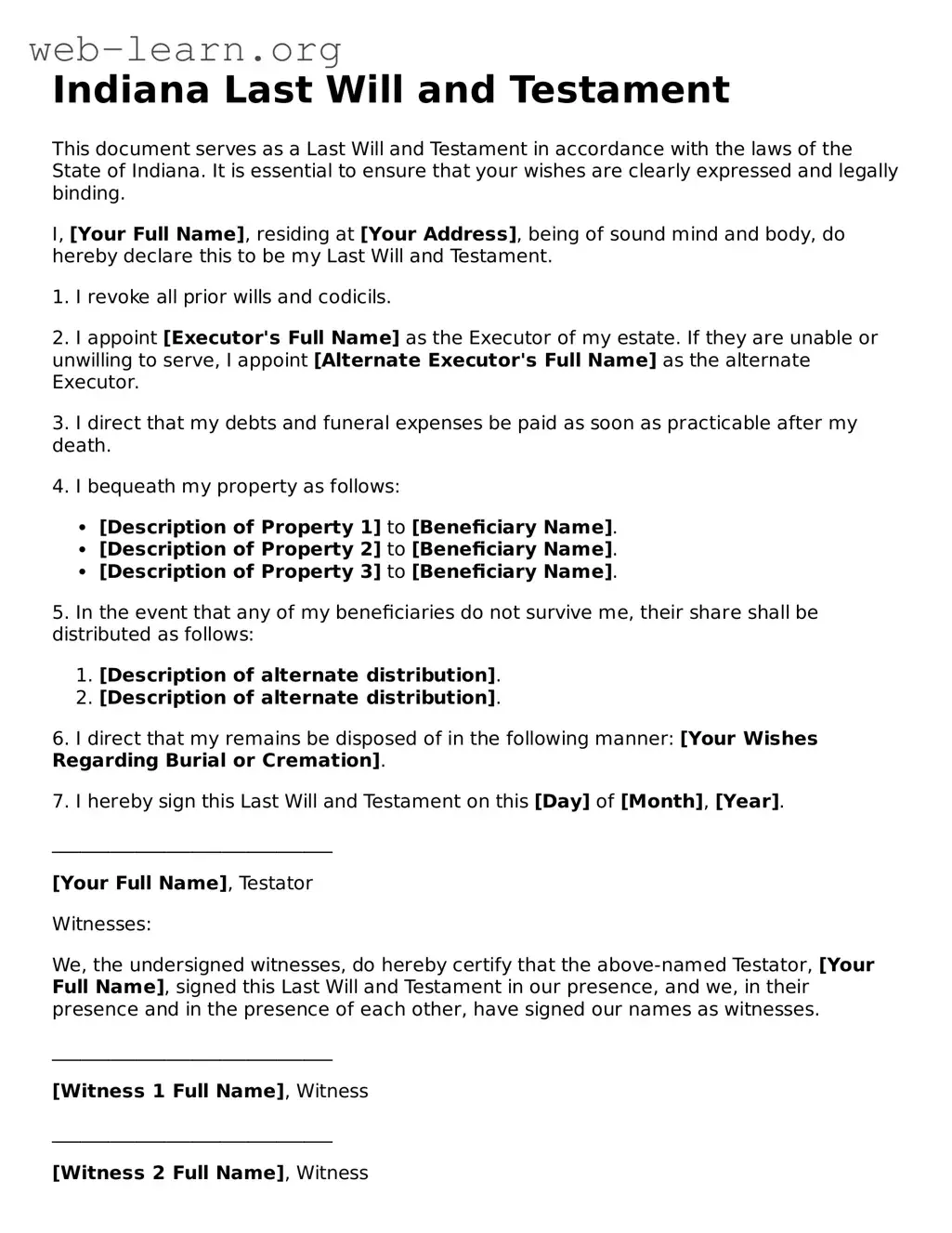
Planning for the future is an essential part of life, and having a Last Will and Testament is a crucial step in ensuring your wishes are honored after you pass away. In Indiana, this legal document allows you to specify how your assets will be distributed, who will care for your minor children, and who will execute your estate. By taking the time to create a will, you can provide clarity and direction for your loved ones during a difficult time. The Indiana Last Will and Testament form includes important sections such as the appointment of an executor, the designation of beneficiaries, and provisions for guardianship. Additionally, it must meet specific state requirements to be valid, including being signed in the presence of witnesses. Understanding these key aspects can help you navigate the process smoothly and ensure that your final wishes are clearly articulated and legally binding.
Indiana Last Will and Testament
This document serves as a Last Will and Testament in accordance with the laws of the State of Indiana. It is essential to ensure that your wishes are clearly expressed and legally binding.
I, [Your Full Name], residing at [Your Address], being of sound mind and body, do hereby declare this to be my Last Will and Testament.
1. I revoke all prior wills and codicils.
2. I appoint [Executor's Full Name] as the Executor of my estate. If they are unable or unwilling to serve, I appoint [Alternate Executor's Full Name] as the alternate Executor.
3. I direct that my debts and funeral expenses be paid as soon as practicable after my death.
4. I bequeath my property as follows:
5. In the event that any of my beneficiaries do not survive me, their share shall be distributed as follows:
6. I direct that my remains be disposed of in the following manner: [Your Wishes Regarding Burial or Cremation].
7. I hereby sign this Last Will and Testament on this [Day] of [Month], [Year].
______________________________
[Your Full Name], Testator
Witnesses:
We, the undersigned witnesses, do hereby certify that the above-named Testator, [Your Full Name], signed this Last Will and Testament in our presence, and we, in their presence and in the presence of each other, have signed our names as witnesses.
______________________________
[Witness 1 Full Name], Witness
______________________________
[Witness 2 Full Name], Witness
This document should be stored in a safe place and a copy should be provided to your Executor.
| Fact Name | Description |
|---|---|
| Legal Age Requirement | In Indiana, an individual must be at least 18 years old to create a valid Last Will and Testament. |
| Witness Requirement | The will must be signed by at least two witnesses who are present at the same time. |
| Governing Law | The Indiana Last Will and Testament is governed by Indiana Code Title 29, Article 1. |
| Revocation | A will can be revoked by a subsequent will or by physically destroying the document with the intent to revoke. |
Creating a Last Will and Testament is an important step in ensuring that your wishes are honored after your passing. Once you have completed the form, you will need to sign it in the presence of witnesses, who will also sign to affirm your intent.
A Last Will and Testament is a legal document that outlines how a person’s assets and property should be distributed after their death. It allows individuals to specify their wishes regarding the distribution of their estate, the appointment of guardians for minor children, and the designation of an executor to manage the estate.
In Indiana, any person who is at least 18 years old and of sound mind can create a Last Will and Testament. This means the individual must understand the nature of the document and its implications. There are no special requirements regarding legal training or expertise.
To ensure a Last Will and Testament is valid in Indiana, the following conditions must be met:
Yes, individuals can change or revoke their Last Will and Testament at any time while they are alive and mentally competent. Changes can be made by creating a new Will or by drafting a codicil, which is an amendment to the existing Will. To revoke a Will, one can destroy it or create a new Will that explicitly states the previous Will is revoked.
If a person dies without a Last Will and Testament, they are said to have died "intestate." In this case, Indiana's intestacy laws will determine how the deceased's assets are distributed. Typically, the estate will be divided among surviving relatives according to a specific hierarchy, which may not align with the deceased's wishes.
When filling out the Indiana Last Will and Testament form, individuals often make critical mistakes that can lead to complications in the future. One common error is failing to clearly identify the testator. It is essential to provide the full legal name and address of the person creating the will. Omitting this information can create confusion and may result in challenges to the validity of the will.
Another frequent mistake is not properly designating beneficiaries. It's vital to list each beneficiary's full name and relationship to the testator. Incomplete or vague descriptions can lead to disputes among family members. Additionally, individuals should avoid naming contingent beneficiaries without specifying what happens if the primary beneficiary predeceases the testator.
People also often neglect to sign the will in the presence of witnesses. Indiana law requires that the will be signed by the testator and at least two witnesses. If this step is skipped, the will may be deemed invalid. Witnesses should also be disinterested parties, meaning they should not stand to gain anything from the will. Failing to follow these requirements can render the document unenforceable.
Another mistake involves not updating the will after significant life events. Changes such as marriage, divorce, or the birth of children can affect how assets should be distributed. If the will does not reflect these changes, it may not serve the testator's current intentions. Regularly reviewing and updating the will is crucial for ensuring it remains valid and effective.
Lastly, people often overlook the importance of clearly outlining the distribution of assets. Ambiguities can lead to misunderstandings and disputes among heirs. It is advisable to be specific about what each beneficiary will receive. This clarity can help prevent conflicts and ensure that the testator's wishes are honored.
When planning for the future, it is essential to consider various documents that work in conjunction with an Indiana Last Will and Testament. These documents help ensure that your wishes are respected and that your affairs are managed according to your preferences. Below is a list of commonly used forms and documents that complement a will.
By understanding these documents and their purposes, individuals can create a comprehensive estate plan that reflects their wishes and provides peace of mind for themselves and their loved ones. Each document plays a unique role in the overall planning process, ensuring that your intentions are clear and legally binding.
Living Trust: A living trust is a legal document that allows an individual to place assets into a trust during their lifetime. Like a Last Will and Testament, it provides instructions for asset distribution upon death. However, a living trust can also facilitate the management of assets during the individual's lifetime if they become incapacitated.
Durable Power of Attorney: This document grants another person the authority to make financial or legal decisions on behalf of someone else. Similar to a Last Will and Testament, it ensures that the individual’s wishes are honored, particularly in situations where they may not be able to communicate their preferences.
Healthcare Proxy: A healthcare proxy designates an individual to make medical decisions for someone if they are unable to do so themselves. Like a Last Will and Testament, it reflects personal choices and desires regarding care, ensuring that one's health preferences are respected.
Living Will: A living will outlines an individual's preferences for medical treatment in the event of terminal illness or incapacitation. This document complements a Last Will and Testament by addressing health care decisions, ensuring that the individual's wishes are clear and respected during critical times.
Codicil: A codicil is an amendment or addition to an existing will. It serves a similar purpose as a Last Will and Testament by detailing changes or updates to the original document, allowing individuals to adjust their estate plans as circumstances evolve.
When filling out the Indiana Last Will and Testament form, it’s important to approach the process with care. Here’s a list of things you should and shouldn’t do to ensure your will is valid and reflects your wishes.
By following these guidelines, you can create a clear and effective Last Will and Testament that meets Indiana's legal requirements.
When it comes to creating a Last Will and Testament in Indiana, several misconceptions can lead to confusion. Understanding these common myths can help ensure that your estate planning is both effective and compliant with state laws. Here are five misconceptions about the Indiana Last Will and Testament form:
This is a common belief, but everyone can benefit from having a will, regardless of their financial situation. A will allows you to specify how you want your assets distributed and can help avoid disputes among family members.
While it is true that Indiana has specific requirements for wills, a handwritten will, also known as a holographic will, can be valid if it is signed by the testator and reflects their intentions. However, it is advisable to follow the formal requirements to ensure clarity and legality.
This is simply not true. You can amend or revoke your will at any time as long as you are of sound mind. Life changes, such as marriage, divorce, or the birth of a child, often necessitate updates to your will.
While a will does take effect upon death, it can also serve to appoint a guardian for minor children or to establish trusts for their benefit. This proactive planning can provide peace of mind for parents.
In Indiana, while many assets may transfer to a spouse through intestate succession, not all assets are automatically included. Certain accounts, like life insurance policies or retirement accounts, may have designated beneficiaries that take precedence over a will.
Being aware of these misconceptions can help you make informed decisions about your estate planning. A well-prepared will can provide clarity and security for your loved ones during a difficult time.
When filling out and using the Indiana Last Will and Testament form, it is important to consider several key aspects to ensure that the document is valid and effective. Below are essential takeaways to guide you through the process:
Understanding these key points can help ensure that your Last Will and Testament accurately reflects your wishes and complies with Indiana law.
Free Illinois Will Template - Can help to ensure that your financial responsibilities are met after you pass.
Free Ny Will Template - Can include instructions for the management of ongoing financial obligations.
California Holographic Will - May allow for the appointment of a trust to manage assets for beneficiaries.