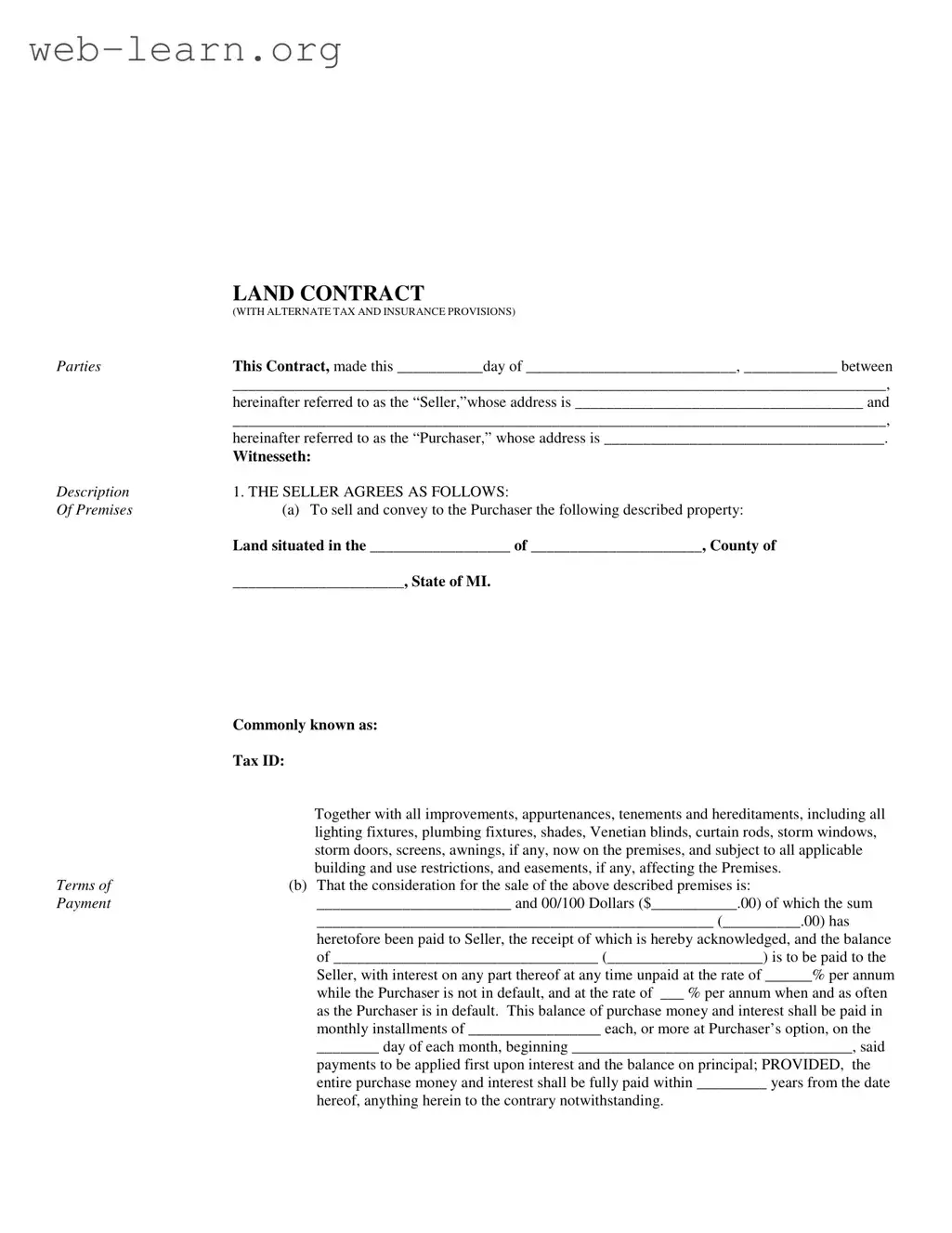
The Indiana Land Contract Example form serves as a crucial document for both sellers and purchasers in real estate transactions. This form outlines the essential terms and conditions under which a seller agrees to convey property to a purchaser. Key aspects include the identification of both parties, a detailed description of the property, and the agreed-upon purchase price. Payment terms are clearly defined, specifying the amount to be paid, the interest rates applicable, and the schedule for monthly installments. The seller commits to providing a warranty deed upon full payment, ensuring a smooth transfer of title. Additionally, the form includes provisions regarding taxes, insurance, and maintenance responsibilities, placing obligations on the purchaser to keep the property in good condition and up to date on payments. The document also addresses potential defaults and the rights of both parties in such situations, ensuring that everyone understands their responsibilities and the consequences of non-compliance. Overall, the Indiana Land Contract Example form is designed to protect the interests of both sellers and purchasers while facilitating a clear and legally binding agreement.
|
LAND CONTRACT |
|
(WITH ALTERNATE TAX AND INSURANCE PROVISIONS) |
Parties |
This Contract, made this ___________day of ___________________________, ____________ between |
|
____________________________________________________________________________________, |
|
hereinafter referred to as the “Seller,”whose address is _____________________________________ and |
|
____________________________________________________________________________________, |
|
hereinafter referred to as the “Purchaser,” whose address is ____________________________________. |
|
Witnesseth: |
Description |
1. THE SELLER AGREES AS FOLLOWS: |
Of Premises |
(a) To sell and convey to the Purchaser the following described property: |
|
Land situated in the __________________ of ______________________, County of |
|
______________________, State of MI. |
|
Commonly known as: |
|
Tax ID: |
|
Together with all improvements, appurtenances, tenements and hereditaments, including all |
|
lighting fixtures, plumbing fixtures, shades, Venetian blinds, curtain rods, storm windows, |
|
storm doors, screens, awnings, if any, now on the premises, and subject to all applicable |
|
building and use restrictions, and easements, if any, affecting the Premises. |
Terms of |
(b) That the consideration for the sale of the above described premises is: |
Payment |
_________________________ and 00/100 Dollars ($___________.00) of which the sum |
|
___________________________________________________ (__________.00) has |
|
heretofore been paid to Seller, the receipt of which is hereby acknowledged, and the balance |
|
of __________________________________ (____________________) is to be paid to the |
|
Seller, with interest on any part thereof at any time unpaid at the rate of ______% per annum |
|
while the Purchaser is not in default, and at the rate of ___ % per annum when and as often |
|
as the Purchaser is in default. This balance of purchase money and interest shall be paid in |
|
monthly installments of _________________ each, or more at Purchaser’s option, on the |
|
________ day of each month, beginning ____________________________________, said |
|
payments to be applied first upon interest and the balance on principal; PROVIDED, the |
|
entire purchase money and interest shall be fully paid within _________ years from the date |
|
hereof, anything herein to the contrary notwithstanding. |
Seller’s Duty to Convey |
(c) |
Upon receiving payment in full of all sums owing herein, less the amount then due on any |
|
|
existing mortgage or mortgages, and the surrender of the duplicate of this contract, to execute |
|
|
and deliver to the Purchaser or the Purchaser’s assigns, a good and sufficient Warranty Deed |
|
|
conveying title to said land, subject to aforesaid restrictions and easements and free from all |
|
|
other encumbrances, except such as may be herein set forth, and such encumbrances as shall |
|
|
have accrued or attached since the date hereof through the acts or omissions of persons other |
|
|
then the Seller or his assigns. |
To Furnish Title |
(d) |
To deliver to the Purchaser as evidence of title, at the Seller’s option, a Policy of Title |
Evidence |
|
Insurance insuring Purchaser, the effective date of the policy to be approximately the date of |
|
|
this contract, and issued by Devon Title Agency, as agent for a title underwriter in good |
|
|
standing. |
Purchaser’s Duties
To Pay Taxes and Keep
Premises Insured
Alternate Payment
Method
Insert amount, if Advance Monthly Installment Method of Taxes and Insurance is to be Adopted
2.THE PURCHASER AGREES AS FOLLOWS:
(a)To purchase said land and pay the Seller the sum aforesaid, with the interest thereon as above provided.
(b)To use, maintain and occupy said premises in accordance with any and all restrictions thereon.
(c)To keep the premises in accordance with all police, sanitary and other regulations imposed by any governmental authority.
(d)To pay all taxes and assessments hereafter levied on said premises before any penalty for non- payment attaches thereto, and submit receipts to Seller upon request, as evidence of payment thereof; also at all times to keep the buildings now or hereafter on the premises insured against loss and damage, in a manner and to an amount approved by the Seller, and to deliver the policies as issued to the Seller with the premiums fully paid.
If the amount of the estimated monthly cost of taxes, assessments and insurance is inserted in the following Paragraph 2(e), then the method of the payment of these items as therein indicated shall be adopted. If this amount is not inserted, then Paragraph 2(e) shall be of no effect and the method of payment provided in the preceding Paragraph 2(d) shall be effective.
(e)To pay monthly in addition to the monthly payments herein before stipulated, the sum of
$____________________, which is an estimate of the monthly cost of the taxes, assessments and insurance premiums for said premises, which shall be credited by the Seller on the unpaid principal balance due on the contract. If the Purchaser is not in default under the terms of this contract, the Seller shall pay for the Purchaser’s account, the taxes, assessments and insurance premiums mentioned in Paragraph 2(d) above when due and before any penalty attaches, and submit receipts therefore to the Purchaser upon demand. The amounts so paid shall be added to the principal balance of this contract. The amount of the estimated monthly payment, under this paragraph, may be adjusted from time to time so that the amount received shall approximate the total sum required annually for taxes, assessments and insurance. This adjustment shall be made on demand of either of the parties and any deficiencies shall be paid by the Purchaser upon the Seller’s demand.
Acceptance of Title and |
(f) That he has examined a Title Commitment referenced above covering the above described |
Premises |
premises, and is satisfied with the marketability of the title shown thereby, and has examined |
|
the above described premises and is satisfied with the physical condition of any structures |
|
thereon. |
Maintenance of Premises |
(g) To keep and maintain the premises and the buildings thereon in as good condition as they are |
|
at the date hereof, reasonable wear and tear excepted, and not to commit waste, remove or |
|
demolish any improvements thereon, or otherwise diminish the value of the Seller’s security, |
|
without the written consent of the Seller. |
Mortgage by Seller |
3. THE SELLER AND PURCHASER MUTUALLY AGREE AS FOLLOWS: |
|
(a) That the Seller may, at any time during the continuance of this contract encumber said land by |
|
mortgage or mortgages to secure not more than the unpaid balance of this contract at the time |
|
such mortgage or mortgages are executed. Such mortgage or mortgages shall be payable in |
|
not less than three (3) years from the date of execution thereof and shall provide for payment |
|
of principal and interest in monthly installments which do not exceed such installments |
|
provided for in this contract; shall provide for a rate of interest on the unpaid balance of the |
|
mortgage debt which does not exceed the rate of interest provided in Paragraph 1 (b); or on |
|
such other items as may be agreed upon by the Seller and Purchaser, and shall be a first lien |
|
upon the land superior to the rights of Purchaser herein; provided notice of the execution of |
|
said mortgage or mortgages containing the name and address of the mortgagee or his agent, |
|
the amount of such mortgage or mortgages, the rate of interest and maturity of the principal |
|
and interest shall be sent to the Purchaser by registered mail promptly after execution thereof. |
|
Purchaser will, on demand, execute any instruments demanded by the Seller, necessary or |
|
requisite to subordinate the rights of the Purchaser hereunder to the lien of any such mortgage |
|
or mortgages. In event said Purchaser shall refuse to execute any instruments demanded by |
|
Seller and shall refuse to accept such registered mail hereinbefore provided, or said registered |
|
mail shall be returned unclaimed, then the Seller may post such notice in two conspicuous |
|
places on said premises, and upon making affidavit duly sworn to of such posting, this |
|
proceeding shall operate the same as if said Purchaser had consented to the execution of said |
|
mortgage or mortgages, and Purchaser’s rights shall be subordinate to said mortgage or |
|
mortgages as hereinbefore provided. The consent obtained, or subordination as otherwise |
|
herein provided, under or by virtue of the foregoing power, shall extend to any and all |
|
renewals or extensions or amendments of said mortgage or mortgages, after Seller has given |
|
notice to the Purchaser as above provided for giving notice of the execution of said mortgage |
|
or mortgages. |
Encumbrances on |
(b) That if the Seller’s interest be that of land contract, or now or hereafter be encumbered by |
Seller’s Title |
mortgage, the Seller shall meet the payments of principal and interest thereon as they mature |
|
and produce evidence thereof to the Purchaser on demand, and in default of the Seller said |
|
Purchaser may pay the same. Such payments by Purchaser shall be credited on the sums first |
|
maturing hereon, with interest at the rate provided in Paragraph 1 (b) on payments so made. |
|
If proceedings are commenced to recover possession or to enforce the payment of such |
|
contract or mortgage because of the Seller’s default, the Purchaser may at any time thereafter, |
|
while such proceeding are pending, encumber said land by mortgage securing such sum as |
|
can be obtained, upon such terms as may be required, and with the proceeds pay and |
|
discharge such mortgage, or purchase money lien. Any mortgage so given shall be a first lien |
|
upon the land superior to the rights of the Seller therein, and thereafter the Purchaser shall |
|
pay the principal and interest on such mortgage so given as they mature, which payments |
|
shall be credited on the sums of matured or first maturing hereon. When the sum owing |
|
hereon is reduced to the amount owing upon such contract or mortgage or owing on any |
|
mortgage executed under either of the powers in this contract a conveyance shall be made in |
|
the form above provided containing a covenant by the grantee to assume and agree to pay the |
|
same. |
(c) That if default is made by the Purchaser in the payment of any taxes, assessments or |
|
Insurance |
insurance premiums, or in the payment of the sums provided for in Paragraph 2(e), or in the |
|
delivery of any policy as herein before provided, the Seller may pay such taxes or premiums |
|
or procure such insurance and pay the premium or premiums thereon , and any sum or sums |
|
so paid shall be a further lien on the land and premises, payable by the Purchaser to Seller |
|
forthwith with interest at the rate as set forth in Paragraph 1(b) hereof. |
Assignment by Purchaser |
(d) No assignment or conveyance by the Purchaser shall create any liability whatsoever against |
|
the Seller until a duplicate thereof, duly witnessed and acknowledged, together with the |
|
residence address of such assignee, shall be delivered to the Seller. Purchaser’s liability |
|
hereunder shall not be released or affected in any way by delivery of such assignment, or by |
|
Seller’s endorsement of receipt and/or acceptance thereon. |
Possession |
(e) |
The Purchaser shall have the right to possession of the premises from and after the date |
|
|
hereof, unless otherwise herein provided, and be entitled to retain possession thereof only so |
|
|
long as there is no default on his part in carrying out the terms and conditions hereof. In the |
|
|
event the premises herein above described are vacant or unimproved, the Purchaser shall be |
|
|
deemed to be in constructive possession only, which possessory right shall cease and |
|
|
terminate after service of a notice of forfeiture of this contract. Erection of signs by |
|
|
Purchaser on vacant or unimproved property shall not constitute actual possession by him. |
Right to Forfeit |
(f) |
If the Purchaser shall fail to perform this contract or any part thereof, the Seller immediately |
|
|
after such default shall have the right to declare the same forfeited and void, and retain |
|
|
whatever may have been paid hereon, and all improvements that may have been made upon |
|
|
the premises, together with additions and accretions thereto, and consider and treat the |
|
|
Purchaser as his tenant holding over without permission and may take immediate possession |
|
|
of the premises and have the Purchaser and each and every other occupant removed and put |
|
|
out. In all cases where a notice of forfeiture is relied upon by the Seller to terminate rights |
|
|
hereunder, such notice shall specify all unpaid moneys and other breaches of this contract and |
|
|
shall declare forfeiture of this contract effective in the time period provided by statute or if no |
|
|
statutory provision applies then within 30 days after service unless such money is paid and |
|
|
any other breaches of this contract are cured within that time. |
Acceleration Clause |
(g) |
If default is made by the Purchaser and such default continues for a period of thirty (30) days |
|
|
or more, and the Seller desires to foreclose this contract in equity, then the Seller shall have at |
|
|
his option the right to declare the entire unpaid balance hereunder to be due and payable |
|
|
forthwith, notwithstanding anything herein contained to the contrary. |
Disposition of Insurance |
(h) |
That during the existence of this contract, any proceeds received from a hazard insurance |
Proceeds |
|
policy covering the land shall first be used to repair the damage and restore the property, with |
|
|
the balance of such proceeds, if any, being distributed to Seller and Purchaser, as their |
|
|
interests may appear. |
|
(i) |
Time shall be deemed to be of the essence of this contract. |
|
(j) |
The individual parties hereto represent themselves to be of full age, and the corporate parties |
|
|
hereto represent themselves to be valid existing corporations with their charters in full force |
|
|
and effect. |
Notice to Purchaser |
(k) |
Any declarations, notices or papers necessary or proper to terminate, accelerate or enforce this |
|
|
contract shall be presumed conclusively to have been served upon the Purchaser if such |
|
|
instrument is enclosed in an envelope with first class postage fully prepaid, if said envelope is |
|
|
addressed to the Purchaser at the address set forth in the heading of this contract or at the |
|
|
latest other address which may have been specified by the Purchaser and receipted for in |
|
|
writing by the Seller, and if said envelope is deposited in a United States Post Office Box. |
Additional Clauses |
|
|
The pronouns and relative words herein used are written in the masculine and singular only. If more than one joins in the execution hereof as Seller or Purchaser, or either be of the feminine sex or a corporation, such words shall be read as if written in plural, feminine or neuter, respectively. The covenants herein shall bind the heirs, devisees, legatees, assigns and successors of the respective parties.
In Witness Whereof, the parties hereto have executed this Contract in duplicate the day and year first above written.
Land Contract Seller(s) / Vendor(s)
|
______________________________________________ |
|
______________________________________________ |
|
Land Contract Purchaser(s) / Vendee(s) |
|
_______________________________________________ |
|
_______________________________________________ |
Use this |
STATE OF MICHIGAN |
Acknowledgement Form |
} S.S. |
for Individuals |
COUNTY OF ____________________ |
|
The foregoing instrument was acknowledged before me this _________day of _________________, |
|
__________ by _____________________________________________________________________ |
|
____________________________________________ |
|
Notary Public |
|
______________________________________County |
|
My commission expires: _______________________ |
Use this |
STATE OF MICHIGAN |
Acknowledgement Form |
} S.S. |
for Corporations |
COUNTY OF ____________________ |
|
The foregoing instrument was acknowledged before me this ____________day of ________________, |
|
________ by ________________________________________________________________________ |
|
__________________________________________ |
|
Notary Public |
|
____________________________________County |
|
My commission expires: _____________________ |
Drafted by: |
When recorded return to: |
| Fact Name | Details |
|---|---|
| Governing Law | The Indiana Land Contract is governed by Indiana state law. |
| Parties Involved | The contract identifies two main parties: the Seller and the Purchaser. |
| Property Description | The contract includes a detailed description of the property being sold. |
| Payment Terms | The Purchaser agrees to pay a specified amount in monthly installments. |
| Seller's Responsibilities | The Seller must convey a Warranty Deed upon full payment. |
| Purchaser's Duties | The Purchaser is responsible for paying taxes and maintaining insurance on the property. |
| Insurance Provisions | The contract allows for the Seller to cover insurance premiums if the Purchaser is not in default. |
| Default Consequences | In case of default, the Seller has the right to declare the contract forfeited. |
| Possession Rights | The Purchaser has the right to occupy the premises unless there is a default. |
| Modification of Terms | Any changes to the contract must be agreed upon by both parties and documented. |
Filling out the Indiana Land Contract Example form is an important step in formalizing the agreement between a seller and a purchaser regarding the sale of property. This contract outlines the terms, responsibilities, and rights of both parties involved. Here’s how to complete the form accurately.
Once the form is filled out, it should be reviewed for accuracy before being signed. Both parties should retain a copy for their records. This ensures that everyone is on the same page regarding the terms of the agreement and helps prevent any misunderstandings in the future.
What is an Indiana Land Contract?
An Indiana Land Contract is a legal agreement between a seller and a buyer for the purchase of real estate. The buyer agrees to make payments to the seller over time instead of paying the full purchase price upfront. This contract outlines the terms of the sale, including payment amounts, interest rates, and responsibilities of both parties.
Who are the parties involved in the contract?
The parties involved are the Seller, who is selling the property, and the Purchaser, who is buying the property. Both parties must provide their names and addresses in the contract.
What information is required about the property?
The contract must include a detailed description of the property being sold. This includes the location, county, and tax identification number. Additionally, it should mention any improvements or fixtures included in the sale.
How is the purchase price structured?
The purchase price consists of an initial payment and the remaining balance to be paid in installments. The contract specifies the total amount, any down payment made, the interest rate, and the monthly installment amounts. Payments typically begin on a specific date and continue until the balance is paid in full.
What are the responsibilities of the Purchaser?
The Purchaser agrees to:
What happens if the Purchaser defaults on the contract?
If the Purchaser fails to meet the payment terms or other obligations, the Seller has the right to declare the contract void. This allows the Seller to retain any payments made and take possession of the property.
Can the Seller encumber the property with a mortgage?
Yes, the Seller can mortgage the property, but only up to the unpaid balance of the contract. The Seller must notify the Purchaser of any such mortgage, and the Purchaser's rights will be subordinate to the new mortgage.
What is the role of insurance in this contract?
The Purchaser must keep the property insured against damage and provide proof of insurance to the Seller. In the event of damage, insurance proceeds should be used to repair the property before any remaining funds are distributed between the Seller and Purchaser.
How are notices served under this contract?
What should be included in the execution of the contract?
Both parties must sign the contract, and it may need to be acknowledged by a notary public. This adds a layer of legal authenticity to the agreement.
Filling out the Indiana Land Contract Example form can be a straightforward process, but there are common mistakes that individuals often make. One frequent error is failing to provide complete and accurate information about the parties involved. It's essential to include the full names and addresses of both the Seller and the Purchaser. Omitting any details can lead to confusion or disputes down the line. Double-checking this information before submitting the form can save time and potential legal issues.
Another common mistake is neglecting to specify the property details clearly. The description of the premises should include not only the address but also the Tax ID and any relevant legal descriptions. Incomplete property information can create problems when it comes to transferring ownership or resolving disputes. Ensuring that all property details are filled out accurately is crucial for a smooth transaction.
Additionally, many people overlook the importance of the payment terms. It's vital to specify the total amount, the down payment, and the interest rate clearly. Leaving any of these sections blank or unclear can lead to misunderstandings about the financial obligations of the Purchaser. Furthermore, it’s advisable to confirm that the monthly payment amounts and due dates are realistic and manageable for both parties.
Lastly, failing to address the insurance and tax payment responsibilities can lead to complications. The Purchaser must understand their obligations regarding taxes and insurance premiums. If these responsibilities are not clearly outlined, it could result in unexpected costs or penalties. It's important to carefully read and fill out this section to ensure both parties are aware of their duties and to prevent any future disputes.
When engaging in a land contract in Indiana, several additional forms and documents may be necessary to ensure a smooth transaction. Each of these documents serves a specific purpose, providing clarity and legal backing to the agreement between the seller and purchaser. Below is a list of commonly used forms that accompany the Indiana Land Contract Example form.
Utilizing these documents alongside the Indiana Land Contract Example form can help facilitate a clear and legally sound transaction. Each form plays a vital role in protecting the interests of both the seller and the purchaser, ensuring a smooth transfer of property rights.
The Indiana Land Contract Example form shares similarities with several other legal documents commonly used in real estate transactions. Each document serves a specific purpose but often overlaps in terms of content and intent. Below is a list of nine documents that are comparable to the Indiana Land Contract Example form, along with a brief explanation of how they are similar.
When filling out the Indiana Land Contract Example form, consider the following guidelines:
It is also important to avoid the following mistakes:
This form is specifically tailored for Indiana and may not comply with the laws and regulations of other states. Each state has its own requirements for land contracts, and using a form from another state could lead to legal issues.
Signing the contract does not transfer ownership. The buyer, referred to as the Purchaser, must complete all payment obligations outlined in the contract before the Seller conveys title through a Warranty Deed.
In fact, the Seller has specific duties, including delivering evidence of title and ensuring the property is free from encumbrances, except those disclosed in the contract. The Seller must also convey the title once the Purchaser fulfills their payment obligations.
The Purchaser is responsible for paying all taxes and insurance premiums as stipulated in the contract. Failure to do so may result in the Seller paying these amounts and placing a lien on the property, which the Purchaser must repay.
While the Seller has the right to declare the contract forfeited upon default, they must provide a notice specifying the unpaid amounts and allow a period for the Purchaser to cure the default before taking further action.
The contract allows for certain contingencies and options for both parties. If the Purchaser defaults, they have a limited time to rectify the situation. Additionally, the Seller may encumber the property, but must follow specific procedures to inform the Purchaser.
Understanding the Indiana Land Contract Example form is crucial for both sellers and purchasers involved in real estate transactions. Here are key takeaways to consider:
By adhering to these key points, both parties can navigate the Indiana Land Contract Example form effectively, ensuring a smoother transaction process.