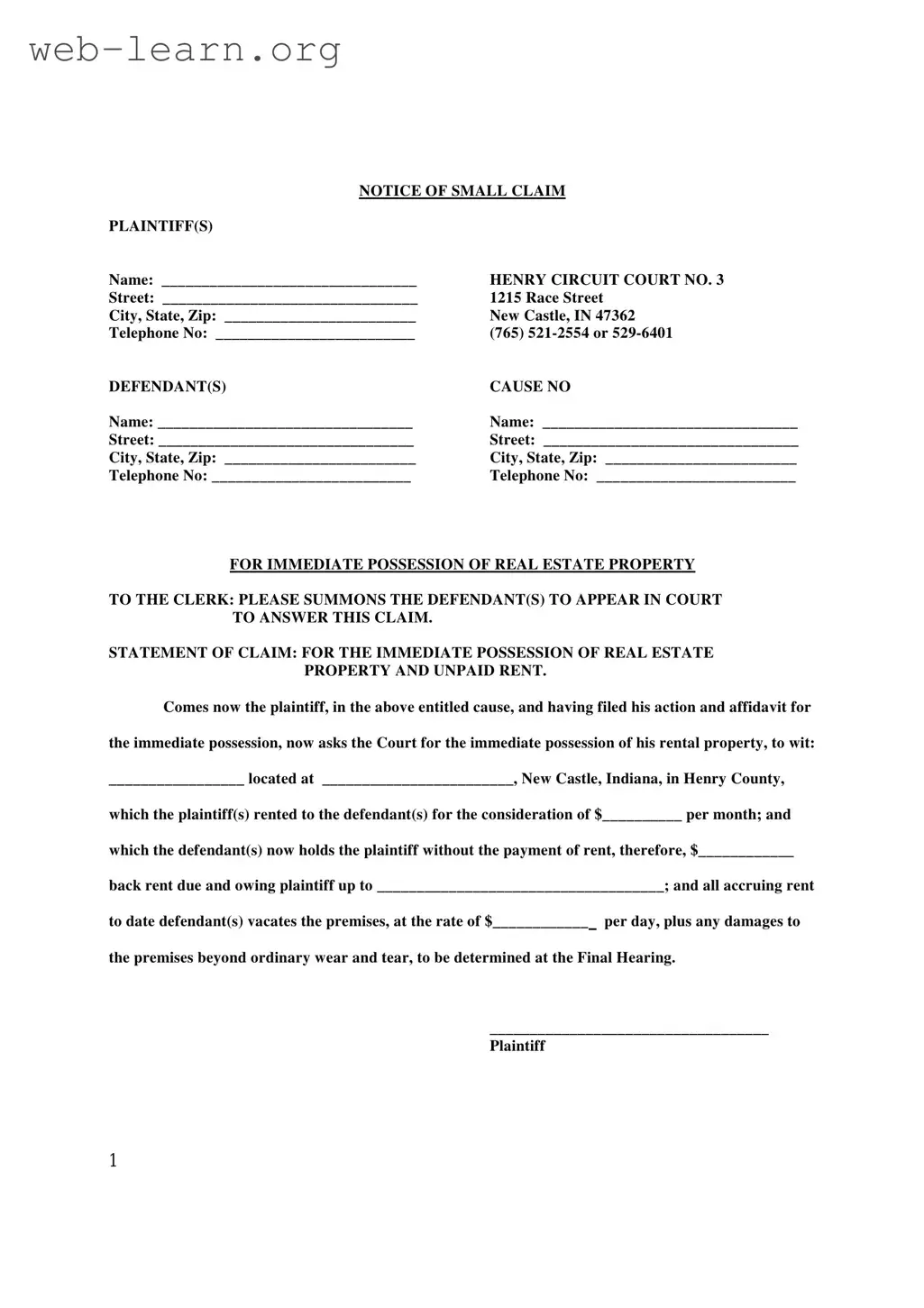
The Indiana Immediate Possession form is a crucial document for landlords seeking to reclaim their rental properties when tenants fail to pay rent. This form initiates legal proceedings in the Henry Circuit Court, allowing landlords to assert their right to immediate possession of real estate. It requires the plaintiff to provide specific details, including the names and addresses of both the landlord and tenant, the property in question, and the amount of unpaid rent. The form also outlines the legal basis for the claim, emphasizing that the tenant's failure to pay rent has caused financial harm to the landlord. Additionally, the document includes a notice for the tenant to appear in court, detailing the date and time for the hearing. By filing this form, landlords can seek not only possession of their property but also any back rent owed and potential damages. Understanding this form is essential for landlords to navigate the eviction process effectively and ensure their rights are protected.
NOTICE OF SMALL CLAIM
PLAINTIFF(S)
Name: ________________________________ |
HENRY CIRCUIT COURT NO. 3 |
Street: ________________________________ |
1215 Race Street |
City, State, Zip: ________________________ |
New Castle, IN 47362 |
Telephone No: _________________________ |
(765) |
DEFENDANT(S) |
CAUSE NO |
Name: ________________________________ |
Name: ________________________________ |
Street: ________________________________ |
Street: ________________________________ |
City, State, Zip: ________________________ |
City, State, Zip: ________________________ |
Telephone No: _________________________ |
Telephone No: _________________________ |
FOR IMMEDIATE POSSESSION OF REAL ESTATE PROPERTY
TO THE CLERK: PLEASE SUMMONS THE DEFENDANT(S) TO APPEAR IN COURT TO ANSWER THIS CLAIM.
STATEMENT OF CLAIM: FOR THE IMMEDIATE POSSESSION OF REAL ESTATE PROPERTY AND UNPAID RENT.
Comes now the plaintiff, in the above entitled cause, and having filed his action and affidavit for
the immediate possession, now asks the Court for the immediate possession of his rental property, to wit:
_________________ located at ________________________, New Castle, Indiana, in Henry County,
which the plaintiff(s) rented to the defendant(s) for the consideration of $__________ per month; and
which the defendant(s) now holds the plaintiff without the payment of rent, therefore, $____________
back rent due and owing plaintiff up to ____________________________________; and all accruing rent
to date defendant(s) vacates the premises, at the rate of $____________ per day, plus any damages to
the premises beyond ordinary wear and tear, to be determined at the Final Hearing.
___________________________________
Plaintiff
1
_____________________________ |
IN THE HENRY CIRCUIT COURT NO. 3 |
Plaintiff(s) |
|
VS |
CAUSE NO. |
________________________________ |
|
Defendant(s) |
|
NOTICE TO APPEAR |
|
T0: |
|
Defendant: ______________________________ |
____________________________________ |
Street:__________________________________ |
____________________________________ |
City, State, Zip: __________________________ |
____________________________________ |
The Plaintiff asks judgment in this Court against you for the sum stated. You are to appear in the Henry Circuit Court No. 3 for a trial upon the Plaintiff’s claim on the ___________
day of __________________, 20__ at ____________. You may appear for the trial in person or
you may appear with your attorney. You should bring to the trial all documents in your possession or under your control, which relate to the Plaintiff’s claim. If you do not wish to dispute the Plaintiff’s claim, you may appear at the time and date stated, for the purpose of assisting the Court in establishing the method by which you will be directed to pay the judgment. If you have questions concerning this matter, you may call the Court Bailiff. If you do not appear for trial at the time, on the date stated, a default judgment may be entered against you for the amount asked by Plaintiff.
________________________________
Clerk, Henry Circuit Court No. 3
2

|
IN THE HENRY CIRCUIT COURT NO. 3 |
___________________________________ |
|
Plaintiff(s) |
|
VS |
CAUSE NO. |
___________________________________ |
|
Defendant(s) |
|
ACTION FOR POSSESSION OF REAL ESTATE
Comes now the Plaintiff(s) and for claim against the Defendant(s), alleges and says:
1.That Plaintiff(s), as landlord, is entitled to immediate possession of the following described real estate in the County of Henry, State of Indiana, to wit:
______________________________________________________________
___ |
. |
2.That Defendant(s) as tenant, now holds possession of said real estate without right and has unlawfully kept Plaintiff(s) out of possession thereof to Plaintiff’s damage in the sum of $___________________.
3.That the costs of this action should be taxed against Defendant(s).
WHEREFORE, Plaintiff(s) prays for judgment for possession of said real estate,
$______________ for back rent plus any rent accruing to the date the premises are vacated,
any damages to the premises beyond ordinary wear and tear, to be determined at the
Final Hearing, costs of this action and other relief just and proper in the premises.
Plaintiff
3

IN THE HENRY CIRCUIT COURT NO. 3
________________________________
Plaintiff(s)
VS |
CAUSE NO. |
________________________________ |
|
Defendant(s) |
|
AFFIDAVIT FOR IMMEDIATE POSSESSION OF REAL ESTATE
Comes now, __________________________, and being first duly sworn, states as follows:
1.That he/she is Plaintiff in the
2.That the Plaintiff, ________________________, is entitled to immediate possession of the real estate described in Plaintiff’s Action of Real Estate filed by virtue of
3.That the estimated value of said real estate is $_____________________.
4.That the reserved rent of said real estate is $____________________ per month.
5.That the Defendant holds possession of said real estate unlawfully and unlawfully retains possession thereof from Plaintiff.
WHEREOF, Plaintiff prays that a hearing be held upon the question of immediate possession of said real estate; that Plaintiff be granted immediate possession of same; and that plaintiff thereafter have and hold possession of said real estate and that such further proceedings be had with reference to the possession of said real estate as by law provided.
I affirm, under the penalties of perjury, that the foregoing representations are true.
Plaintiff
4
|
IN THE HENRY CIRCUIT COURT NO. 3 |
___________________________________ |
|
Plaintiff(s) |
|
Vs |
CAUSE NO. |
___________________________________ |
|
Defendant(s) |
|
ORDER TO APPEAR AT HEARING ON IMMEDIATE POSSESSION OF REAL ESTATE
Defendant in the
day of ___________________, 20___ at _____________ at the Henry Circuit Court No. 3
located at 1215 Race St, New Castle, Indiana, for the purpose of controverting Plaintiff’s Affidavit for Immediate Possession of Real Estate, a copy of which is attached, or to otherwise show cause why a prejudgment order for immediate possession should not be issued and the property delivered to the Plaintiff. You as Defendant may filed affidavits on your behalf at the time of the
Dated this ____________day of ______________________________, 20___.
________________________________
Judge, Henry Circuit Court No. 3
5
| Fact Name | Description |
|---|---|
| Purpose | The Indiana Immediate Possession form is used by landlords to seek immediate possession of rental property from tenants who have not paid rent. |
| Governing Law | This form is governed by Indiana Code Title 32, Article 31, which pertains to landlord-tenant relations. |
| Filing Requirement | The form must be filed with the Henry Circuit Court No. 3 to initiate the legal process for eviction. |
| Defendant Notification | Defendants are required to be summoned to court to respond to the claim made by the landlord. |
| Back Rent | The form allows the landlord to claim unpaid rent, specifying the amount owed and any additional daily rent accruing until the tenant vacates. |
| Damages Clause | Landlords can seek damages for any harm to the property beyond normal wear and tear, to be assessed at a later hearing. |
| Default Judgment Risk | If the defendant fails to appear in court, a default judgment may be entered against them, granting the landlord possession of the property. |
| Affidavit Requirement | An affidavit must be included, stating the plaintiff's entitlement to immediate possession and confirming the tenant's unlawful retention of the property. |
After completing the Indiana Immediate Possession form, the next step involves submitting it to the appropriate court. This form is crucial for initiating the legal process regarding possession of rental property. Ensure all details are accurate to avoid delays.
The Indiana Immediate Possession form is a legal document used by landlords to request the immediate possession of rental property from tenants who have not paid their rent. This form initiates a legal action in the Henry Circuit Court, allowing landlords to seek a court order for possession of their property.
Only landlords or property owners can file this form. The plaintiff, who is the landlord, must have a valid claim against the tenant for unpaid rent or unlawful possession of the property.
The form requires detailed information, including:
Once the form is filed, the court will issue a summons to the tenant. The tenant is required to appear in court on the specified date to respond to the landlord's claim. Failure to appear may result in a default judgment against the tenant.
Yes, tenants can contest the claim. They have the right to appear in court, present evidence, and argue their case. Tenants may also file affidavits or other documents to support their defense.
If the tenant pays the overdue rent before the court hearing, the landlord may choose to withdraw the claim for immediate possession. However, the landlord can still seek any damages or costs incurred due to the late payment.
The court may grant immediate possession to the landlord, allowing them to regain control of the property. Alternatively, the court may rule in favor of the tenant, allowing them to remain in the property. The court may also order a payment plan for any outstanding rent.
While legal representation is not required, it is highly recommended. An attorney can help navigate the legal process, ensure that all documents are completed correctly, and represent the landlord's interests effectively in court.
Completing the Indiana Immediate Possession form requires careful attention to detail. One common mistake individuals make is failing to provide complete and accurate information about the parties involved. The form requires the full names, addresses, and telephone numbers of both the plaintiff and the defendant. Omitting any of these details can lead to delays in the legal process or even result in the dismissal of the case.
Another frequent error is neglecting to specify the exact amount of unpaid rent and the duration for which it is owed. It is crucial to clearly state how much rent is past due and the time frame for which it has not been paid. If this information is vague or incorrect, it can weaken the plaintiff's claim and may lead to complications during the court proceedings.
Many individuals also overlook the importance of properly documenting the claim for damages beyond normal wear and tear. The form should indicate any additional damages that have occurred to the property. Failing to do so can impact the ability to recover these costs later in the process. Courts often require detailed evidence to support claims of damages, so providing this information upfront is essential.
Lastly, some people mistakenly ignore the requirement to file the form with the correct court and to ensure that all necessary documents are attached. The Indiana Immediate Possession form must be submitted to the appropriate court, and any supporting affidavits or evidence should be included. Incomplete submissions can lead to delays or rejection of the claim, ultimately hindering the pursuit of immediate possession.
In Indiana, when seeking immediate possession of a rental property, several forms and documents may accompany the Immediate Possession form. Each of these documents plays a crucial role in the legal process, ensuring that both landlords and tenants understand their rights and obligations. Below is a list of commonly used forms that may be relevant in such cases.
Understanding these documents is vital for both landlords and tenants navigating the legal landscape of property possession in Indiana. Each form serves a specific purpose and contributes to the overall process of resolving disputes related to rental properties.
The Indiana Immediate Possession form shares similarities with several other legal documents that serve similar purposes in landlord-tenant disputes. Below is a list of eight documents that are comparable in function and intent:
When filling out the Indiana Immediate Possession form, there are essential practices to follow. Here are five things you should and shouldn't do:
By following these guidelines, you can help ensure that your filing is processed smoothly and efficiently.
Misconceptions about the Indiana Immediate Possession form can lead to confusion and unnecessary complications. Here are six common misconceptions:
Ensure all information is accurate and complete. This includes names, addresses, and any relevant details about the property and rental agreement.
The form must be filed in the appropriate court, specifically the Henry Circuit Court No. 3 in Indiana, to initiate the process.
Clearly state the reason for seeking immediate possession. This typically involves non-payment of rent or unlawful retention of property.
Include the total amount of back rent owed by the defendant. This figure is crucial for the court's consideration.
Specify any additional damages beyond normal wear and tear that may apply. This can affect the final judgment.
Be prepared for a court hearing. The defendant will be summoned to appear, and both parties should bring relevant documents.
If the defendant does not appear, a default judgment may be entered. This can result in immediate possession being granted to the plaintiff.
Consider consulting with an attorney if there are complexities in your case. Legal advice can provide clarity and improve your chances of a favorable outcome.