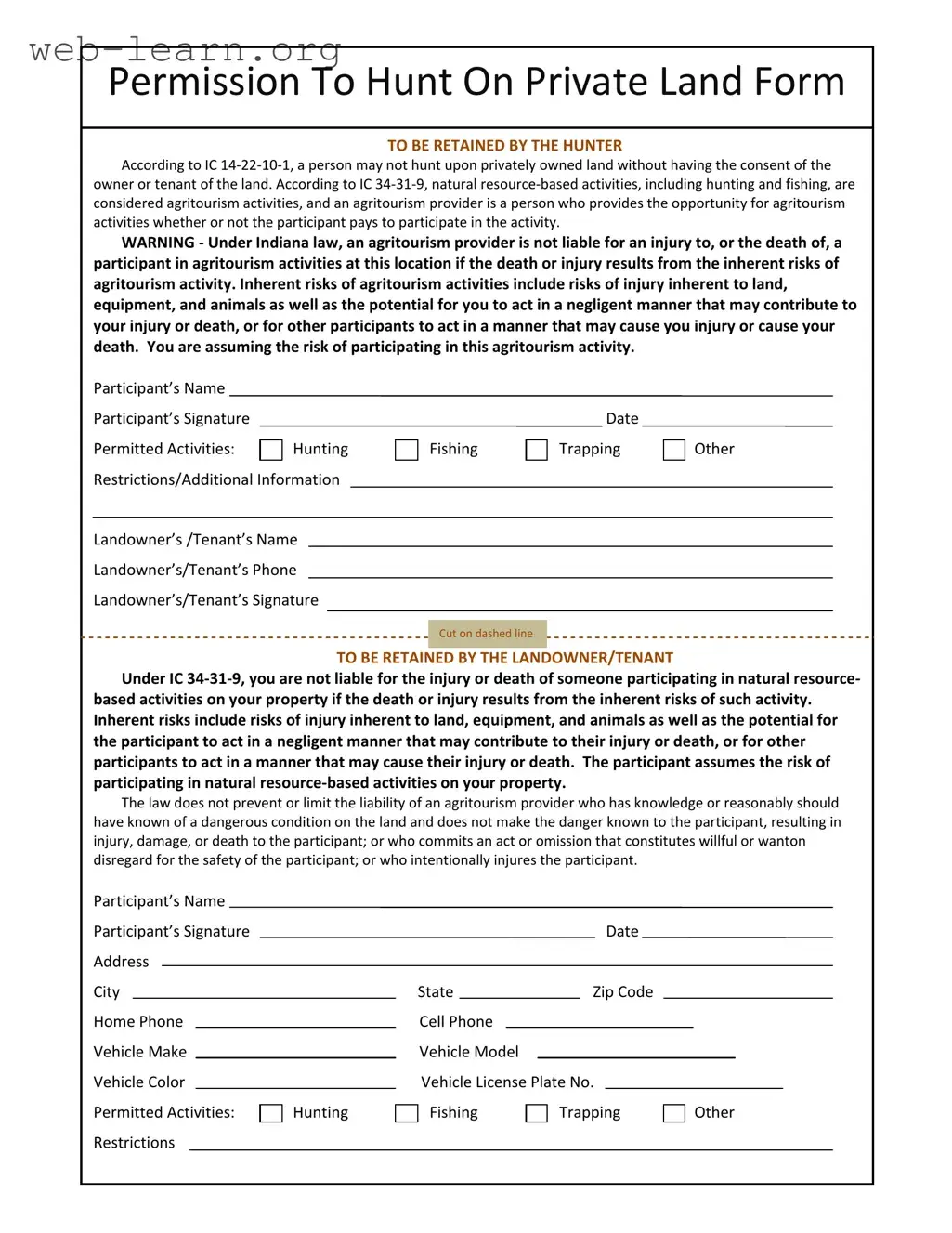
When planning to hunt on private land in Indiana, understanding the Indiana Hunting Permission form is essential. This form serves as a legal document that grants hunters the necessary consent from landowners or tenants, as mandated by state law. It outlines the specific activities permitted, such as hunting, fishing, or trapping, and requires signatures from both the participant and the landowner. The form also includes important warnings regarding liability, emphasizing that agritourism providers are not liable for injuries or deaths resulting from inherent risks associated with these activities. Participants must acknowledge these risks, which include potential hazards from the land, equipment, and animals, as well as the possibility of negligent actions by themselves or others. Additionally, the form captures vital information, including contact details and vehicle descriptions, ensuring clear communication between hunters and landowners. By completing this form, both parties protect their rights and responsibilities while fostering a safe hunting environment.

Permission To Hunt On Private Land Form
TO BE RETAINED BY THE HUNTER
According to IC 14‐22‐10‐1, a person may not hunt upon privately owned land without having the consent of the owner or tenant of the land. According to IC 34‐31‐9, natural resource‐based activities, including hunting and fishing, are considered agritourism activities, and an agritourism provider is a person who provides the opportunity for agritourism activities whether or not the participant pays to participate in the activity.
WARNING ‐ Under Indiana law, an agritourism provider is not liable for an injury to, or the death of, a participant in agritourism activities at this location if the death or injury results from the inherent risks of agritourism activity. Inherent risks of agritourism activities include risks of injury inherent to land, equipment, and animals as well as the potential for you to act in a negligent manner that may contribute to your injury or death, or for other participants to act in a manner that may cause you injury or cause your death. You are assuming the risk of participating in this agritourism activity.
Participant’s Name
Participant’s Signature
Permitted Activities: Hunting Restrictions/Additional Information
Fishing
Date
Trapping
Other
Landowner’s /Tenant’s Name
Landowner’s/Tenant’s Phone
Landowner’s/Tenant’s Signature
Cut on dashed line
TO BE RETAINED BY THE LANDOWNER/TENANT
Under IC 34‐31‐9, you are not liable for the injury or death of someone participating in natural resource‐ based activities on your property if the death or injury results from the inherent risks of such activity. Inherent risks include risks of injury inherent to land, equipment, and animals as well as the potential for the participant to act in a negligent manner that may contribute to their injury or death, or for other participants to act in a manner that may cause their injury or death. The participant assumes the risk of participating in natural resource‐based activities on your property.
The law does not prevent or limit the liability of an agritourism provider who has knowledge or reasonably should have known of a dangerous condition on the land and does not make the danger known to the participant, resulting in injury, damage, or death to the participant; or who commits an act or omission that constitutes willful or wanton disregard for the safety of the participant; or who intentionally injures the participant.
Participant’s Name |
|
|
|
|
|
|
|
|
|
|
|
|
|
|
|
|
|
||||
Participant’s Signature |
|
|
|
|
|
|
|
|
|
|
Date |
|
|
|
|||||||
Address |
|
|
|
|
|
|
|
|
|
|
|
|
|
|
|
|
|
|
|
|
|
|
|
|
|
|
|
|
|
|
|
|
|
|
|
|
|
|
|
|
|
||
City |
|
|
|
|
State |
|
|
|
Zip Code |
|
|
|
|
||||||||
Home Phone |
|
|
|
|
Cell Phone |
|
|
|
|
|
|
|
|
|
|
|
|
||||
Vehicle Make |
|
|
|
|
Vehicle Model |
|
|
|
|
|
|
|
|
|
|
||||||
Vehicle Color |
|
|
|
|
Vehicle License Plate No. |
|
|
|
|
|
|
|
|||||||||
Permitted Activities: |
|
Hunting |
|
Fishing |
|
|
Trapping |
|
|
Other |
|||||||||||
|
|
|
|
|
|||||||||||||||||
Restrictions |
|
|
|
|
|
|
|
|
|
|
|
|
|
|
|
|
|
|
|||
| Fact Name | Description |
|---|---|
| Consent Requirement | According to Indiana Code IC 14-22-10-1, you cannot hunt on private land without the owner's or tenant's permission. |
| Agritourism Definition | Under IC 34-31-9, hunting is classified as an agritourism activity, which involves providing opportunities for such activities, regardless of payment. |
| Liability Disclaimer | Indiana law states that agritourism providers are not liable for injuries or deaths resulting from inherent risks associated with agritourism activities. |
| Assumption of Risk | By participating in hunting or other agritourism activities, you acknowledge and accept the risks involved, including potential negligence. |
Filling out the Indiana Hunting Permission form is a straightforward process that ensures both hunters and landowners are aware of their rights and responsibilities. This form serves as a record of consent from the landowner or tenant, allowing hunters to participate in activities such as hunting, fishing, or trapping on private property. Below are the steps to complete the form accurately.
Once the form is completed, both the hunter and the landowner should retain a copy for their records. This ensures clarity and safety for all parties involved in the hunting activity.
What is the Indiana Hunting Permission form?
The Indiana Hunting Permission form is a legal document that grants permission for individuals to hunt on privately owned land. This form ensures that hunters have the consent of the landowner or tenant, as required by Indiana law. It also outlines the inherent risks associated with hunting and agritourism activities.
Why is this form necessary?
This form is essential because it protects both the hunter and the landowner. It provides legal consent for hunting on private property and helps clarify the responsibilities and risks involved in such activities. Without this permission, hunting on private land is considered illegal under Indiana law.
What information is required on the form?
The form requires several key pieces of information, including:
What are the inherent risks mentioned in the form?
Inherent risks refer to the potential dangers associated with agritourism activities, including hunting. These risks may involve:
What liability protections does the form provide?
The form provides liability protections for landowners and tenants. Under Indiana law, they are not liable for injuries or deaths that result from inherent risks of agritourism activities, as long as they do not knowingly create dangerous conditions or act with willful disregard for the safety of participants.
Can the landowner impose restrictions on the hunting activities?
Yes, landowners can impose specific restrictions on hunting activities. This may include limitations on the types of game that can be hunted, the areas where hunting is permitted, or the times when hunting can occur. It is important for these restrictions to be clearly stated on the form to avoid any misunderstandings.
How long is the permission valid?
The Indiana Hunting Permission form does not specify a time limit for validity. However, it is advisable for both parties to agree on a specific timeframe for the permission, especially if hunting is seasonal. Clear communication can help prevent confusion and ensure that all parties are on the same page.
What should I do if I have questions about the form?
If you have questions about the Indiana Hunting Permission form or the hunting process in general, consider reaching out to a local hunting organization or the Indiana Department of Natural Resources. They can provide guidance and help clarify any concerns you may have regarding hunting laws and permissions.
Completing the Indiana Hunting Permission form accurately is crucial for both the hunter and the landowner. A common mistake arises when individuals fail to provide their full legal name. Using nicknames or incomplete names can lead to confusion and potential legal issues. It is essential that the name matches the identification documents to ensure clarity and accountability.
Another frequent error involves neglecting to specify the permitted activities. The form requires clear identification of what activities are allowed, such as hunting, fishing, or trapping. Omitting this information can create misunderstandings between the landowner and the participant, potentially leading to unauthorized activities on the property.
Additionally, many people overlook the importance of including contact information. Providing a valid phone number is essential for communication. Without this information, landowners may struggle to reach participants in case of emergencies or if there are changes in permissions. This lack of communication can result in dangerous situations.
Lastly, failing to obtain the landowner's signature is a critical mistake. The signature serves as proof of consent and agreement to the terms outlined in the form. Without it, the permission to hunt or engage in other activities on the property is not legally valid. Participants must ensure that all signatures are obtained before proceeding with any activities.
When preparing to hunt in Indiana, it's essential to have the right documentation in place. Along with the Indiana Hunting Permission form, several other forms and documents may be required or beneficial for both hunters and landowners. Here’s a list of these important documents:
Having these documents prepared and readily available can help ensure a safe and enjoyable hunting experience. Always verify the requirements before heading out, as regulations can change and vary by location.
When filling out the Indiana Hunting Permission form, it is essential to follow certain guidelines to ensure clarity and compliance. Here is a list of things you should and shouldn't do:
Many believe that the Indiana Hunting Permission form applies solely to hunting activities. In reality, it covers various agritourism activities, including fishing and trapping. It’s essential to understand that the form is versatile and should be used for any permitted activity on private land.
Some people think that landowners are automatically responsible for any injuries that occur on their property. However, Indiana law states that landowners are not liable for injuries resulting from inherent risks associated with agritourism activities, as long as they do not knowingly create dangerous conditions.
A common belief is that participants cannot be held responsible for their own safety. This is incorrect. By signing the form, participants acknowledge and accept the risks involved in the activities, which include potential injuries from the land, equipment, and other participants.
Some individuals think that completing the form is optional. In fact, it is a legal requirement under Indiana law to obtain permission from the landowner before engaging in any hunting or agritourism activities on private land.
It’s a common misunderstanding that signing the form protects participants from all forms of liability. While it does acknowledge inherent risks, it does not shield participants from injuries caused by negligence or willful disregard for safety by themselves or others.
When filling out and using the Indiana Hunting Permission form, keep the following key takeaways in mind: