For families in Indiana considering homeschooling, the Homeschool Letter of Intent form serves as a crucial first step in the educational journey. This form is a simple yet essential document that notifies the local school district of a family's intention to educate their child at home. It typically includes basic information such as the child's name, age, and the address of the homeschooling family. By submitting this form, parents fulfill a legal requirement while also establishing a clear communication channel with their school district. The form is not only a notification but also a declaration of commitment to provide a quality education tailored to the child's unique needs. Understanding how to properly complete and submit this form can help ensure a smooth transition into homeschooling and pave the way for a fulfilling educational experience.
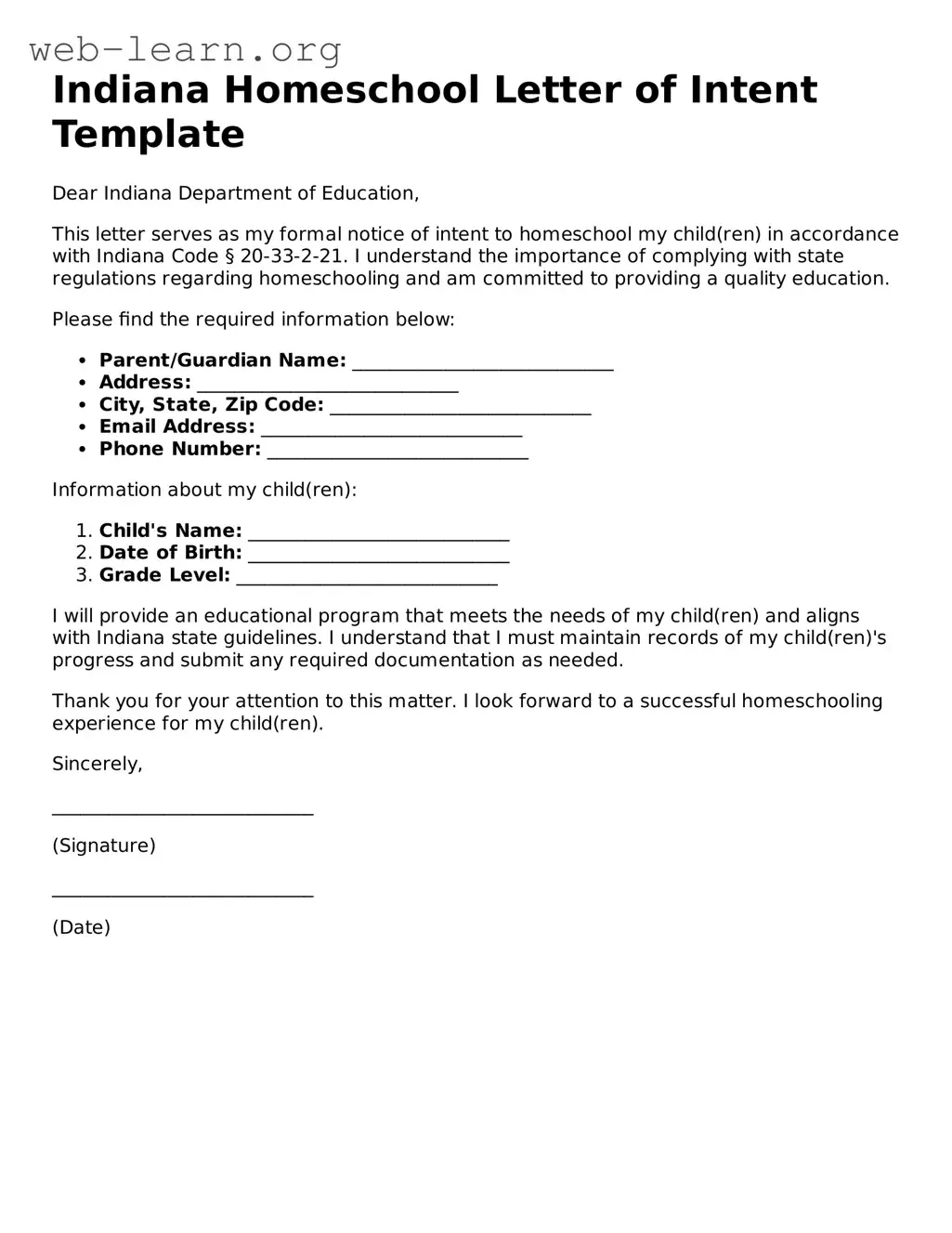
Indiana Homeschool Letter of Intent Template
Dear Indiana Department of Education,
This letter serves as my formal notice of intent to homeschool my child(ren) in accordance with Indiana Code § 20-33-2-21. I understand the importance of complying with state regulations regarding homeschooling and am committed to providing a quality education.
Please find the required information below:
Information about my child(ren):
I will provide an educational program that meets the needs of my child(ren) and aligns with Indiana state guidelines. I understand that I must maintain records of my child(ren)'s progress and submit any required documentation as needed.
Thank you for your attention to this matter. I look forward to a successful homeschooling experience for my child(ren).
Sincerely,
____________________________
(Signature)
____________________________
(Date)
| Fact Name | Description |
|---|---|
| Governing Law | The Indiana homeschool law is governed by Indiana Code 20-33-2-21. |
| Form Requirement | Parents must submit a Letter of Intent to homeschool their child. |
| Submission Timeline | The Letter of Intent must be submitted within 10 days of starting the homeschool program. |
| Recipient of the Form | The form should be sent to the superintendent of the local school district. |
| Information Included | The form must include the child's name, age, and address. |
| Educational Plan | While not required, including a brief educational plan is recommended. |
| Annual Assessment | Parents are encouraged to conduct annual assessments of their child's progress. |
| Record Keeping | Families should maintain records of educational materials and assessments. |
| Notification of Withdrawal | If a child is withdrawn from public school, parents must notify the school. |
Filling out the Indiana Homeschool Letter of Intent form is an important step in starting your homeschooling journey. Once you submit the form, you will be officially notifying the state of your intent to homeschool your child. This is a straightforward process that ensures you meet the necessary requirements.
After submitting your form, keep a copy for your records. You may also want to reach out to your local school district to confirm that they received your letter of intent and to ask any questions you may have about the next steps in your homeschooling journey.
The Indiana Homeschool Letter of Intent is a document that parents or guardians must submit to the local school corporation to formally notify them of their decision to homeschool their children. This letter serves as an official declaration of intent to provide home-based education and is a requirement under Indiana law.
Any parent or guardian who wishes to homeschool a child in Indiana must file this letter. This includes children who are of compulsory school age, typically between 7 and 18 years old. If you are withdrawing a child from a public or private school to homeschool, submitting the letter is essential.
The Letter of Intent must include specific details such as:
Providing accurate and complete information is crucial to ensure compliance with state requirements.
The Letter of Intent should be submitted at the beginning of the homeschooling period. It is advisable to file the letter at least two weeks before starting the homeschooling process. This allows the local school corporation to process the notification and ensures that you meet all legal obligations.
Once the Letter of Intent is submitted, the local school corporation will acknowledge receipt. They may not require any further action from you, as homeschooling in Indiana is largely parent-directed. However, it is wise to keep a copy of the letter for your records, as it serves as proof of your intent to homeschool.
Filling out the Indiana Homeschool Letter of Intent form is an important step for families wishing to educate their children at home. However, several common mistakes can lead to complications or delays in the process. Being aware of these pitfalls can help ensure a smooth submission.
One frequent error is failing to provide complete and accurate information. The form requires specific details about the child, such as their name and age. Omitting any of this information can result in rejection of the application. It is crucial to double-check all entries for accuracy before submission.
Another common mistake is not signing the form. The Indiana Homeschool Letter of Intent must be signed by the parent or guardian. Neglecting to do so can cause significant delays in the processing of the application. Always ensure that the form is signed in the designated area.
Some families mistakenly submit the form after the deadline. Indiana law requires that the Letter of Intent be submitted at least 10 days before the start of the school year. Missing this deadline can lead to complications in starting the homeschooling process. Planning ahead is essential to avoid this issue.
In addition, individuals sometimes fail to keep a copy of the submitted form. It is advisable to retain a copy for personal records. This can be helpful for future reference and can serve as proof of submission if any questions arise later.
Another error involves misunderstanding the requirements for curriculum and instruction. While the form does not require a detailed curriculum plan, parents should be prepared to provide information about their educational approach if requested. Being unprepared can lead to unnecessary questions from the local school district.
Lastly, some people overlook the importance of notifying the local school district about their homeschooling plans. After submitting the Letter of Intent, it is a good practice to inform the district. This helps establish clear communication and ensures that the homeschooling process is recognized officially.
By being mindful of these common mistakes, families can navigate the Indiana Homeschool Letter of Intent form more effectively. Attention to detail and proper planning can make a significant difference in the homeschooling journey.
When families decide to homeschool in Indiana, they often need to complete the Homeschool Letter of Intent form. However, this form is just one part of the process. Other documents can help ensure a smooth homeschooling experience. Here are six important forms and documents that are often used alongside the Indiana Homeschool Letter of Intent.
By preparing these documents, families can create a structured and effective homeschooling environment. Each form plays a role in supporting the educational journey and ensuring compliance with Indiana's homeschooling laws.
When filling out the Indiana Homeschool Letter of Intent form, it’s important to follow certain guidelines to ensure everything goes smoothly. Here’s a list of things you should and shouldn’t do:
When considering homeschooling in Indiana, many families encounter misconceptions about the Homeschool Letter of Intent form. Understanding the facts can help ensure a smooth homeschooling journey. Below are nine common misconceptions clarified.
This is false. Homeschooling is legal in Indiana, and families can educate their children at home by following state guidelines.
In reality, the form is straightforward and requires basic information about your child and educational plans.
Actually, once you submit the form, it remains valid as long as you continue to homeschool. You only need to resubmit if you change your educational approach or if your child changes grade levels.
This is not true. Any child can be homeschooled in Indiana, regardless of their learning needs or background.
While you should have a plan, the form itself does not require a detailed curriculum. General educational goals are sufficient.
Notification is not required before you start homeschooling, but you do need to submit the Letter of Intent to the local school district.
This is a misconception. Families from various backgrounds choose homeschooling for a multitude of reasons, including academic flexibility and personalized learning.
In fact, there are numerous resources, including local support groups, online communities, and educational materials available to homeschooling families.
This is incorrect. Families can choose to return to public school at any time, provided they follow the re-enrollment procedures set by the school district.
By addressing these misconceptions, families can make informed decisions about their homeschooling journey in Indiana.
Filling out the Indiana Homeschool Letter of Intent form is an important step for families who choose to educate their children at home. Here are some key takeaways to keep in mind:
By following these key points, you can navigate the process of homeschooling in Indiana with confidence and clarity.
Do You Get Paid to Home School - Essential for compliance with state homeschooling laws.
Best Homeschool Programs in Alabama - Can be submitted annually to confirm ongoing homeschooling efforts.