The Indiana General Power of Attorney form serves as a crucial legal document that empowers an individual, known as the principal, to designate another person, referred to as the agent, to act on their behalf in various financial and legal matters. This form can cover a wide range of responsibilities, including managing bank accounts, handling real estate transactions, and making investment decisions. It is important to note that the authority granted can be broad or limited, depending on the principal's preferences. The form must be signed by the principal and notarized to ensure its validity. Additionally, the agent is expected to act in the best interest of the principal, maintaining a fiduciary duty throughout their engagement. This document is especially significant for individuals who may face health challenges or anticipate a need for assistance in managing their affairs. Understanding the Indiana General Power of Attorney form is essential for anyone considering this option, as it provides a structured way to ensure that personal and financial matters are handled according to one’s wishes.
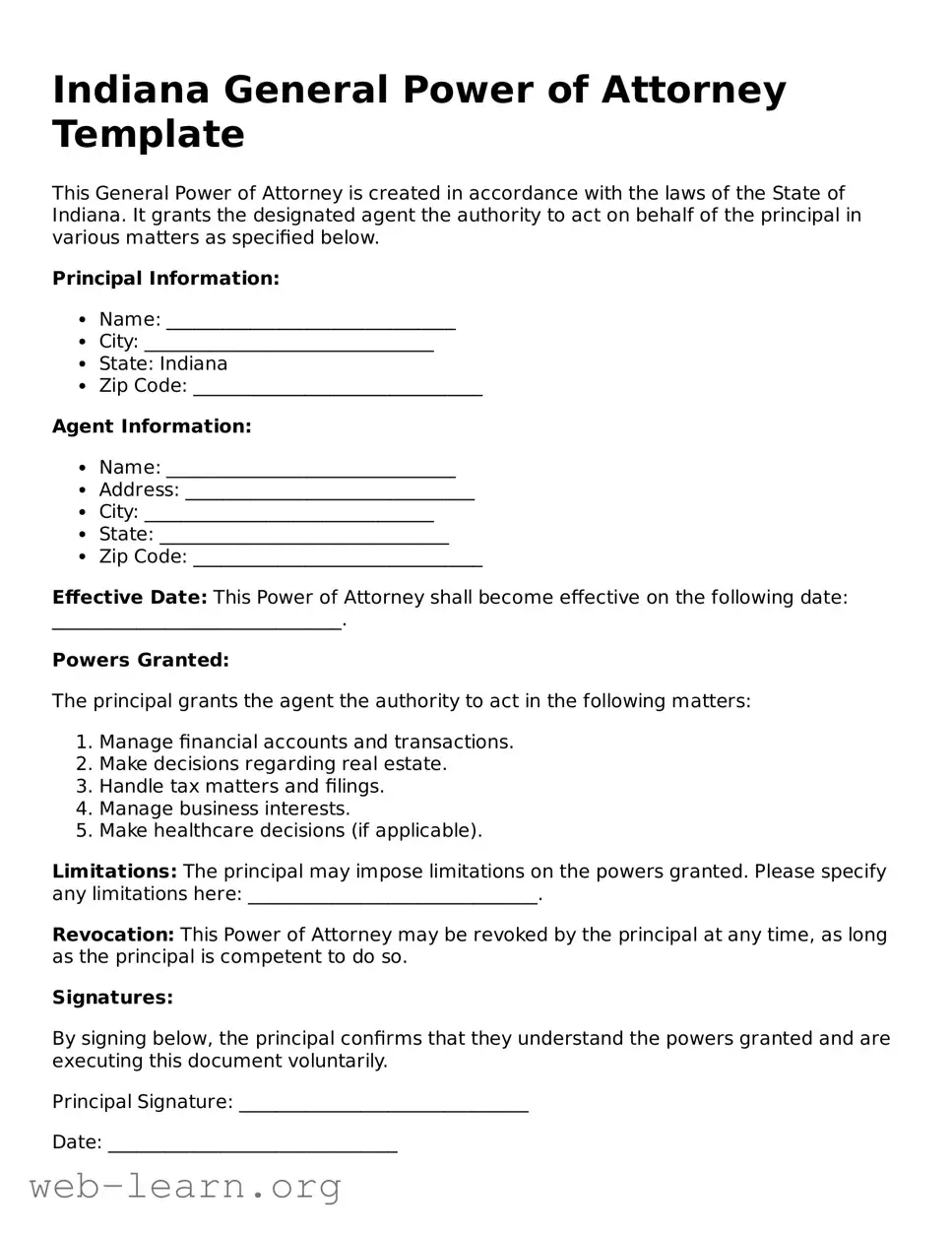
Indiana General Power of Attorney Template
This General Power of Attorney is created in accordance with the laws of the State of Indiana. It grants the designated agent the authority to act on behalf of the principal in various matters as specified below.
Principal Information:
Agent Information:
Effective Date: This Power of Attorney shall become effective on the following date: _______________________________.
Powers Granted:
The principal grants the agent the authority to act in the following matters:
Limitations: The principal may impose limitations on the powers granted. Please specify any limitations here: _______________________________.
Revocation: This Power of Attorney may be revoked by the principal at any time, as long as the principal is competent to do so.
Signatures:
By signing below, the principal confirms that they understand the powers granted and are executing this document voluntarily.
Principal Signature: _______________________________
Date: _______________________________
Agent Signature: _______________________________
Date: _______________________________
Notarization: This document must be notarized to be valid.
State of Indiana
County of _______________________________
Subscribed and sworn to before me on this _____ day of _______________, 20__.
Notary Public: _______________________________
My commission expires: _______________________________
| Fact Name | Details |
|---|---|
| Definition | The Indiana General Power of Attorney form allows a person to appoint someone else to make decisions on their behalf regarding financial and legal matters. |
| Governing Law | This form is governed by Indiana Code Title 30, Article 5, which outlines the laws related to powers of attorney in the state. |
| Durability | The general power of attorney can be durable, meaning it remains effective even if the principal becomes incapacitated, provided it is specified in the document. |
| Revocation | The principal can revoke the power of attorney at any time, as long as they are mentally competent to do so. |
| Notarization | While notarization is not always required, having the document notarized can help ensure its validity and acceptance by third parties. |
Filling out the Indiana General Power of Attorney form is an important step in designating someone to act on your behalf. After completing the form, you will need to sign it in the presence of a notary public. This ensures that the document is legally valid and recognized.
A General Power of Attorney (GPOA) in Indiana is a legal document that allows one person, known as the principal, to grant another person, called the agent or attorney-in-fact, the authority to make decisions and act on their behalf. This authority can cover a wide range of matters, including financial transactions, property management, and legal decisions. The principal retains the right to revoke or change the GPOA at any time, as long as they are mentally competent.
The Indiana General Power of Attorney form typically includes several important components:
A General Power of Attorney can become effective immediately upon signing, or it can be set to activate at a future date or upon the occurrence of a specific event, such as the principal becoming incapacitated. If the principal chooses to have it effective immediately, the agent can start acting on their behalf right away. If it is contingent on a specific event, the principal must clearly define that event in the document.
Yes, a principal can revoke a General Power of Attorney at any time, as long as they are mentally competent. To revoke the GPOA, the principal should provide a written notice of revocation to the agent and any institutions or individuals who may have relied on the original document. It is advisable to also create a new power of attorney if the principal wishes to appoint a different agent.
If the principal becomes incapacitated and the General Power of Attorney was set to take effect immediately, the agent can continue to act on behalf of the principal. However, if the GPOA was designed to activate only upon incapacitation, the agent would need to provide proof of the principal's incapacity to exercise their powers. In either case, it is essential for the principal to discuss their wishes and the powers granted with the agent beforehand to ensure that their intentions are clear.
Filling out the Indiana General Power of Attorney form can be a straightforward process, but many individuals make common mistakes that can lead to complications. One frequent error is not clearly identifying the principal. The principal is the person granting authority. If their name or details are incorrect, it could invalidate the entire document.
Another mistake involves failing to specify the powers granted to the agent. The form should clearly outline what decisions the agent can make on behalf of the principal. Vague language can lead to confusion and disputes later on. It is essential to be precise about the powers, whether they involve financial matters, healthcare decisions, or other specific areas.
People often overlook the importance of signing and dating the document correctly. Both the principal and the agent must sign the form, and it should be dated to reflect when the powers were granted. A missing signature or incorrect date can raise questions about the validity of the authority granted.
Additionally, individuals sometimes forget to have the document notarized. While notarization is not always required, it adds an extra layer of legitimacy. Without a notary's signature, there may be challenges in enforcing the document, especially if it is contested in the future.
Another common error is neglecting to inform the agent about their role and responsibilities. The principal should communicate openly with the agent to ensure they understand the expectations and limitations of their authority. Without this conversation, the agent may act in ways that the principal did not intend.
People also mistakenly assume that a General Power of Attorney remains effective indefinitely. In Indiana, this document can be revoked at any time, and it is important to understand the conditions under which it may cease to be valid. Failing to keep the document updated can lead to unintended consequences.
Lastly, many individuals do not consider the impact of their decisions on family dynamics. Appointing an agent can create tension among family members, especially if there are multiple heirs or potential agents. It is wise to discuss these choices with loved ones to minimize conflict and ensure everyone understands the principal’s wishes.
In the context of estate planning and financial management, the Indiana General Power of Attorney form is often accompanied by several other important documents. These documents serve various purposes, from healthcare decisions to estate management, ensuring that an individual's wishes are respected and their affairs are handled effectively. Below is a list of commonly used forms and documents alongside the General Power of Attorney in Indiana.
Each of these documents plays a vital role in ensuring that an individual's preferences are respected and that their affairs are managed according to their wishes. When used in conjunction with the Indiana General Power of Attorney form, they create a comprehensive framework for both financial and healthcare decision-making.
When filling out the Indiana General Power of Attorney form, it's important to follow specific guidelines to ensure the document is valid and effective. Here are nine things you should and shouldn't do:
Understanding the Indiana General Power of Attorney form is crucial for individuals considering its use. However, several misconceptions exist regarding its purpose and functionality. Below is a list of common misconceptions along with clarifications.
Understanding these misconceptions can help individuals make informed decisions regarding the Indiana General Power of Attorney form.
When considering the Indiana General Power of Attorney form, it's essential to understand its significance and the implications it carries. Here are some key takeaways to keep in mind:
Filling out the Indiana General Power of Attorney form thoughtfully can provide peace of mind, knowing that your affairs will be handled according to your wishes, even if you cannot do so yourself.