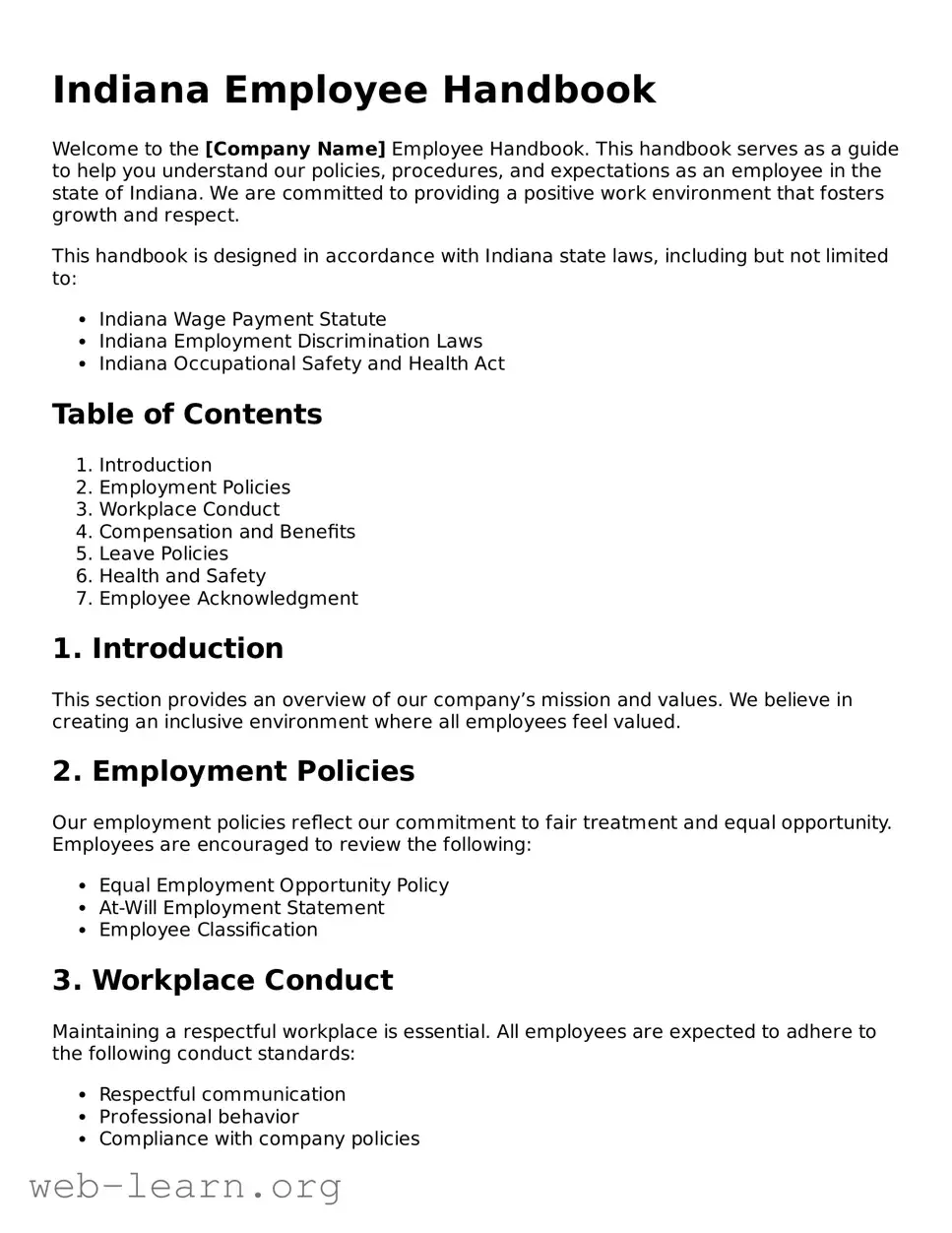
Creating a comprehensive employee handbook is a vital step for any business in Indiana, serving as a cornerstone for effective workplace communication and policy enforcement. This handbook outlines essential company policies, procedures, and expectations, ensuring that both employers and employees are on the same page. It typically includes sections on workplace conduct, attendance policies, benefits, and disciplinary procedures. Additionally, it addresses important legal requirements, such as anti-discrimination laws and workplace safety regulations, providing a framework for a respectful and compliant work environment. By clearly articulating these elements, the Indiana Employee Handbook form not only protects the rights of employees but also helps employers mitigate risks and foster a positive workplace culture. Understanding the key components of this form can empower business owners to create a tailored handbook that meets their unique needs and complies with state regulations.
Indiana Employee Handbook
Welcome to the [Company Name] Employee Handbook. This handbook serves as a guide to help you understand our policies, procedures, and expectations as an employee in the state of Indiana. We are committed to providing a positive work environment that fosters growth and respect.
This handbook is designed in accordance with Indiana state laws, including but not limited to:
Table of Contents
1. Introduction
This section provides an overview of our company’s mission and values. We believe in creating an inclusive environment where all employees feel valued.
2. Employment Policies
Our employment policies reflect our commitment to fair treatment and equal opportunity. Employees are encouraged to review the following:
3. Workplace Conduct
Maintaining a respectful workplace is essential. All employees are expected to adhere to the following conduct standards:
4. Compensation and Benefits
We offer competitive compensation and benefits to support our employees. This includes:
5. Leave Policies
Employees are entitled to various types of leave. Please familiarize yourself with the following:
6. Health and Safety
Your safety is our priority. We comply with all health and safety regulations to ensure a secure workplace. Employees should report any hazards or unsafe conditions immediately.
7. Employee Acknowledgment
All employees are required to acknowledge receipt of this handbook. Please sign and return the acknowledgment form to Human Resources.
Thank you for being a part of [Company Name]. We look forward to a successful partnership.
| Fact Name | Description |
|---|---|
| Purpose | The Indiana Employee Handbook serves as a guide for employees, outlining workplace policies, procedures, and expectations. |
| Governing Laws | This handbook is governed by Indiana state employment laws, including the Indiana Code Title 22, which covers labor and employment regulations. |
| Mandatory Policies | Indiana law requires that certain policies, such as anti-discrimination and harassment policies, be included in the handbook. |
| Employee Acknowledgment | Employees should sign an acknowledgment form to confirm they have received and understood the handbook. |
| Updates | Regular updates to the handbook are essential to ensure compliance with changing laws and organizational policies. |
Completing the Indiana Employee Handbook form is an important step in ensuring that you understand your rights and responsibilities as an employee. Following these steps will help you fill out the form accurately and efficiently.
What is the Indiana Employee Handbook form?
The Indiana Employee Handbook form is a document that outlines the policies, procedures, and expectations of an employer regarding their employees. It serves as a guide for employees to understand their rights and responsibilities within the workplace.
Why is it important to have an Employee Handbook?
An Employee Handbook is crucial for several reasons:
What should be included in the Employee Handbook?
The Employee Handbook should cover various topics, including:
How often should the Employee Handbook be updated?
It is advisable to review and update the Employee Handbook at least once a year. Changes in laws, company policies, or workplace culture may necessitate updates. Regular reviews help ensure that the handbook remains relevant and compliant with current regulations.
Do employees need to sign an acknowledgment of the Employee Handbook?
Yes, it is recommended that employees sign an acknowledgment form after receiving the Employee Handbook. This signature indicates that they have read and understood the policies outlined in the handbook. It also provides a record for the employer that the employee has been informed of the company’s policies.
Can the Employee Handbook be used in legal situations?
Yes, the Employee Handbook can be used in legal situations. If there is a dispute regarding employment practices, the handbook may serve as evidence of the company’s policies and the expectations set for employees. However, it is essential that the handbook is clear and legally compliant to be effective in such situations.
Is it necessary to consult a lawyer when creating an Employee Handbook?
While it is not strictly necessary, consulting a lawyer is highly recommended. A legal professional can help ensure that the handbook complies with federal and state laws, minimizing the risk of legal issues in the future. They can also provide guidance on best practices for your specific industry.
Filling out the Indiana Employee Handbook form can be a straightforward process, but many individuals encounter common mistakes that can lead to confusion or delays. One frequent error is failing to read the instructions thoroughly. Each section of the form has specific requirements, and overlooking these can result in incomplete or incorrect submissions.
Another common mistake is providing inaccurate personal information. This includes errors in names, addresses, or contact details. Such inaccuracies can complicate communication and may hinder the processing of important documents related to employment.
Some individuals neglect to sign and date the form. A signature indicates that the employee has read and understood the handbook, while a date provides a clear timeline of when the acknowledgment occurred. Omitting either can render the form invalid.
Additionally, employees sometimes skip sections that they believe do not apply to them. However, every part of the form is designed to ensure that all employees understand the policies. Skipping sections can lead to misunderstandings about workplace expectations.
Another mistake is failing to ask questions when uncertain about the content. Employees may hesitate to seek clarification, but doing so is crucial. Understanding the handbook's policies is essential for maintaining a positive work environment.
Some individuals also submit the form without reviewing it for errors. Typos or unclear handwriting can lead to misinterpretations of the information provided. Taking a moment to proofread can help avoid these issues.
Moreover, individuals may not keep a copy of the completed form for their records. Retaining a copy can be beneficial for future reference, especially if questions arise about the handbook's policies.
Finally, a common oversight is not updating the form when personal circumstances change. For example, a change in address or contact information should be reported promptly. Keeping the form current ensures that communication remains effective.
When developing an Indiana Employee Handbook, several other forms and documents can complement it, ensuring that both employers and employees have a clear understanding of workplace policies and expectations. These documents help create a cohesive framework for managing workplace relationships and compliance with state and federal laws.
Utilizing these additional forms and documents alongside the Indiana Employee Handbook can significantly enhance communication and clarity within the workplace. They create a comprehensive approach to managing employee relations and ensuring compliance with applicable laws and regulations.
When filling out the Indiana Employee Handbook form, it is essential to approach the task with care and attention. Below is a list of things you should and shouldn't do to ensure that the process goes smoothly.
By following these guidelines, you can ensure that your submission is both thorough and compliant with the requirements set forth in the Indiana Employee Handbook.
Here are five common misconceptions about the Indiana Employee Handbook form:
Many people believe that having an employee handbook is optional. However, while it is not legally mandated in Indiana, having one can help clarify policies and protect both the employer and employees.
Some assume that once an employee handbook is created, it does not need to be updated. In reality, policies and laws can change, so it is important to review and revise the handbook regularly.
People often think that employee handbooks are interchangeable. However, each handbook should be tailored to fit the specific needs and culture of the organization.
Some believe that employees will not find the handbook useful. In fact, it serves as a valuable resource for understanding workplace expectations and procedures.
Many think that the employee handbook is solely about disciplinary measures. However, it should also include information on benefits, workplace conduct, and other essential policies.
When filling out and using the Indiana Employee Handbook form, it is important to keep a few key points in mind. This form serves as a vital resource for both employers and employees, ensuring that everyone understands workplace policies and expectations.
By following these guidelines, both employers and employees can benefit from a well-structured employee handbook that promotes a positive work environment.