Homepage Attorney-Approved Power of Attorney Template Attorney-Approved Durable Power of Attorney Template Attorney-Approved Durable Power of Attorney Document for the State of Indiana
Outline

The Indiana Durable Power of Attorney form is an essential legal document that allows individuals to designate someone they trust to make decisions on their behalf in the event they become incapacitated. This form is particularly important because it remains effective even if the individual becomes unable to manage their affairs due to illness, injury, or other reasons. Key aspects of the form include the ability to specify the powers granted to the agent, which can range from handling financial matters to making healthcare decisions. Additionally, it is crucial for the principal to choose an agent who is reliable and understands their wishes, as this person will have significant authority over important aspects of their life. The form must be properly executed, including signatures and, in some cases, notarization, to ensure it holds legal weight. Understanding the implications of this document and the responsibilities it entails can help individuals make informed decisions about their future and the care they wish to receive.

Sample - Indiana Durable Power of Attorney Form

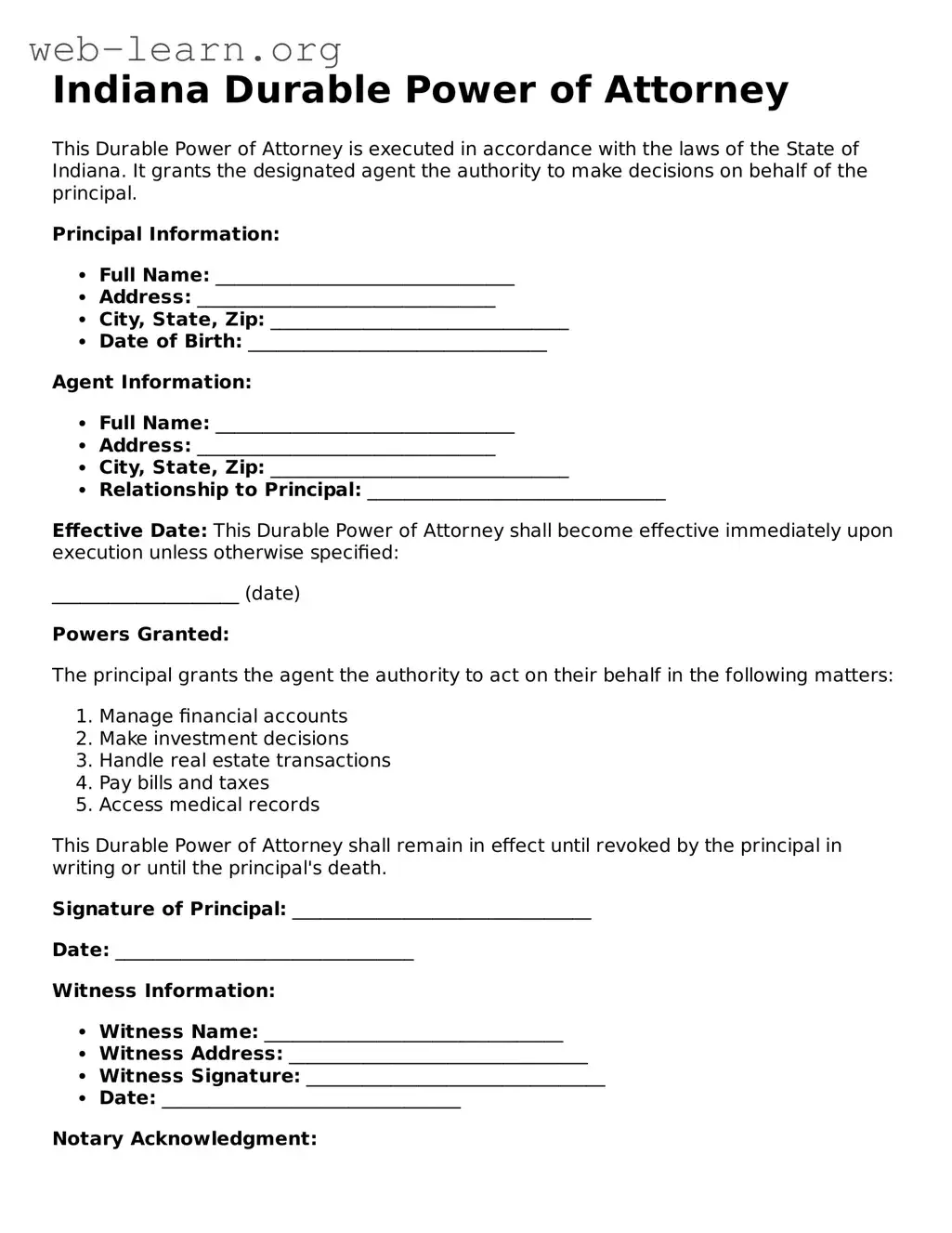
Indiana Durable Power of Attorney

This Durable Power of Attorney is executed in accordance with the laws of the State of Indiana. It grants the designated agent the authority to make decisions on behalf of the principal.

Principal Information:

  • Full Name: ________________________________
  • Address: ________________________________
  • City, State, Zip: ________________________________
  • Date of Birth: ________________________________

Agent Information:

  • Full Name: ________________________________
  • Address: ________________________________
  • City, State, Zip: ________________________________
  • Relationship to Principal: ________________________________

Effective Date: This Durable Power of Attorney shall become effective immediately upon execution unless otherwise specified:

____________________ (date)

Powers Granted:

The principal grants the agent the authority to act on their behalf in the following matters:

  1. Manage financial accounts
  2. Make investment decisions
  3. Handle real estate transactions
  4. Pay bills and taxes
  5. Access medical records

This Durable Power of Attorney shall remain in effect until revoked by the principal in writing or until the principal's death.

Signature of Principal: ________________________________

Date: ________________________________

Witness Information:

  • Witness Name: ________________________________
  • Witness Address: ________________________________
  • Witness Signature: ________________________________
  • Date: ________________________________

Notary Acknowledgment:

State of Indiana, County of ________________

Subscribed and sworn before me on this _____ day of ____________, 20__.

Notary Public Signature: ________________________________

My Commission Expires: ________________________________

File Characteristics

Fact Name Details
Definition A Durable Power of Attorney allows an individual to appoint someone to make decisions on their behalf, even if they become incapacitated.
Governing Law The Indiana Durable Power of Attorney is governed by Indiana Code § 30-5-1-1 et seq.
Durability This type of power of attorney remains effective even if the principal becomes mentally or physically incapacitated.
Principal and Agent The person creating the document is the principal, while the person designated to act is the agent or attorney-in-fact.
Limitations While the agent can make many decisions, certain actions, like altering a will, may be restricted.
Revocation The principal can revoke the Durable Power of Attorney at any time, as long as they are mentally competent.
Signing Requirements The form must be signed by the principal and acknowledged by a notary public to be valid in Indiana.

Detailed Guide for Filling Out Indiana Durable Power of Attorney

Filling out the Indiana Durable Power of Attorney form is a straightforward process. After completing the form, you will need to ensure that it is signed and witnessed properly to be legally valid. Follow these steps to fill out the form accurately.

  1. Download the Indiana Durable Power of Attorney form from a reliable source or obtain a physical copy.
  2. Begin by entering your name and address in the designated sections. This identifies you as the principal.
  3. Clearly name the person you are appointing as your attorney-in-fact. Include their full name and address.
  4. Specify the powers you wish to grant your attorney-in-fact. You can choose general powers or limit them to specific tasks.
  5. Indicate the effective date of the power of attorney. You can choose to make it effective immediately or upon a certain event, like your incapacity.
  6. Sign and date the form in the presence of a notary public. This step is crucial for the validity of the document.
  7. Have at least one witness sign the form. Ensure that the witness is not the person you are appointing as your attorney-in-fact.
  8. Make copies of the completed form for your records and to provide to your attorney-in-fact and any relevant institutions.

Obtain Answers on Indiana Durable Power of Attorney

  1. What is a Durable Power of Attorney in Indiana?

    A Durable Power of Attorney (DPOA) in Indiana is a legal document that allows an individual, known as the principal, to designate another person, referred to as the agent, to make financial and legal decisions on their behalf. The key feature of a DPOA is that it remains effective even if the principal becomes incapacitated.

  2. What are the benefits of having a Durable Power of Attorney?

    Having a DPOA provides several advantages:

    • It ensures that someone you trust can manage your affairs if you become unable to do so.
    • It can help avoid the need for a court-appointed guardian, which can be a lengthy and costly process.
    • It allows for specific instructions regarding the scope of authority granted to the agent.
  3. Who can be an agent under a Durable Power of Attorney?

    In Indiana, the agent can be any competent adult, including family members, friends, or professionals. It is crucial to choose someone you trust, as they will have significant control over your financial and legal matters.

  4. How does one create a Durable Power of Attorney in Indiana?

    To create a DPOA in Indiana, follow these steps:

    • Obtain a Durable Power of Attorney form. These forms can often be found online or through legal offices.
    • Fill out the form, specifying the powers granted to the agent.
    • Sign the document in the presence of a notary public.
  5. Can I revoke a Durable Power of Attorney?

    Yes, you can revoke a DPOA at any time as long as you are mentally competent. To do this, you must create a written revocation notice and notify your agent. It is also wise to inform any institutions or individuals who may have a copy of the original DPOA.

  6. What powers can I grant to my agent?

    You can grant a wide range of powers to your agent, including:

    • Managing bank accounts and investments.
    • Handling real estate transactions.
    • Paying bills and managing debts.
    • Making legal decisions on your behalf.

    However, you can also limit the powers granted if you wish.

  7. Does a Durable Power of Attorney need to be filed with the court?

    No, a DPOA does not need to be filed with the court in Indiana. It is a private document. However, it is advisable to keep copies in a safe place and provide them to your agent and any relevant financial institutions.

  8. What happens if I do not have a Durable Power of Attorney?

    If you do not have a DPOA and become incapacitated, a court may need to appoint a guardian to manage your affairs. This process can be time-consuming and may not align with your wishes, making it essential to consider establishing a DPOA while you are still able to do so.

Common mistakes

Filling out the Indiana Durable Power of Attorney form can be straightforward, but many people make mistakes that can lead to complications later. One common error is failing to specify the powers granted to the agent. It's essential to clearly outline what decisions the agent can make on your behalf. Without this clarity, your agent may not be able to act in your best interest when needed.

Another mistake is not signing the document in the presence of a notary. Indiana law requires that the Durable Power of Attorney be notarized for it to be valid. Skipping this step can render the document ineffective, leaving your wishes unfulfilled. Always ensure that you follow the proper signing and witnessing requirements.

People often overlook the importance of updating the form. Life changes such as marriage, divorce, or the death of the appointed agent can affect your Durable Power of Attorney. If you don’t update the form to reflect these changes, it could lead to confusion or disputes about who has the authority to act on your behalf.

Another frequent mistake is not discussing the role with the chosen agent beforehand. It’s vital to have a conversation with the person you intend to appoint. They should understand their responsibilities and be willing to take on this important role. Without this discussion, your agent may be caught off guard when the time comes for them to act.

Lastly, some individuals make the mistake of using outdated forms. Laws can change, and using an old version of the Durable Power of Attorney form may not comply with current regulations. Always ensure you are using the most recent version of the form to avoid any legal issues down the line.

Documents used along the form

A Durable Power of Attorney (DPOA) is an important document that allows someone to make decisions on your behalf if you become unable to do so. However, there are several other forms and documents that are often used in conjunction with a DPOA to ensure comprehensive planning and protection of your interests. Here are some commonly associated documents:

  • Living Will: This document outlines your wishes regarding medical treatment and end-of-life care. It helps guide your healthcare providers and loved ones when you cannot communicate your preferences.
  • Healthcare Power of Attorney: Similar to a DPOA, this document specifically grants someone the authority to make healthcare decisions for you. It is particularly useful if you want to designate a trusted individual to handle medical matters.
  • Will: A will details how you want your assets distributed after your death. It can also name guardians for minor children and specify funeral arrangements.
  • Trust: A trust can hold assets for your benefit or the benefit of others. It helps avoid probate and can provide more control over when and how your assets are distributed.
  • Advance Directive: This document combines elements of a living will and a healthcare power of attorney. It provides instructions for medical care and appoints someone to make decisions on your behalf.
  • Financial Power of Attorney: This form allows you to designate someone to manage your financial affairs, including paying bills, managing investments, and handling real estate transactions.

These documents work together to ensure that your wishes are respected and that your affairs are managed according to your preferences. It’s important to consider your unique situation and consult with a professional to determine which documents are right for you.

Similar forms

  • General Power of Attorney: This document grants broad authority to an agent to act on behalf of the principal. Like a Durable Power of Attorney, it allows the agent to make financial and legal decisions, but it typically becomes invalid if the principal becomes incapacitated.
  • Healthcare Power of Attorney: This form specifically designates an individual to make medical decisions for the principal if they are unable to do so. It serves a similar purpose as the Durable Power of Attorney, focusing on health-related matters rather than financial ones.
  • Living Will: While not a power of attorney, a living will outlines the principal's wishes regarding medical treatment and end-of-life care. It complements the Healthcare Power of Attorney by providing guidance to the appointed agent.
  • Financial Power of Attorney: This document allows an agent to handle financial matters on behalf of the principal. It can be durable or non-durable, but when it is durable, it remains effective even if the principal becomes incapacitated, similar to a Durable Power of Attorney.
  • Revocable Trust: A revocable trust allows the principal to manage their assets during their lifetime and designate beneficiaries for after their death. While it serves a different function, both documents facilitate the management of the principal's affairs and can be altered or revoked.
  • Advance Healthcare Directive: This document combines elements of a Healthcare Power of Attorney and a living will. It provides both the designation of a healthcare agent and the principal's specific wishes regarding medical treatment, ensuring that their preferences are respected.

Dos and Don'ts

When filling out the Indiana Durable Power of Attorney form, it’s important to approach the process with care. Here are some key do's and don'ts to keep in mind:

  • Do ensure that you understand the powers you are granting. This includes knowing what decisions your agent can make on your behalf.
  • Do choose a trustworthy agent. This person will have significant authority, so select someone who is responsible and reliable.
  • Don't leave sections of the form blank. Every part of the form should be completed to avoid any confusion or legal issues later.
  • Don't rush the process. Take your time to review the document thoroughly before signing to ensure everything is accurate.

Misconceptions

Understanding the Indiana Durable Power of Attorney form is essential for anyone looking to plan for the future. However, several misconceptions often arise. Here are ten common misunderstandings, along with clarifications to help you navigate this important legal document.

  1. It only applies to financial matters. Many people believe that a Durable Power of Attorney is limited to financial decisions. In reality, it can also cover healthcare decisions if specified.
  2. It becomes effective only when I am incapacitated. This is not always true. A Durable Power of Attorney can be set up to be effective immediately or only upon incapacitation, depending on your preferences.
  3. Anyone can be my agent. While you can choose almost anyone, it is advisable to select someone trustworthy and capable of making decisions on your behalf.
  4. I can’t change my Durable Power of Attorney once it’s signed. This is a misconception. You can revoke or modify your Durable Power of Attorney at any time, as long as you are competent to do so.
  5. My agent can do anything they want with my assets. Your agent must act in your best interest and follow the guidelines set forth in the document. They are not free to act outside of those parameters.
  6. It’s only necessary for older individuals. Many believe that only seniors need a Durable Power of Attorney. However, unexpected events can happen at any age, making this document important for everyone.
  7. It’s the same as a regular Power of Attorney. While both documents grant authority to an agent, a Durable Power of Attorney remains effective even if you become incapacitated, unlike a regular Power of Attorney.
  8. My family will automatically make decisions for me if I can’t. Without a Durable Power of Attorney, your family may have to go through a lengthy court process to gain authority to make decisions on your behalf.
  9. It’s too complicated to create. While legal documents can seem daunting, many resources and templates are available to help you create a Durable Power of Attorney that meets your needs.
  10. Once I create it, I don’t need to think about it again. Life changes, and so may your needs. It’s important to review and update your Durable Power of Attorney periodically to ensure it still reflects your wishes.

Addressing these misconceptions can help you make informed decisions about your future and ensure that your wishes are respected when it matters most.

Key takeaways

When filling out and using the Indiana Durable Power of Attorney form, keep these key takeaways in mind:

  • Choose a trusted agent. Your agent will make decisions on your behalf, so select someone you trust completely.
  • Be clear about your wishes. Clearly outline the powers you want to grant to your agent. This can include financial decisions, medical care, and more.
  • Sign and date the form. Ensure you sign the document in front of a notary public. This adds an extra layer of validity.
  • Keep copies. After completing the form, make several copies. Share them with your agent and any relevant institutions.
  • Review regularly. Life changes, so review your Durable Power of Attorney periodically to ensure it still reflects your wishes.