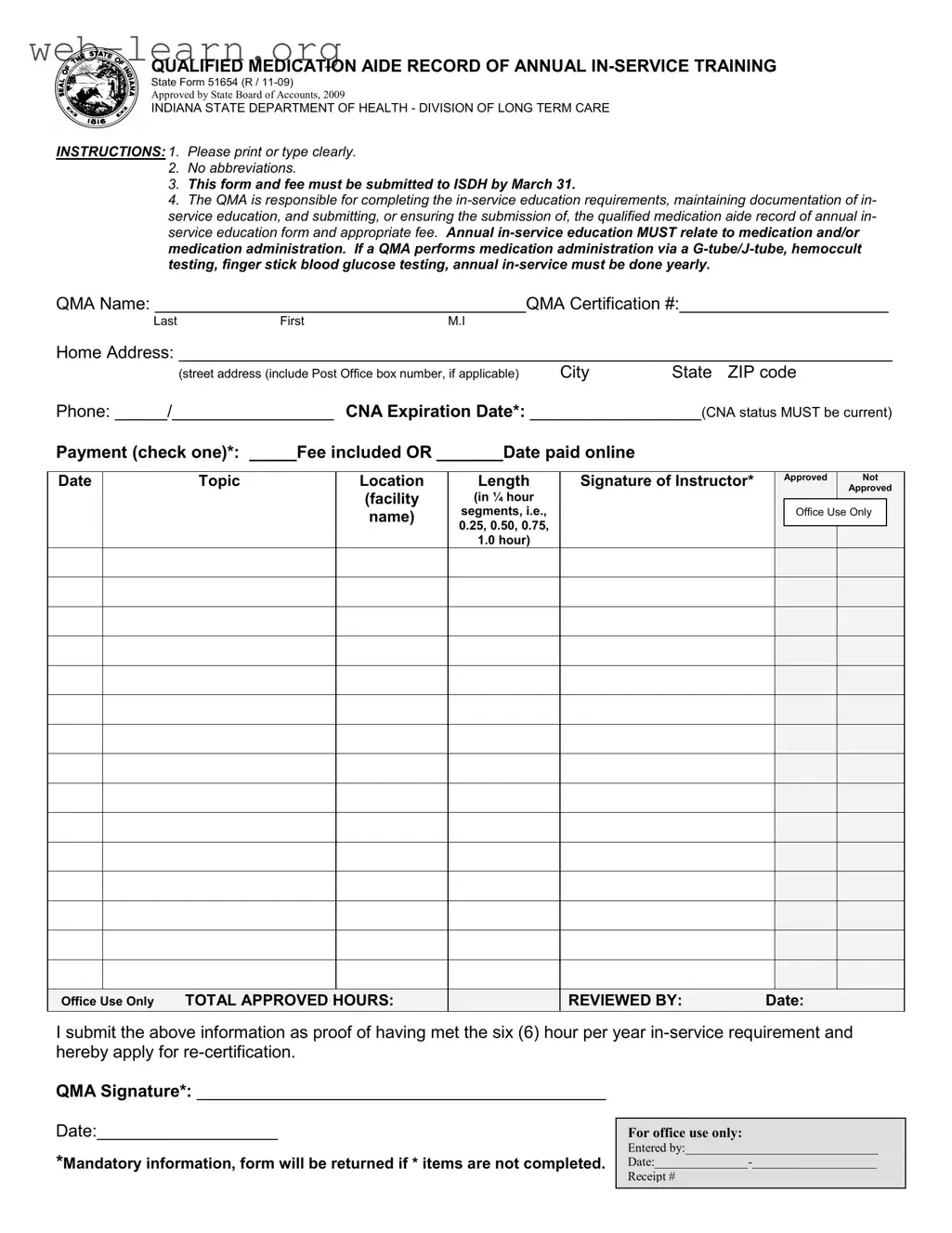
The Indiana Department Annual Inservice form, known as the Qualified Medication Aide Record of Annual In-Service Training, plays a crucial role in maintaining the standards of care provided by Qualified Medication Aides (QMAs). This form is not just a piece of paperwork; it is a vital tool that ensures QMAs complete their annual in-service education requirements. Each QMA must document a minimum of six hours of training related to medication administration every year, which is essential for their certification renewal. The form requires personal information, such as the QMA's name, certification number, and contact details, along with a record of the training completed, including topics covered, duration, and the instructor's signature. It’s important to note that the completed form, along with a fee, must be submitted to the Indiana State Department of Health by March 31 each year. This process not only helps QMAs stay current with best practices in medication administration but also safeguards the health and well-being of the individuals they serve. Failure to adhere to these requirements can lead to significant consequences, including removal from the QMA registry, which necessitates additional steps for reinstatement. Understanding the importance of this form and the associated requirements is essential for all QMAs looking to maintain their certification and provide the highest level of care.
QUALIFIED MEDICATION AIDE RECORD OF ANNUAL
State Form 51654 (R /
Approved by State Board of Accounts, 2009
INDIANA STATE DEPARTMENT OF HEALTH - DIVISION OF LONG TERM CARE
INSTRUCTIONS: 1. Please print or type clearly.
2.No abbreviations.
3.This form and fee must be submitted to ISDH by March 31.
4.The QMA is responsible for completing the
QMA Name: _______________________________________QMA Certification #:______________________
LastFirstM.I
Home Address: ___________________________________________________________________________
(street address (include Post Office box number, if applicable) City State ZIP code
Phone: __ ___/_________________ CNA Expiration Date*: __________________(CNA status MUST be current)
Payment (check one)*: _____Fee included OR _______Date paid online
Date
Topic
Location (facility name)
Length
(in ¼ hour
segments, i.e., 0.25, 0.50, 0.75, 1.0 hour)
Signature of Instructor*
|
Approved |
|
Not |
|
|
|
|
Approved |
|
|
|
|
|
|
Office Use Only
|
|
|
|
|
|
|
|
|
|
|
|
|
|
|
|
|
|
|
|
|
|
|
|
|
|
|
|
|
|
|
|
|
|
|
|
|
|
|
|
|
|
|
|
|
|
|
|
|
|
|
|
|
|
|
|
|
|
|
|
|
|
|
|
|
|
|
|
|
|
|
|
|
|
|
|
|
|
|
|
|
|
|
|
|
|
|
|
|
|
|
Office Use Only TOTAL APPROVED HOURS: |
|
REVIEWED BY: |
Date: |
|
|
|
|
|
|
|
I submit the above information as proof of having met the six (6) hour per year
QMA Signature*: ___________________________________________
Date:___________________
*Mandatory information, form will be returned if * items are not completed.
For office use only:
Entered by:_______________________________
Receipt #
IMPORTANT NOTICE
CERTIFICATION/RECERTIFICATION/REINSTATEMENT and
QUALIFIED MEDICATION AIDE (QMA)
Effective January 1, 2005, the QMA certification process and
1.Be certified by the Indiana State Department of Health every year;
2.Obtain a minimum of six (6) hours per year of
3.Submit appropriate fee to Indiana State Department of Health with recertification request.
RECERTIFICATION:
At least 30 days prior to the expiration of the certificate, the individual must:
1.obtain a minimum of six (6) hours per year of annual
2.submit to the Indiana State Department of Health a qualified medication aide record of annual
3.submit to the ISDH the appropriate fee.
The QMA is responsible for completing the
REINSTATEMENT:
If the recertification fees and/or
1.complete an ISDH approved QMA course;
2.submit to the testing entity an application approved by the ISDH;
3.pass the written competency test in three (3) or fewer attempts with a passing score of 80%.
Annual
1.medication administration via
2.hemoccult testing;
3.finger stick blood glucose testing (specific to the glucose meter used).
QMA certificates are effective upon issue and expire on March 31 of the next year. The annual
Qualified Medication Aide Record of Annual
Indiana State Department of Health
Cashier’s Office
PO Box 7236
Indianapolis, IN
Failure to submit certification in a timely manner may result in additional fees or removal from the QMA registry. (Removal from the registry will require completion of a QMA course and passing of the QMA competency test for re- instatement).
If you have additional questions, please contact Gina Berkshire at [email protected] or
or Nancy Gilbert at [email protected] or
| Fact Name | Details |
|---|---|
| Form Title | Qualified Medication Aide Record of Annual In-Service Training |
| Governing Law | Indiana Administrative Code 412 IAC 2-1-10 |
| Annual Requirement | QMAs must complete a minimum of six hours of in-service education each year. |
| Submission Deadline | The form and fee must be submitted to the Indiana State Department of Health by March 31. |
Completing the Indiana Department Annual Inservice form is an important step for Qualified Medication Aides (QMAs) to maintain their certification. This form must be filled out accurately and submitted on time to ensure compliance with state regulations. Below are the steps to guide you through the process of filling out the form.
After submitting the form, keep a copy for your records. It's essential to ensure that all information is correct and complete to avoid any delays or issues with your certification. If you have questions, reach out to the contacts provided for assistance.
What is the purpose of the Indiana Department Annual Inservice form?
The Indiana Department Annual Inservice form, officially known as the Qualified Medication Aide Record of Annual In-service Training, is designed to document the completion of required annual in-service education for Qualified Medication Aides (QMAs). Each year, QMAs must complete at least six hours of training focused on medication administration and related topics to maintain their certification. This form serves as proof of that training and must be submitted to the Indiana State Department of Health (ISDH) along with the appropriate fee.
What are the key deadlines associated with this form?
The completed form and the associated fee must be submitted to the ISDH by March 31 each year. Additionally, the in-service education requirement period begins on March 1 and ends on the last day of February the following year. This timeline is crucial for ensuring that QMAs remain compliant and avoid any penalties, including potential removal from the QMA registry.
What happens if I miss the deadline for submitting my form?
If the form and fee are submitted after the deadline of March 31, the individual may incur additional fees or risk removal from the QMA registry. If removed, the individual must complete an ISDH-approved QMA course and pass the competency test to regain their certification. It is essential to stay on top of deadlines to avoid these complications.
How do I ensure my in-service education meets the requirements?
To meet the in-service education requirements, the training must be directly related to medication administration. This includes topics such as:
QMAs are responsible for maintaining documentation of their training and ensuring that the training aligns with these guidelines. Always consult with your facility's policies to confirm that your training meets the necessary criteria.
Completing the Indiana Department Annual Inservice form requires attention to detail. One common mistake is failing to print or type clearly. The instructions specify that clarity is essential for processing the form. Illegible handwriting or unclear typing can lead to delays or even rejection of the submission. Ensuring that all information is easily readable is crucial for the form's acceptance.
Another frequent error involves the use of abbreviations. The guidelines explicitly state that no abbreviations should be used. This rule is in place to avoid confusion and misinterpretation of the information provided. When abbreviations are used, it can hinder the understanding of the qualifications or training being reported, potentially impacting the certification process.
Timeliness is also a critical factor. Submitting the form and payment after the March 31 deadline is a mistake that can have significant consequences. If the form is submitted late, the individual may face additional fees or removal from the QMA registry. Adhering to the submission deadline is essential to maintain certification and avoid unnecessary complications.
Lastly, incomplete mandatory information is a common oversight. The form requires specific details, such as the QMA signature and certification number. If any of these items are left blank, the form will be returned, causing delays in the certification process. It is imperative to double-check that all required fields are filled out completely before submission.
When working with the Indiana Department Annual Inservice form, several other documents and forms are commonly required to ensure compliance with state regulations. Each of these documents plays a vital role in the certification and training process for Qualified Medication Aides (QMAs). Below is a list of these essential forms, along with a brief description of each.
Each of these documents complements the Indiana Department Annual Inservice form, creating a comprehensive system for tracking the education and certification of QMAs. Proper documentation not only helps maintain compliance with state regulations but also ensures that QMAs are well-prepared to provide safe and effective medication administration in their roles.
The Indiana Department Annual Inservice form shares similarities with several other important documents related to healthcare training and certification. Here’s a list of nine documents that are comparable, along with a brief explanation of how they are similar:
When filling out the Indiana Department Annual Inservice form, it is essential to follow specific guidelines to ensure that your submission is complete and accepted. Here are some important dos and don'ts to consider:
By adhering to these guidelines, you can facilitate a smooth process for your annual in-service education submission.
The form and fee must be submitted to the Indiana State Department of Health by March 31 each year. Late submissions may incur additional fees or result in removal from the QMA registry.
Each Qualified Medication Aide (QMA) must complete a minimum of six hours of in-service education every year to maintain certification.
Annual in-service education must specifically relate to medication and/or medication administration. This ensures that QMAs remain knowledgeable about their responsibilities.
QMAs are responsible for maintaining documentation of their in-service education. This documentation must be submitted with the Annual Inservice form.
The form must be submitted along with the appropriate fee. Failure to include payment will result in the form being returned.
If the in-service education form and fees are received more than 91 days after the certification expiration, the individual will be removed from the QMA registry and must complete additional steps for reinstatement.
Key Takeaways for Filling Out the Indiana Department Annual Inservice Form: