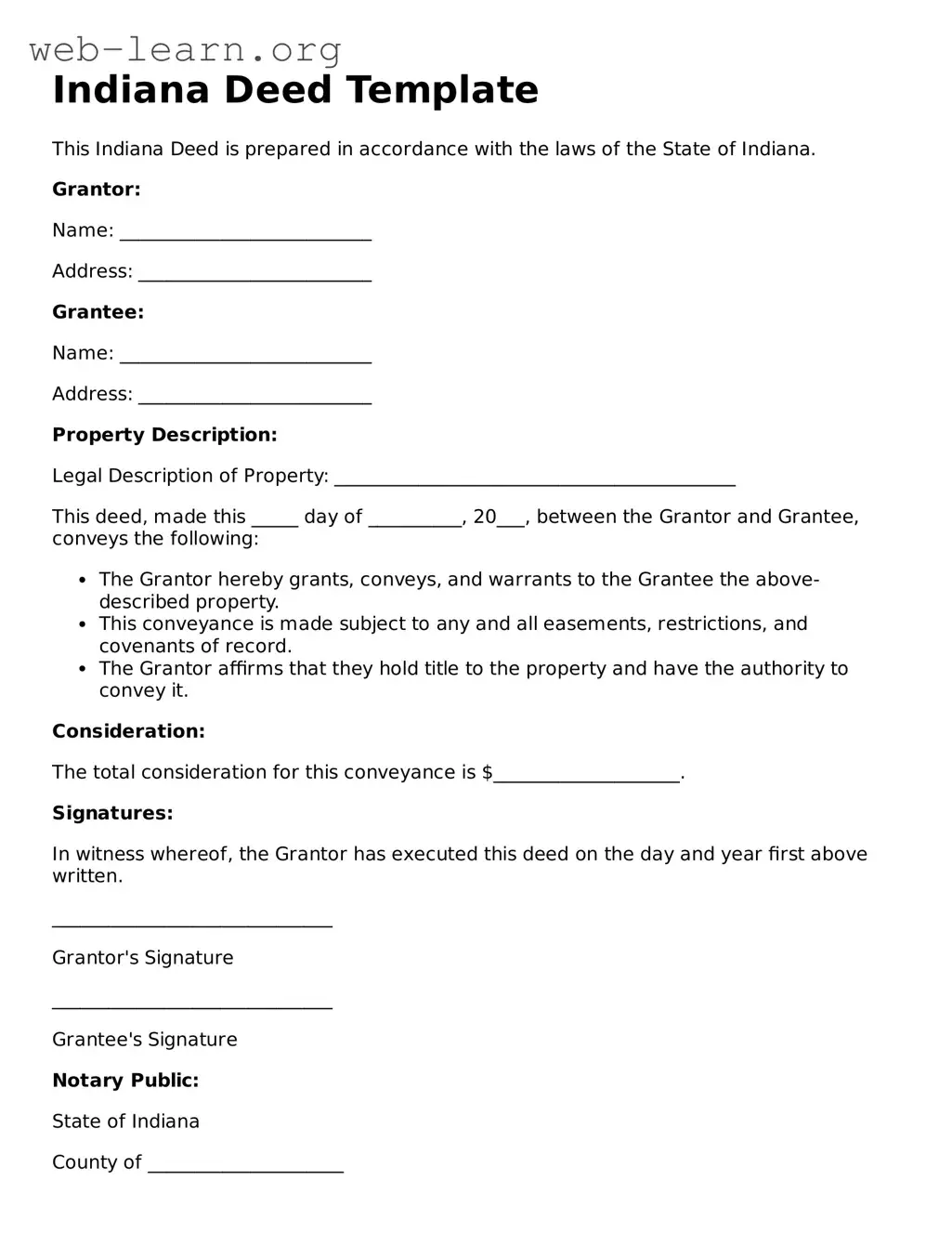
The Indiana Deed form is an essential legal document used in real estate transactions across the state. It serves as a formal record that transfers property ownership from one party to another. This form includes critical details such as the names of the grantor and grantee, a description of the property, and the consideration, or payment, involved in the transfer. Additionally, it requires signatures from the involved parties, which must be notarized to ensure authenticity. The Indiana Deed form also specifies the type of deed being used, whether it is a warranty deed, quitclaim deed, or another variation. Understanding these aspects is crucial for anyone looking to buy or sell property in Indiana, as proper completion of the form can prevent future legal issues and ensure a smooth transfer of ownership.
Indiana Deed Template
This Indiana Deed is prepared in accordance with the laws of the State of Indiana.
Grantor:
Name: ___________________________
Address: _________________________
Grantee:
Name: ___________________________
Address: _________________________
Property Description:
Legal Description of Property: ___________________________________________
This deed, made this _____ day of __________, 20___, between the Grantor and Grantee, conveys the following:
Consideration:
The total consideration for this conveyance is $____________________.
Signatures:
In witness whereof, the Grantor has executed this deed on the day and year first above written.
______________________________
Grantor's Signature
______________________________
Grantee's Signature
Notary Public:
State of Indiana
County of _____________________
Subscribed and sworn to before me this _____ day of __________, 20___.
______________________________
Notary Public Signature
My Commission Expires: _______________
| Fact Name | Details |
|---|---|
| Governing Law | The Indiana Deed form is governed by Indiana Code Title 32, Article 21. |
| Types of Deeds | Indiana recognizes several types of deeds, including warranty deeds, quitclaim deeds, and special warranty deeds. |
| Grantor and Grantee | The deed must clearly identify the grantor (seller) and grantee (buyer) by their legal names. |
| Property Description | A legal description of the property must be included, detailing the boundaries and location. |
| Consideration | The deed should state the consideration, which is the amount paid for the property. |
| Execution Requirements | The grantor must sign the deed in the presence of a notary public for it to be valid. |
| Recording | To protect against claims from third parties, the deed must be recorded in the county where the property is located. |
| Transfer Tax | Indiana imposes a transfer tax on property transactions, which must be paid upon recording the deed. |
| Homestead Exemption | Homeowners may apply for a homestead exemption after the deed is recorded, potentially reducing property taxes. |
| Legal Capacity | All parties involved in the deed must have the legal capacity to enter into the transaction, meaning they must be of sound mind and legal age. |
Once the Indiana Deed form is completed, it should be submitted to the appropriate county office for recording. This process ensures that the transfer of property ownership is officially recognized. Follow the steps below to fill out the form accurately.
What is an Indiana Deed form?
An Indiana Deed form is a legal document used to transfer ownership of real estate in the state of Indiana. This form outlines the details of the property being transferred, including the names of the parties involved, the legal description of the property, and any conditions or restrictions related to the transfer. It is essential for ensuring that the transfer of property is recorded correctly and legally recognized.
Who needs to use an Indiana Deed form?
Anyone who is buying or selling real estate in Indiana should use an Indiana Deed form. This includes individuals, businesses, and organizations. Whether you are transferring property through a sale, gift, or inheritance, a deed is necessary to formalize the transfer and protect the rights of all parties involved.
What types of deeds are available in Indiana?
Indiana recognizes several types of deeds, including:
Choosing the right type of deed depends on the specific circumstances of the property transfer.
How do I fill out an Indiana Deed form?
To fill out an Indiana Deed form, you will need to provide specific information, including:
Make sure to double-check all information for accuracy, as errors can complicate the transfer process.
Do I need to have the deed notarized?
Yes, in Indiana, the deed must be signed by the grantor in the presence of a notary public. This step is crucial for verifying the identities of the parties involved and ensuring that the deed is legally binding. The notary will also add their signature and seal to the document.
How is the Indiana Deed form submitted after completion?
Once the Indiana Deed form is completed and notarized, it must be recorded with the county recorder's office in the county where the property is located. This recording process officially documents the transfer of ownership and makes it part of the public record. There may be a small fee for recording the deed, so it's advisable to check with the local recorder's office for specific requirements.
What happens if I don’t record the deed?
If you do not record the deed, the transfer of ownership may not be recognized by third parties. This could lead to complications, such as disputes over ownership or difficulties in selling the property in the future. Recording the deed is essential for protecting your rights as the new property owner and ensuring that your ownership is legally recognized.
Filling out the Indiana Deed form can seem straightforward, but many people make common mistakes that can lead to complications. One frequent error is failing to include the correct legal description of the property. This description must be precise and should match the information in public records. Omitting or misrepresenting this detail can create confusion and may even result in disputes over property ownership.
Another common mistake is neglecting to sign the document in the appropriate places. The deed must be signed by the grantor, and if there are multiple grantors, all must sign. Missing signatures can invalidate the deed, leading to delays or the need for additional paperwork to correct the issue.
People often overlook the importance of notarization. In Indiana, a deed must be notarized to be legally binding. Failing to have the document notarized can render it ineffective, meaning the transfer of property might not be recognized by the state. Always ensure that a qualified notary public witnesses the signing of the deed.
Lastly, many individuals forget to record the deed with the county recorder's office after it has been completed and notarized. Recording the deed is crucial for protecting ownership rights. Without this step, the transfer may not be publicly acknowledged, leaving the property vulnerable to claims from other parties. Always take the time to ensure that the deed is properly recorded to safeguard your investment.
When transferring property in Indiana, several forms and documents may accompany the Indiana Deed form. Each of these documents serves a specific purpose and helps ensure a smooth transaction. Understanding these forms can help you navigate the process more effectively.
Being aware of these documents can help you prepare for the property transfer process. Each form plays a crucial role in protecting your interests and ensuring compliance with Indiana law.
The Deed form is an important legal document used in various transactions, particularly in real estate. However, it shares similarities with several other documents. Below is a list of seven documents that are comparable to the Deed form, highlighting how they are alike.
Understanding these documents can help individuals navigate the complexities of property transactions and legal agreements more effectively.
When filling out the Indiana Deed form, it is crucial to follow specific guidelines to ensure the process goes smoothly. Below is a list of things you should and shouldn't do.
Things You Should Do:
Things You Shouldn't Do:
Taking these steps seriously will help prevent delays and complications in the transfer of property. Make sure to follow the guidelines closely for a successful filing.
When it comes to the Indiana Deed form, several misconceptions can lead to confusion. Understanding the truth behind these myths is essential for anyone involved in property transactions. Here are six common misconceptions:
Many people believe that all deeds serve the same purpose. In reality, different types of deeds exist, such as warranty deeds and quitclaim deeds, each with its own implications for ownership and liability.
While it's often beneficial to consult a lawyer, especially for complex transactions, individuals can prepare a deed themselves. However, ensuring that all legal requirements are met is crucial.
Notarization is important for many deeds, but not all types require it. Understanding the specific requirements for the type of deed being used can clarify this misconception.
Some believe that a deed is set in stone once signed. However, deeds can be amended or revoked under certain circumstances, depending on state laws and the type of deed.
While deeds are commonly associated with sales, they are also required for transferring property as gifts, inheritance, or other types of transfers. Understanding this can help in various property situations.
Some individuals think that recording a deed is not necessary. However, recording provides public notice of ownership and protects against claims from third parties, making it an important step in the process.
Clearing up these misconceptions can help individuals navigate property transactions in Indiana more effectively. Always consider seeking professional advice when dealing with legal documents to ensure compliance with state laws.
When filling out and using the Indiana Deed form, it’s important to keep a few key points in mind. Here are five essential takeaways:
By keeping these points in mind, individuals can navigate the process of using the Indiana Deed form more effectively.
Quick Claim Deeds Kansas - The Deed form is a key document in estate planning.
Quit Claim Deed Broward County - Establishes the rights of the buyer and seller in a real estate transaction.
What Does a House Deed Look Like in Michigan - Can be a critical part of commercial lease agreements.